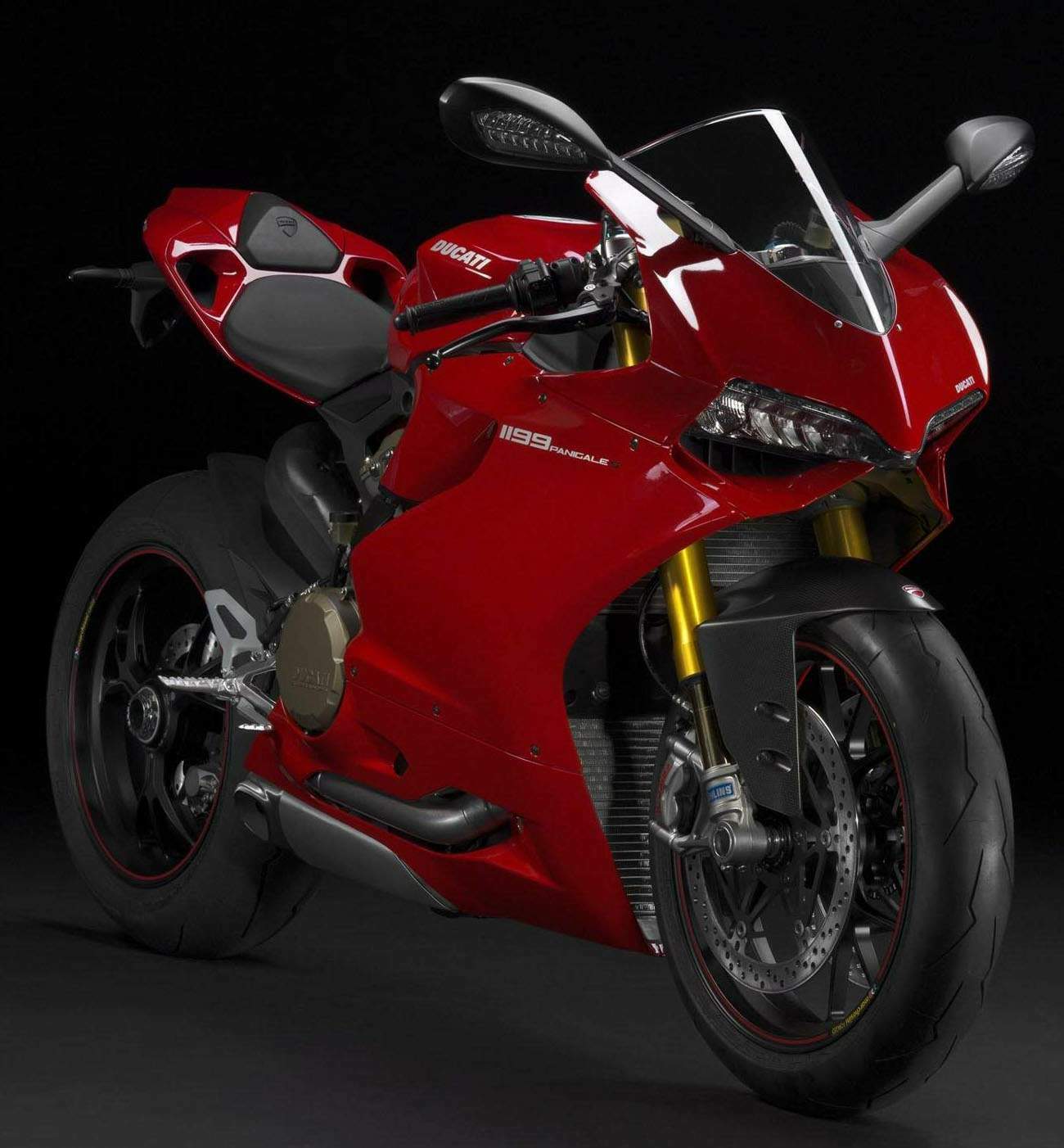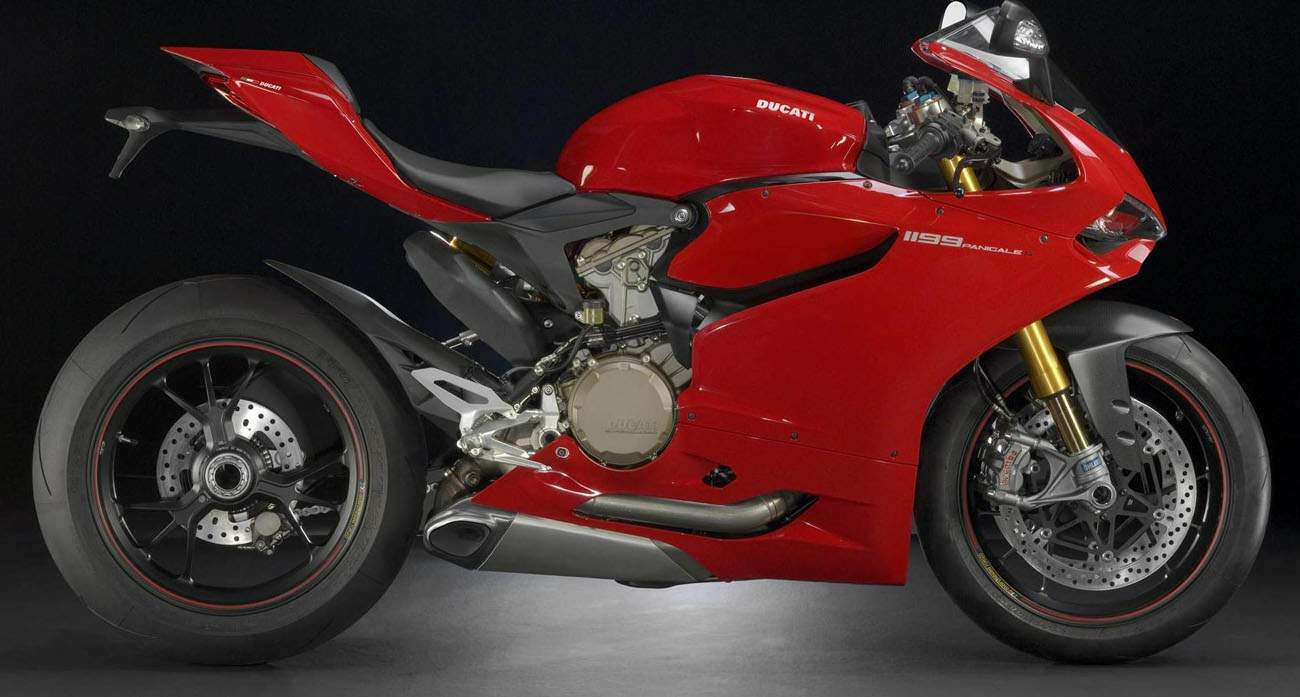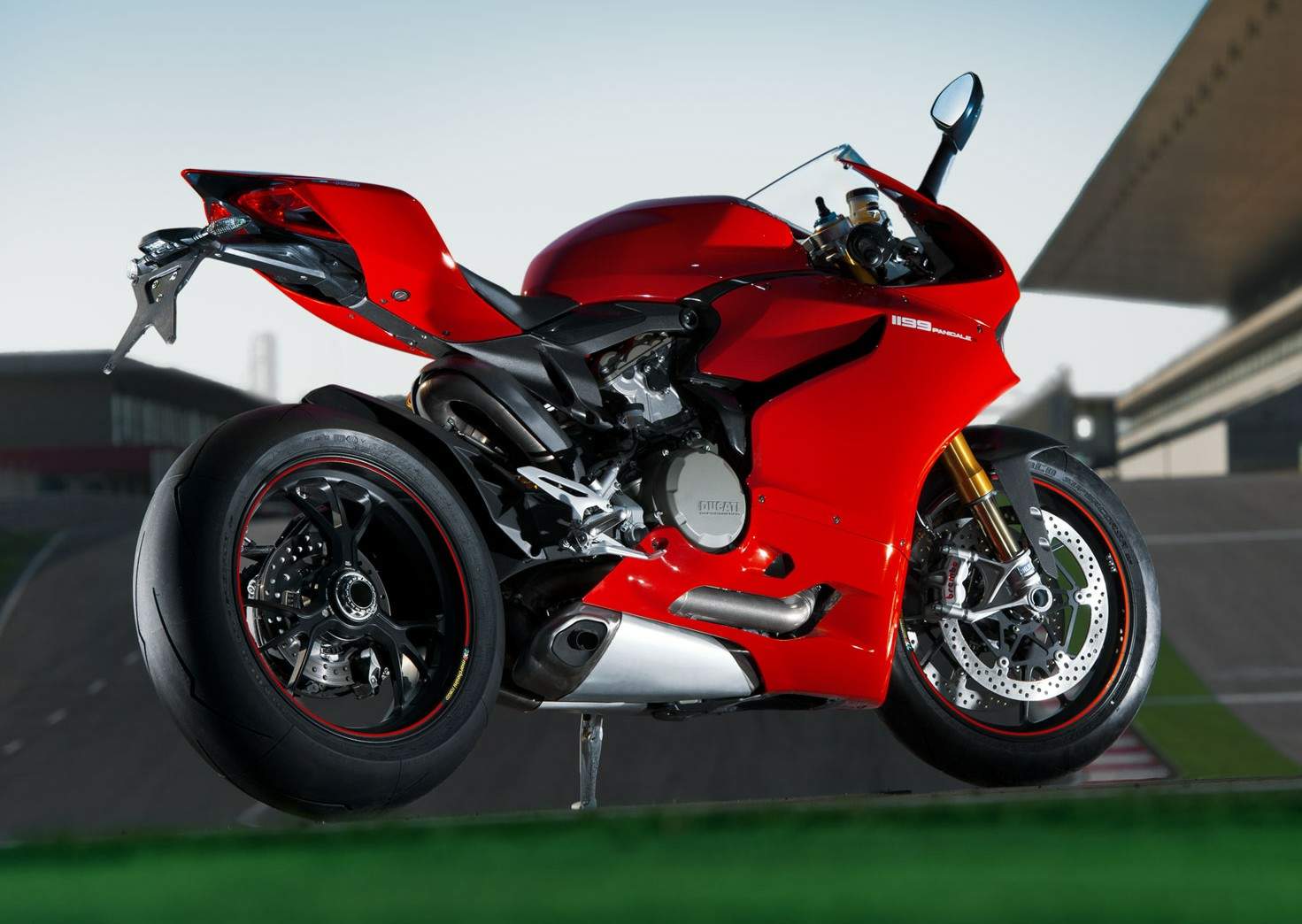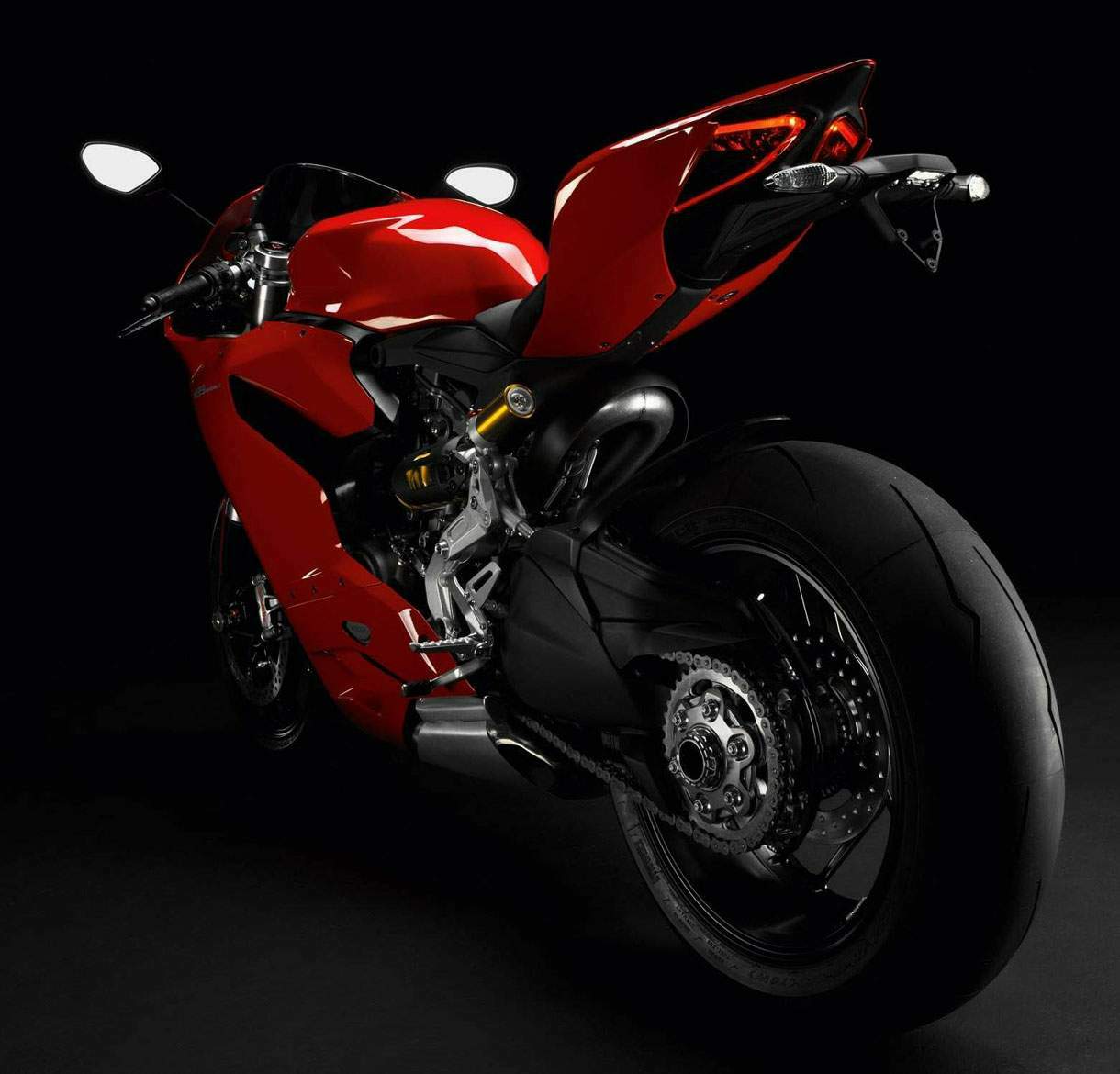
Supreme performance, superlative technology,
magnetic personality, enthralling design: on track or on road, there’s nothing
to beat the 1199 Panigale.
This model is equipped with Marzocchi’s new 50mm
lightweight aluminium front forks and Sachs rear suspension unit.
This version is also equipped with DTC, DQS, EBC
and Power Mode combined into the Ducati Riding Modes.
The 1199 Panigale is available in standard
configuration with optional ABS*.
The most extreme benchmark
Our Designers and Engineers were given a “blank
canvas” to reach the apparently impossible 1199 Panigale targets of 10kg less
weight and 25hp more power. Every detail, every dimension and every design
decision has been driven entirely by a zero-compromise brief to create the
highest performance Ducati Superbike of all time.
This new model breaks with our Superbike
tradition by adding a name to its 1199cc engine capacity, making a significant
association to our historic roots in the Borgo Panigale area of Bologna. In an
Italian territory known as “Motor Valley” and where high performance and racing
runs through the veins of its passionate people, we now underline our pride in
being world ambassadors for the “Made in Italy” title and immortalize our
birthplace in the name of the new Superbike.
Unmistakably Ducati
Every last detail of the 1199 Panigale pays
tribute to our rich heritage of racing: each component is not only functionally
efficient, but beautifully engineered into pieces of automotive art.
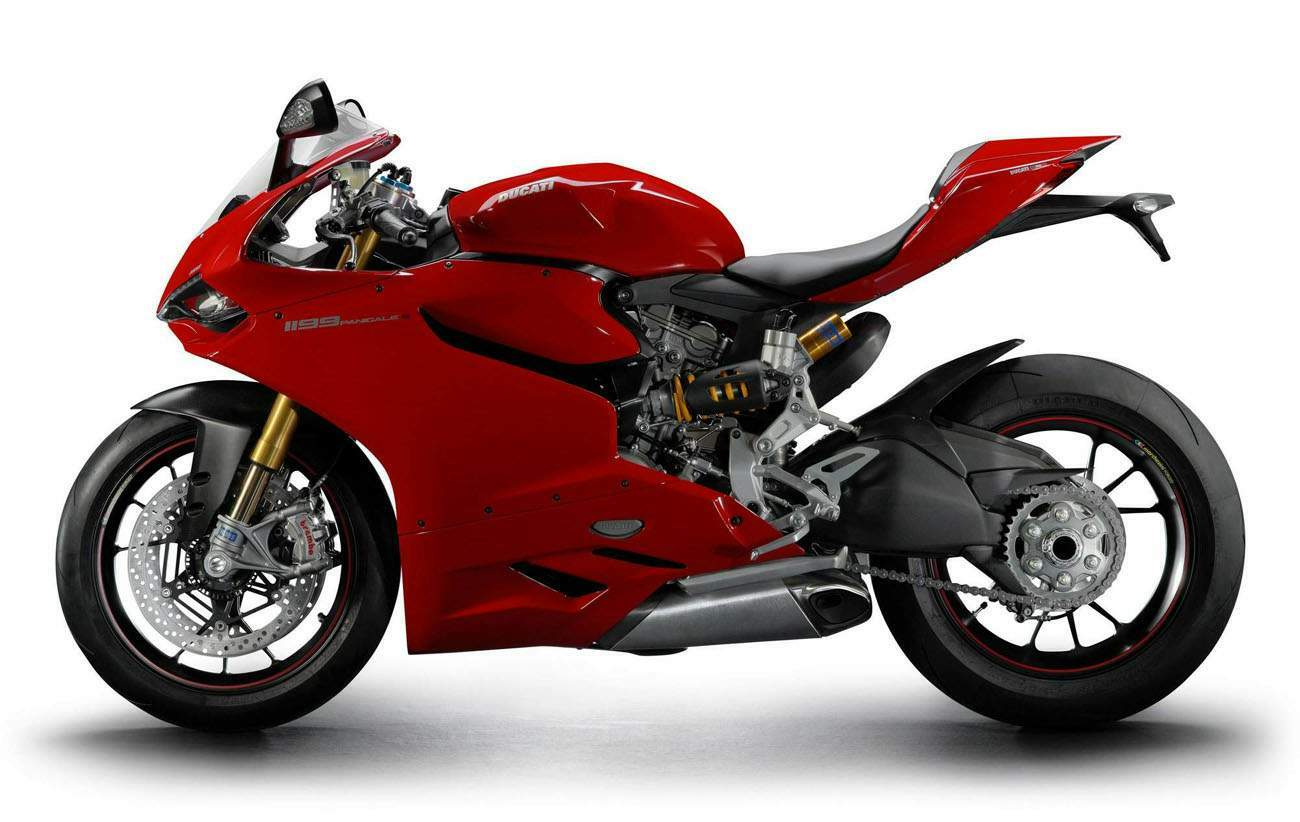
The fairings sweep back towards the rear of the
bike, emphasizing the pulled-in effect, so much that the fairing surface had to
be cut to house the engine covers and exhaust pipe.
Another highly distinctive feature of this bike
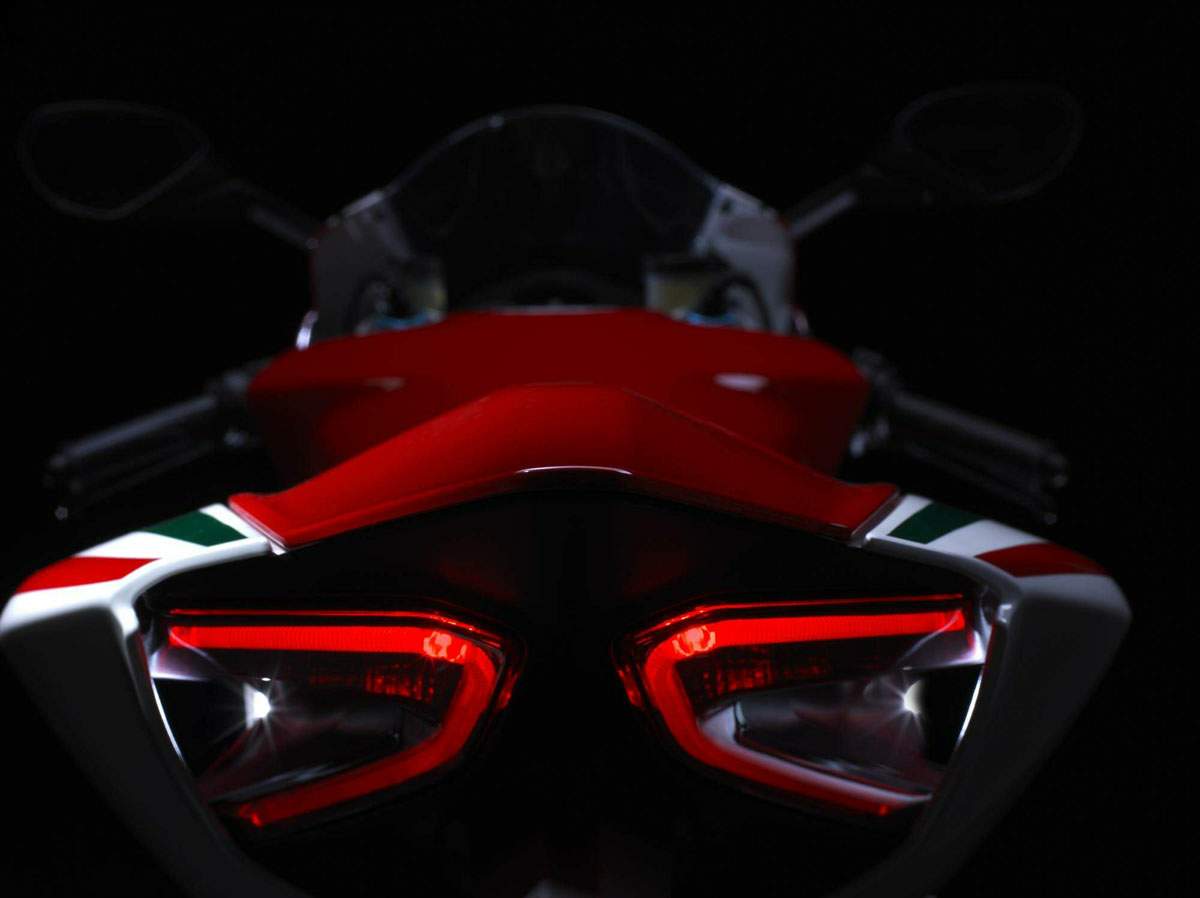
is the rear light mounted in the streamlined and pointed tail.
Everything about this bike communicates power,
elegance and agility.
Ducati 1199 Panigale Key Features and Benefits
Monocoque technology
The 1199 Panigale’s chassis represents a step
forward in motorcycle design, merging multiple parts into one compact and
lightweight component, while re-evaluating rider posture with a revised
ergonomic triangle.
Using the Superquadro engine as a stressed member
of the chassis, the short and strong aluminium monocoque is made in die-cast
aluminium and is responsible for 5kg (11lb) of the overall weight saving of the
new design.
The monocoque attaches to the cylinder heads of
the new specially designed engine, protruding forward to house the steering head
bearings and forming the airbox along the way, which is capped-off and sealed
when the 1.9kg (4.2lb) lighter aluminium fuel tank is attached, again using one
component to the fulfil the roles of two.
Weight distribution and ergonomics
This optimal configuration has been achieved by
centralising the mass at the front.
While the cylinders remain true to Ducati’s
signature 90° L-twin configuration, the new engine has rotated the top-end
backwards around the crankshaft a further 6° to give more clearance on the front
wheel and enable engineers to modify the front and rear weight bias. This also
enables a front-end geometry of 25.5° of rake and 100mm (3.94in) of trail.
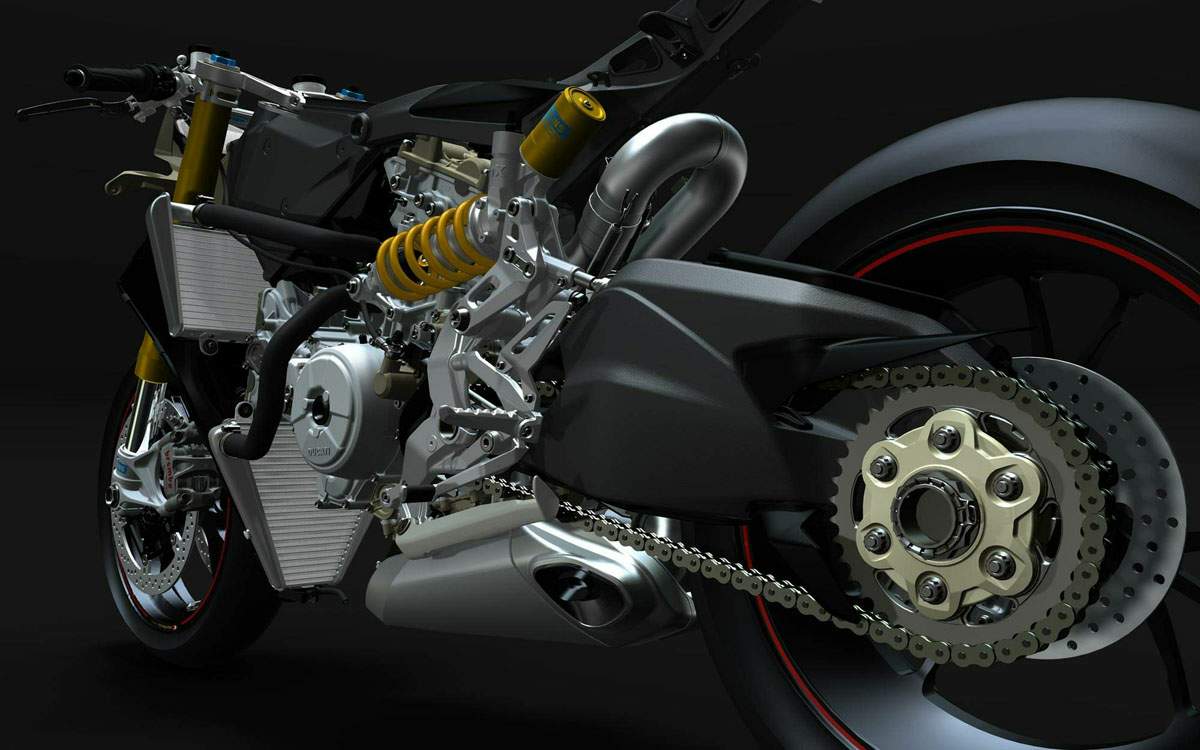
Attaching directly to the rear of the engine, the
new fully die-cast aluminium, single-sided swingarm is 39mm longer than the
1198, contributing to the increased the wheelbase of 1,437mm (56.6in) and the
optimal weight distribution of the 1199 Panigale.
With the exhaust system now relocated below the
engine, the die-cast aluminium rear sub-frame is considerably lighter and also
attaches directly to the Superquadro engine, while the super lightweight,
magnesium front sub-frame attaches directly to the monocoque frame, providing
secure support for the headlamp, instrumentation and fairing. This combination
of weight saving and centralisation of mass around these high front and rear
sub-frame areas substantially contributes to overall vehicle agility.
The new ergonomics parameters for seat position
and handlebar are defined to offer a fatigue-free riding position which ensure a
perfect integration between the rider and the bike.
Seat-to-handlebar dimension is shorter, 30mm
(1.18in), and bar height is higher, 10mm (0.39in), and wider, 32mm (1.26in).
Innovative suspension
The electronic suspension adjustment can be made
either by using the pre-set Riding Modes, or in independent mode, which allows
riders to use their own personal and saveable settings.
The 1199 Panigale uses brand new, incredibly
lightweight 50mm Marzocchi usd forks that feature hard-anodized aluminium
sliders. This new fork, fully adjustable in spring pre-load and compression and
rebound damping, represents a cutting-edge solution, saving a further 1kg
(2.2lb).
The matte champagne coloured fork bodies house
low-friction, hard-anodized black aluminium sliders and aluminium, cnc-machined
fork bottoms with beautifully formed radial calliper mountings.
A fully adjustable Sachs rear suspension unit
completes the package.
The triple-clamp fork centres are set to World
Superbike-style widths enabling uncompromised flow for optimum brake cooling.
The rear suspension of the 1199 Panigale features
a stylish and practical side-mounting, enabling increased space for the rear
cylinder head, which has been rotated further backwards around the new engine.
The unique positioning renders the unit totally accessible for spring pre-load
and rider-height adjustment, and is designed to provide a fast and easy linkage
adjustment by simply changing the pushrod fixing-point from “progressive rate”
for road use with a passenger to “flat rate” for track use.
New generation brakes and ABS
The twin Monobloc M50 callipers each have four
30mm pistons that grip 330mm discs to achieve spectacular braking performance.
The 1199 Panigale introduces a very latest in
sport-oriented ABS technology to enable full integration with the
three-programmed Riding Modes.
Operating with the latest generation 9ME Bosch
processor, the system enables full ABS on the front only, when in Race mode,
allowing the rider initial braking drift on the rear during race track corner
entry. The system also boasts a refined “rear lift-up” detection activated in
Sport and enhanced in Wet Riding Modes.
Remaining almost undetectable at the lever, these
advanced features enable shorter braking distances by optimising brake force
distribution for superior vehicle stability.
The advanced ABS, which is optional on the 1199
Panigale and 1199 Panigale S and standard equipment on the 1199 Panigale S
Tricolore, can also be deactivated via the instrumentation control panel.
New wheel and tyre designs
The 1199 Panigale rolls on brand new 10-spoke
wheels in 3.5in front rim width and 6.00in rear. Enabling an even faster change
of direction and enhanced acceleration and braking performances, the new
black-finished wheels provide a 0.5kg (1.1lb) weight-saving over previous
components.
All 1199 Panigale versions roll on Pirelli Diablo
Supercorsa SP tyres, at 120/70 ZR17 for the front, and 200/55 x ZR17 on the rear
– the widest rear tyre ever fitted to a road-going Ducati Superbike.
Designed for precise line-holding and corner
trajectory, the rear 200/55 x ZR17 effectively increases the contact patch area
and speed of lean by combining the 200mm width with a higher profile.
The structures and compounds are derived directly
from Pirelli’s experience in World Superbike competition. They present a complex
carcass designed for stiffness under heavy braking and shoulder areas that
maximise contact patch, further enhanced with a bi-compound tread laced with new
polymers to generate rapid warm-up and constant grip.
LED lights
The horizontal twin headlamps have become more
integrated with the frontal intake ducts and create a true “race face” for the
new Superbike.
While the 1199 Panigale illuminates with LED
positioning lights and main light bulbs, the 1199 Panigale S and Tricolore boast
full LED positioning and lighting solutions, for the first time in the
motorcycle world.
Twin rear lights are moulded perfectly around the
recessed seat air ducts and illuminate with an attractive light-guide surround
effect, enhanced with LED brake lights. Front LED indicators are integrated into
the mirror bodies and rear indicators, which are also LED* (*Country specific),
are styled with clear lenses.
Thin Film Transistor instrumentation (TFT)
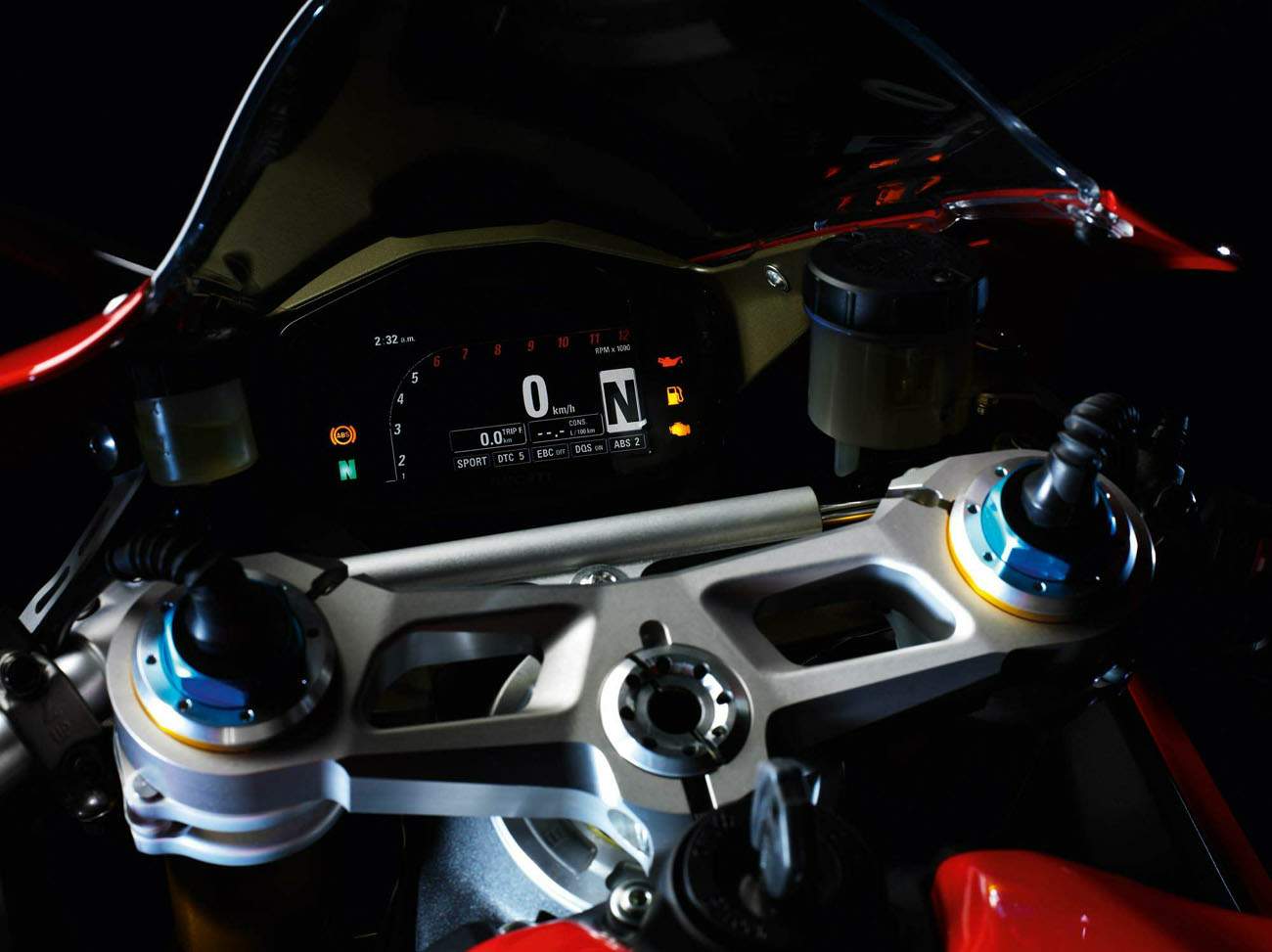
Along the bottom of the screen from left to
right, is the current status and/or setting of Riding Mode, ABS (if equipped),
DTC, DQS and EBC and on the right of the screen an easy-to-read gear indicator.
In “Road” and “Wet” Riding Modes the vehicle
speed takes precedence in the centre of the display with large numerals, while
two framed “additional information” panels, situated below, present total
mileage by default and engine coolant temperature .
In “Race” Riding Mode, the display automatically
reconfigures, moving the lesser important vehicle speed to the lower left info
frame and making way for the latest lap time to be displayed large in the centre
of the screen.
The 1199 Panigale display is also equipped with a
“dynamic” over-rev indicator: a strip of red lights rising on the right and left
outer edges and across the top of the instrumentation illuminate incrementally
upwards to warn of over-rev. When the 1199 Panigale is stationary, the
instrumentation is also used as a user-friendly control panel to personalise
ABS, EBC, DES, DTC, DQS, and RbW settings within each Riding Mode before saving.
Ducati Riding Modes
An electronic Ride-by-Wire (RbW) system
administers different mappings (Power Mode) to regulate power delivery, while
Ducati Electronic Suspension (DES), by Öhlins, instantly configures the
suspension set-up with electronic adjustment. The Ducati Traction Control system
(DTC) uses eight levels of system interaction to enhance control by reducing
wheel-spin and the latest generation of ABS processor provides ideal anti-lock
levels. EBC monitors crankshaft de-acceleration under heavy braking and
administers RbW throttle opening to maintain optimum grip.
Race Riding Mode
The Race Riding Mode provides the track rider
with an unrestricted 195hp with direct RbW throttle response and, on the ‘S’
version, an instant track-oriented suspension set-up. Race mode also reduces the
DTC system intervention, provides a race-oriented EBC and front-only ABS with
reduced anti-rear-lift-up and instantly reconfigures the instrumentation layout
with a track-oriented display.
Sport Riding Mode
The Sport Riding Mode provides the road or track
rider with 195hp, delivered with a “smooth” RbW throttle response and, on the
‘S’ version, a sport-oriented suspension set-up. Sport mode slightly increases
the DTC system intervention, provides a sport-oriented both EBC and front and
rear ABS with incresed anti-rear-lift-up.
Wet Riding Mode
The Wet Riding Mode provides the road or track
rider with 120hp, delivered with a “smooth” RbW throttle response, increased DTC
system intervention, environment-appropriate EBC, DQS off and fully enhanced ABS
and, on the ‘S’ version, a suspension set-up optimised for low grip conditions.
Ducati 1199 Panigale Model Highlights
2012 DUCATI SUPERBIKE
The 2012 Ducati Superbike family marks the
official introduction of the ground-breaking 1199 Panigale, 1199 Panigale S and
flagship 1199 Panigale S Tricolore and opens a new chapter in the company’s
iconic Superbike history. The highly successful 848EVO and new for 2012, 848EVO
Corse Special Edition with enhanced electronics, suspension and stunning Ducati
Corse livery, complete an incredible range.
SUPERBIKE 1199 PANIGALE
The most extreme benchmark
Ducati’s new generation Superbike, the 1199 Panigale, goes beyond the barriers
of motorcycle design and engineering to set the most extreme benchmark ever and
the direction for future sport bikes. Developed in the red-hot environment of
racing and designed to raise the performance bar to its highest, the 1199
Panigale uses innovative Ducati Corse-derived solutions to make World
Championship level technology available to everyone.
The most high tech, most powerful twin-cylinder
production engine on the planet is now an integral part of an innovative
monocoque chassis that combine to deliver an astonishing 195hp from 164kg*
(361.5lb) of futuristic Italian thoroughbred. The highest production motorcycle
power-to-weight and torque-to-weight ratios in the world are fitting trophies
for the incredible results that Ducati have achieved.
With the click of a button, Ducati’s Riding Mode
concept delivers performance with enhanced rider confidence by combining seven
class-leading technologies. The latest-generation sports ABS system, Ducati
Traction Control (DTC), Ducati Electronic Suspension (DES), Ducati Quick-Shift (DQS),
Ducati’s new race-derived Engine Brake Control (EBC) and Ride-by-Wire (RbW) are
now all programmed into seamless, electronic rider assistance. Even the full
colour Thin Film Transistor (TFT) display changes to suit the rider’s
environment.
State-of-the-art from the ground-up and melding
latest technologies with exciting new family features, the 1199 Panigale is
totally “Ducati” in every respect. Its no-compromise approach to sport design
and stylish attention to incredibly fine detail presents authentic Italian
performance at its purist.
Racing is the platform on which Ducati has always
challenged and measured itself. It is a discipline for designers and engineers
and the bedrock of motivation for a company in which the constant desire for
victory has become a way of life. With over 300 World Superbike race wins, more
World Championship titles than all other manufacturers together and the
passionate driver of innovation in MotoGP, Ducati’s focus on sportbikes is
stronger than ever.
Ducati now combine the innovative “monocoque”
frame solution with the extraordinary new “Superquadro” L-twin engine design and
race-derived electronics to produce the champion of all Superbikes. Bred for the
track and trained for the road, the new 1199 Panigale is a true revolution of
the species destined to influence the entire sportsbike environment. Available
early in 2012, the new Superbike will be built in 1199 Panigale, 1199 Panigale S
and 1199 Panigale S Tricolore versions. *Dry weight
Revolution of the species
Every generation of Superbike produced at Ducati
represents an accurate and historic snap-shot of technology and engineering
solutions at that time. Some features like the Trellis frame and under-seat
exhaust will remain as legendary milestones in Superbike history, innovative
benchmarks qualified by endless imitation.
In the predatory world of racing, however, where
complacency risks extinction, a constant Darwinian-like adaption to the
environment would not have been enough for survival. Instead, Ducati invested
its time in a “revolution” of the species, not an evolution. An innovative and
ingenious breakthrough design where multiple vital components have morphed into
one to create the new monocoque skeleton of the 1199 Panigale.
Designers and Engineers of the new generation
Superbike were given a “blank canvas” to reach the apparently impossible 1199
Panigale targets of 10kg less weight and 25hp more power. Every detail, every
dimension and every design decision has been driven entirely by a
zero-compromise brief to create the highest performance Ducati Superbike of all
time. The 1199 Panigale now sets the most extreme benchmark ever and its arrival
represents one of the most historic moments in Ducati’s incredible Superbike
history.
Pronounced “Pan-ee-gah-lee”, the new model breaks
with Ducati’s Superbike tradition by adding a name to its 1199 engine
designation, making a significant association to its historic roots in the Borgo
Panigale area of Bologna. In an Italian territory known as “Motor Valley” and
where high performance and racing runs through the veins of its passionate
people, Ducati now underline their pride in being world ambassadors for the
“Made in Italy” title and immortalize their birthplace in the name of the new
Superbike.
Unmistakably Ducati
Every last detail of the 1199 Panigale pays
tribute to the rich heritage of racing on which Ducati is built. Components that
are not only functionally efficient, but also minimalist, essential and
beautifully engineered into pieces of automotive art.
Climb aboard the 1199 Panigale and take hold of
the bars and the feeling of pure racing is everywhere.The finely formed
top-clamp with weigh-saving hollows and recesses immediately communicates
Italian engineering at its very best.
Radial brake and clutch pumps, Ducati’s precise
switchgear and full Ride-by-Wire twistgrip give a racedriven sense of minimalism
further enhanced with the monocoque-integral steering head flowing into the
magnesium front sub-frame and Ducati Corse-style instrumentation. Revised rider
ergonomics are immediately noticeable from the cockpit with seat-to-handlebar
dimension 30mm (1.18in) shorter and bar height 10mm (0.39in) higher and 32mm
(1.26in) wider. Even the lightweight, 17 litre (4.5 gal US) aluminium
fuel tank is sculpted perfectly to the rider.
The horizontal twin headlamps have also become
more integrated with the frontal intake ducts and create a true “race face” for
the new Superbike. While the 1199 Panigale illuminates with LED positioning and
conventional main light, the 1199 Panigale S and Tricolore boast motorcycling’s
first ever full LED positioning and main light solutions.
Twin rear lights are moulded perfectly around the
recessed seat air ducts and illuminate with an attractive light-guide surround
effect, enhanced with LED brake lights. Front LED indicators are integrated into
the mirror bodies and rear indicators, which are also LED*, are styled with
clear lenses.
The majority of the frontal air ducts feed the
main airbox, while a small splitter also diverts air into the fairing bodywork
to ensure efficient cooling for the onboard electronics. The carefully executed
shape at the rear of the fairing enables a highly efficient exit from the
radiator area, protecting the Superquadro’s power output and further reducing
aerodynamic resistance.
The sleek shape of the seat and tail-piece is now
accentuated by the relocation of the exhaust system, further enhancing the
aggressive stance of a true Ducati Superbike. *Country specific
Monocoque technology
The 1199 Panigale’s chassis represents Ducati’s
innovative and courageous step forward in motorcycle design, merging multiple
parts into one compact and lightweight component, while re-evaluating rider
posture with a revised ergonomic triangle. Developed in the super-competitive
racing environment, the extremely compact monocoque construction integrates the
airbox to become one of the key elements in reducing the Superbike’s overall dry
weight by an incredible 10kg (22lb) to a benchmark 164kg (361.5lb).
Using the Superquadro engine as a stressed member
of the chassis, the short and strong aluminium monocoque is made in die-cast
aluminium and is responsible for 5kg (11lb) of the overall weight saving of the
new design. The monocoque attaches to the cylinder heads of the new specially
designed engine, protruding forward to house the steering head bearings and
forming the airbox along the way, which is capped-off and sealed when the 2.9kg
(6.3lb) lighter aluminium fuel tank is attached, again using one component to
the fulfil the roles of two.
While the cylinders remain true to Ducati’s
signature 90° L-twin configuration, the new engine has rotated the top-end
backwards around the crankshaft a further 6° to give more clearance on the front
wheel and enable engineers to modify the front and rear weight bias. This also
enables a front-end geometry of 24.5° of rake and 100mm (3.94in) of trail.
Attaching directly to the rear of the engine, the new fully die-cast aluminium,
single-sided swingarm is 39mm longer than the 1198, contributing to the
increased the
wheelbase of 1,437mm (56.6in) and weight distribution of the 1199 Panigale from
50/50 to 52% front and 48% rear with average-size rider onboard.
With the exhaust system now relocated below the
engine, the die-cast aluminium rear sub-frame is considerably lighter and also
attaches directly to the Superquadro engine, while the super lightweight,
magnesium front sub-frame attaches directly to the monocoque frame, providing
secure support for the headlamp, instrumentation and fairing. This combination
of weight saving and centralisation of mass around these high front and rear
sub-frame areas substantially contributes to overall vehicle agility.
Innovative suspension
Incorporating Ducati’s Riding Mode technology
into the Superbike for the first time, the 1199 Panigale S and Tricolore are
fully equipped with front and rear Ducati Electronic Suspension (DES) system by
Öhlins. The 43mm Öhlins NIX30 forks are adjustable electronically in compression
and rebound damping, while spring pre-load is manual. An adjustable steering
damper completes the full Öhlins package.
The Öhlins TTX36 rear unit features twin tube
technology to offer totally separate damping adjustment in compression and
rebound and minimise the risk of cavitation under extreme conditions. The unit
is fully adjustable electronically in compression and rebound damping, while
spring pre-load is manual. The electronic suspension adjustment can be made
either by using the pre-set Riding Modes, which have been developed by Ducati
test riders and racers, or in independent mode, which allows riders to use their
own personal and saveable settings. Digital damping adjustments send signals
that execute the mechanical adjustment via electronic actuators mounted in the
suspension units.
The 1199 Panigale uses brand new, incredibly
lightweight, 50mm pressurised Marzocchi usd forks that feature hard-anodised
aluminium sliders. Proven by Marzocchi in the most severe off-road environments,
the new aluminium fork assembly uses a pressurised damping system that also
enables a reduction in oil capacity and, therefore, also weight. They represent
a cutting-edge solution for the 1199 Panigale, saving a further 1kg (2.2lb) on a
project which demanded innovation to achieve the extreme weight-saving targets
set by designers.
Fully adjustable in spring pre-load and
compression and rebound damping, the matte champagne coloured fork bodies house
low-friction, hard-anodised black aluminium sliders and forged aluminium fork
bottoms with beautifully formed radial calliper mountings. A fully adjustable
Sachs rear suspension unit completes the package.
On all versions of the 1199 Panigale, the fork
leg centres are set to World Superbike-style widths, enabling uncompromised
air-flow to the brake discs for optimum cooling.
The rear suspension of the 1199 Panigale features
a stylish and practical side-mounting, enabling increased space for the rear
cylinder head, which has been rotated further backwards around the new engine.
The unique positioning renders the unit totally accessible for spring pre-load
and rider-height adjustment, and is designed to provide a fast and easy linkage
adjustment by simply changing the pushrod fixing-point from “progressive rate”
for road use with a passenger to “flat rate” for track use.
New generation brakes
For its new generation of Superbike, Ducati
ensured the selection of an equally new braking system. The 1199 Panigale is
exclusively equipped with new generation Brembo Monobloc M50 callipers,
presenting a super-compact design that reduces their total unsprung weight by a
further 0.5kg.
Machined from a single piece of alloy, the
callipers achieve a higher rigidity and resistance to distortion during extreme
braking. The resulting increase in hydraulic efficiency not only delivers
incredible braking power, but also provides an enhanced and precise 'feel' at
the brake lever. The twin Monobloc M50 callipers each have four 30mm pistons
that grip 330mm discs to achieve spectacular braking
performance.
Sport-oriented ABS
The 1199 Panigale introduces the very latest in
sport-oriented ABS technology to enable full integration with Ducati’s three
pre-programmed Riding Modes. Operating with the latest generation 9ME Bosch
processor, the system enables full ABS on the front only, when in Race mode,
allowing the rider initial braking drift on the rear during race track corner
entry. The system also boasts a refined “rear lift-up” detection activated in
Sport and enhanced in Wet Riding Modes.
Remaining almost undetectable at the lever, these
advanced features enable shorter braking distances by optimising brake force
distribution for superior vehicle stability. The advanced ABS, which is optional
on the 1199 Panigale and 1199 Panigale S and standard equipment on the 1199
Panigale S Tricolore, can also be deactivated via the instrumentation control
panel..
New wheel and tyre designs
The 1199 Panigale rolls on brand new 10-spoke
wheels in 3.5in front rim width and 6.00in rear. Enabling an even faster change
of direction and enhanced acceleration and braking performances, the new
blackfinished wheels provide a 0.5kg (1.1lb) weight-saving over previous
components.
The 1199 Panigale S and 1199 Panigale S Tricolore
are equipped with stylishly designed, triple 3-spoke, forged and machined wheels
by Marchesini. Finished in black with signature red pin-striping, the super
lightweight wheels represent a 0.4kg (0.88lb) weight-saving over previous
components.
All 1199 Panigale versions roll on the new
Pirelli Diablo Supercorsa SP tyres, road-going race replicas of the official
World Superstock 1000 tyres. While the front uses a 120/70 ZR17, the 200/55 x
ZR17 represents the widest rear tyre ever fitted to a production Ducati
Superbike.
Designed for precise line-holding and corner
trajectory, the rear 200/55 x ZR17 effectively increases the contact patch area
and speed of lean by combining the 200mm width with a higher profile. Pirelli
and Ducati engineers worked together to create this ideal "match" between front
and rear profiles and the results generate incredible "feel" and directional
agility from the new monocoque chassis technology during cornerentry.
The structures and compounds are derived directly
from Pirelli’s experience in World Superbike competition. They present a complex
carcass designed for stiffness under heavy braking and shoulder areas that
maximise contact patch, further enhanced with a bi-compound tread laced with new
polymers to generate rapid warm-up and constant grip.
Electronic technology
The 1199 Panigale is now the focal point of the
latest innovative electronics that Ducati has developed and proven on the race
track. Appropriate, therefore, that they are combined, managed and displayed on
full TFT technology instrumentation, first introduced to the motorcycle industry
on the Ducati Diavel and now super-enhanced on the 1199 Panigale.
The state-of-the-art electronics package features
an enhanced version of the Ducati Data Analyser (DDA+), and Ducati Riding Modes,
which now fully incorporate ABS, Ducati Electronic Suspension (DES), Ducati
Traction Control (DTC), Ducati Quick Shift (DQS), Engine Brake Control (EBC),
full Ride-by-Wire (RbW) and the Thin Film Transistor instrumentation (TFT).
The 1199 Panigale inherits a more compact version
of its Ducati Quick Shift (DQS), first introduced on the 1198 SP and now
increases its formidable fire power with a sport-intended, adjustable ABS system
and the debut of Ducati’s Engine Brake Control system (EBC), designed to enhance
stability during de-acceleration.
Ducati Riding Modes
Introduced on the award-winning Multistrada in
2010, Ducati’s industry-changing Riding Modes effectively offer the perfect
set-up appropriate to rider and environment by selecting from a choice of three
pre-set modes. Each Riding Mode is pre-programmed to instantly change engine
character and suspension set-up in addition to ABS, DTC and EBC levels - even
while riding. The modes are made possible by combining a number of class-leading
technologies.
An electronic Ride-by-Wire (RbW) system
administers different mappings to regulate power delivery, while on the “S”
version Ducati Electronic Suspension (DES), by Öhlins, instantly configures the
suspension setup with electronic adjustment. The Ducati Traction Control system
(DTC) uses eight levels of system interaction to enhance control by reducing
wheel-spin and the latest generation of ABS processor provides ideal anti-lock
levels. EBC monitors crankshaft de-acceleration under heavy braking and
administers RbW throttle opening to maintain optimum grip.
Race Riding Mode
The Race Riding Mode provides the track rider
with an unrestricted 195hp with direct RbW throttle response and, on the ‘S’
version, an instant track-oriented suspension set-up. Race mode also reduces the
DTC system intervention, provides a race-oriented EBC and front-only ABS with
reduced anti-rear-lift-up and instantly reconfigures the instrumentation layout
with a track-oriented display.
Sport Riding Mode
The Sport Riding Mode provides the road or track
rider with 195hp, delivered with a “smooth” RbW throttle response and, on the
‘S’ version, a sport-oriented suspension set-up. Sport mode slightly increases
the DTC system intervention, provides a sport-oriented both EBC and front and
rear ABS with incresed antirear- lift-up.
Wet Riding Mode
The Wet Riding Mode provides the road or track
rider with 120hp, delivered with a “smooth” RbW throttle response, increased DTC
system intervention, environment-appropriate EBC, DQS off and fully enhanced ABS
and, on the ‘S’ version, a suspension set-up optimised for low grip conditions.
Thin Film Transistor instrumentation (TFT)
The 1198 Panigale instrumentation takes Ducati’s
industry-leading Thin Film Transistor (TFT) screen to the next step with a
stunning race-derived unit that embraces the very latest information display
technology.
The full colour display automatically changes its
layout according to the Riding Mode selected in order to provide optimum clarity
of information appropriate to the motorcycle’s environment, even reversing its
character and background colours in low-light conditions.
The brand-new, high-definition instrumentation
displays RPM from 1000-12000 in a scale that curves through 90° around the left
and upper edge of the main screen, incrementally adding bars of light around the
display as the engine speed increases, while enlarging each of the main 1-12
numbers in the scale as each value is reached. During the first 1000km
running-in period, the “orange section” of the rev-range automatically moves
down from its normal 10,500 lower level to 6,000rpm. When the running-in period
is completed, the orange section automatically returns to its 10,500-11,500rpm
range, although during each
engine warm-up, it is programmed to start from 8,000rpm, increasing to 9,000 and
finally to its normal 10,500rpm position when the engine reaches normal working
temperature.
Along the bottom of the screen from left to
right, is the current status and/or setting of Riding Mode, ABS (if equipped),
DTC, DQS and EBC and on the right of the screen, an easy-to-read gear indicator
displaying from N to 6 with the top left corner of the screen displaying the
time.
In “Road” and “Wet” Riding Modes the vehicle
speed takes precedence in the centre of the display with large numerals, while
two framed “additional information” panels, situated below, present total
mileage by default on the left and engine coolant temperature on the right. Both
left and right readings are scrollable while riding to read trip 1, trip 2 and
fuel reserve trip on the left info frame with the scroll-up button on the
switchgear. Actual and average fuel consumption, average speed, journey time and
air temperature appear on the right info frame with the scroll-down button.
In “Race” Riding Mode, the display automatically
reconfigures, moving the lesser important vehicle speed to the lower left info
frame and making way for the latest lap time to be displayed large in the centre
of the screen. When actuated, the lap time facility is triggered manually by
using the flasher button on the switchgear or automatically with the new GPS
equipped DDA+.
When the 1199 Panigale is stationary, the
instrumentation is also used as a user-friendly control panel to personalise
ABS, EBC, DES, DTC, DQS, and RbW settings within each Riding Mode before saving.
In addition to listing the last 30 recorded lap times, each time also shows the
lap number and the maximum speed and maximum rpm recorded during that lap.
Fixed icons on the left of the main screen from
top to bottom show warnings for left turn signal, main beam, ABS-off and
neutral, while from top to bottom on the right of the display are turn signal
right, oil pressure, fuel reserve and engine electronics. Countdown icons are
programmed to appear on the screen to advise of upcoming scheduled maintenance.
A strip of red lights rising on the right and left outer edges and across the
top of the instrumentation illuminate incrementally upwards to warn of over-rev.
The first 25% at 10,500rpm, 50% at 10,700rpm, 75% at 10,900rpm and 100% as both
strips meet and the top centre bar starts to flash.
Below the top, centre over-rev bar is a second
bar that illuminates in orange during DTC interaction.
Ducati Data Analyser+ (DDA+)
The Ducati Data Analyser (DDA) consists of a
software download, which is also now available for Mac, and a USB-ready data
retrieval card and evaluates the performances of the bike and its rider by
graphically presenting specific channels of information.
DDA+ is the latest generation of the system and
introduces a GPS function that automatically records laptimes every time the
1199 Panigale crosses a circuit start/finish line. As the rider crosses start
and finish line and presses the lights flasher button, the innovative system
logs the coordinates of that position and then automatically logs each lap time
as the motorcycle completes subsequent laps.
DDA+ is fitted as standard equipment on the
Tricolore version and available for the 1198 Panigale and Panigale S as a
plug-and-play accessory by Ducati Performance.
An essential piece of equipment for the circuit,
DDA records numerous channels of data including throttle opening, vehicle speed,
engine rpm, gear selected, engine temperature, distance travelled, laps and lap
times. An additional channel of information is also dedicated to recording the
DTC index which can then be viewed as a graphic trace indicating the amount of
DTC interaction during wheel-spin. At the end of a ride or track session, data
can be downloaded ready to compare, analyse and get an inside view of the
performance of the rider and motorcycle.
Ducati Electronic Suspension (DES)
The ‘S’ versions of the 1199 Panigale are
equipped with Öhlins suspension that features the innovative Ducati Electronic
Suspension (DES). The new technology enables front and rear rebound and
compression damping adjustments to be controlled automatically by using the
pre-set Riding Modes, which have been developed by Ducati test riders and
racers, or in independent mode, allowing riders to use their own personal and
saveable settings. Digital damping adjustments made via the instrumentation send
signals that
execute the mechanical adjustment via electronic actuators mounted inside the
suspension units.
Ducati Traction Control (DTC)
Ducati’s highly successful DTC system has been
further refined for the 1199 Panigale and fully integrated into the electronics
package of all versions. It uses the same software logic developed and used by
Ducati Corse for their MotoGP and World Superbike motorcycles and offers a
choice of eight settings developed by a team of professional test riders and
racers.
Accessible from the left-hand switchgear and
displayed on the new TFT instrumentation, the system offers a choice of eight
profiles, each one programmed with a wheel-spin tolerance graded from one to
eight. While level eight administers a confidence-building, high level of
interaction from the system by activating upon the slightest detection of
wheel-spin, level one offers a much higher tolerance and so reduced intervention
for highly competent riders. The DTC system status and level is constantly
displayed on the instrumentation, reminding the rider of the current interaction
level if the Riding Modes is changed.
When the level that best suits the combination of
road or track conditions and riding style has been selected and the DTC system
activated, front and rear wheel sensors compare speed differential to sense when
rear traction is being broken (wheel-spin). DTC then decides the best
combination of two different types of instant electronic adjustment, calculated
with data supplied from multiple sources.
The first 'soft' stage of system interaction is
executed by high speed software that makes instant electronic adjustment to the
ignition timing, administering varying amounts of ignition retardation to reduce
the engine's torque. If the DTC software detects that the first 'soft' stage of
system interaction is inadequate to control the wheel-spin, it continues to
administer ignition retardation and, in addition, instructs the engine ECU to
initiate a pattern of constantly increasing injection cuts until, if necessary,
full injection cut.
During both stages of system interaction, an
orange warning light, which is visible in the rider’s peripheral vision and
situated across the top of the instrumentation, illuminates to signify that DTC
has is being used.
As soon as the system recognises the gradual
return of equal wheel speeds, it incrementally re-establishes normal power
delivery. This seamless interaction is key to the super-smooth operation of the
system.
Ducati Quick Shift (DQS)
The Ducati Quick Shift (DQS) system, first used
on the 2011 1198 SP, was the first electronic quick-shift supplied as original
equipment on a production Ducati. The 1199 Panigale takes that same technology
and makes it even more compact. Normally used specifically for racing, the
system allows the rider to keep the throttle open when changing-up through the
gearbox, helping to save vital fractions of a second in the pursuit of faster
lap-times. The system not only saves time when changing gear, but also enables
the
possibility of uninterrupted air flow through the throttle bodies throughout the
upward gear-changing process.
The system consists of a micro-switch built into
the linkage of the gear change lever, which when actuated in the direction of
selecting a higher gear, sends a signal to the main ECU. The ECU instantly
understands which gear the motorcycle is in by calculating the rpm and vehicle
speed and then reads the amount of throttle opening before applying a
pre-programmed cut in fuel injection and ignition measured in milliseconds. This
spilt-second electronic interruption in drive is programmed precisely to allow
the next gear to be selected without having to actuate the clutch or close the
throttle. As the system only functions for a matter of milliseconds, the 1199
Panigale can still be ridden using a normal gear-changing style.
Engine Brake Control (EBC)
Ducati’s latest electronic introduction to a
road-going production motorcycle is its “Engine Brake Control” (EBC). The system
was developed by Ducati Corse to help riders optimise vehicle stability under
extreme corner entry conditions in MotoGP and World Superbike by equalising the
positive and negative forces of torque subjected to the rear tyre under severe
engine-braking conditions. EBC monitors throttle position, gear selected and
crankshaft de-acceleration rate under heavy braking and administers precise RbW
throttle openings to balance the torque forces acting on the tyre. EBC has a
three level operating system accessible from the 1199 Panigale’s instrumentation
and is integrated automatically into its three Riding Modes to provide an
additional and highly effective rider aid.
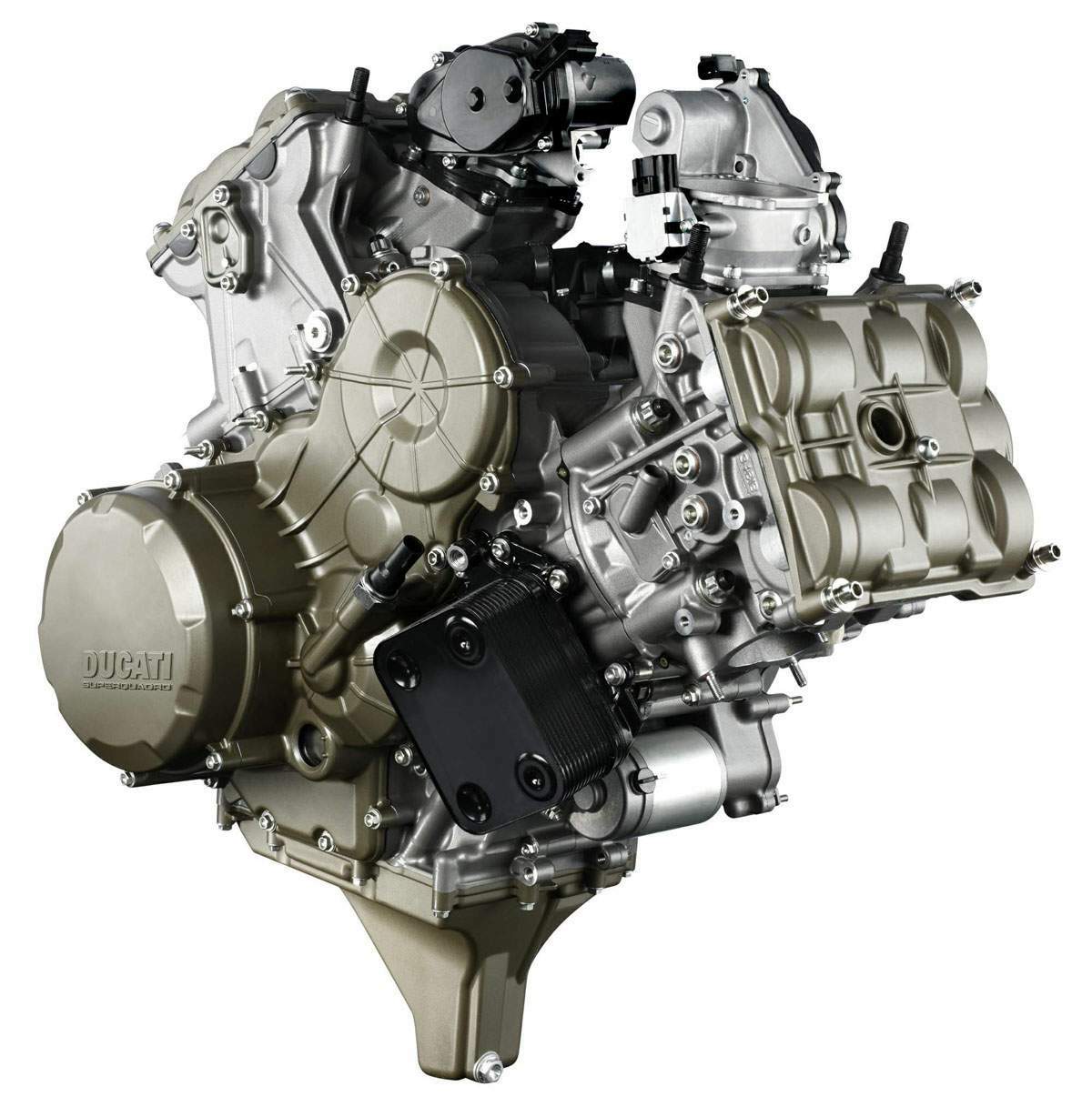
The “Superquadro” power house
Ducati’s latest engine, the Superquadro, goes
beyond the barriers of engineering to enable the 1199 Panigale. Its
no-compromise approach to design, combined with Ducati’s Italian innovation has
now set the most extreme benchmark ever and stands as the latest milestone in
Ducati’s long and iconic history of Superbike engines.
Ducati engineers were given a near impossible
design brief to create the new generation Superbike engine for the Ducati 1199
Panigale. Increase power, torque and user-friendliness and reduce overall
vehicle weight and scheduled maintenance costs seemed impossible tasks, but
given a “blank canvas” to create the new power-plant and encouraged to think
outside-of-the-box to achieve the unachievable, engineers have finally ticked
all the boxes.
The innovative Superquadro engine, so called
because of its massively over-square bore and stroke ratio, has increased power
to an absolute production twin-cylinder milestone of 195hp and torque to 98.1
lb-ft (13.5kgm) with user-friendly Riding Modes that deliver that power
appropriate to the rider’s style and environment. Its construction has enabled a
radical reduction in overall vehicle weight and, further identifying Ducati’s
constant pursuit of performance perfection, major services have been extended to
24,000km (15,000 miles)
Only Fabio Taglioni’s masterpiece 90° L-twin
configuration and Desmodromic valve control have been retained from previous
engines. Everything else is new.
Engine architecture
With the engine designed to be a fully stressed
member of the chassis, its architecture has been completely re-calculated to
provide the best possible vehicle construction for layout, weight distribution
and strength.
The cylinders, which remain at 90° to each other,
have been rotated backwards around the crankcases by a further 6°, until the
front cylinder is 21° from horizontal. This has enabled the engine to be
positioned 32mm further forwards for improved front / rear weight distribution
in addition to perfectly positioning the cylinder head attachment points for the
1199 Panigale’s monocoque frame.
The crankcases, which are vacuum die-cast using
Vacural® technology to ensure optimal weight saving, consistent wall thickness
and increased strength, also incorporate the outer water-jacket of the
“cylinder”, eliminating the jointing face that used to exist at the base of the
cylinders. Instead, the Superquadro has separate nikasil-coated aluminium
“wet-liners” inserted into the tops of the crankcase apertures. This design
enables secure fixing of the cylinder head directly to the crankcase, improved
sealing and enhanced heat dissipation from the thin cylinder-liners directly
into the surrounding coolant.
The primary-drive casing, clutch casing and outer
cover, sump and cam covers are all cast in magnesium alloy, ensuring a
lightweight engine despite its increased strength as an integral part of the
chassis.
In addition to cylinder position, the crankcases
now use shell main bearings for the crankshaft, previously only used by Ducati
on the Desmosedici RR engine. Removing the roller bearings has enabled an
increase in diameter of the crank journals for enhanced rigidity and an increase
the crankcase section around the main bearing area for improved strength in line
with the Superquadro’s extreme power output. The shell bearings are force-fed
oil from internal drillings within the main bearing pillars to keep the new
crankshaft well lubricated and is quickly scavenged back into the sump with the
introduction of a new Ducati feature, a highly efficient MotoGP-style vacuum
pump.
The pump is driven by the main oil pump shaft and
effectively maintains constant vacuum in the crankcase area below the pistons,
reducing atmospheric resistance during the down-stroke of the piston and
controlling the internal “breathing” of the engine.
Extreme dimensions
In calculating the optimum configuration for the
next big step forward in power output for the L-twin engine, Ducati and Ducati
Corse engineers increased engine speed and enhanced breathability with the
incredible bore and stroke of 112mm x 60.8mm (4.40x2.39in). The intense study of
power and ridability resulted in an output of 195hp @ 10,750rpm and 98.1 lb-ft
(13.5kgm) @ 9,000rpm. The new bore and stroke ratio of 1.84:1 effectively
increases rpm with the ultra-short stroke of the crankshaft and increases the
cylinder area to enable increased valves diameters. Inlet valves have increased
from 43.5 to 46.8mm (1.71-1.84in) and
exhaust valves from 34.5 to 38.2mm (1.35-1.5in).
With such large inlet valves operating at higher
rpm, the intense inertial forces have been controlled by using titanium instead
of steel, a solution only previously used on full “R” models. The new valves are
actuated by racing-derived rocker arms, 'super-finished' for reduced friction
and fatigue and then coated in polymeric-like carbon (PLC), a process originally
developed for the aerospace industry.
The race-derived Superquadro pistons have a
distinctive double-ribbed undercrown to achieve high strength and reduced
friction by using minimal piston wall surface area. Using technology developed
by Ducati Corse, the design enables reliable operation of the 112mm diameter
pistons when performing at high rpm.
The improved volumetric efficiency of the
increased inlet valve diameters is further capitalised on by increasing the oval
throttle body dimensions from an equivalent diameter of 63.9 to a massive and
highflowing 67.5mm (2.66in). The Ride-by-Wire throttle bodies feed air across
twin injectors per cylinder, one positioned below the butterfly for enhanced
flexibility and one above for outright power.
Clean power
With such enhanced “breathing”, the challenge for
the Superquadro’s Design Engineers was to program performance-optimised fuel
mapping for a smoother cycle-to-cycle engine operation, without compromising
emissions. To achieve this, Ducati introduced a secondary air system that
completes the oxidisation of unburned hydrocarbons and effectively reduces HC
and CO levels. The system is activated when the engine ECU recognises specific
conditions in the engine’s operation via the lambda and throttle opening
sensors. It then opens a valve enabling a flow of clean air from the main airbox
to a reed valve situated in each cylinder head, which enables one-way flow into
an air gallery exiting into the exhaust port close to the exhaust valve.
Entering the hottest point of the exhaust gasses, the fresh charge of air
enhances the burn environment, eliminating any unburned fuel that escapes during
the exhaust cycle under certain conditions.
Desmo dependent
Never before has Ducati's unique Desmodromic
system been so vitally important. With the high engine speeds at which the
Superquadro operates combined with such incredibly large valves, it would be
impossible for the valve’s rocker-arm to follow the steep closure profile of the
cam lobe using normal valve closure springs. The Desmo system actuates valve
closure mechanically with the same method and accuracy as it opens, enabling
steep cam profiles, radical cam timings, large valves and high operating
speeds. This system is used on every single Ducati motorcycle and is constantly
proven on Ducati Corse’s World Superbikes and Desmosedici MotoGP bikes.
The power of precision
Controlling such large valves with the precise
Desmodromic system also led engineers to replace the original belt-drive system,
used since the introduction of the Ducati Pantah in 1979, with a combined chain
and gear-drive arrangement. The conventional bush-type chain runs from the
crankshaft to the cylinder head where a single sprocket positioned between inlet
and exhaust camshafts, is attached back-to-back to a gear wheel mounted on its
own short, dedicated shaft. The attached gear meshes directly with gears on the
ends of both the inlet and exhaust camshafts, which are also designed with +/-
position adjustment for ultraprecise cam-calibration. The cam chain, therefore,
provides highly efficient point-to-point drive route and, tensioned
automatically, provides continuous reliability, further reducing the cost of
routine maintenance.
On the end of each exhaust cam drive gear is a
centrifugal flyweight which retracts at speeds below tickover to rotate a
“protrusion” from the concentric section of the cam, thus creating sufficient
valve lift to act as a de-compressor. This ingenious device enables the
Superquadro engine to be started easily without using a larger battery and
starter motor, which has reduced overall vehicle weight by approximately 3.3kg
(7.3lb).
When the engine starts and the camshafts begin to
rotate at tick-over speed, the centrifugal flyweight flicks out, retracting the
“protrusion” back into the cam and allowing complete valve closure for full
compression.
This innovative feature further underlines the
lengths to which designers and engineers have worked together in the
single-minded pursuit of weight-saving.
New transmission
Ducati’s engineers also capitalised on the
opportunity of the “blank canvas” project to increase dimension between the
centres of the six-speed gearbox shafts, enabling larger diameter, stronger
gears to transmit the enhanced power output. New for a top-of-the-range Ducati
Superbike is a “wet”, oil-bath clutch. Based very closely on the design of the
Multistrada and Diavel components, the clutch assembly features a “slipper”
function and a progressive self-servo mechanism that compresses the friction
plates when under
drive from the engine. While enhancing frictional efficiency, this also results
in a rider-friendly light clutch lever “feel” at the handlebar. Conversely, when
the drive force is reversed (over-run), the mechanism reduces pressure on the
friction plates, enabling a true racing “slipper” action, reducing the
destabilizing effect of the rear-end under aggressive down-shifting.
Performance perfection
Innovative, cutting-edge and setting the most
extreme benchmark ever, the Superquadro is the most powerful twin-cylinder
production engine on the planet and is destined to power the new Ducati 1199
Panigale with absolute performance perfection.
1199 Panigale versions
The 1199 Panigale is available in standard
configuration with optional ABS and equipped with Marzocchi’s new 50mm
lightweight aluminium front forks, Sachs rear suspension and steering damper and
with DTC, DQS, EBC and RbW combined into the Ducati Riding Modes.
The 1199 Panigale S is also available with
optional ABS and is equipped with Öhlins electronic 43mm front forks with
adjustable Öhlins steering damper and an Öhlins electronic TTX suspension unit
on the rear. In addition, the model rolls on super lightweight forged and
machined Marchesini wheels, has a carbon fibre front mudguard and the
motorcycling world’s first ever full LED lighting. The “S” model is supplied
also with an “Aero kit”, which consists of two lateral attachments for the top
section of the fairing, designed to further enhance the machine’s aerodynamic
penetration and reduce its drag coefficient. The 1199 Panigale S adds
DES to the full electronics fire-power of ABS (optional) DTC, DQS, EBC and RbW
to provide the Ducati Riding Modes.
A special 1199 Panigale S Tricolore version
celebrates the arrival of the new generation Superbike, fitted with ABS as
standard and sporting the proud Italian colours of red, white and green. The
distinctive model carries the same equipment as the S version with the addition
of the new generation DDA+ with special GPS lap time function as well as a
titanium racing muffler kit* by Ducati Performance. *Country specific
NOTE: Some of the photos on
Motorcycle Specs are owned by somebody. If you see any of your
photos, you can let me know so that I can acknowledge it, or if
you object to it, I can remove it altogether. If any copyright
holder objects to their articles being placed on Motorcycle
Specs, it will be removed upon request. Any correction or more
info on these bikes will kindly beappreciated
Contact MePrivacy
Policy
Website Stats