2007 Ducati 1098S Corse - Track Test
12/10/2007 By Adam Waheed
Motorcycle USA
After riding Bologna's finest in our 2007 Aprilia
RSV1000R vs Ducati 1098S comparison , I was dreaming red. Night after
tumultuous night, visions of blurred pavement mixed with that oh-so seductive
sporting twin thump-thump-thump exhaust bark bellowing from behind was all I
could imagine. Those two epic days of blasting around Buttonwillow Raceway
exposed the Ducati for the Superbike thoroughbred it is and, alas, Ducati's
1098S is permanently etched into my subconscious. Like any true addict, we keep
our ears to the street, so when we heard that Ducati North America had thrown a
whole slew of Ducati Performance accessories onto a new 1098S, we just had to
have our fix.
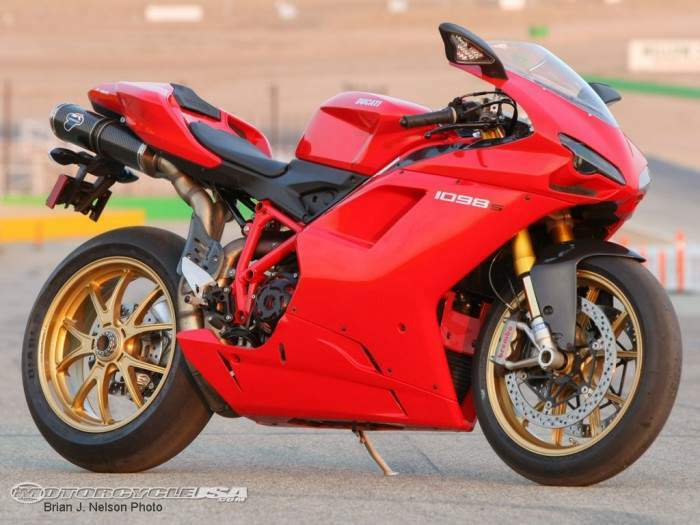
Our story starts out with a luscious candy red 2007 Ducati 1098S, which comes
standard with Öhlins suspension, 17-way Öhlins transversely mounted adjustable
steering damper, Ducati's DDA data acquisition system, forged aluminum
Marchesini wheels, and a carbon fiber front fender. The $19,995 stocker was then
transformed by Hattar Motorsports of San Rafael, California. The Nor-Cal based
Duc shop added some key racing components along with weight-saving, eye-catching
carbon fiber pieces, thereby magically transforming this 1098S into an
asphalt-inhaling, time-bending, 393-lb (no fuel) projectile. That's no typo,
this thing is lighter than an
'08 Yamaha R6!
To make sure that we'd be able to extort full performance out of this 145
horsepower sled, we slung on the stickiest rubber we could find - new generation
Pirelli Diablo Superbike slicks (120/70-R17 front, 190/55-R17 rear). All decked
out we made the trek inland, to a Fastrack Riders Association trackday at
California Speedway in Fontana, California. The 20-turn AMA-spec course would be
the perfect playground to test the track blitzing prowess of this Bolonga
hot-rod. Let the games begin.
The 1098 is already known for its powerful, stump-pulling 1099cc L-Twin mill.
Rather than building the 1098 mill to the moon and sacrifice reliability, the
boys up north choose to leave it entirely stock, except for a pair of lighter
and stronger titanium connecting-rods. Lighter con-rods reduce reciprocating
mass and help the Testraretta Twin build rpm's much more quickly. In fact,
getting the revs up quickly and keeping the engine on the massively wide
powerband is what these Corse go-fast goodies are all about.
Lurking inside those narrow engine cases is an incredibly trick (and expensive)
Corse racing gearbox. To say that the Corse racing gearbox is close-ratio would
be an understatement. Besides the track-oriented super-tall first gear - which
is good for over 80-mph, but also requires much more clutch work than a stock
1098 off the line - second through sixth gears are only seconds away from each
other.
Exit the final second-gear left-hand turn coming onto Cal Speedway's NASCAR
oval, nail the throttle and let the gear banging commence. The horizontal LCD
rpm bar swings wildly to the right and we're stomping down on the billet shift
lever (race-pattern) as fast as we can, trying to keep the Duc out of the triple
red shiftlights atop the Digitek MotoGP-style dash. Normally we would consider a
lot of shifting a pain, but it is incredible how the racing gearbox allowed us
to keep the engine zinging in the meat of the 1098's 80-plus lb-ft of torque,
from 7700 rpm on to its 10,700 rpm redline.
Moments later and inches away from the NASCAR wall to the right, we glance down
and see an indicated 165-mph in top-gear with one solo shiftlight blaring. We
pop out from behind the protective tranquility of the windscreen, grab one
downshift and muscle the 56.3-inch wheelbase Twin into Turn 1.
There's no denying that the racing tranny requires constant attention. Helping
to make sure that it gets the love it so desperately needs is a set of fully
adjustable billet aluminum Corse foot controls. The bolt-on, easy to manipulate
units offer a variety of different mounting points, which makes them suitable
for riders of all size. Shifting action was notchy but precise and the stubby
pegs themselves had a solid and grippy base, which made sure our feet never
slipped off the pegs (except for a particularly over-zealous throttle stab
mid-corner. but, um, never mind.)
Keeping the desmo-valve equipped engine singing is a quarter-turn aluminum
throttle. The Corse unit allows an even faster flood of fuel to the throttle
bodies, all while maintaining smooth twist action. In addition to the increased
G.G.J.F.C. (go-go juice flood capacity), the quarter-turn throttle has very
precise feel and it bridges the gap far better than the stock setup, allowing
the rider to feel every soulful power pulse from the potent L-Twin.
Helping to heighten overall throttle response and boost power output throughout
the rev range is the superlight 70mm Termignoni 2-1-2 full race system.
Installing a race exhaust is one of the first and most popular mod 1098 owners
are likely to do. Termignoni and Ducati have built a relationship based on
racing championships, making the exhaust to run if your riding Red. The
multi-piece Italian-made system snakes through the 1098's insides and is pure
contemporary moto-art. The thick, gold-colored pipes will uncork both noise and
horsepower lurking within that pristine bodywork. The $2800 exhaust comes with a
replacement ECU and a racing-style air filter, which all work in unison to
maximize power gains. The entire setup is literally plug-and-play, with no
remapping or other engine tuning required - just bolt on and ride. Ducati claims
an 8-percent power increase over stock and a quick look at the dyno chart
courtesy of Mickey Cohen Motorsports (714- 993-5000), confirms the power
increase over the heavy, restrictive stockers.
In addition to the benefits of pushing exhaust out faster, the bark that emits
from the twin carbon fiber canisters is the most delightful mechanized racket
we've ever heard. But, beware, because when the 1099cc engine is alive, anyone
within one a three-hundred foot radius will both hear and feel the big power
tremors being pumped out from the big-bore Twin. And if that's not enough, the
teeth rattling jangle-jangle-jangle of the open-air Ducati Performance dry
racing slipper clutch will make common folk scatter out of your way as if it
were Satan's own steel-framed steed.
The racing slipper clutch doesn't only look and sound cool - it works. From
upwards of 120 mph we came hauling into Cal Speedway's bus-stop Turn 3. Grab
four hasty downshifts, dump the clutch and the 1098S complies without a hint of
rear-wheel instability. The adjustable-rate diagraph spring in our 1098S allowed
the bike to almost free-wheel into the corner with extremely little engine
braking effect - especially for a big-bore Twin. Coming into the 180-degree left
Turn 5, the ramp-style slipper clutch was again put through its paces. A firm,
but light brake lever pull and the awesomely overkill Brembo monobloc brakes
slowed the 1098 voraciously quick. Grab two downshifts, drop the clutch and let
the slipper clutch do the rest.
There's no question that the Öhlins suspension that adorns the 1098S is high-end
componentry, but without proper setup it can be hard to get comfortable and as
we all know suspension settings are extremely subjective. What works for one
rider may not work for another, and after our first two 20-minute track
sessions, it became apparent that this 1098S could use some dialing in.
At Cal-Speedway, it's really important to have a bike that can turn quickly -
especially coming into the 130-plus mph Turn 1. We were losing time and using a
lot of energy trying to hustle the Italian machine through the first turn.
Another point of concern was the rear end of the bike. Powering through Turn 3,
the rear end would pogo up and down and just wouldn't settle. That made it
unnerving to get on the gas hard, which again was costing us time. Fortunately
for us, Lenny Albin of
Race Tech Suspension was at the track.
Lenny knows a thing or two about setting up the 1098's unique suspension
package, so we wheeled the Duc over to the Race Tech garage and explained the
problems.
Lenny measured both front and rear sag. As expected, it was off. Lenny noted the
measurements and went to work adding preload to the 43mm Öhlins FG511 fork and
the Öhlins 46PRC rear shock. After he had dialed in 35mm front and 30mm rear
rider sag, we went on to ride height.
"Rear ride height is bit high," said the suspension guru. "Setting up the 1098
is different than the 999/749. Those bikes needed the rear to be raised in order
to get them to turn. The 1098 is the complete opposite."
In order to help get our bike to turn a bit easier, Lenny recommended that we
lower the ride height by 2mm.
"Lowering the rear will give the bike more trail and help it bite in the
corner," said Larry. "It will also make the bike more stable."
Next up was suspension action. When I was jumping up and down on the bike while
setting sag, Lenny's keen eye noticed that the suspension wasn't completely
balanced. The rear seemed to be rebounding faster than the front and front
seemed to be compressing slower than the rear. Albin added some rear rebound to
the rear shock and removed some compression out of the fork.
After about 30-minutes we had the bike dialed. Heading back out, we were blown
away by the improved handling. We no longer had to use so much muscle getting
the bike to turn in - especially into Turn 1. The bike's rearward propensity to
pogo was completely eliminated and, after Race Tech's quick setup, we were way
more confident circulating around the technical 2.2-mile circuit. Best of all,
you can have access to Albin's year's of suspension know-how for just a paltry
$30-definitely money well spent.
Reducing weight is always a good thing, but it's even better when it comes off
of something that's spinning. For this reason the already feather light
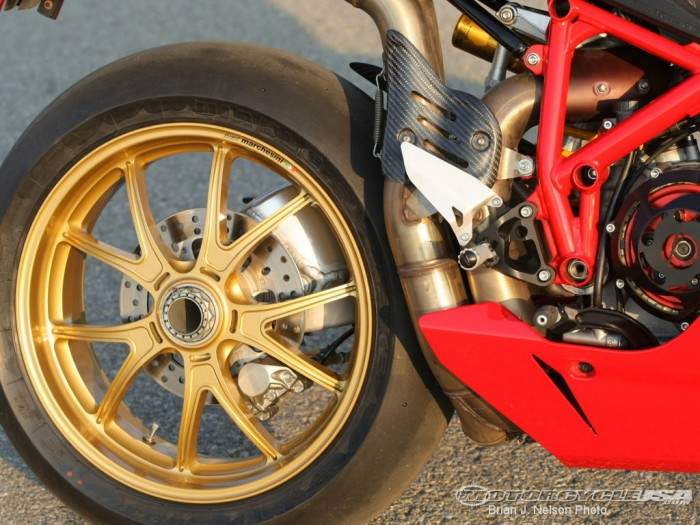
Marchesini forged aluminum wheels were ditched in favor of an even lighter and
stronger set of Marchesini forged magnesium wheels. Yep, you've read right,
forged magnesium - high-dollar superbike stuff to the tune of almost four large,
making them more expensive than their fourteen pounds of weight in sliver. After
we had the suspension setup we were amazed by how quick this hopped-up Duc
turns. Side-to-side direction changes were easier than a boozed up Paris Hilton
on New Years Eve.
With the 1098 entering the World Superbike foray next year, we were wondering
what the Corse engineers have in store for the new machine. Well wonder has been
transformed into awe. If this bike is any insight to what the future holds for
the Xerox Ducati SBK team-then it looks like this small Italian motorcycle
marque might be the team to beat in next year's World Superbike Championship.
This hopped up $37,037.94 1098S is just that good.
NOTE: Some of the photos on
Motorcycle Specs are owned by somebody. If you see any of your
photos, you can let me know so that I can acknowledge it, or if
you object to it, I can remove it altogether. If any copyright
holder objects to their articles being placed on Motorcycle
Specs, it will be removed upon request. Any correction or more
info on these bikes will kindly beappreciated
Contact MePrivacy
Policy
Website Stats