|
|

|
|
|
|
Classic Bikes
Custom Bikes
Individual
Racing Bikes AJP
AJS
Aprilia
Ariel
Avinton / Wakan
Bajaj
Benelli
Beta
Bimota
BMW
Brough Superior
BRP Cam-Am
BSA
Buell / EBR
Bultaco
Cagiva
Campagna
CCM
CF Moto
Combat Motors
Derbi
Deus
Ducati
Excelsior
GASGAS
Ghezzi Brian
Gilera
GIMA
Harley Davidson
Hero
Highland
Honda
Horex
Husaberg
Husqvarna
Hyosung
Indian
Jawa
Kawasaki
KTM
KYMCO
Laverda
Lazareth
Magni
Maico
Mash
Matchless
Mondial
Moto Guzzi
Moto Morini
MV Agusta
MZ / MuZ
NCR
Norton
NSU
Paton
Peugeot
Piaggio
Revival Cycles
Roland Sands
Royal Enfield
Sachs
Sherco
Sunbeam
Suzuki
SWM
SYM
Triumph
TVS
Ural
Velocette
Vespa
Victory
Vincent
VOR
Voxan
Vyrus
Walt Siegl
Walz
Wrenchmonkees
Wunderlich
XTR / Radical
Yamaha
Zero
Video
Technical
Complete Manufacturer List
|
Ducati 1000S2
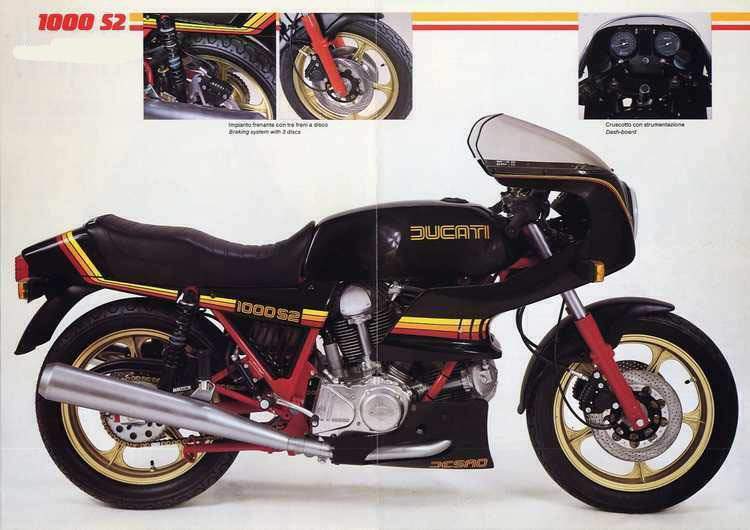
900 S2, 1000 S2,1985 Following a legend is always difficult. Motor Cycle News, when testing the new 900 S2 in their 10 August 1983 issue, had this to say about the motorcycle which had replaced the popular 900 SS: "Probably the last true Ducati is possibly the worst they've ever produced. A sad fact is that, despite turning in a respectable 130mph, the 900 S2 has been transformed by a 'civilization' program from the free-revving big cat of the last decade to an animal with canine qualities. Up against the beautiful creations from the Bologna factory, the S2 is a dog." Strong words, but there were more: "Whereas the recently tested Laverda had risen to the challenge of noise restrictions with greater breathing efficiency, the Duke has simply collected its choking mufflers, huge air box and electric start like an old man collects gray hairs." Having tested the same bike for Motorcycle Enthusiast, I concur with MCN's findings. Although I didn't carry out a maximum speed or acceleration test with the machine, I know it wasn't a match for the earlier unrestricted 900 SS models. As if to offer proof that they were choking the engines, the silencers suffered heat-bluing areas which appeared halfway along their length. Maybe it was a combination of the air filters and restrictive silencers, but the S2 didn't seem to accelerate like earlier models, progress being ponderous by comparison. That is not to say the bike wasn't fast, for its tall gearing offered l00mph cruising at 6000rpm. But quite frankly it would have performed better with a couple more teeth on the rear wheel sprocket. What was really lacking most, compared to the 900 SS, was midrange punch. And as the MCN tester revealed, "A ratio or two will have to be sacrificed to get the motor spinning, something unheard of with Ducatis a few years back." But the same journalist was much more enthusiastic about the handling, at least on fast "A" roads: "Here was the fun I had on the S2, which still handles as well as Bimota, Harris or Moto Martin. Here, where speeds can be kept constantly high, corners melted into straights as the Duke's incredible stability scoffed at lesser machines' attempts to keep up." But, as 1 found, you were reminded of its drawbacks just as soon as you hit slower, more bumpy going, where the over-hard suspension could not cope half as well. The 1983 S2 was offered with or without an electric start—either you had an electric button or a kickstart lever—but not both, unlike the various SS models, which only ever came with a kickstart. One definite plus for the S2 was reliability. Stronger cogs were introduced in 1983, which at last finally put to rest the gearbox gremlins—an added advantage is that these gears will fit into earlier engines. Compared with the 130mph obtained by MCN, the rival Motor Cycle Weekly could only record 123.94mph. But they did note that "the Duke is so long-legged it was still accelerating through the timing lights." Unlike MCN (and myself), Paul Carroll, who carried out the test for MCW, was more impressed with the S2: "I've been pleasantly surprised in my first Ducati test to find I enjoyed every moment of it. It's the kind of bike that every rider I met took an interest in, whether they were riding a Suzuki, I^mbretta, Puch Maxi or Harley. My initial impression was thai it wasn't as nice looking as the 900 Super Sport, but the restyled bodywork, now more like its small brother, the 600 Pantah, grows on you." Carroll didn't like the pillion end of the seat—neither did my wife!—who complained that it was all too easy to slip backWard or forward on the rubber foam seat moulding, thus giving a feeling of insecurity, as no grab handle was provided. The over-hard rear suspension, even on the softest setting, didn't help either. In typical Ducati fashion though, like the Pantah, there was a very neat and practical fold-up lexer provided to facilitate the center-stand operation. Another bonus of the S2 was the excellent Nippondenso instruments—the same as fitted to the Darmah and Pantah. MOV considered the machine's best features to be "good fuel consumption," and "superb handling," and its worst "restricted steering lock" and "uncomfortable pillion position." For 1984 the S2 remained mechanically unchanged, but featured a new color scheme. Out went the gunmetal gray and black, in came a striking combination of red chassis, with black tank, seat and fairing. The garish red, orange and yellow striping introduced on the S2 remained unchanged. Then, in early 1985, came the final variant, the 1000 S2. Like the Mike Hailwood Replica Mille, the 1-liter S2 was much more than a simple bigger-bore job. For a start, both the bore and stroke were altered—88x80 mm—giving 973cc. But the factory's engineers didn't stop there. They added a hydraulic clutch, a revised lubrication system with a full-flow, screw-type filter, plain bearing big-ends, and substantially revised engine casings. In addition, there was an improved dual-seat, new-style cast-alloy wheels and brake discs, electric fuel taps, revised instrument console, and belly pan-plus other more minor alterations. The "1000" was also offered with two levels of performance, 83 and 90bhp. The difference was a two-into-one exhaust and bell-mouths for the 40mm carburetors—in place of the Silentium silencers and air filters. The factory claimed 146 and 137mph respectively, which, if accurate, made the performance version of the 1000 S2 the fastest of the whole SS/S2 family. Certainly the 1-liter S2 was a significantly better motorcycle than the small version. Its main problem is that it was available for only a few months in 1985, before the Cagiva takeover. In the light of what was in reality virtually a major redesign, it would appear that Ducati didn't have time to recoup their investment and that spares could be a problem in the future for those parts different from the earlier models. As is related later, Cagiva promptly pensioned off the bevel-driven twins to concentrate on the Pantah-based engines. What to Watch for Over some two and one-half years of production very few S2s of either capacity were actually produced, as the company had reached a position where it found it increasingly difficult to continue trading. I feel that, of the two bikes, the larger one is much the better, but I'd worry about potential parts problems. None of the S2s have the charisma of the SS models, even though they are probably more practical—and certainly more reliable— for everyday use. But how many Ducati buffs use their pride and joy as personal transport? Most are ridden on sunny days and holidays, so high-mileage reliability and practicality don't score as highly as riding fun, style or aura. And unfortunately the S2s can't match the SS models in these areas—hence the low star ratings. Source Ducati Mick Walker
|
|
|
Any corrections or more information on these motorcycles will be kindly appreciated. |