|
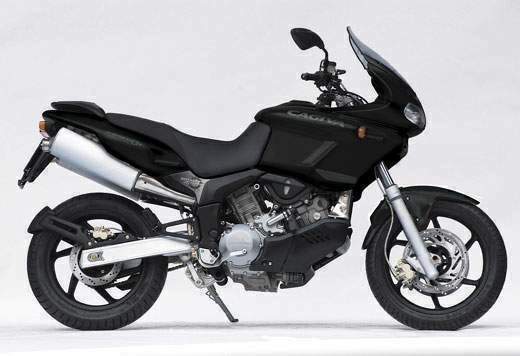
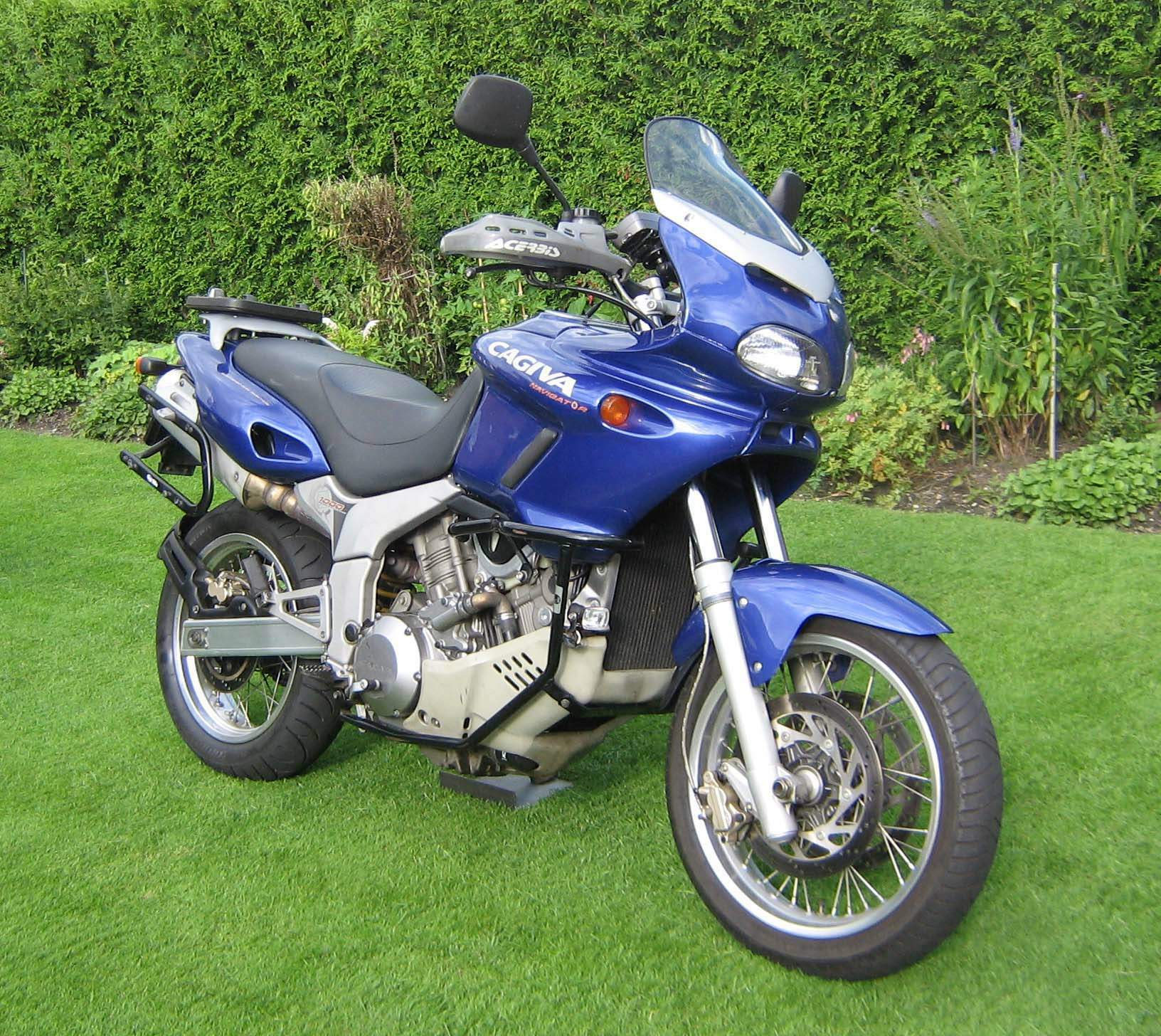
Cagiva Navigator 1000

|
Make Model |
Cagiva Navigator 1000 |
|
Year |
2005 |
|
Engine |
Liquid
cooled, four stroke, 90°-V-twin, DOHC, 4
valves per cylinder. |
|
Capacity |
996 |
|
Bore x Stroke |
98 X 66 mm |
|
Compression Ratio |
11.3:1 |
|
Induction |
Electronic fuel injection |
|
Ignition /
Starting |
Electronic, transistorized
/ electric |
|
Max Power |
99 ho 73 KW @ 8500 rpm |
|
Max Torque |
95 Nm 9.7 kg-m @ 7000
rpm |
|
Transmission /
Drive |
6 Speed / chain |
|
Clutch |
Cable-operated
multi-plate wet clutch. |
|
Front Suspension |
45mm Telescopic hydraulic fork |
|
Rear Suspension |
Progressive with hydraulic
monoshock, preload and rebound damping adjustable. |
|
Front Brakes |
2x 298mm discs 4 piston calipers |
|
Rear Brakes |
Single 220mm disc 2 piston caliper |
|
Front Tyre |
110/80-18 |
|
Rear Tyre |
150/70-17 |
|
Seat Height |
850mm |
|
Dry-Weight / Wet-Weight |
210 kg / 225 kg |
|
Fuel Capacity (res) |
20 Litres (5L) |
|
Consumption average |
17.3 km/lit |
|
Standing
¼ Mile |
12.0 sec |
|
Top Speed |
211.6 km/h |
|
Overview |
Motoring.co.za /
Motomag
/
Motocorse |
The Navigator is based on Cagiva's Gran Canyon trailbike,
but with the engine replaced by Suzuki's TL1000 engine. Cagiva's own exhaust
and intake system has produced an engine with lower peak power than the
TL1000R, or Cagiva's own Raptor 1000 (which also uses the TL engine). But
the Navigator is still one of the most powerful trail-styled bikes
available, and is comparatively light, giving it sharp performance. The
V-twin engine allows for a narrow chassis and low air resistance for higher
top speed. But while the small front-fairing looks good, it does not offer
as much protection as some of the Navigator's larger competitors. The soft
suspension and strong brakes just about keep up with the engine.
Cagiva’s love affair with big Suzuki V-twin
motors continues. Not satisfied with building the Grand Canyon - the most nimble
big trailie around - (see IOL’s road review) it has dropped the kick-ass TL1000
engine into an updated version of the Canyon frame to create the seriously
muscular Navigator.
Even detuned to 73kW, at the time of its introduction it was the most powerful
dual-purpose machine on the market and capable of well over 200km/h while the
shortened “off-road” gearing produces impressive acceleration and effortless
wheelies.
Hamamatsu’s 996cc 90-degree twin needs little introduction but in this
application it retains the 98x62
Even detuned to 73kW, it was the most powerful
dual-purpose machine on the market..6mm bore and stroke, twin overhead cams,
eight valves and twin-swirl combustion chambers of the original. However, but
the cam profiles have been reconfigured for maximum torque - and it works.
Although neither Cagiva nor Suzuki will quote torque figures for the detuned
edition, it will cruise as low as 2400rpm without juddering and pulls like a
steam train from 3200rpm. Above six there’s real big-bike power, through until
8000rpm, when the motor becomes harsh and vibratious as it runs out of steam.
The Navigator was reluctant to reach the 10 000rpm red line in any gear at the
1500m altitude where I rode it so I didn’t force the issue, just kept it in the
meaty part of the torque curve between four and seven, revelling in the
effortless grunt and smooth power delivery.
There’s very little spritzer snatch on this version of the fuel-injected Suzuki
mill and the clutch is smooth and predictable hot or cold
The controls are chunky and positive, the fascia
neatly laid out.. The gearshift on the test bike was slicker than most of the
cog sets Suzuki sells to other marques and I was soon able to make respectable
upchanges without recourse to the left lever - although matching the revs pretty
closely is required due to pronounced driveline lash.
It’s all mounted in a trellis frame of square-section steel tubing with two big
triangular plates to stiffen the headstock. The motor was designed to be a fully
stressed chassis member and is used as such in this application, with a mounting
point on the top of the crankcase in the vee of the cylinders and another on the
front cylinder head.
There are no downtubes or cradle below the sump but two neat silver plastic
covers fill the space between the seat and the fabricated steel engine plates so
that at first glance it looks like a fashionable beam frame. Neat, but blocky,
alloy castings extend from below the engine mounts to provide mounting points
for the rider’s footpegs while the pillion pegs are mounted on classic
triangular hangars.
The swing-arm is made from aluminium extrusions (did you know that the first
all-alloy perimeter frame, on the Bimota YB4 which won the 1987 World F1
championship, was in fact made from components originally intended for
doorframes?). The rear suspension uses a rising-rate linkage and a single Boge
shock-absorber adjustable for rebound and spring preload while the 18-inch front
wheel rides in 45mm conventional Marzocchi forks devoid of adjustment.
Japanese specialists Nissin provide braking and at first glance it’s
uninspiring, with twin-piston floating callipers on 296mm discs, but looks in
this case are deceiving. Lever effort is a little high and there’s not much feel
for what’s going on between rubber and road but, with a little practice, the
Cagiva can be made to stop in distances that’ll raise eyebrows among riders of
big dual-purpose machinery, despite unnerving amounts of front-end dive.
The rear brake also works better than I expected, given another low-tech
floating calliper, but needs to be used with discretion as it will lock up
easily.
The distinctive body panels have the signature of South African designer Pierre
Terblanche all over them. There are no sharp edges or straight lines. Everything
is organically curved and smoothly flowing; the fairing is neatly waisted along
the line of the top of the fuel tanks to separate the centre of the bike from
the top hamper.
Nothing sticks out - the indicators are mounted in neat circular cut-outs at the
widest point of the centre module and the built-in rear carrier mirrors the line
of the tail-piece, making it the only example I’ve ever seen that looks designed
in rather than added on. Its leading edges are also thickened and rounded to
double as a very practical and comfortable pillion grab handle.
The big airbox above the fuel injection throttle bodies would have made a
conventional saddle tank unattractively humped and raised the centre of gravity
when full so Terblanche fitted a 10-litre plastic tank either side of the frame
with identical aircraft-style filler caps side by side in a separate panel. The
tanks are siamesed by a balance pipe across the frame under the tanks so that
fuel is evenly drawn from both sides, but it’s much easier to fill them
individually - and so cool!
The only drawback is that the front of the saddle is a little wide and I found
that it caught me on the inside of the thighs, which took a little getting used
to. That aside, the seating position is superb, the saddle wide and deeply
padded, with just the slightest step up to pillion country, and plenty of room
for both pilot and navigator (sorry!) to move around on long rides.
The wide handlebars have very little rise but the steering head and upper triple
clamp are relatively high so hand position is just above elbow height, about
right for a big trailie if a little upright for the high speeds this one can
reach.
The controls are chunky and positive, the fascia neatly laid out with speedo,
tacho and the usual idiot lights, but in a plain, very unimaginative black
plastic panel. It’s a cop-out. Nevertheless, the flight deck earns top marks for
neatness, fit and finish.
With its upright seating position and a saddle height of 850mm - high for a
street bike if reasonable for a trailie - and the wide bars giving plenty of
manoeuvrability, the Cagiva easily handles commuting. The motor pulls usefully
from just over 2400rpm, the bike is stable almost to walking pace and you can
see over most of the tin-tops to spot trouble two and three cars ahead.
On the open road the little screen protects well and the bike is rock-steady,
right up to its top speed of just over 208km/h (at altitude - expect
considerably more at sea level). The suspension soaks up the bumps like a luxury
bus and the gentle vee-twin throbbing makes the bike a very relaxing companion.
My only quibble is that the seat is a little too sit-up-and-beg for all-day
comfort, unless you’re into touring at relatively modest velocities.
It’s on the narrow, bumpy back roads that this motorcycle comes into its own.
The Navigator lets you relax and enjoy the scenery - which is why you chose the
road less travelled in the first place, isn’t it?
On the tarred twisties it can be thrown around with gay abandon, flicked around
like a much lighter bike because of the leverage afforded by the wide bars. The
motor’s midrange punch shoots it out of corners like only a big V-twin can go
and the trailie styling endows the Cagiva with practically limitless ground
clearance.
The forks are a little underdamped, which shows up as a slightly choppy ride in
town and as a distinct tendency to “pogo-stick” when pushed hard on bumpy
corners. It never got out of hand and the bike held its line fine, but the front
wheel could be made to feel unsettled. It must be said that the bike’s superb
open road comfort is in no small degree due to its supple suspension, so I felt
that this was an acceptable compromise.
Cagiva’s Navigator is more of a street bike than its styling would suggest,
although it’s as sure-footed on gravel as any other 210kg light tourer and
better than some purpose-built mud-pluggers, within the limits of its street
tyres. Nevertheless, on the blacktop it’s superbly competent; it’ll commute,
it’ll tour, it takes two in comfort and it’ll give you the kind of Sunday
morning rides that make motorcycling worthwhile.
Build quality, fit and finish will stand comparison with the best in the world
and the design work shows real insight into what a motorcycle actually does;
it’s cohesive, smooth and very practical.
Source
By Dave Abrahams 2002
|