Here in the hallowed portals of Rathbone Place, WB?'s crusading
editorial team generally pride themselves on their legendary objectivity, even
the panic stricken pleading of the Ad dept in the face of plummeting revenue
cannot shake us from our resolve to maintain our unbiased standards. Trouble is,
every now and then a test bike appears which plays on the prejudices and
subjective facets of our various souls. With Willis and Kemp, Moto Guzzis seem
to set their heart strings twanging, Schiller frequently professes to an
unhealthy desire for Laverdas, Phillips lusts after big Kawasaki's, and Rev. and
myself, while not fully fledged Ducatisti, are pretty besotted by the
marque.
Now it's no secret that Ducati have been gradually phasing out production of
complete bikes throughout the year, and instead providing Cagiva with their
V-twin engines. So when Three Cross Motorcycles rang to confirm that we could
pick up their Cagiva 650 for an albeit brief test, I was tucking in my Damarts in readiness for a cold ride down to Three
Legged Cross before the receiver was back in its place.
As the Pantah represented a move by Ducati away from the single minded, some
would say, harsh performance and styling to be found in the SS, towards a more
civilised and practical motorcycle hopefully appealing to a wider market, so the
Alazzurra (Blue Wing) can be seen as a creditable attempt to take on the
increasingly exotic styling exercises from Japan. I really liked it.
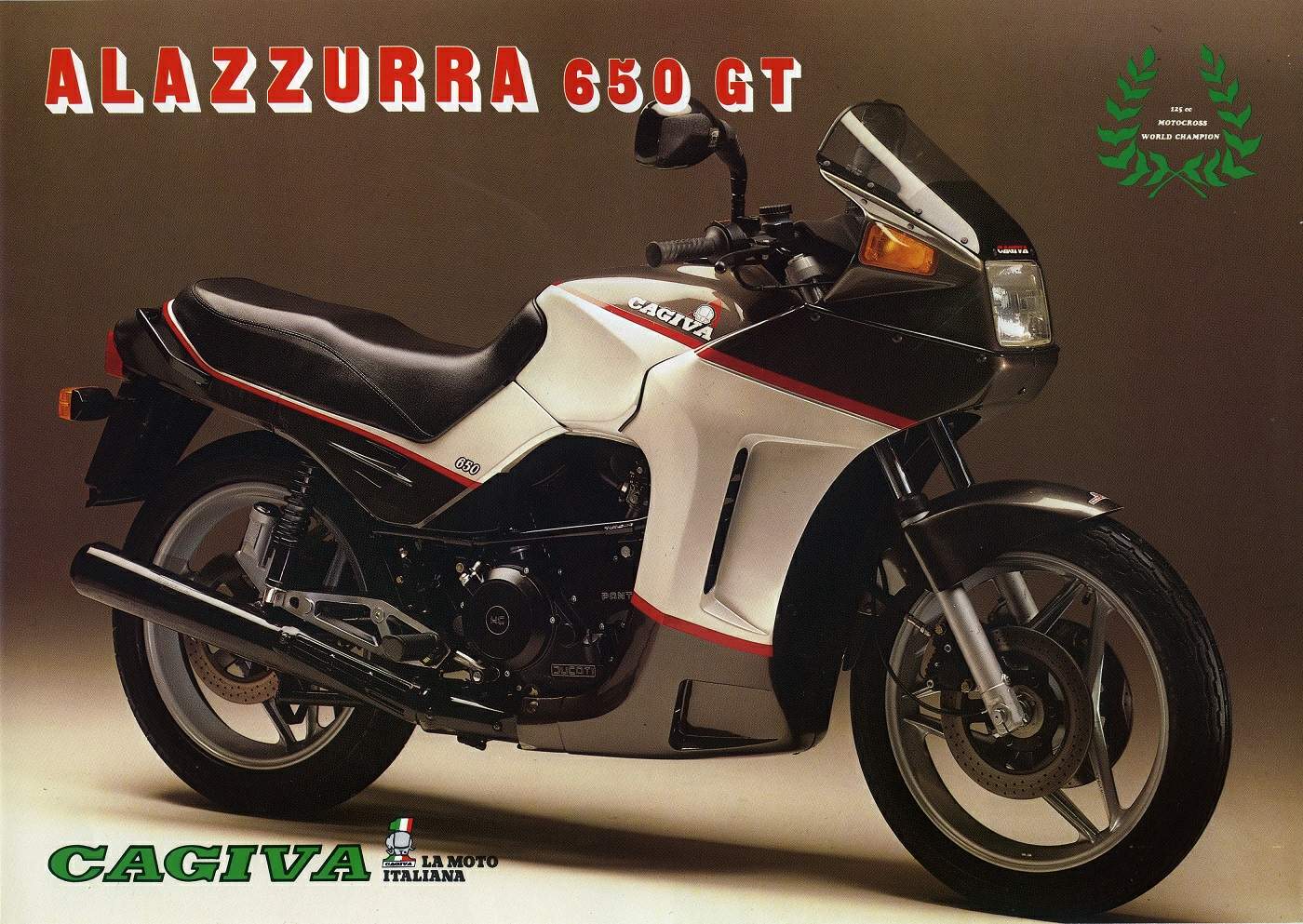
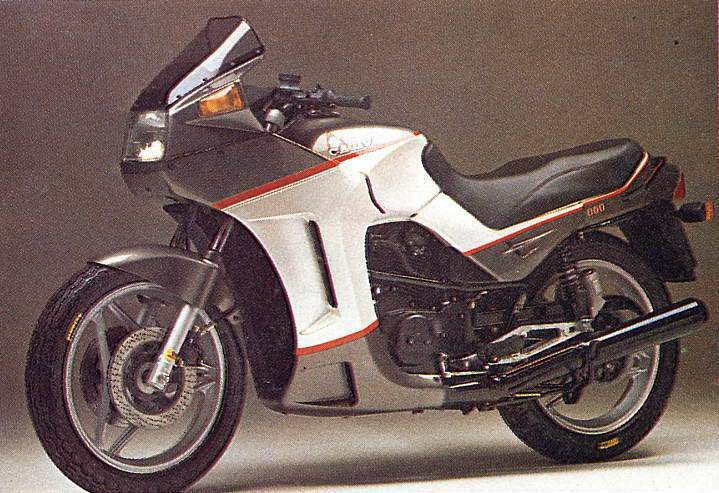
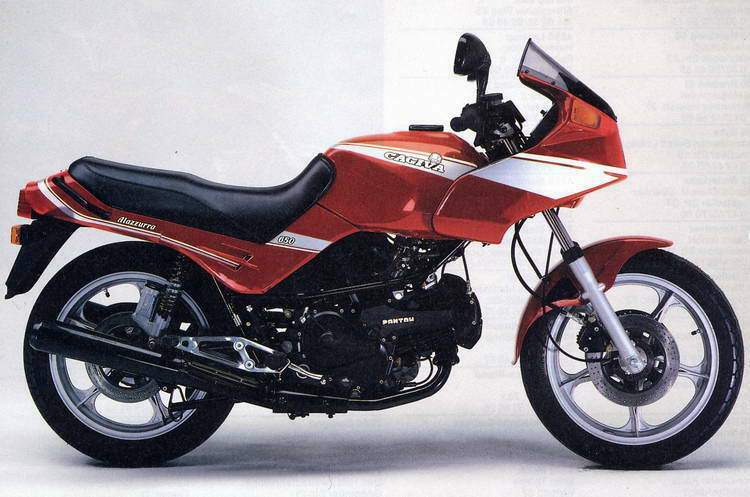
The 650's lines seem to flow far better from the headlamp to the shrouded
tail lamp than the Pantah's ever did. The whole bike looks more graceful yet
manages to incorporate useful touches such as the grabrails, tank cut-outs for
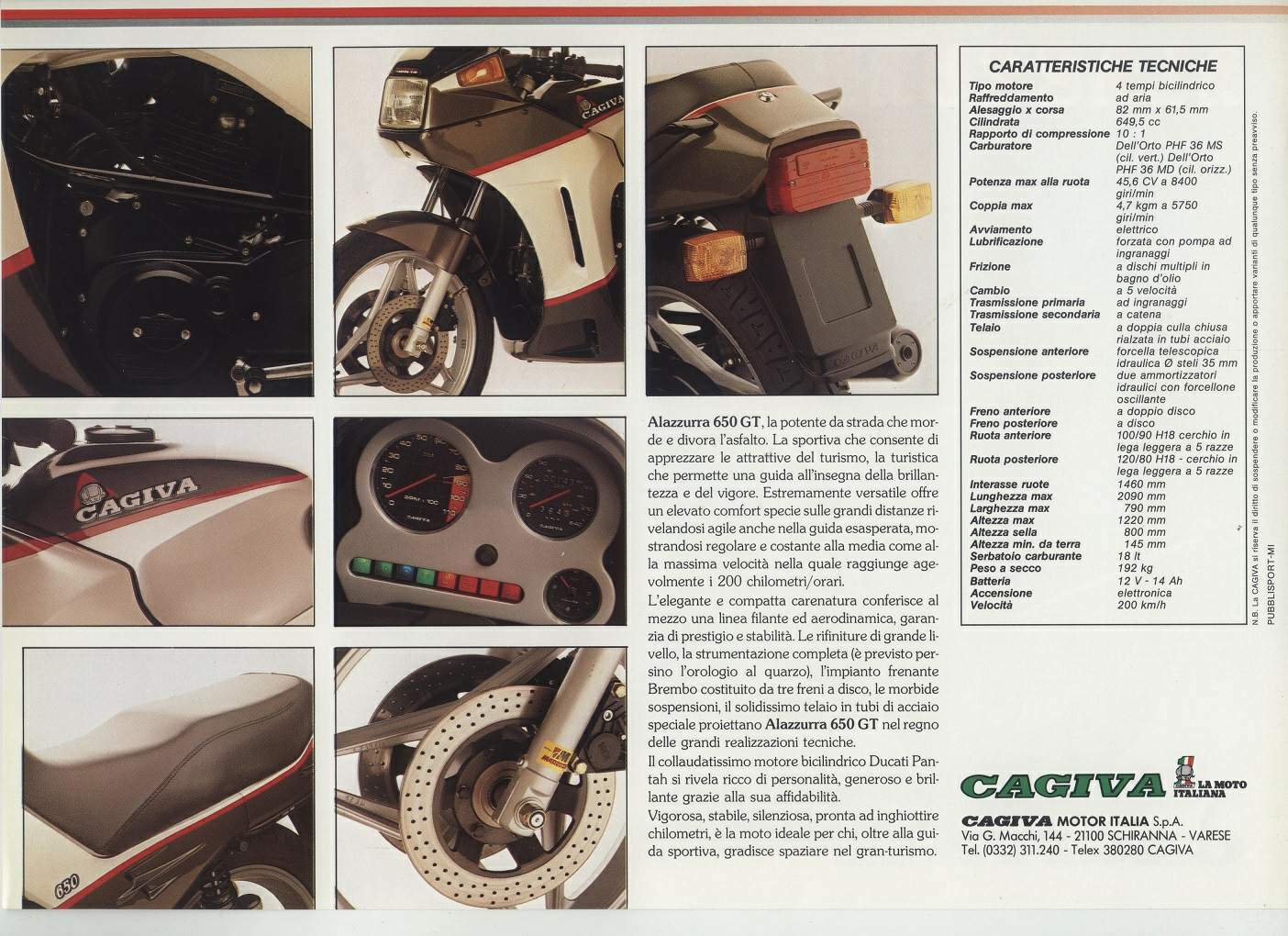
the rider's knees to hug and the clock in the instrument panel. As well as the
timepiece there is a row of eight warning lights set along the bottom of the
dash along with the tacho and smaller speedo. The switchgear has been revised,
but I feel the indicator switch escaped as it is far too imprecise and only the
Bee Emm-esque bleeper saves best compromises around for everyday riding plus the occasional bout of
silliness. Relatively narrow, flat bars, minimal distance between kneecaps and
slightly swept back footrests dictate a moderate lean forward possie without
putting undue pressure on your wrists and arms at legal speeds, yet still allows
you to disappear behind the screen when you inevitably open up on some deserted
road.
Not that I felt really able to, mind you, after certain threats had been made towards my puny frame should I
exceed 5000 rpm (the bike having only just topped the 160 mile mark) I was very
careful to stay within limits for the first 200kms. Then, as the engine felt
loose enough and in the interests of pioneering journalism (without a thought
for my health should those lovely chaps from Three Cross subsequently take out a
contract on me,) I, dear reader, opened her up. It was a revelation. At 5000rpm
the cams really started to perform and the bike hurled itself down the road to
the accompaniment of a surprisingly lusty growl from the Silentiums in a display
of relaxed aggression. Wishing to limit Three Cross's retribution to a Chinese
burn and a kick on the shin, I called a halt at 6500rpm yet still saw
140Rph(87mph) in top. Which would appear to indicate that the factory's claims
of a 200Rph (125mph) top speed are not unreasonable. Trying to work out max.
speed on paper did bring to light a difference in gearing. The pre-production
models had a 15/37 pairing while on our test bike it was 15/41, so it would
appear the internal gear ratios have been altered to raise the gearbox speed as
the bike's overall speed seems equal. One of the plausible reasons we see for
this was to make the gearbox's action sweeter, in which case I dread to think
what the earlier bikes were like, as, even allowing for its virgin state the
Cagiva was extremely notchy, especially on downchanges.
It's no surprise that the Cagiva displayed the same roadholding
characteristics as the Pantah, sharing, as it does, basically the same frame
apart from a few mounting points and unaltered vital statistics of wheelbase, rake
and trail. Through the fast sweeping bends of the A31, the Pantah's
unimpeachable reputation for unerring accuracy shone through, yet on slower
corners the more upright riding position and wider bars make the Cagiva more
responsive should a manhole cover or bovine deposit hove into view. However,
Cagiva's engineers haven't rested on their laurels as the suspension showed a
marked improvement over the Pantah's. The rear Marzocchis have a softer initial
spring rate and the front forks have revised damping for improved low speed
comfort, though, to be honest, I still found myself shaken about on rough roads
and with that wooden feeling after 100 miles.
Overall the Alazzurra offers a distinct improvement on the Pantah yet it has
its share of niggling problems. I know fuel warnings are fashionable, but when
one comes on 100 miles before reserve I do wonder if they're justified. Though
the mirrors were excellent they marred the bike's flowing lines; I'm no designer
but I feel they could've been better positioned. And the paint job is typical
Italian, diving into the tank at the mere sight of a petrol pump nozzle.
Against this you have the usual excellence of Pirellis and Brembos, an
improvement in finish and an engine with a good mechanical reputation with
greater torque and brisker acceleration than its predecessor.
I see no reason why, at a price only slightly greater at £2899 the Cagiva
shouldn't take over where the Pantah left off and ensure that the Desmo V-twin lives on. Hooray.
Q5
Source Which Bike 1985