|
| |
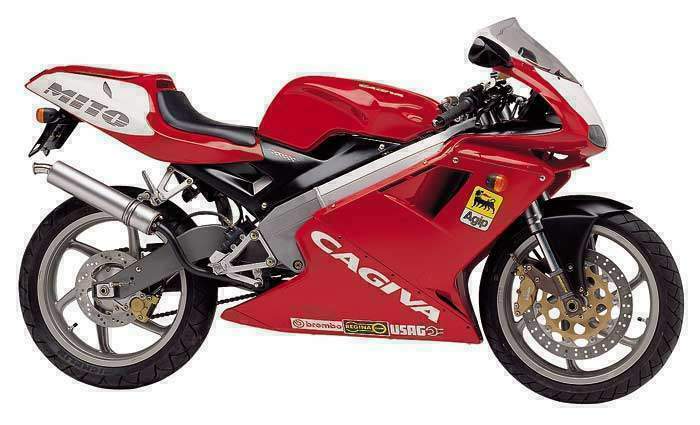
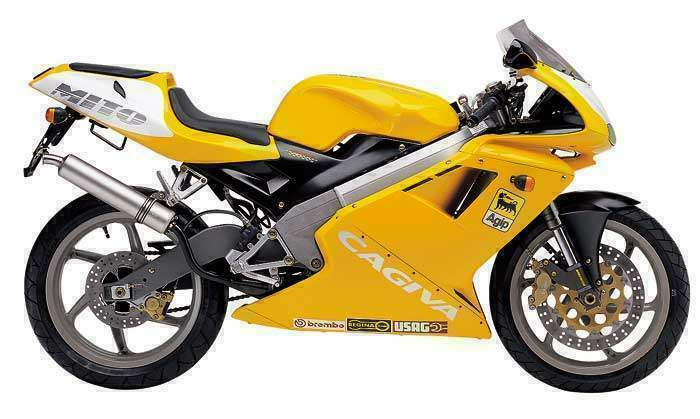
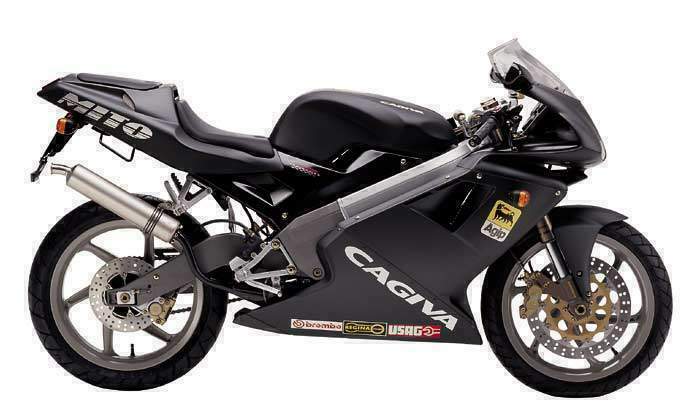
Cagiva Mito 125

|
Make Model |
Cagiva Mito 125 |
|
Year |
2000-01 |
|
Engine |
Liquid cooled, read valve, two stoke single
cylinder,
electric power valve |
|
Capacity |
125.6 |
|
Bore x Stroke |
56 x 50.6 mm |
|
Compression Ratio |
6.3:1 |
|
Induction |
Dell'Orto carb |
|
Ignition /
Starting |
CDI / electric |
|
Max Power |
34 hp 24.8 kW @ 12000 rpm |
|
Max Torque |
23 Nm @ 11000 rpm |
|
Transmission /
Drive |
6 Speed / chain |
|
Front Suspension |
40mm Marzocchi telescopic forks, 120mm wheel
travel. |
|
Rear Suspension |
Monoshock, 133mm wheel travel. |
|
Front Brakes |
Single 320mm disc 4 piston caliper |
|
Rear Brakes |
Single 230mm disc 2 piston caliper |
|
Front Tyre |
110/70 ZR17 |
|
Rear Tyre |
150/60 ZR17 |
|
Dry-Weight |
129 kg |
|
Fuel Capacity |
12.5 Litres |
|
Consumption average |
20.1 km/lit |
|
Braking 60 - 0 / 100 - 0 |
12.9 m / 36.4 m |
|
Standing
¼ Mile |
14.2 sec / 149.3 km/h |
|
Top Speed |
172.3 km/h |
|
Manual |
diff.ru: /
blackbears.ru |

It was almost the perfect
outbraking manoeuvre. Approaching the left-bend I was in the other guy‚s
slipstream, our little red Mitos identically matched, and as he sat up to brake
I pulled out and flashed up on the inside. But I didn't quite make it. Letting
go of his brakes, he shot forward again then cut in towards the apex ahead of
me, almost taking away my front wheel and leaving me entering the bend off-line
and travelling slightly slower than normal.
On the Mito you just can't afford to do that. The little bike made it round the
bend easily enough; its brilliant chassis saw to that. But I was on the wrong
part of the track and in too high a gear, and when I opened the throttle again I
was greeted with a flat bluuur as the little two-stroke bogged at a mere
8000rpm, exited the bend much more slowly than normal and allowed my opponent to
open up a 20-yard gap.
Moral of that tale is that you can't afford to hesitate when riding a 125cc
race-replica, even a bike as stunningly fast and competent as this one. When an
eighth-litre engine is tuned to give over 30bhp at 11,000rpm (that's
240bhp/litre!), if you let it go off the boil you're in trouble. These little
two-strokes, popular with young riders in Italy and elsewhere in Europe, demand
a skilled and energetic hand on the throttle at all times.
The new Cagiva Mito, for all its redesign and its fancy styling, is no
exception. At a glance this might look like a genuine full-bore superbike, with
its twin-beam frame, its trick cycle parts and its bodywork modelled on that of
the delicious Ducati 916. But a peek behind the hype and the red-and-grey
plastic reveals the latest version of the single-cylinder stroker that has been
at or near the top of the Italian sales charts ever
since its launch in 1990.
This is a very comprehensive revamp, mind, and worthy of Cagiva's assertion that
the Mito Evolution or EV, as it's called, is virtually a new motorcycle. Like
the 916, this project was handled by Cagiva's Rimini-based research centre,
under the guidance of the two engineering Massimos, Tamburini and Parenti (and
the overall control of another one, Bordi). This explains the initials CRC on
the fairing, as well as the Mito's resemblance to the Ducati flagship.
Most obvious example of that is at the front, where the little Cagiva's sharp
fairing nose and slanted twin headlights could almost belong to the bigger bike.
(In fact no parts are shared.) The new circular fuel tap is neat, although it
would be more useful if it included a reserve position to back-up the low-level
light. The seat manages to incorporate a thinly-padded pillion perch without
losing its streamlined shape.
Of course even the Mito can't keep up the big-bike illusion once you get up
close, but it's still a well finished motorcycle, built to a standard that even
the best Italian superbikes didn't meet a decade ago. What you see is pretty
much what you get too. The single silencer is carbon-wrapped alloy rather than
the real thing, but the frame is genuine aluminum rather than steel (which can't
be said for most Japanese 600s) and the carbon-look stickers on the previous
Mito's curved alloy swing-arm are gone. The frame is one of the least changed
parts of the bike, having merely been modified to accept a 916-style transverse
steering damper on the pilot's side of the enlarged top yoke. Suspension is also
revised rather than renewed, although the non-adjustable 40mm Marzocchi
upside-down forks and the Boge shock, which is adjustable only for preload, have
been comprehensively reworked.
Engine is still a watercooled single with dimensions of 56 x 50.6mm for a
capacity of 124.6cc, but it incorporates a host of changes aimed a squeezing out
every last fraction of performance. Combustion chamber shape is revised to give
a larger squish band, and cylinder porting is also redesigned. The seven-speed
gearbox‚s ratios are spaced more closely together, and the crankshaft balancing
system is modified.
Breathing is uprated at both ends, too. A new and larger airbox uses vents on
the bottom rim of the fuel tank to channel fresh air to the motor, via a
recalibrated 28mm Dell‚Orto carb and new carbon-fibre reed valve petals. The
pipe and its silencer are also new. The changes add up to a claimed boost of
about 3bhp at the top end, with a slight increase all the way through the range.
The factory does not quote an official figure, but an estimate of 30bhp at the
rear wheel is not far off the mark.
It's the motor that grabs your attention after settling into the racy but fairly
roomy Mito's low seat, and not for the best of reasons. View is of clocks with
easily removable speedo and idiot lights, plus neatly finished fairing inners
and mirrors full of forearm. The tacho is redlined at a heady 11,400rpm but even
this doesn't prepare you for firing up to find that, even when blipping the
throttle in neutral, at low revs the motor wheezes like an asthmatic
octogenarian rather than revving crisply.
Pulling away smartly requires at least 7000rpm on the dial, which means that in
traffic you'd either depart feebly or scream off making lots of smoke and noise.
Not that the soft option could be contemplated on this bike especially at a
racetrack, such as this one at Varano, near Palma in northern Italy. Giving the
new smooth-action throttle a big tweak, I slipped the clutch, and the Cagiva
accelerated up the pit-lane feeling like
Kocinski's 500 running on one pot (but pretty good all the same).It still felt
very racer-like a few laps later, despite the lack of out-and-out speed, as I
put my head down and caned the little motor past the 11,000rpm mark through the
gears. Worthwhile acceleration kicked in at between eight and nine grand, though
for quick progress it was essential to keep the needle in five-figure territory.
That was normally easy enough, because changing up through the close-set higher
ratios dropped revs by only about 1000rpm as the Mito aimed for its top speed of
a little over 100mph. If the revs fell below eight, though, the Mito went
instantly to sleep, as my abortive overtaking attempt proved. The motor actually
pulled cleanly with only a few grand showing on the tacho, but power built so
slowly that I‚d have been better off parking and waiting for a bus.
Happily the handling remained sharp at all speeds, combining lightness and
flickability with very impressive stability. In common with other race-replica
125s the Mito‚s unchanged steering geometry is not particularly radical (rake is
25 degrees; trail 98mm), but the bike steered into bends with a light touch of
the bars, and never even threatened the slightest wobble. It's doubtful whether
the steering damper had much to do with this, but it looked good and did no
harm.

Cagiva‚s suspension-tuning efforts have been concentrated on improving comfort
without compromising handling, and on this evidence the mods work. The Mito
flashed round the tight and twisty racetrack with barely a twitch, its
suspension nonchalantly soaking up some suspicious looking patches and ripples
in the tarmac. The race-kitted Sport Production Mito that I also rode felt
noticeably tauter, proving that for track use the roadster's forks could
usefully be firmed-up a touch, but for the road they would be just about right.
The Boge shock also performed superbly well, particularly during one hectic
three-way racetrack dice, despite having to deal with my unusually large body.
This little bike could certainly handle far more power than its engine is able
to put through the chassis even given the gumball grip of Michelin's Hi-Sport
radials, which come in unchanged 110/70 front and 150/60 rear sizes.
Hard use of the single 320mm Brembo front disc and four-piston caliper also
failed to upset the Mito's stability. The brake worked well but at the track I
was slightly disappointed with the level of effort and lever travel required,
given the bike's dry weight figure of just 276lb. On reflection, considering
that the Cagiva will be ridden on the road by juvenile Italian novices in shorts
and sneakers, a sharper-still stopper probably wouldn't be a good thing after
all.
That balance between road and racetrack performance is crucial to bikes like
this. In town, on a freeway, or at any time when the constant need to provide at
least 9000rpm in exactly the correct gear became a pain rather than a pleasure,
the Cagiva would be no fun at all. But on a twisty racetrack or a winding
country road, the Mito's blend of style, agility and rev-happy motor provides
thrills out of all proportion to its size.
Source .insidebikes.com |