|
|
|
|
Classic Bikes
Custom Bikes
Individual
Racing Bikes AJP
AJS
Aprilia
Ariel
Avinton / Wakan
Bajaj
Benelli
Beta
Bimota
BMW
Brough Superior
BRP Cam-Am
BSA
Buell / EBR
Bultaco
Cagiva
Campagna
CCM
CF Moto
Combat Motors
Derbi
Deus
Ducati
Excelsior
GASGAS
Ghezzi Brian
Gilera
GIMA
Harley Davidson
Hero
Highland
Honda
Horex
Husaberg
Husqvarna
Hyosung
Indian
Jawa
Kawasaki
KTM
KYMCO
Laverda
Lazareth
Magni
Maico
Mash
Matchless
Mondial
Moto Guzzi
Moto Morini
MV Agusta
MZ / MuZ
NCR
Norton
NSU
Paton
Peugeot
Piaggio
Revival Cycles
Roland Sands
Royal Enfield
Sachs
Sherco
Sunbeam
Suzuki
SWM
SYM
Triumph
TVS
Ural
Velocette
Vespa
Victory
Vincent
VOR
Voxan
Vyrus
Walt Siegl
Walz
Wrenchmonkees
Wunderlich
XTR / Radical
Yamaha
Zero
Video
Technical
Complete Manufacturer List
|
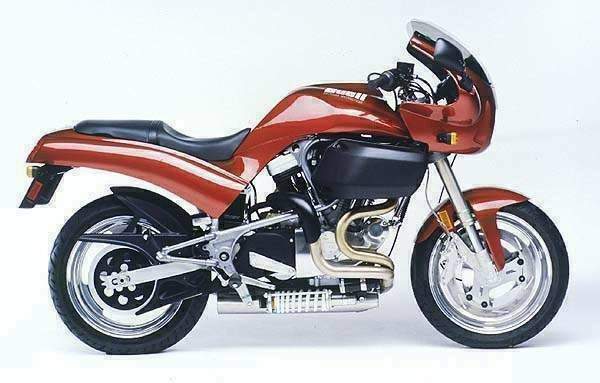
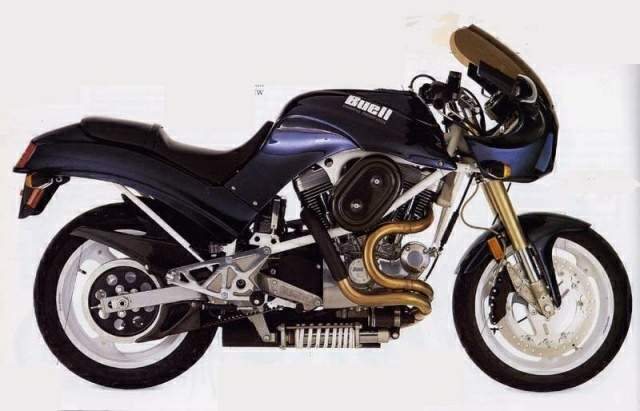
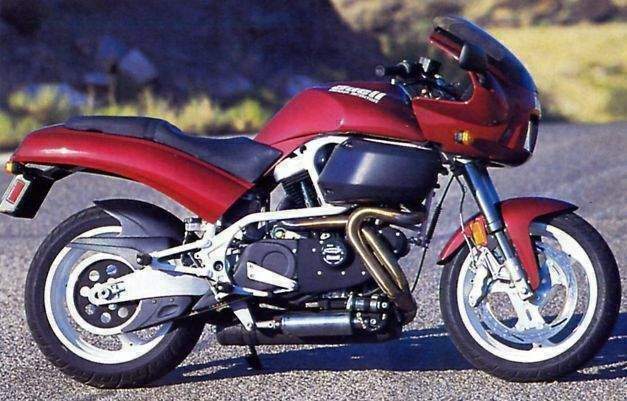
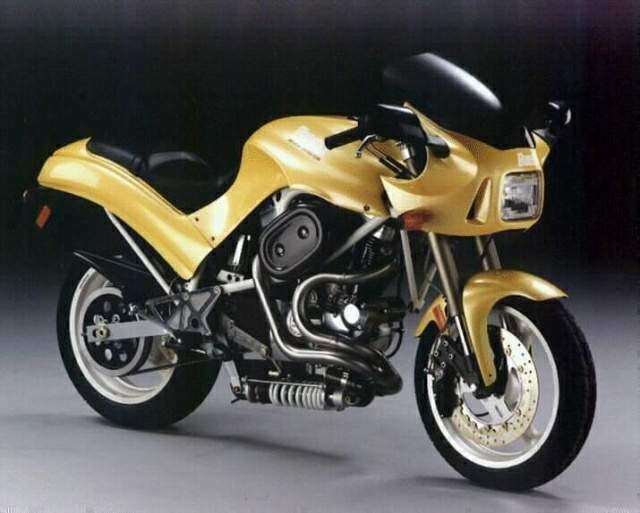
Buell S2 Thunderbolt
In 1993 Harley-Davidson became almost-half owner of the Buell Motorcycle Company. Milwaukee, in a refreshing bit of candor, admitted its specialized factory sport bikes had achieved little success. Better to assist someone well-suited to the design, chassis and assembly requirements of those machines, with Harley-Davidson acting only as the engine supplier.
The timing was right. Buell was under-capitalized, Harley needed a sport bike and an investment opportunity. In 1994 the Thunderbolt was the first product of the new partnership between Milwaukee and MukWonago. The chassis' wheel-base and steering geometry were unchanged, but the new design left more of both the engine and frame visible. The riding position became something of a compromise between the racer's crouch and the cruiser's slouch.
The Thunderbolt bristles with tasty techno-pieces, from the frame and engine mounts, huge disc brake with 6-piston caliper, inverted fork, to the subverted shock absorber and carbon-fiber air cleaner cover. The oversize muffler permits some tweaking of the 1200 Sportster's performance profile, and the horsepower rating bumps up to 76 at 5,200 rpm, with exactly matching figures for torque. The curb weight is 481 pounds (218kg). The production schedule was set for 300 Thunderbolts in its debut year. In 1996 the S2T was introduced with color coordinated saddlebags and fairing lowers, with touring handlebars and footpegs. Another example of Harley-Davidson's support showed in the prices; the S2 listed for $11,995 and the touring model for $12,795, well in line with the competition.
|
|
|
Any corrections or more information on these motorcycles will be kindly appreciated. |