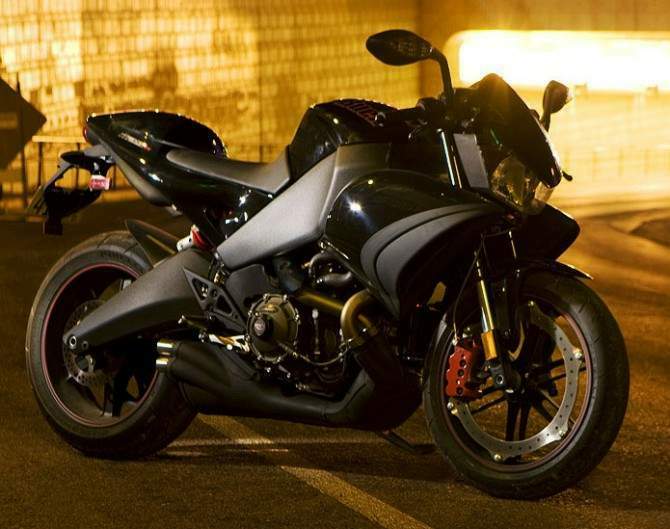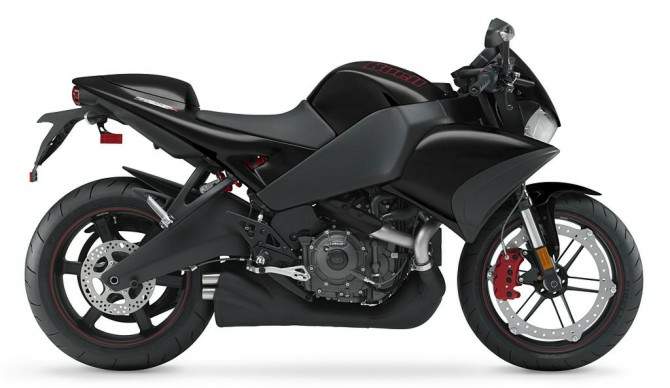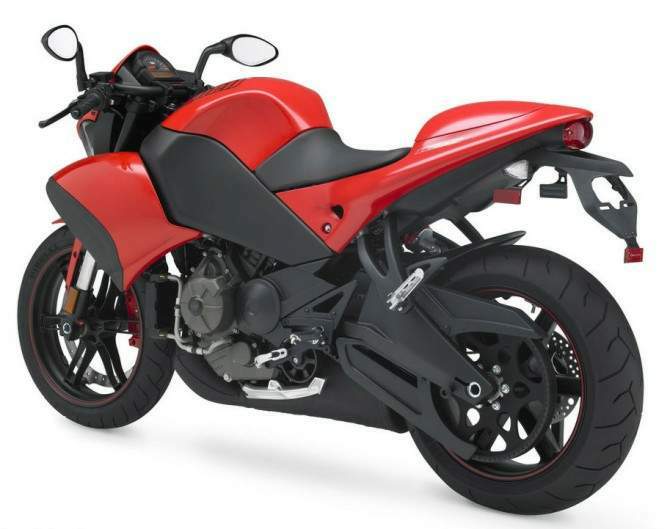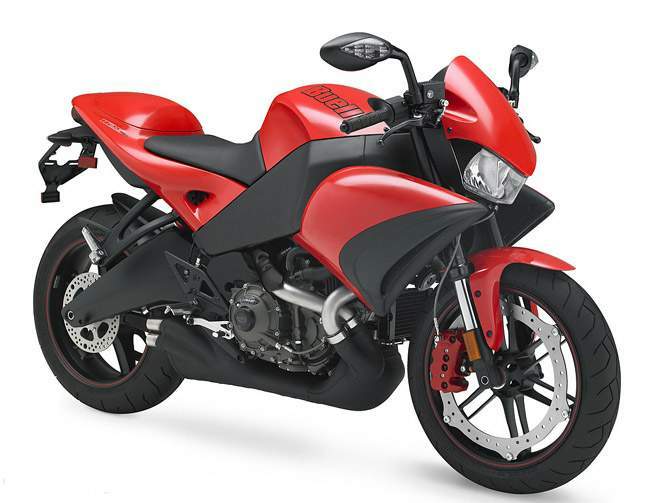
Buell Motorcycles got the jump on its foreign rivals
unveiling its 2009 superbikes, with the American company unveiling the new Buell
1125CR.
If you want the sweet and condensed version of what the new 1125CR is, look no
further than Buell chairman and chief technical officer, Eric Buell, who says of
the new 2009 design:
"Part superbike and part streetfighter, the 1125CR is my vision of a 21st
century Café racer. It's got Clubman-style bars and a flyscreen instead of a
fairing. Then we geared it down to optimize acceleration. With a class-leading
weight-to-horsepower ratio, the 1125CR takes streetfighter performance to a new
level."
The new machine incorporates the same liquid-cooled 1125cc Buell Helicon V-Twin
powering its superbike kin - the 1125R. Internally, however, the engine (in both
machines) has been tweaked for '09 with "targeted fuel injectors, relocated O2
sensors and updated engine spark and fuel maps."
Buell claims the engine mods improve sub-6000rpm performance, with better
throttle response, fuel economy and heat management. (The new spark and fuel
mapping will be available for 2008 1125Rs.)
As a Buell, the 1125CR features all the usual Buell-esque engineering i.e. the
underslung muffler, fuel-in-frame chassis (5.3 gallons in the Buell Intuitive
Response Chassis), and the ZTL2 (Zero Torsional Load) front brakes. The new
Buell also features fully-adjustable Showa components, a 47mm fork and rear
shock absorber.
From a visual standpoint, the CR is easier on the eyes than its R sibling. With
a pared down front end from the windscreen and narrower headlamp pod, the CR
looks sleeker. Available in the same black scheme as the R, the CR looks quite
fetching in red.
Buell 1125CR highlights
(Courtesy of Buell)
- Buell Helicon 1125cc liquid-cooled, four-stroke 72-degree V-Twin engine
- 146 peak hp @ 9800 rpm
- 82 ft. lbs. peak torque at 8000 rpm
- 76/27 final drive gearing optimized for acceleration
- Underslung muffler with Helmholtz chamber
- DDFI 3 Electronic Fuel Injection ECM
- Ram-air pressurized air box
- Twin side-mount radiators
- HVA (Hydraulic Vacuum Assist) Slipper Action clutch
- ZTL2 four-pad, eight-piston front brake
- Fully adjustable 47 mm Showa inverted fork
- Fully adjustable Showa rear shock absorber
- Fuel-in Frame 5.3-gallon capacity
- Dry Weight: 375 pounds
- Wheelbase: 54.5 inches
- Seat height: 30.5 inches
- Pirelli Diablo Corsa III tires
- Pre-Wired for Accessory Heated Grips
The 1125CR’s chunky, muscular styling oozes
testosterone, but this certainly isn’t a beautiful looking bike. The riding
position reminds you of older Ducati Monsters, the spacious saddle lets you move
around a bit till you find a position that’s comfortable for you, and the clutch
and brake levers are adjustable.
On the move, the Buell 1125CR feels unexpectedly docile. At least in the
beginning. But open up that throttle and you feel a direct connection between
the accelerator and the rear wheel. And the six-speed gearbox is quiet, precise
and quick.
The 1125CR can be hustled around corners pretty quickly. The bike’s aluminum
perimeter frame, which also doubles as a fuel tank, mated to a 47mm USD fork at
the front and monoshock at the back, works well. The Pirelli Diablo Corsa III
tyres are excellent, and the 375mm single brake disc at the front, with its
eight-piston calipers, is quite capable of hauling up the Buell in a hurry.
With its rather extreme steering geometry, the 1125CR is very agile and changes
direction in a snap. But the surprising bit is that it also manages to remain
stable at elevated speeds and remains planted in high-speed corners. The
suspension, however, may benefit from some recalibration – the bike tends to hop
around a bit when the roads get rough.
BMW K1300R vs Buell 1125CR
This isn’t, perhaps, the most awaited sportsbike
shootout ever. We doubt if too many BMW loyalists would ever leave their beloved
Bavarian machines and switch over to Buell, while fans of the all-American Buell
aren’t very likely to ever defect to the BMW camp. Still, Motociclismo recently
had the opportunity to pit the K1300R against the 1125CR, and here’s what they
have to say about how the two bikes stack up against each other:
The technology that’s gone into these two bikes is as unconventional as their
styling. The 176bhp K1300R uses shaft drive, the 146bhp 1125CR uses belt drive.
The BMW uses Duolever front suspension, which you won’t find on any other bike,
while the Buell’s perimeter disc braking system at the front wheel entails the
use of a single disc – unlike all other large-displacement sportsbikes, all of
which use twin disc set-ups at the front.
The BMW is the better bike for riding in the city, thanks to its anti-lock
brakes (ABS) and optional traction control – things which provide a lot of
reassurance during hard braking and acceleration. The riding position is pretty
comfortable too, though your shin will often hit the BMW’s engine casing on the
right hand side, when you put your feet down while coming to a complete stop.
Riding the Buell in the city gets tiring within a few kilometres – the high
footpegs, and the shape and the positioning of the handlebar sees to that. But
while it affects low speed comfort, the 1125CR’s sports-oriented riding position
is perfect for high speed cornering.
Another thing that goes against the Buell is its brakes, which work in a rather
abrupt fashion. Initially, the brakes don’t seem powerful enough at all and
then, when they suddenly bite, they can upset the bike somewhat.
Developed by Rotax, the Buell’s v-twin is one of the most pleasant twin-cylinder
engines current available in the market. Low-rpm torque delivery makes the bike
very rideable at low speeds and the linear power delivery means the bike picks
up speed smoothly and consistently.
The BMW’s four-cylinder engine is also much improved over its predecessor – it
feels significantly more powerful, the roughness has disappeared and power
delivery has been smoothened out very well. On the highway, the K1300R offers
better wind protection than the 1125CR and feels more planted, more stable,
while the Buell feels more nimble and responsive.
When it comes to high speed cornering, the Buell outshines the BMW. The K1300R
isn’t bad – in fact it’s quite good considering it’s size and weight – but the
Buell is in a different league. The Buell’s braking characteristics and
suspension set-up are just more conducive to letting the rider push harder in
the corners, and the bike is more supple and responsive in the bends than the
BMW.
So there you are – most of the important questions regarding the two bikes’
behaviour have been answered. But, somehow, we doubt if too many BMW or Buell
buyers were actually waiting for this shoot-out in order to decide which bike
they want. No, they've made up their minds already...
NOTE: Some of the photos on
Motorcycle Specs are owned by somebody. If you see any of your
photos, you can let me know so that I can acknowledge it, or if
you object to it, I can remove it altogether. If any copyright
holder objects to their articles being placed on Motorcycle
Specs, it will be removed upon request. Any correction or more
info on these bikes will kindly beappreciated
Contact MePrivacy
Policy
Website Stats