The motorcycle that redefines the
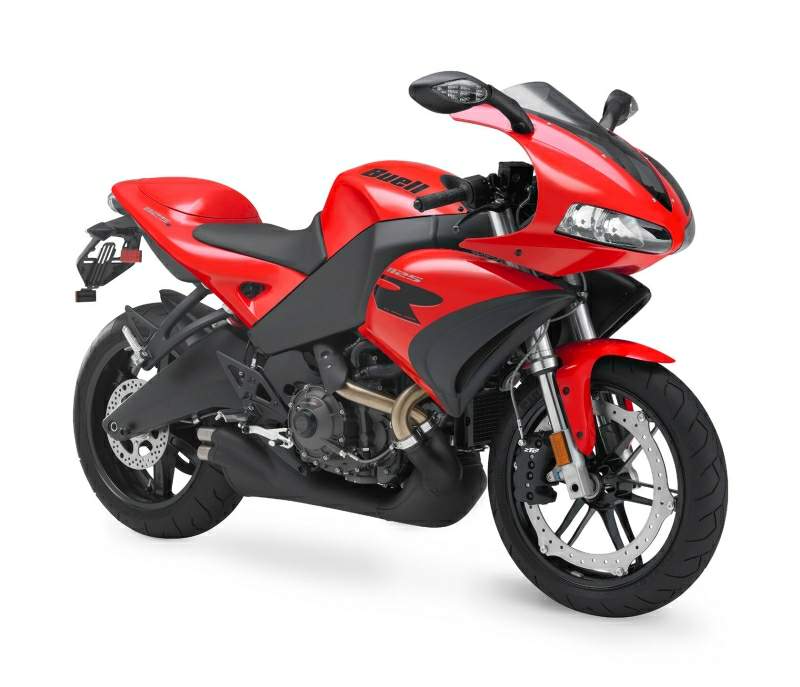
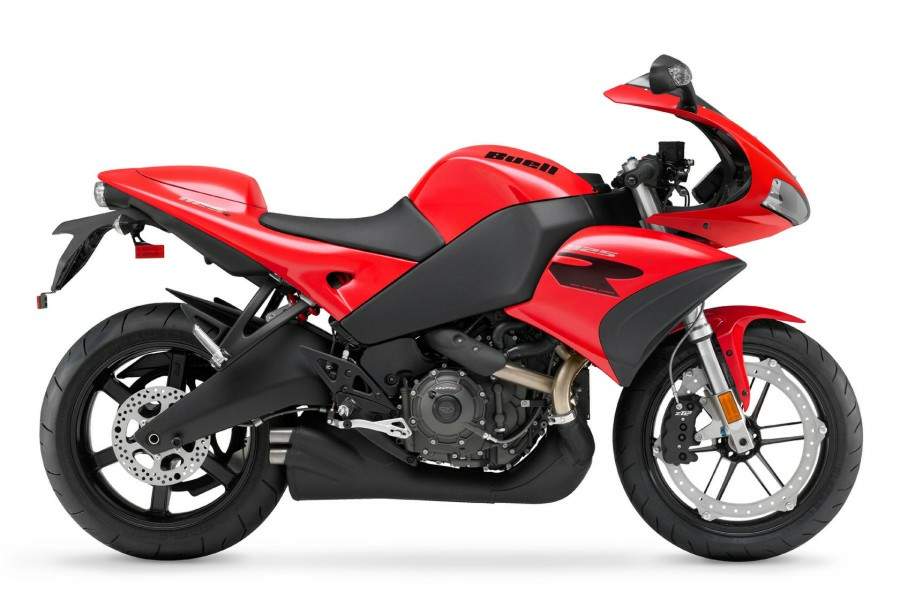
superbike category the 2009/10 Buell 1125R is powered by the 1125 cc
liquid-cooled 72-degree V-Twin Helicon engine generating 146 crank hp and 82 ft.
lbs. of peak torque. With a foundation built on the core Buell Trilogy of
Technology creating optimum performance, the 1125R remains true to Buell’s
original sense of sportbike style and design.
New for 2009/10 on the 1125R and 1125CR models are targeted fuel injectors,
relocated O2 sensors, and updated engine spark and fuel maps. The combination of
these features offers improved drivability below 6000 rpm, even crisper throttle
response, improved heat management, and significantly improved fuel economy. The
updated engine spark and fuel maps will also be made available for 2008 1125R
models.
A new gear position readout is added to the digital display on the instrument
panel as a scroll-to feature. A high-output alternator has increased capacity
for accessory use. Slider bobbins have been added to the swingarm for protection
and easy use of a rear stand.
The front wheel rides on fully adjustable Showa 47 mm upside-down forks, while
the Buell ZTL2 front brake has an eight-piston caliper. A smooth-shifting
six-speed transmission works with a HVA (Hydraulic Vacuum Assist) slipper-action
clutch that uses engine vacuum for easy clutch-lever action and reduced engine
braking during downshifts.
Quiet Zone aerodynamics optimize air flow around the rider for enhanced race
performance and rider comfort. The fairing shape was developed using
Computational Fluid Dynamics (CFD) analysis, and features six-bulb headlamps,
while LED turn signals are integrated into the mirror housings.
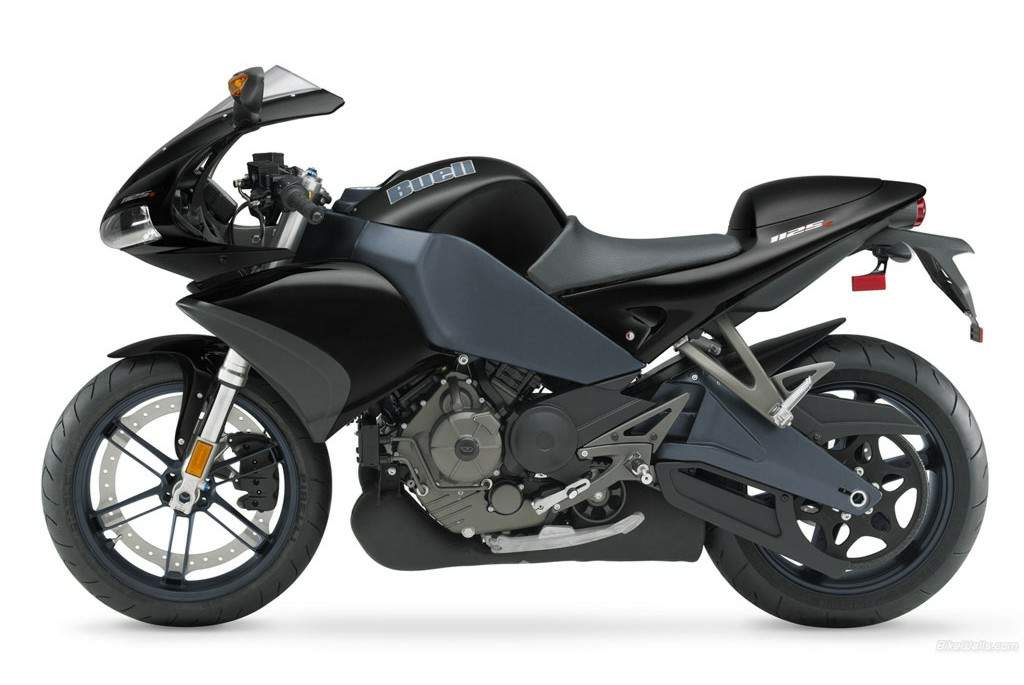
The 1125R is restyled for 2009/10 with new blacked-out chassis components, and
is offered in Midnight Black and new Racing Red with Phantom Metallic (Black)
wheels, and Arctic White with Hero Blue translucent wheels. Production of the
2009/10 1125R is scheduled to begin in late September 2008.
Buell 1125R highlights
Buell Helicon 1125 cc liquid-cooled four-stroke, 72-degree V-Twin engine
146 peak hp @ 9800 rpm
82 ft. lbs. peak torque at 8000 rpm
New Phantom Metallic frame and swingarm with blacked-out footpeg mounts and heel
guards
New tinted windscreen, Hero Blue with Arctic White bodywork and Smoked with
Racing Red and Midnight Black
New gear position readout on the instrument cluster
New high output alternator increases capacity for accessory use
New slider bobbins on swingarm for protection and use of rear stand
Underslung muffler with Helmholtz chamber
DDFI 3 Electronic Fuel Injection ECM
New targeted fuel injectors
Ram-air pressurized air box
Twin side-mount radiators
HVA (Hydraulic Vacuum Assist) Slipper Action clutch
ZTL2 four-pad, eight-piston front brake
Fully adjustable 47 mm Showa inverted fork
Fully adjustable Showa rear shock absorber
Fuel-in Frame 5.3-gallon capacity
Dry Weight: 375 pounds
Wheelbase: 54.6 inches
Seat height: 30.5 inches
Pirelli Diablo Corsa III tires
Pre-Wired for Accessory Heated Grips
Midnight Black, Arctic White or Racing Red bodywork
Road Test
Erik Buell has wanted to build a Buell sportsbike
from scratch for a number of years. When starting the 1125R project Erik first
went to the Motor Company to get a brand new engine built for a new sportsbike.
In the last few years Buell has managed to get Harley-Davidsons full and whole
support and funding is not a problem.
However, resources to build and develop a brand new liquid-cooled sports twin
was one task too much for Harley-Davidson as they are very busy with their own
engine projects. So in a meeting with Harley executives Erik Buell got the green
light to go shopping for an external development team to do the new Helicon
engine. For this type of engine BRP-Rotax is one of the leading manufacturers
and it was only natural that the experienced Austrian engineering firm got the
job. But with strict Buell instructions that details both internal and external
engine parts. All the new 1125R engines will be delivered by BRP-Rotax ready
assembled to the Buell factory in Wisconsin.
The 146bhp 72 degree V-twin will be produced exclusively for Buell motorcycles.
Erik Buell is Buell motorcycles without a doubt. His enthusiasm drives the
company forward in almost all levels of producing a motorcycle. Erik is hands on
from the smallest internal motor component to external design. We have been told
when questioning the design part of the project that Erik himself loves to
fiddle with the clay models of prototypes and the finished product is pretty
much by Erik’s own signature also on the external design part. Some may argue
that it is a mistake not outsourcing the external design. We may agree with the
sceptics here as there are no reason whatsoever why Buell 1125R couldn’t get the
aesthetics of any super exotic Italian superbike. After all, it’s only a front
fairing, rear end and some side panels that only an Italian designer could make
sexy enough for the European motorcycle aristocracy. Erik; I’ve got some names
for some excellent freelance designers for you.
Laguna Seca was Erik’s choice of venue for launching Buell’s biggest new effort
in the 25th Anniversary.
My first ever experience of the famous Californian track will forever be
associated with the Buell 1125R. What a great way to experience the Corkscrew
for the first time. This was Christmas for all of the attending motorcycle
journalists, me included.
-After waiting a couple of seconds to allow the
electronics to boot up and fuel injectors to load the 1125R’s intravenous food I
hit the starter button. The 1125R chugs along in the Laguna Paddock much like an
Aprilia RSV1000R on idle, but with a tad more authority due to the extra
125cc’s. After a couple of warm up laps I’m ready to do business on Laguna Seca.
Most of my laps over turn one which in reality is part of the start/finish
straight was done in fourth gear. However I did click up into fifth on a couple
of laps. Never mind the Corkscrew, doing full throttle in fifth over the blind
turn one where I had to brush of all speed downhill and into the Andretti
hairpin was my single most thrilling moment at Laguna Seca.
I absolutely loved how the Buell 1125R felt going over turn one in a fashion
that felt suicidal at first and rewarding in the end utilizing the powerful
8-piston caliper on the rim-mounted brake disc to slow me down. To gain
stability on the front during heavy braking Buell have chosen a 47mm front fork
rather than the 43mm we find on several other Buell motorcycles. Jeremy
McWilliams input was important here, but Buell did not want to add a steering
damper.
There are some movements over the front but very small and they don’t disturb
the handling much really. However, with a steering damper in place the ride
would have been less physical and easier on the arms at the very least.
Through the Andretti hairpin accelerating hard out in second gear I’m at turn
three that’s done in second gear followed by a short straight where I preferred
to keep third gear through the very fast turn four onto a slightly longer
straight before braking hard from fourth gear into turn five. This is the place
where I got the best feel for the new slipper clutch that worked without a
glitch during the whole day.
Turn five is my least favourite corner on the track and then uphill through turn
six and onto the uphill Rahal straight. This and the start/finish straight are
the two places at Laguna which reward horsepower as the Rahal straight is the
steep uphill section leading me into the famous Corkscrew. The big 72 degree
V-twin breaths freely and utilizes all its massive but also smooth torque up the
hills. I never had a single moment going on the throttle out of corners which
speaks of a well balanced torque curve.
With good drive from lower rpms the 1125R never feels underpowered, but it’s
from 9.000rpms that the real sports element shines through with quite hard
acceleration. What vibrates and not on high rpms I’ll talk more about on the
road test part.
The Corkscrew is probably even more famous than Craner Curves at Donington and
now I finally know why. At first the 1125R felt too soft when going through the
steep left-right downhill section called the Corkscrew. The right-hander leading
down towards the Rainey corner is hard on the suspension and requires quite a
hard set-up for such a slow section of the track (Corkscrew). Flicking the 1125R
from sharp left down to sharp right almost feels like landing after a small
jump! Then I shouted “yeeha” inside my helmet in the same fashion as you do on a
roller-coaster ride. I did the flick in the middle of second gear most of the
time where the throttle can be opened fully immediately after flicking to the
right. The Rainey corner is also a pretty exciting place to go fast on the Buell
1125R which by now has manifested itself to be a very nimble sportsbike with a
big engine! Third gear is good through the banked left-hander down to second for
turn ten. Towards the left-hander turn eleven that leads onto the start/finish
straight I felt that the 1125R could have been geared even lower to utilize
third gear better as I was stuck on the limit on second a couple of times before
braking for turn eleven.
Short-shifting is fine on the 1125R, but acceleration is great from 9.000 rpms
where you’d want to be for a fast lap.
Onto the start/finish straight that is almost 1.000 metres I didn’t feel that I
could tuck properly into the “quiet zone” as Buell calls it. It is mostly due to
my butt not having enough space to push backwards to tuck properly in behind the
wind-screen. On a Yamaha R1 or Suzuki GSX-R1000 you have enough space to push
weight forwards or backwards which is lacking a bit on the short Buell 1125R. A
different design to the single seat cover or rear part of the seat would have
solved the problem for a 6-footer like me.
At no point on Laguna Seca can you call the 1125R wheelie-prone. It speaks of
some great handling abilities as the wheelbase is a very short 1384mm. But with
a little help (throttle off-on) the 1125R power wheelies easily in second.
That’s a good thing really as I have always felt that belt-drive is a tad
flexible for clutch ups.
The newly designed belt is super strong though and can take some serious abuse.
Should it ever snap you could always use some super-glue to get it all back
together (Don’t do that by the way…) Belt-drive is perfectly maintenance free
and much lighter than a chain. The only reason why you would want a chain
instead is to be able to change the gearing more easily. Not much else, in terms
of horsepower loss Buell has assured us that there’s virtually nothing in it.
The claimed 146bhp transforms to about 135 rear-wheel horsepower according to
Buell’s Dyno. That is a respectable figure on a V-twin, but I struggled to get
the feel of all that power and wish I had some proof. It shouldn’t be grounds
for any doubt as both Buell and Rotax knows what they are doing, but it could be
that the smooth torque curve hides the beast a bit so to say. -Should be good
for the road part of our test.
The Pirelli Diablo Corsa III sport tyres that are standard on the 1125R worked
fine around Laguna Seca. However, I missed some more sense of feel through the
suspension. Usually these tyres provide lots of feedback and inspire confidence,
but through the fairly stiff Buell chassis I could have wished for more tyre
feedback. Some riders complained about tyre issues and at one point one of the
rear tyres were way too hot when stopped in the paddock after a few laps. That
doesn’t contribute much to neither feel nor traction.
The 8-piston or Octal as I have called the new front brake is supremely
powerful, but once again I didn’t get the same perfect feel that I remember from
the 07 Suzuki GSX-R1000 and Yamaha R1. Quite often I applied the brakes a little
bit too early as a direct cause.
The steep knee angle is the one ergonomically feature that speaks against the
1125R as a roadbike the most. On the track it felt pretty much perfect with
quite a relaxed handlebar position for a sportsbike. But the knee angle is
fairly steep with high footpegs.
In California the Police are all-powerful and not very lenient towards minor
offences like speeding.
Everywhere there are double yellow lines and ridiculously low speed limits such
as 35-45 many places on the Pacific Highway (Highway 1). But as usual,
journalists risks it all testing new motorcycles even though the consequences
are grave in the US. We had an absolutely beautiful 196 mile route to ride in
the mountains and along the coastal highway. Chugging along after tourists doing
30 miles per hour or less for a great length of time on a sportsbike could drive
anyone insane, so we crossed the double yellows and fancied our chances. Rather
die by the sword than by boredom?
Through the Carmel Valley we rode some beautiful sweeping corners perfect for
the Buell 1125R before it got tighter. As long as the engine speed is above
4.000 rpm it’s all bliss and happy riding. Through villages and towns where rpms
sink below 4.000 rpms I didn’t like the throttle response at all. It got a bit
unpredictable and on a modern V-twin anno 2008 this should have been sorted.
All the test bikes were pre-production models and there is still time for Buell
to smoothen things out, but whether it’s the engine management or the new DPPI
fuel injection that causes low speed issues I’m not sure.
With an abundance of torque on tap from the big twin I spent a lot of time
riding the midrange between 4-8.000rpms. The engine is very flexible in the
midrange and as long as the rpms can be kept above 4.000rpms it’s all very
smooth and predictable as it should be on a roadbike. The engine has been tuned
this way as this is what Buell says its customers say that they want. I believe
Buell on this one and it makes it a lot easier to get used to the extra power if
you come from an air-cooled Buell.
The six-speed gearbox was a big positive surprise and very easy to use with
light and precise action. Only once did the rear wheel protest on a downshift
from second to first when the tyre was cold. Other than that the slipper clutch
always worked perfectly making downshifts very safe with moderate engine
braking.
I already knew that the 1125R is very fast from the day at Laguna Seca so I was
more interested in how the slow-speed manoeuvrability was on the road. The turn
radius is very good along with a perfectly balanced chassis. The chassis still
features Buell trademarks such as fuel in the frame.
More than 20 litres in the 1125R frame with thinner, stronger and lighter walls.
But on Buell’s first ever liquid-cooled production motorcycle the oil sump has
been moved from the swinging-arm and incorporated in the new Helicon engine to
keep oil-pressure optimum in all situations. For the first time, Buell is now
supplied with frames from an American company just down the road from the Buell
factory in East Troy.
After reaching Greenfield we did a few motorway miles until we entered the roads
around Fort Hunter-Liggett. Overtaking on the motorway can be done in all gears
including sixth, but I did prefer to get down to fourth a few times for stronger
acceleration. The mirrors on the 1125R are wide enough, but still they vibrate a
lot. Even on lower rpms they vibrate, but above 9.000rpm they shake almost
violently. Hence pretty much useless if you’re not into Blur (cheap, I know…)
We entered a high security military area where the roads suddenly disappeared to
become no wider than a cycle route. The hairpins released each other and if on
full lean the rider would cover the whole road.
Not good for traffic coming in the opposite lane whatever that was. One rider
did go down on this route and I decided to slow down before it got out of hand
in the name of self preservation.
Reaching the famous Highway 1, also called the Pacific highway the roads
widened. This road really would have been perfect for the Buell 1125R had it not
been for all the tourists. My legs did catch some serious heat from the engine
riding in 30-45mph and it was not very pleasant. Slightly roasted, but having
enjoyed a very beautiful day I arrived back at Laguna Seca where the road route
had started.
Conclusion:
Laguna Seca baby! Needless to say that track left me with a huge impression. The
all-new liquid-cooled Buell 1125R launch gave me the generous opportunity to
both ride the famous track and test the new flagship Buell model. What an
amazing privilege it was! Even though the Buell 1125R is made more for the road
than the track I still liked it much more on Laguna Seca than on the road. On
the track there were no issues with unpredictable low rpm responses, roasting of
my legs or vibrating mirrors. I’d go and ride the 1125R on track any day again.
For the road part I found a few issues that Buell hopefully have got time to
address before the great new bike goes into production this autumn. The engine
response below 4.000rpms is one whilst excessive heat to the legs and vibrating
mirrors are others. Still, it was a great experience riding the 1125R also on
the road, just not as great as on Laguna Seca. Happy 25th to Buell and welcome
to the 21st Century with an all new high tech liquid-cooled engine!
+
Buell joins liquid-cooled manufacturers with a powerful 1125cc V-twin
Handling both on track and on the road
Maintenance friendly (Major service @ 20.000 and 40.000 miles + belt-drive…)
Big fuel capacity (sportsbikes with 20+ litre fuel capacity are rare…)
-
Unpredictable throttle response below 4.000 rpms
Engine heat by feet
Vibrating mirrors
NOTE: Some of the photos on
Motorcycle Specs are owned by somebody. If you see any of your
photos, you can let me know so that I can acknowledge it, or if
you object to it, I can remove it altogether. If any copyright
holder objects to their articles being placed on Motorcycle
Specs, it will be removed upon request. Any correction or more
info on these bikes will kindly beappreciated
Contact MePrivacy
Policy
Website Stats