|
|
|
|
Classic Bikes
Custom Bikes
Individual
Racing Bikes AJP
AJS
Aprilia
Ariel
Avinton / Wakan
Bajaj
Benelli
Beta
Bimota
BMW
Brough Superior
BRP Cam-Am
BSA
Buell / EBR
Bullit
Bultaco
Cagiva
Campagna
CCM
CF Moto
Combat Motors
Derbi
Deus
Ducati
Excelsior
Fantic
GASGAS
Ghezzi Brian
Gilera
GIMA
Harley Davidson
Hero
Highland
Honda
Horex
Husaberg
Husqvarna
Hyosung
Indian
Jawa
Kawasaki
KTM
KYMCO
Laverda
Lazareth
Magni
Maico
Mash
Matchless
Mondial
Moto Guzzi
Moto Morini
MV Agusta
MZ / MuZ
NCR
Norton
NSU
Paton
Peugeot
Piaggio
Revival Cycles
Roland Sands
Royal Enfield
Sachs
Sherco
Sunbeam
Suzuki
SWM
SYM
Triumph
TVS
Ural
Velocette
Vespa
Victory
Vincent
VOR
Voxan
Vyrus
Walt Siegl
Walz
Wrenchmonkees
Wunderlich
XTR / Radical
Yamaha
Zero
Video
Technical
Manufacturer List Contact
|
Bimota YB9 SR
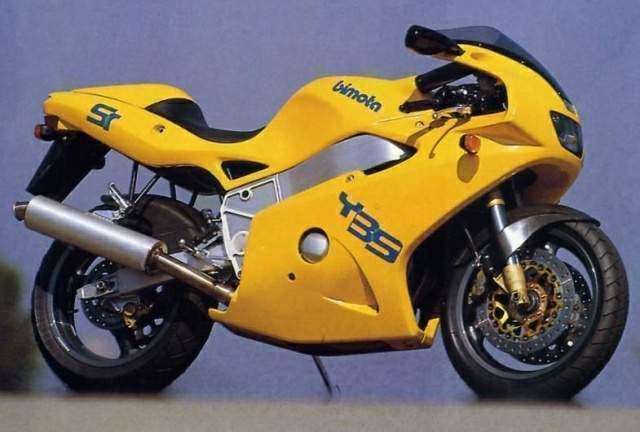
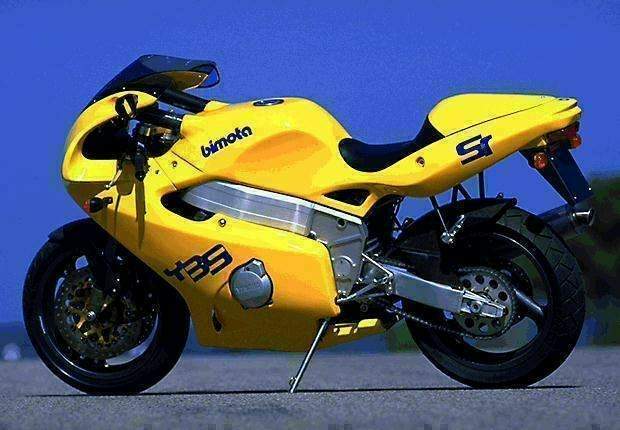
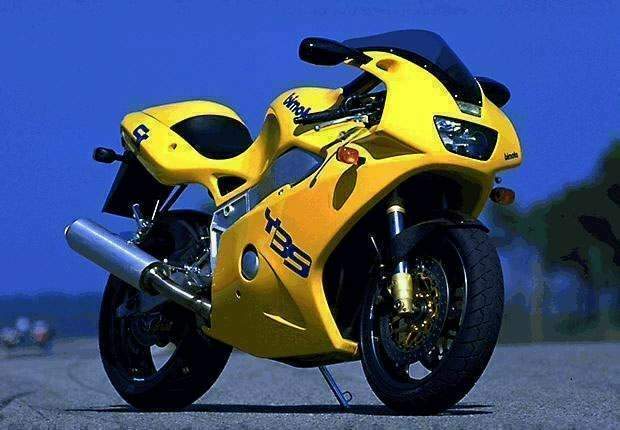
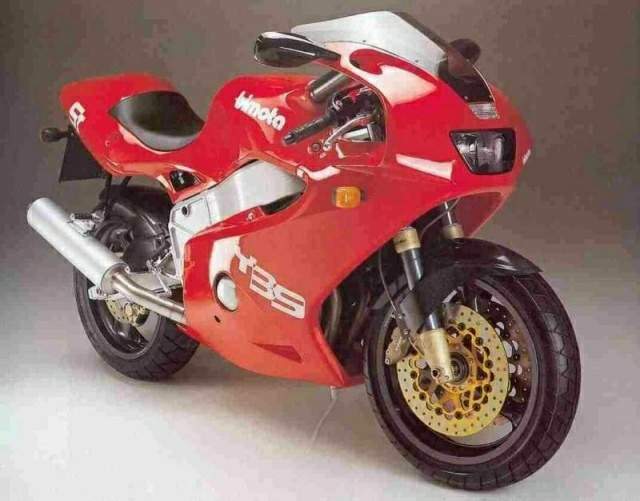
Then they went and made it even better, in the shape of the Thundercat engined YB9sri, which featured a fuel injected, wailing banshee of a motor. Just one slight problem. The YB9 cost around £13,000. Oh well, back to the Superdream 250 and the lottery scratch card wasn't quite the introduction I'd intended. On arriving at Bimota's launch in the south of France, I'd planned to start the day by taking a bike I was already familiar with for a few fairly gentle exploratory laps, before attacking the twisty, Armco-lined and slightly intimidating Le Luc circuit in full go-for-it track-testing mode on the new YB9 SR, the one model present that I'd not yet ridden.
But things didn't work out quite like that. Instead, I turned up to find that one of the two YB9s that Bimota had brought had been written off in a crash the day before. And that my first short session on the sole survivor was right now, with no time for a warm-up and no guarantee that the little yellow machine would still be in one piece when my turn came round again later in the day. If I felt under a bit of pressure shortly afterwards, as I snapped my dark visor shut, knocked the YB9 into gear and accelerated down the pit-lane, then it didn't take Bimota's newest star long to blow any worries clear out of my mind. A few minutes later I was winding the throttle back to the stop out of a long right-hander, snicking into fourth gear on the next short straight, and then holding the YB9 flat-out through the following curve engine revving crisply, horizon tilted severely, right knee planted on the ground and the Speedo indicating just over 100mph.If that sounds like a tiresome tale of bravado, then precisely the opposite is intended. Far from enjoying pushing my luck on dangerous and unfamiliar racetracks, I‚have always treated places like Le Luc with a caution deserving of a thick YB9-coloured streak up the back of my leathers. Yet the Bimota inspired such instant and total faith in its reserves of handling ability, grip and ground clearance that this high-speed attack on a bike I'd barely met wasn't a big deal in the slightest. Such refined racetrack behavior was to be expected, given that this Bimota, powered by Yamaha's latest FZR600 motor, is a development of the old FZR-engined Bellaria model (which was also designated the YB9). Although designed as a two-seater and rather soft and gentle by Bimota standards, the Bellaria was still ruff 'n tuff enough to win two Italian supersport titles in the hands of the Rimini firm‚s development rider Gianluca Galasso. The SR shares the Bellaria's familiar twin-spar alloy frame design, which can be traced back all the way to Virginio Ferrari's 1987 world Formula One championship-winning YB4, but almost every other component is new. Even the frame has not escaped attention completely, its steering head angle having been steepened slightly to give rake and trail figures of 24 degrees and 93mm. The steel rear sub frame has also been modified, and is claimed to be both lighter and stiffer. Suspension is totally new. Bimota's familiar milled alloy yokes hold 41mm Paioli forks whose sliders are also machined from solid billet, rather than cast, for extra strength. All compression damping is handled by the left leg and all rebound by the right, which increases hydraulic efficiency although it inevitably introduces twisting forces into the system. The carbon-fibre front mudguard is built extra-thick in the middle, to add rigidity by acting as a brace. Another novel front-end feature is the floating bearing in each fork leg. These bearings can move backwards and forwards up to 0.7 degrees, theoretically improving the fit between stanchion and slider under the inevitable flex that occurs particularly under hard braking. Bimota is resigned to using telescopics rather than its own Tesi front end for the immediate future, but in the meantime is making every effort to minimise the system's inherent drawbacks. Rear suspension is also by Paioli, and works a new alloy swing-arm that is slightly shorter than the Bellaria's as well as being stiffer and lighter. Wheelbase is adjustable by 15mm (ride-height can also be fine-tuned by adjusting the shock length by up to 5mm), and is nominally just 1380mm, 35mm shorter than that of the standard FZR600. The Bimota's 175kg dry weight figure gives a 9kg advantage over the standard Yam, too. Even by 600cc class standards, this is one seriously small and light motorbike. At 810mm its seat is quite high, and the footrests are very high, positioned to give unlimited cornering clearance at the expense of severely folded legs. There‚s a fair stretch forward to handlebars, which offer a certain amount of adjustability though not much because they're bolted below the top yoke, and the surrounding area is taken up not just with the fairing, but also with the air-ducts that lead back from its nose to the under-tank airbox. Those ducts help give the front-end a suitably mean look, and the whole bike is very smoothly shaped, in contrast to the rather slabby looking Bellaria. The tank-seat unit is a particularly neat piece of styling, especially in its dramatically waisted tail section. This bike is much less accommodating than the Bellaria, though it does have a thin pillion perch that can be bolted in place of the normal seat-hump. Bimota had use of Yamaha's new water-cooled motor almost before the FZR was in the showrooms, so somebody in Rimini must be pulling a few strings. (It's probably no coincidence that Bimota managing director Walter Martini was previously general manager of Italian Yam importers Belgarda). The 16-valve lump is totally unmodified, though its Keihins are rejetted to suit a new airbox and four-into-one exhaust system. Bimota originally claimed this had given the prototype a few extra horses, but the production YB9‚s claimed peak output of 100bhp at 11,500rpm is identical to that of the stock FZR. So too is the delivery all the way through the range. Like many a 600cc four, the Yam motor thrives on being caned to within a gnat‚s of its redline but at low revs is as flat as last night's half-finished bottle of Lambrusco.
You can pull away gently yet cleanly with just 3000rpm showing on the tacho (clocks are also borrowed from the FZR). But acceleration is mediocre even from twice that engine speed, and for serious progress the needle must stay above eight grand. Not that this was a problem at Le Luc, where the Bimota's light throttle, slick gear change and impressive smoothness made keeping the motor on the boil both easy and enjoyable. Trickiest part of the track was a left-right-left sequence followed by a long and slightly downhill right-hander. Happily the Bimota would just about pull all the way through in one gear, leaving the pilot to concentrate on grip and steering. Then it was throttle open and helmet behind the tinted screen to devour the fastest section of the circuit, in a vain attempt to reach the YB9's top speed of about 150mph. Even most Bimota pilots would doubtless be happy enough with that level of top-end performance, and with the right rider the Nine was the quickest bike around Le Luc's twists and turns. As with any 600, though, the lack of midrange overtaking punch would be much more tiresome on the road. Whether on road or racetrack, you could hardly fail to appreciate the YB9's lightness and brilliantly agile handling. Stability at speed goes almost without saying. The bike felt as solid as a lump of Provencal granite (ever tried putting in a tent-peg at nearby Paul Ricard?) both in a straight line and through the aforementioned flat-out right kink, which would have been much more of a test of bottle on any other 600 you could name. Steering was light, neutral and very precise, with the hands-down, bum-up riding position aiding control and putting plenty of weight over the front wheel. I was impressed with the forks, which were firm enough to keep brake dive to a minimum yet compliant enough for plenty of feedback (though I wouldn't particularly want to sample them in Dalston High Street). If there was the slightest twisting in the system due to the legs‚ opposing damping forces then I couldn't feel it, even when the familiar front-brake combination of four-piston Brembo calipers and 320mm drilled discs was used to the full. The Paioli shock also did a good job, keeping the back end under excellent control despite the forces being fed into it by the ultra-grippy 160/55-section rear Hi-Sport. Maybe the shock seemed a fraction soft through the slight dip coming out of the circuit's final slow right-hander, but that didn't feel like anything that a little adjustment couldn't cure. (Talking of adjustment, one hack was surprisingly critical of the YB9's handling before admitting he'd been trying to fine-tune the forks with the choke knob, set in Bimota's normal position on the top yoke. At least he hadn't slagged the motor for running too rich...)The only things I could seriously find to complain about, mediocre midrange apart, were the high footrests that made my legs ache after just 20 minutes. In a way, it's the radical riding position that best sums-up the YB9. In contrast to its predecessor the Bellaria, which ironically was arguably more comfortable than the standard Yam, this is a hard, fast, no-compromise sportster in traditional Bimota mould. The Rimini factory hasn't yet produced enough bikes to make it eligible for racing outside Italy, but when that happens it will almost certainly clean up. So it should, of course, considering that the market for Japanese 600s is so price-sensitive that most have steel frames and few fancy details. Bimota doesn't have the same concerns, but is making a big effort to keep prices down even so. At £9999 the YB9 costs half as much again as any mass-produced 600, but this is by far the cheapest Bimota. And maybe ten grand isn't so expensive for a hand-built machine that brings a new level of speed, style and exclusivity to middleweight motorcycling.
|
|
|
Any corrections or more information on these motorcycles will be kindly appreciated. |