|
|

|
|
|
|
Classic Bikes
Custom Bikes
Individual
Racing Bikes AJP
AJS
Aprilia
Ariel
Avinton / Wakan
Bajaj
Benelli
Beta
Bimota
BMW
Brough Superior
BRP Cam-Am
BSA
Buell / EBR
Bultaco
Cagiva
Campagna
CCM
CF Moto
Combat Motors
Derbi
Deus
Ducati
Excelsior
GASGAS
Ghezzi Brian
Gilera
GIMA
Harley Davidson
Hero
Highland
Honda
Horex
Husaberg
Husqvarna
Hyosung
Indian
Jawa
Kawasaki
KTM
KYMCO
Laverda
Lazareth
Magni
Maico
Mash
Matchless
Mondial
Moto Guzzi
Moto Morini
MV Agusta
MZ / MuZ
NCR
Norton
NSU
Paton
Peugeot
Piaggio
Revival Cycles
Roland Sands
Royal Enfield
Sachs
Sherco
Sunbeam
Suzuki
SWM
SYM
Triumph
TVS
Ural
Velocette
Vespa
Victory
Vincent
VOR
Voxan
Vyrus
Walt Siegl
Walz
Wrenchmonkees
Wunderlich
XTR / Radical
Yamaha
Zero
Video
Technical
Complete Manufacturer List
|
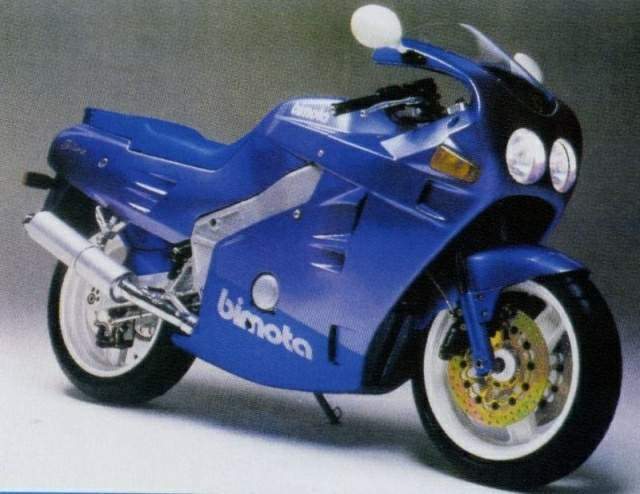
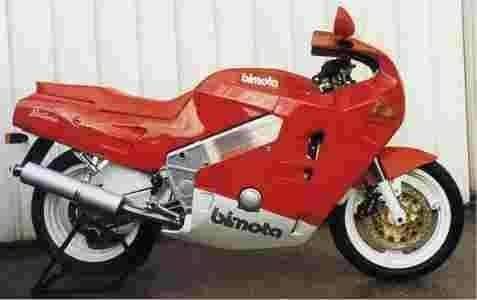
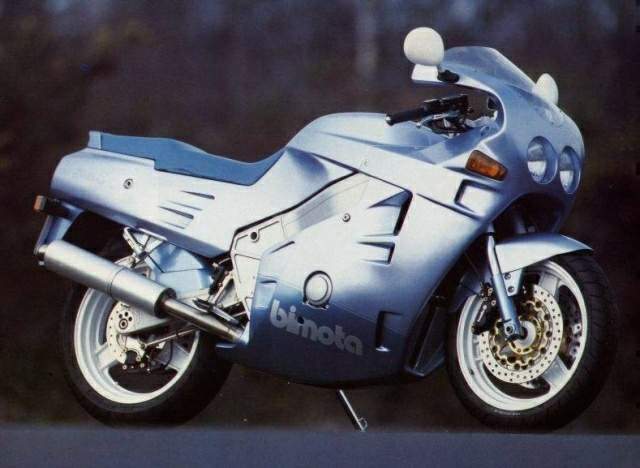
Bimota YB9 Bellaria
Bimota's first bicycle built for two is intended to be a sports-tourer supreme. A machine for blasting across sunny Alpine passes and for carving curves, for "wide spaces and the land of freedom, where the wonderful emotions of a couple are intensified". (Quoting from Bimota brochures is clichéd but sorry, I just can't help it...)Some chance. Mid-February in England meant storm-clouds on the horizon, gusts of icy wind swirling rubbish into the air, fingers numb inside thin gloves, watery sun showing very occasional bursts of interest, policemen much more keen to intervene. It says a lot for the Bellaria that the cops were just fascinated and that the bike had me enthralled despite the weather - though its sheer class really hit me only after I'd got off. With time short and rain forecast, we'd picked a particularly nasty roundabout to take photographs. Light on traffic but uncomfortably small, its lap-time of only 20-odd seconds means you can bash off a roll of film in minutes rather than hours - if the rider can stand the strain of constant concentration as he picks his way round the damp patches, tarmac seams and dead leaves while dragging limbs in suitably dramatic style. On many bikes its a real effort to keep going, your once-smooth course becoming increasingly ragged due to cramped legs, jarred wrists and the fight either to heave around some unwieldy brute or to point a flighty front-end in the right direction. The Bimota was no handful. Beautifully poised, supremely stable, it virtually plotted its own rapid but effortless course, the odd hollow brush of knee scraper on tarmac cutting in with a sound like that of skis in crisp snow above the busy whine of the engine. Such good manners had been expected. Much less predictable was the fact that after finishing 100-plus laps with barely a break, my legs and arms weren't aching and I could easily have carried on for more. The words "comfort" and "Bimota" have in the past been almost a contradiction in terms. The Bellaria, the company's first purpose-built two-seater and the first machine that designer Pierluigi Marconi can really call his own, changes that. Not only does the "Beautiful Air" feature a reasonably plush dual seat, complete with grab rail and not a tailpiece or piece of glued-on foam in sight, but other ergonomics have been subtly modified too. Bars are still clip-ons, of course, but they sit a few inches higher than the steering head. And the rider's footrests are set a little lower than on bigger Bim's, for a considerably more roomy riding position. If the Bellaria's pastel colouring suggests a softer approach after years of harder reds and greens, then that is doubtless what Marconi intended. It's ironic that the machine around whose engine all this is based, Yamaha's FZR600, is by far the most single-minded and uncomfortable of the Japanese bunch. With its racer like twin- headlamp fairing, butt-in-the-air riding position, afterthought pillion seat and a motor best suited to frantic cog-swapping, the stock FZR is indeed a motorcycle that could make two-up touring an emotional experience. But Signor Marconi loves a challenge, as he has shown in his enthusiasm for the Tesi. The Bellaria uses the standard 599cc 16-valve FZR motor, adding a few horsepower - from a claimed 90bhp to about 95 - by tweaking the bits on either side of it. The Yam's 32mm downdraught Mikunis breathe through a big airbox that is fed via scoops in the front of the all-enveloping bodywork, and the stock 4-1 pipe is replaced by a 4-2-1 of Bimota's own design. Absence of fuel injection and EXUP leave plenty of potential for midrange gains in the future; at the moment the serious power starts arriving at 7000rpm.The motor hangs from a traditional Bimota twin-spar chassis at the same 45-degree angle it takes up in the Yamaha.
The chassis similarities end right there. The Bellaria's frame is made from real alloy, unlike the Yamaha's painted steel, and its wheelbase is a mere 1375mm against the Yam's 1420mm. When you consider that even Bimota's own 750-powered YB4 has a wheelbase of 1400mm, and that Yamaha's tiny FZR400 is listed at 1407mm, you start to appreciate just how miniscule the Bellaria is. Other figures too suggest an ease of steering that becomes apparent on the move. Rake and trail are 22.5 degrees and 92mm respectively, the latter 2mm sharper than the cutthroat stock FZR figure. Dry weight, at 359lb, undercuts the Yamaha by 35lb despite the Bimota rarity of a hefty alloy rear sub frame carrying a pair of high-level pillion pegs. (Potential passengers should be warned that this is no Gold Wing: short legs, strong arms and stronger resolve are desirable.) Upside-down forks may be a high-tech selling point for the likes of Suzuki, and even Ducati, in some markets this year but by Bimota standards the high fashion of 1990 already seems almost old hat. Marconi has gone on record to say that this will be the last Bim he'll design with alloy-beam frame and conventional front suspension; let's hope the Tesi works out and he's right. In the meantime, the Bellaria wears a set of inverted teles from the house of Marzocchi. The GP men have been using upside-downers for some time now with great success and the advantage of having the thicker part of the leg at the top to take most strain, and the thinner bit down below as unsprung weight, is enough to make you wonder why forks were not designed this way in the first place. The Marzocchi's' only adjustment is a three-way compression damping knob at the top of each leg. But this pre-production Bellaria needed some slightly more drastic action because its front was too soft even on the highest setting, diving too much under braking and even bottoming out every so often, apparently due to the correct fork-oil level figure having been lost in the translation from the Italian. A little more would doubtless have helped, and at least the Marzocchi's gave none of the soft-forked standard FZR's misbehaviour under hard cornering, but more compression damping and possibly even a stiffer spring might be needed for heavyweight hooliganism - especially with a pillion on board. As it was, though, the Bellaria was well-behaved one-up even over fast and quite bumpy roads, once or twice flapping its front for an instant over 100mph-ish ripples before settling. In slower bends the bike was even more impressive, somehow absorbing minor road irregularities yet still giving plenty of feedback through the 17-inch front wheel. As a bonus, the soft front end and relatively high-barred riding position (everything's relative with Bimota) helped give wrists an easy time. It's to be hoped that those characteristics can be retained when the forks are tuned to become progressively much firmer. Front brakes are predictably wide 300mm discs gripped by four-piston Brembo calipers, backed up by a 230mm disc at the rear. The handlebar lever needed slightly more pressure than I'd expected but there was plenty of feel, and a firm pull unleashed poke a-plenty. Not that the chunky front Michelin Hi-Sport radial was ever troubled. The stock FZR's Dunlop's are harsh, and the rear lets go a little early under combat conditions. But even when assisted by a fistful of horses and well cranked over, I couldn't catch out the much more compliant radials for grip. Some of the credit for that goes to the rear Marzocchi, which with standard mid-way settings gave a mix of comfort and control that was just about right for my 14 stone. Adding a passenger is bound to wreck the feel of any bike, but the Bellaria at least has a remote compression damping adjuster with which the speed that the Marzocchi is compressed over bumps can be varied through 30 close-spaced positions. The dial is tucked up on the rear sub frame, opposite a similar knob for nine-way rebound damping and within reach if you don't mind a few streaks of chain-lube up your arm from groveling around inside the bodywork. Greater accessibility would be nice - and a remote preload adjuster, instead of the normal collar, would be more useful still for two-up travel. There again, perhaps it's as well not to give pillions too much encouragement to upset the ride...One thing that would definitely be handy when heavily loaded is a bit more midrange pull from the high-revving' four-pot motor, which Final Final Final Drives cleanly from down low but doesn't really start putting down power until seven grand. The Yamaha mill makes max power at 10,500rpm, redlines 2000rpm later and is happiest when being kept on the boil with plenty of right wrist and much stirring of the close-spaced six-speed gearbox.Not ideal characteristics for a sports-tourer, but then the Bellaria is only anything of the sort when compared to its more selfish single-seat sisters. An FZR1000-powered Bellaria would be sensational but at heart this bike is still a small- bore scratcher. By Bimota standards it is a delight around town - slim, soft and with surprisingly good steering lock. On the open road it has to make up with lightness, buzziness and impeccable steering what it loses to bigger bikes in out- and-out stomp. On top-end it will be good for not far short of 150mph, though the last few will necessitate getting well tucked-in behind the surprisingly protective bubble. Over-policed freeways are by no means the ideal place for speed-testing but I saw well over 200 flick up on the digital Speedo; customers who attempt a similar figure on their mph-calibrated units will probably be rewarded with either a severe pull or a rod through the crankcases. The electronic instrument console is a brave touch but looks a bit like the sort of thing electronics whiz kids used to wire up to their Z1000 Café-racers. Even bystanders who were dumbstruck by the Bellaria's sleek lavender-blue lines didn't like it, and to make matters worse the unit (admittedly pre- production) showed flashes of traditional Italian temperament more suited to that country's soccer fields, first misbehaving and then playing dead altogether. Worst of all, the digital Speedo proved harder to read at a glance than a simple dial even when it was working properly. And though water temp, mileage and fuel level are all displayed alongside, there is no room for even the most basic digital clock. At least the tacho, a flickering black bar along the top, is more readable, and other details are to Bimota's impeccable standard. Mirrors are wide and clear, switches are Yamaha and excellent, sculpting of alloy parts such as the headstock is predictably superb. Paint and fibreglass finish is as gorgeous as ever, too, though ham fisted attempts at fairing replacement had already put cracks around a couple of boltholes. No owner would commit such a crime, of course, simply because people in a position to lay out around well over ten grand on a 600cc bike are not the sort to waste time servicing - or even polishing - it themselves. Bimota customers have always been a breed apart, people who want the best and can pay for it, and it's a fair guess that few who choose the 600 will do so to reduce their insurance premiums. In a way it is almost bound to be a disappointment, this Bimota: all that money for a mere middleweight; all that unused chassis potential, capable of harnessing half as much horsepower again. But for those who want a small Bimota, a two-seat Bimota or who simply don't mind lashing out three times the cost of an FZR600 for a taste of middleweight motorcycling perfection, the Bellaria is something very special.
|
|
|
Any corrections or more information on these motorcycles will be kindly appreciated. |