|
|
|
|
Classic Bikes
Custom Bikes
Individual
Racing Bikes AJP
AJS
Aprilia
Ariel
Avinton / Wakan
Bajaj
Benelli
Beta
Bimota
BMW
Brough Superior
BRP Cam-Am
BSA
Buell / EBR
Bullit
Bultaco
Cagiva
Campagna
CCM
CF Moto
Combat Motors
Derbi
Deus
Ducati
Excelsior
Fantic
GASGAS
Ghezzi Brian
Gilera
GIMA
Harley Davidson
Hero
Highland
Honda
Horex
Husaberg
Husqvarna
Hyosung
Indian
Jawa
Kawasaki
KTM
KYMCO
Laverda
Lazareth
Magni
Maico
Mash
Matchless
Mondial
Moto Guzzi
Moto Morini
MV Agusta
MZ / MuZ
NCR
Norton
NSU
Paton
Peugeot
Piaggio
Revival Cycles
Roland Sands
Royal Enfield
Sachs
Sherco
Sunbeam
Suzuki
SWM
SYM
Triumph
TVS
Ural
Velocette
Vespa
Victory
Vincent
VOR
Voxan
Vyrus
Walt Siegl
Walz
Wrenchmonkees
Wunderlich
XTR / Radical
Yamaha
Zero
Video
Technical
Manufacturer List Contact
|
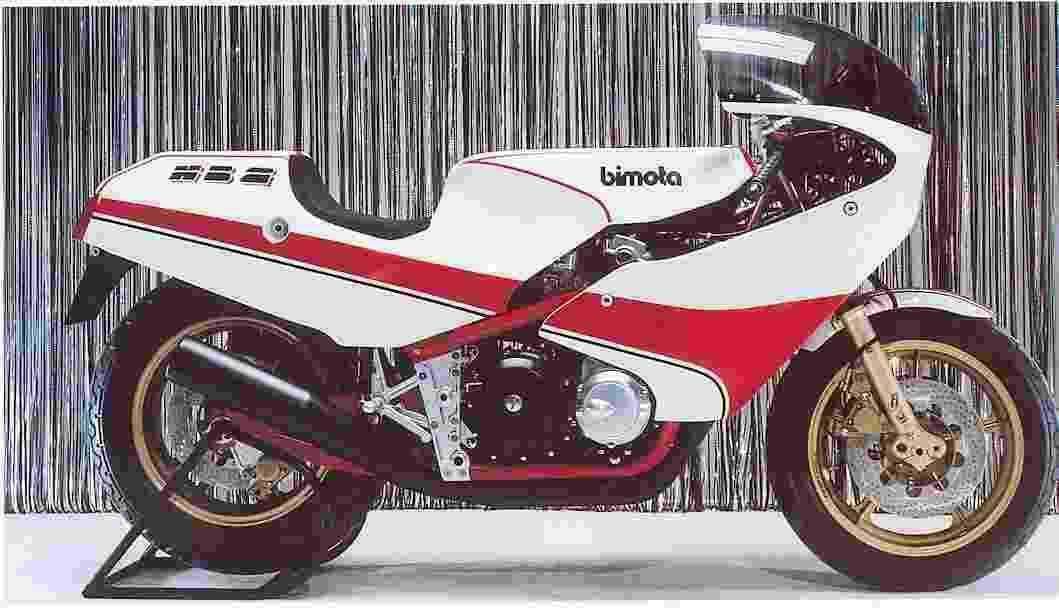
Bimota HB2
Bimota's exotic HB2. with its rounded half-fairing, one-piece tank-seat unit, aluminium frame sections and rising-rate rear suspension unit, seemed like a motorcycle from a different planet when it was launched in 1982. The sleek Italian superbike's Japanese rivals were mostly naked fours with steel frames and twin shocks. Even Honda's mighty CB1100R was almost old-fashioned by comparison. The HB2's initials stood for Honda Bimota, and its engine was the air-cooled, 90Icc twin-cam engine from the Japanese giant's CB900F. In Bimota style the 16-valve motor was left standard, complete with its bank of Keihin carbs and airbox, although some owners fitted larger flat-slide Mikunis. Bimota's twin-silencer exhaust system saved some weight but barely increased the standard 900F's output of 94bhp. The big motor was partially covered by the Bimota's half-fairing, which blended with the one- piece tank-seat unit. (This could be removed after undoing just four bolts plus an electrical connector.) The screen was usefully tall and protective; the view from the rider's thinly padded single seat was of a top triple clamp machined from a solid chunk of lightweight alloy. Stiff and lightweight frame When the tank-seal unit was removed, the quality of the HB2 became clear. The frame's visible steel tubes, which ran down to join the alloy plates at the swingarm pivot, were backed up by numerous smaller tubes around the steering head. The aluminium plates at the swingarm pivot provided strength and light weight in that crucial area. A De Carbon rear shock, vertically mounted and operated via a rising-rate linkage, replaced the 900F's twin shocks. Front suspension was exotic, too: a pair of Ceriani telescopic forks with gold-finished sliders and. at the top of the legs, adjusters that could be turned by hand. In combination with the Bimota's reduced weight - at 441 lb (200kg) it was over 70lb (32kg) lighter than the CB900F - that gave a substantial handling advantage. The suspension worked superbly well, giving a taut yet also very comfortable ride. Other high quality parts included five-spoke alloy wheels, produced in the 16-inch diameters that were popular in grand prix racing at the time. The front brake set-up of twin-piston Brembo calipers and drilled 280mm discs was state of the art. as was the fat Michelin rubber. And the Italian bike was superb in a straight line. too. At low revs the Honda engine impressed with its smoothness and torque, especially with the original CV carbs in place. There were no glitches Original Bimota: the HB1 Bimota's first ever bike had also been powered by a four-cylinder Honda engine. The first HB1 was built from the wreck of the CB750 that Bimota design ace Massimo Tamburini had crashed at Misano. With its racetrack-derived styling and rigid tubular steel frame, the HB1 was a stunningly advanced machine when unveiled in 1972. Only ten examples were ever produced. or stumbles as the Bimota purred forward at a fearsome rate. Unlike the standard Honda, the HB2 had the fairing and the tucked-in riding position to make cruising speeds of 100mph (I6lkm/h) or more hugely enjoyable for almost as long as its rider dared. And the HB2 remained impeccably stable as it headed towards a top speed that one magazine tested at I38mph (222km/h). Fewer than 200 examples of the exotic HB2 were built, plus a further 100 units of its similarly styled successor the HB3. which was powered by the engine from Honda's CB1100R. The HB3 was produced until 1985. by which time the Japanese manufacturers, too. had introduced fairings, aluminium frames and monoshock suspension. In typical Bimota style, the HB2 had led the way.
Nestled in a fold of the South Downs is a sleepy village in the middle of which is an old pub with a thatched roof. The tranquil picture postcard image is deceptive, however. The fact is the adjacent square miles contain some of the most testing bits of tarmac for hustling bikes. A combination of country lanes winding through hills and valleys, tight tree lined turns, hump backed bridges and for good measure a new motorway classed road that has been pushed through to take the sightseers down to Portsmouth. Many expensively produced and lavishly promoted makes have found their Waterloo upon these roads. A few, very few, have excelled. On balance the roads have usually defeated them. Until now! Now the yardstick has been broken the book of comparisons thrown out of the window. The Bimota's have changed all that. Even to try a comparison with other machine is pointless. They are so totally different. You can only try to describe them and begin to comprehend what they are about. They are simply a different concept in motorcycling. It is a mark of how far we have gone down the road of mass marketing for Mr Average that the Bimota's are so unique and so specifically superior. Specifically, because in overall consumer terms there are a number of important disadvantages to owning one, not least the price, and in fact you would be too scared to park it anywhere less secure than a locked concrete bunker. A Bimota is a very basic motorcycle. There are no mirrors, no indicators, no pillion seat, no luggage space, and only enough room for the pilot if he is prepared to stretch and squeeze his body into the position the machine demands. It is uncompromising, uncomfortable, anti social, and impractical. It is also the most incredible exhilarating and beautiful experience on two wheels other than winning the 500 cc World Championship. Compared to that the Bimota is cheap. Let us go back to the motorcycle as a concept. The Japanese view is that the machine is a method of transport, a means to an end. This is inevitable because it was the whole reason for the establishment of their two-wheel industry. They were not enthusiasts who wanted to go racing and experiment with engines and chassis design, they were practical businessmen who worked methodically to provide mobility for a nation and eventually half the world. If it could not be conveniently made, and profitably sold. It was not worth considering. To reach the maximum number of customers, a bike is built with the broadest possible appeal at the cheapest acceptable cost, If that means cutting corners and accepting lower standards in material and design, that is all accounted for in the eventual price. A large part of that price in any case is the cost of promoting and packaging the product - convincing Mr Average that this really is what he wants to ride this year. Next year of course he will have to buy something else because fashion will convince him it is out of date. Bimota's are not on the mass production merry go round. True they keep innovating the two new frame kits are a testimony of that. But even a four-year-old Bimota looks advanced and futuristic to its rivals. Bimota do not see motorcycles as a means of transport, it is not a means to an end, and it is an end in itself. It is perfection, which is the goal. Whether it is generally acceptable or affordable does not particularly bother them, theirs is a statement of fact, not fashion or frills. Take the lack of pillion seat as an example. It is not because of an over large petrol tank or a boy racer seat, it is because the perfect motorcycle can only be designed to carry one person and he is already seated as low as possible to keep the centre of gravity down. If Bimota wanted a two seater they would have to redesign the whole chassis. The design concept is carried through into production without being modified or compromised by consideration of cost or simplicity. Just look at the naked bones of the two new bikes reveals the awesome truth. Unlike most bike frames which are simple cradles or spines, with bits tacked on to carry the extras, the Bimota is a jigsaw puzzle of cross braces, using short tubes in a triangulated pattern with very little bending as such. It is a principle much used in aircraft construction because it avoids stress, which is inherent in long tube runs, which are bent, and then have to be gusseted at the joints for strength. There are hardly any gussets on a Bimota frame. All the joints in the chrome moly steel tubes are made to take directional stress end to end along each tube, not only as joints themselves. The tubes may be compressed but they will not twist nor will they flex. The price of this rigid construction is complexity. The KB2 frame for the 550 Kawasaki, for example, has 44 individual tube members from the steering head to the swing arm pivot. This means pains taking welding on a precise jig - a very time consuming job for a craftsman only. Despite its web like appearance, the frame is in fact a cradle. It is just that it cradles the engine from side to side, not to bottom, keeping the height down whilst giving clearance underneath for the exhaust pipe. With the tank and seat removed, the rolling chassis is a virtually mobile workbench, allowing a top end overhaul with ease - something the Japanese tend to forget about. The only thing that is a bind to reach on the KB2 is the gearbox sprocket, which is behind the swing arm pivot. Outrigger forgings house the swing arm bearing directly in line with the countershaft sprocket to give perfect chain tension through swing arm movement. Bimota have done away with this on the HB2 frame for the bigger Honda engine, not so much for maintenance as to keep the overall width to acceptable levels. The Honda has a massive clutch housing on the right hand side of the crankcase, which would require too much hardware to clear. Instead they have gone for a neat alloy casting behind the engine which replaces frame tube members at the base of the cradle. The intricately connecting tubing of both frames forms a straight line between steering head and the swing arm axis, giving maximum rigidity between the two main load bearing pivots. The engine is just shoe horned into the cradle formed by the two spars of the backbone. When it is exposed, the Honda motor is revealed in all it's glory with it's cobby double cam boxes and the threatening open bell mouths of a bank of four 33mm Mikuni slide carburetors. Just stationary in the workshop it is a thing of real beauty, a solid structure of engineering finesse. The HB2 chassis is obviously higher and wider to cope with the larger powerhouse beneath and inside it, but other than that there are a similar number of components. The rear suspension system is a particular Bimota innovation. The Japanese first introduced rising rate systems on production Motor cross bikes two years ago. Bimota introduced one that works in 1975. It has been moved around in the chassis quite a bit because of the variety of frames, but the essential single De Carbon unit arrangement is retained. It is compressed at both ends, being mounted nearly upright, with an aluminium rocker arm levered by pushrods mounted on rose joints above it. The set-up gives an exceptionally high leverage ratio of 8:1 (rear wheel movement to damper rod action) which gives precise control; but makes it particularly difficult to set the shock correctly for rider weight and riding style. A small adjustment of the shock translates into a much bigger alteration in wheel travel. A continuous thread sets preload, and a click stop knob gives both ten compression and rebound damping settings. Such great leverage imposes much higher stress on the frame than conventional twin shocks. Therefore it is doubly important that the chassis is integrated with the system instead of just having it bolted on the back for reasons of fashion. The essential difference between Bimota's system and that used on some large Japanese sportsters is that Bimota's works better the harder it is pushed. That is the way Bimota's are designed and that is the way they work. The majority of modern super bikes have a high centre of gravity, long travel suspension and an excess of power. The combination, while technically impressive, is potentially highly unstable in inexperienced hands and often barely manageable even in experienced ones. The sobering thing about riding a Bimota is that it has achieved such a perfect balance of those forces. You have to learn to ride all over again - or more to the point, un learn a lot of the instinctive reactions bred by relatively poor handling machines. There are other, lighter machines with less horses that can approach a similar standard, but Bimota have harnessed the giant Japanese power houses and made them work in a motorcycle. It is a development that has historical validity with a sounder basis than the sketchy memories of those who just seem to remember that bikes did handle better in the good old days. They did, but not through any particular ancient wisdom - the simple fact was that they generally less power and weight to cope with compared to nowadays. It is almost indecent to comment on what it is like riding a Bimota, revealing secrets shared by so few. It is harder still to put the experience into adequate words, so often misused by the bland description of other mere motorcycles. How do you compare them? By how much do they steer better? handle better? brake better? There is no suitable graph on which to plot the relative performance; other than to say that all comparisons are irrelevant. On a scale from 1 to 10 the Bimota's come in at around 15. The only reasonable contrast is between the tow models. I rode the Kawasaki first, some time back, and it felt big and strange. You just cannot sit on a Bimota and cruise around on it. You are forced to conform to it, squeezing your legs onto the footrests, backside into the seat and dislocating your shoulder blades to reach the handlebars. This is called assuming the riding position. Once there, very little else you do seems to make a lot of difference to the bike. It knows it has got you where it wants. Now it is in control. You think you have a hold of the throttle, you think you are using the brakes properly, but the bikes just sat there chuckling away underneath you because it knows it is not even trying. Like the GPz550 engine, which is its heart, it thrives on revs. The KB2's motor has a 600 conversion, although it is not noticeably more powerful, probably because of the slightly higher overall gearing to make use of the bikes aerodynamics, in fact if anything it is underpowered, due to the excess of handling performance. Once you are into the feel of the thing, you find you can use all of its rpm because the chassis can cope. In comparison, the Honda feels like a monster. Once your limbs and tendons have been stretched and contorted by the KB2, they are ready to be further extended by the additional bulk of the HB2. It feels big; it is big, the weight being evident in slow speed maneuvering. After the KB2, it takes a bit of getting used to. Actually on the road, and at speed, those extra pounds are a help in some circumstances as they press the bike more firmly on the tarmac. The KB2 may start to skip on some bumps under acceleration - the HB2 just thunders over them. Its additional power, of course, is equally dramatic. Although the conversion will accept standard carbs and airbox, our test bike had Mikuni racing units and open bell mouths, creating a gorgeous burbling beneath the tank. They do not like having the throttles yanked open, so swapping from the fast revving Kawasaki model needs little bit more finesse, but once under load it surges like a stream train. It is outrageously fast in a straight line, but the thing that takes longer to appreciate is that it is extremely rapid through turns. All turns not just long sweeping ones, you can apply the power smoothly, though tight fiddly turns where a smaller bike may have an edge. What Bimota have done is made a 900 handle like a 500. One of the secrets of the new generation Bimota's is matching all that frame and engine technology to 16 inch wheels, and making them work. It is something that few, even in racing, have so far satisfactorily achieved. The 16 inch wheel gives you not only a much lower bike with a better centre of gravity, but a five inch spread of rubber at the front and six inches at the back. The V rated Michelin tyres are big, in fact, their rolling diameter is not a lot less that a conventional 18 inch wheel, but the overall contact area is so much greater. Compared to them a normal Superbike wheel looks like it has come off a bicycle. The tread on the rims gets the power down at all angles, and allows use of the full force of the three 11 inch Brembo discs. Either stopping or starting the potential is awesome. The only drawback at the moment is that there are no alternative tyres, and the shallow treads of the Michelins will not last long with road use. In the future most big road bikes may have 16-inch rims, but it will be a long time before they catch up with Bimota's expertise. The reason why they work is that a smaller diameter requires less leverage on the steering making the bike more responsive and easier to change direction. The problem is that the whole chassis has to be designed to handle that potential if it is not going to become an unstable flying hinge. How far Bimota have integrated that principle is evident when looking at the bare chassis and engine. Despite the fact that they have got the whole bike as low as possible on it's small wheels, they have still got the bowels of the engine - it's heaviest point - close to the axle line. If it were much lower, the bike would stand up on it's own. A further trick at the steering end is the offset yokes. The fork yokes are not parallel, but four degrees out of line, the bottom one being further away from the headstock than the top. This slightly pushes out the stanchions, compensating for the reducing trail under heavy braking. Just a little touch, a couple of degrees, but all part of the precision of perfection. The Bimota's bristle with such niceties, from fundamental design, to almost trivial detail like flush fitting Allen headed bolts, and beautifully milled aluminium brackets. Bimota does not cut corners, instead of running unsightly pipes and plumbing for the brake hydraulics, they drill the yokes to act as a junction box. There are no superfluous features on a Bimota. The gulf is now wider than it was a decade ago when Hailwood and Agostini were locked in a titanic battle for 500 cc honours in racing. Even then the contrast between the approach of the Honda and MV factory could not have been more apparent. In order to combat the evidently superbly handling Italian machine, Honda's solution was an engine with even more power. The theory was logical enough. If it went fast enough down the straights it ought to be far enough ahead by the turns. Unfortunately the end result was a bike that went slower through the corners because it handled so badly. So it lost all the advantage it gained on the straights. How satisfying for Hailwood when a supposedly outdated Ducati in the Isle of Man more than ten years later, he could remind the Honda team that they still had not learnt the lesson? Perhaps the final comment worth considering is from someone whom had never seen a Bimota before, and knew nothing about them. Mick Whitlock has never been to a road race and barely ridden a road bike, though he has spent all of his working life involved with motorcycles. He works in the equally precise world of trials, building what is generally reckoned to be the finest chassis kits for one of the most demanding sports. I took the KB2 round to show him, and let him look it over. He did not look at the tank or the fairing or the paintwork. He studied the engineering, and the quality, and knew the hours spent. Then I told him the price. "Yes" he said "I can see why". Source Bike magazine from November 1982
|
|
|
Any corrections or more information on these motorcycles will be kindly appreciated. |