|
|
|
|
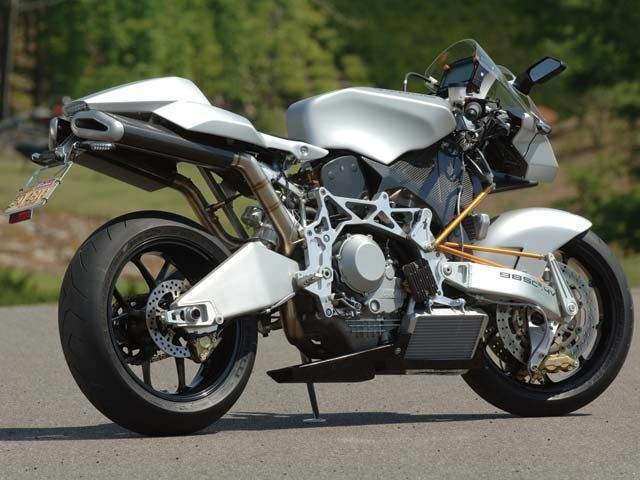
Vyrus 985 C3 4V
The
making of the
most high-tech
sport bike on
the market
Photography
by Tom
Riles
writer:
Alan Cathcart
Rimini-born
Vyrus virtuoso
Ascanio Rodorigo has
lived and
worked all his
life in
themotorcycling hotbed of
the Riviera
Adriatica, beginning as
a 20-year old
wrench for
thelocal Bimota factory
race team in
1973 under the
aegis of his
idol, Massimo
Tamburini.After Tamburini's
departure, Bimota suffered
one of its
periodic financial
crises andstopped
racing, although
Tamburini's replacement,
Federico Martini,
soon righted
matterscommercially by
creating the firm's
best-selling debut
Ducati-powered bike,
the DB1. Aftera
spell on the
production line
building customer bikes,
Rodorigo was,
ironically, long goneby
the time
Martini built the
first-ever Honda
V4-powered Tesi
prototype in 1985,
ahub-center design
which was the
Mech.E thesis
(hence the name)
of his young
assistant freshout
of university,
Pierluigi Marconi.
"I learned a lot building customer bikes for Bimota, but it was so repetitive I had toleave before I got bored," admits Rodorigo, who on January 1, 1985 opened his own companyunder the ARP name on the other side of Rimini, a small but soon well-regarded workshopproducing special parts for race or road, as well as a variety of special sportbike frames."My passion has always been to build prototypes and one-off concepts," says themachine-room Picasso, who also became recognized as the man to visit if you had an unusualbike, and especially a racer, that needed work done. "Our team at ARP was very adaptableand could work very fast in making one-off parts or complete bikes. We were like a mousecompared to the elephant that bigger companies' development departments were, bycomparison. I worked on quite a few Tesis, and we were always having problems with themwhich seemed impossible to resolve. But I had an Australian friend, Matthew Casey, whoworked for Bimota in the 1990s, and he has four of them! He was always telling me to make aTesi the way I wanted to-`It's your kind of motorcycle-just go and do it!' he kept tellingme. So, eventually, in September 2002, I decided to do so."
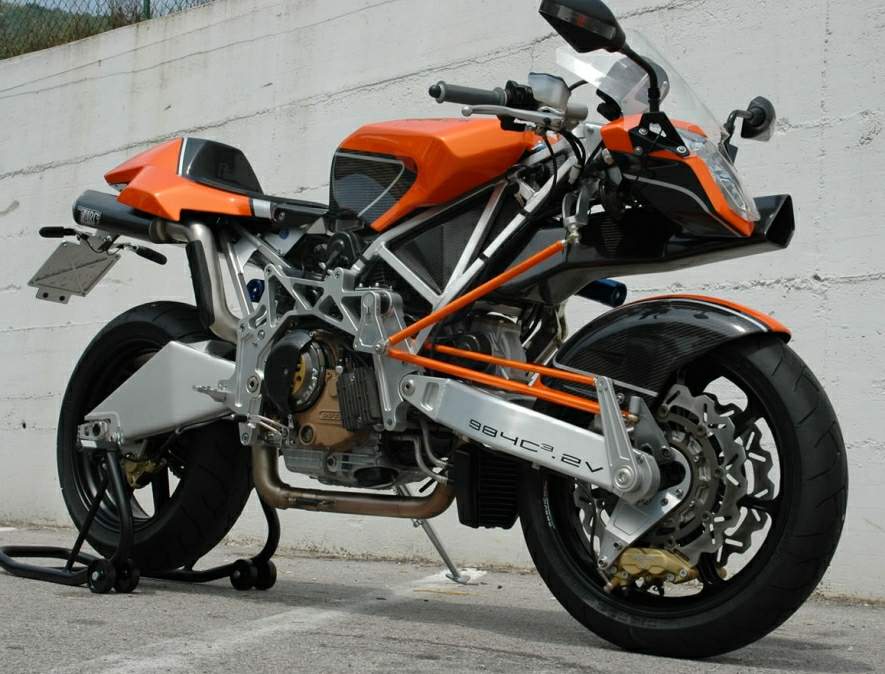
ARP already had some pretty effective after-hours helpers, not least Dervis Macrelli, theframe-making wizard who's worked with Tamburini putting his ideas into metal ever since theearly Bimota days, and who got into the habit of stopping by ARP after clocking off at CRC(Cagiva Research Center) to help create what became known as the Vyrus. Where'd thatsomewhat, er, negative-sounding name come from, then? "When considering how the firstprototype should be, we decided to build a bike to display at the Padova Show the followingJanuary, which is the Mecca for anyone doing something special on two wheels in Italy,"explains Rodorigo. "It was a real challenge that meant we worked day and night for threemonths. One night at 3 a.m., I was washing my hands free of powder after working on thebody styling-we didn't have 3D computer modeling, we did everything by hand according to arough drawing, just by eye. My friend Mauro working with me was a builder during the day,and he kept trying to persuade me to go to bed-so he could too, I guess! But I wanted toget the body finished-then when we'd done so I suddenly realized we hadn't got a name forthe bike. We couldn't call it Tesi, because that was Bimota's name-but then Mauro told me,we must call it Vyrus, but with a `y' not an `i', because this is not like the one before,a virus that is in every computer and maybe in us, too, to be so crazy working here at 3a.m. to build a motorcycle. So, that's when ARP became Vyrus." That first Vyrus 984 duly made its debut at the Padova Show in January 2003, powered by atuned Ducati 900SS desmodue motor of the kind ARP had been racing with success inSuperTwins events-hence the model designation, which was the cubic capacity of the engine."We knew this engine very well from racing it, so it had no secrets from us," statesRodorigo. "If we were to concentrate on trying to make this high-tech chassis design workproperly, we had to not worry at all about the engine, so that's why we chose the desmodue.It was a known quantity." But the proprietor of the new Vyrus company admits to beingcompletely unprepared for the rapturous reception his new bike received. "We had literallyhundreds of inquiries to make production versions of our prototype, which we were quiteunprepared to do," he says. "But I realized we had now to turn the prototype into acustomer version we could manufacture in series in small batches, always by hand, but insome kind of volume. We had to get the bike homologated first, though, which in fact was afascinating experience I enjoyed very much, producing the lightest twin-cylinder sportbikein the marketplace, though always completely street-legal-but finally we succeeded."
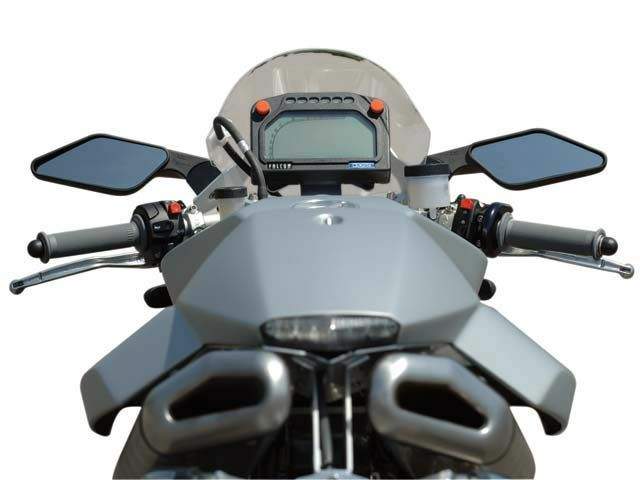
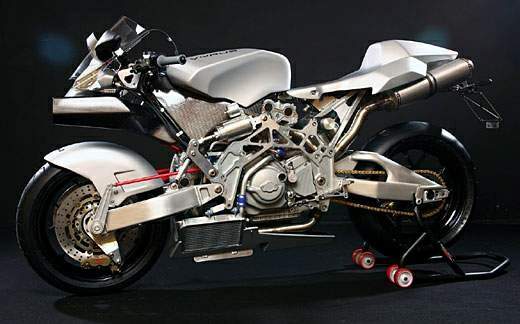
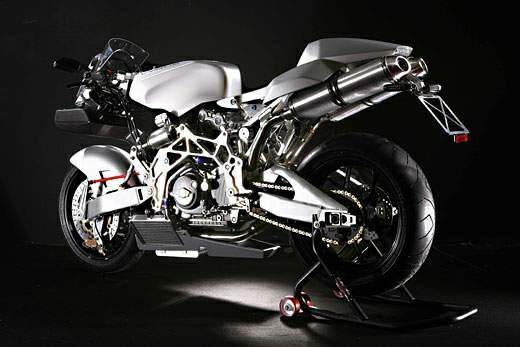
After an intensive development process on the racetrack, during which the Vyrus 984 ProTwins racer became a regular visitor to the rostrum in European twin-cylinder racing in thehands of Gianluca Villa, nephew of the late four-time world champion Walter, the firstfully homologated Vyrus streetbike met its happy customer in January 2003. Since then, atotal of 70 such bikes have been constructed, 25 of them marketed in a neat squaring of thecircle under the Tesi 2D tag by the born-again Bimota company through their dealers aroundthe world-including two bikes sold in Russia, and 10 to Japan. With production up andrunning of this desmodue version, delivering 77 bhp in a bike weighing 339 pounds instreet-legal form, Rodorigo turned his attention to a Superbike version powered by Ducati's104mm-bore 999cc Testastretta motor, to create a modern version of the original Tesi whichinspired the whole design. After a strung-out development path beginning back in 2004 ("Weare only five people, and demand for the 984 is so constant, we couldn't spare the time topay attention to the new bike," he shrugs), the first 985 appeared at the start of thisyear, and was promptly sold-to Russia! Since then, two more 4V bikes have been built, ofwhich the test machine was the first Vyrus to cross the Atlantic to head up a U.S. salesdrive. The dramatic modernist styling of the Vyrus 985 is the work of Rodorigo himself, with closehelp from ex-Ducati designer Sam Matthews, formerly Pierre Terblanche's right-hand man, butnow working for Citroen in Paris. "We did this at long distance, with Sam making CADdrawings and me interpreting them into a full-size clay model, then e-mailing him photos ofthe result," says Rodorigo. A copy of the finished article can be yours in the color ofyour choice 60 days after placing an order for 54,750 Euro (about $67,750) inclusive of taxin Italy, with full EU homologation. A fully-faired option will be available later thisyear, at additional cost.-MC Source Motorcyclist
|
|
NOTE: Some of the photos on Motorcycle Specs are owned by somebody. If you see any of your photos, you can let me know so that I can acknowledge it, or if you object to it, I can remove it altogether. If any copyright holder objects to their articles being placed on Motorcycle Specs, it will be removed upon request. Any correction or more info on these bikes will kindly be appreciated. Contact Me Privacy Policy Website Stats |