|
Victory Cross Country

|
Make Model |
Victory Cross Country |
|
Year |
2010-11 |
|
Engine |
Air/oil cooled, four stroke, 50° V twin SOHC, 4 valves
per cylinder,
self-adjusting cam
chains, hydraulic lifters |
|
Capacity |
1731 |
|
Bore x Stroke |
101 x 108
mm |
|
Compression Ratio |
9.8:1 |
|
Induction |
Electronic Fuel Injection
with 45mm throttle bodies |
|
Ignition /
Starting |
- / electric |
|
Clutch |
Wet, multi-plate |
|
Exhaust |
Split dual exhaust with
crossover |
|
Max Power |
|
|
Max Torque |
|
|
Transmission /
Drive |
6 Speed / Carbon Fiber Reinforced Belt |
|
Front Suspension |
43mm Inverted cartridge telescopic
fork, 130mm wheel
travel |
|
Rear Suspension |
Single, mono-tube gas
forged and cast aluminum w/ rising-rate
linkage 120mm wheel travel, preload adjustable
spring |
|
Front Brakes |
2x 300mm floating rotor 3 piston caliper |
|
Rear Brakes |
Single 300mm floating rotor
2 piston caliper |
|
Front Tyre |
130/70 R18 |
|
Rear Tyre |
180/60 R16 |
|
Seat Height |
667 mm / 26.25 in |
|
GVWR |
618 kg / 1360 lb |
|
Dry-Weight |
347 kg / 765
lb |
|
Fuel Capacity |
22.7 Litres / 5.8 gal |
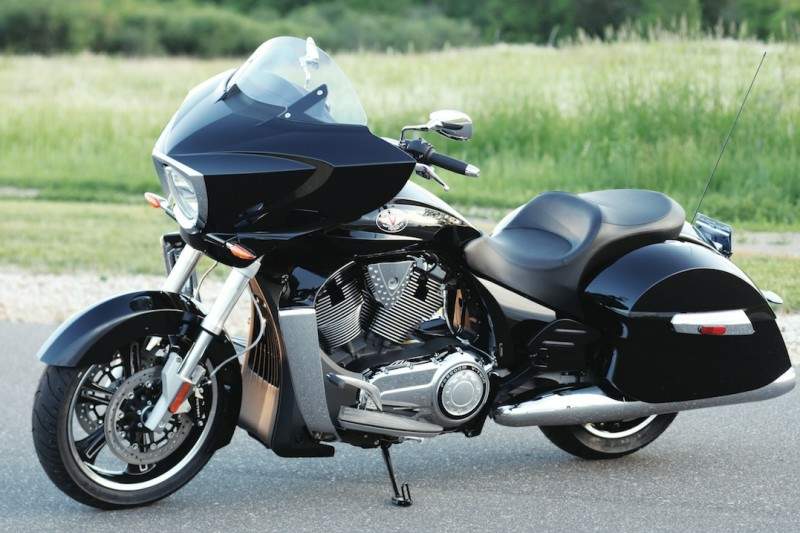
The Cross Country offers a touring rider
outstanding protection, comfort and convenience with its fork-mounted fairing.
The fairing serves as the headlight housing, it blocks and deflects wind,
precipitation and road debris such as stones kicked up by other vehicles, and it
hosts extensive instrumentation and an audio system.
The design of the fairing is both stylish and practical. The styling coordinates
with the unique look of the Cross Country, and the design provides optimal rider
protection. Extensive computer modeling, wind tunnel testing and on-road
evaluation went into the fairing's final design. A ridge running across the
front face of the fairing is stylish - and it also deflects wind and rain to the
sides, beyond the driver's hands. At the base of the windshield is a small
channel that allows air to stream up the back face of the windshield for
optimized air flow. Pure Victory Gear offers a selection of high and low
accessory windshields. The combination of an
accessory tall windshield and lower wind deflectors will provide the most
thorough protection and comfort for high-mileage touring riders.
On the driver-facing side of the fairing is MFD (multi-function display)
instrumentation and the bike's audio system. The MFD includes an analog
speedometer and tachometer, fuel gauge and a battery charge meter. The wealth of
data in a digital display panel includes: gear indicator, clock, ride time,
odometer, two trip meters and fuel economy information such as current range for
the available fuel and current MPG data. A driver scrolls through the data using
a trigger switch mounted by the left hand grip. This switch also resets
functions such as the trip meters, ride time and clock.
An AM/FM radio is standard on the Cross Country, and the bike can be equipped
with an iPod or satellite radio that plays through the bike's audio system. The
audio display screen presents detailed information about the radio station
currently playing, or the iPod track name, artist, satellite station and more.
The fairing also accommodates installation of switches controlling accessories
such as heated handgrips. These are available from Pure Victory Gear, as are
accessories needed to store an iPod in the right saddlebag and play it through
the bike's audio system.
An accessory GPS unit can be mounted on the left handlebar using an accessory
ball joint mount, and audio information from the GPS can be fed through the
bike's audio system.

Other elements that are unique to the Cross
Country include:
The Cross Country makes full use of the advanced Victory CORE Technology in
its chassis. As a result, it is the lightest bike in its class, with the highest
load capacity.
Reflective of Victory being "The New American Motorcycle," the Cross Country
has distinctive highway bars that complement the bike's styling. These forged
aluminum bars can be cleanly equipped with accessory highway pegs or driving
lights, and chrome covers are available for the horizontal top sections of the
bars.
The Cross Country has floorboard-styled passenger footrests that serve as a
secure, comfortable foothold.
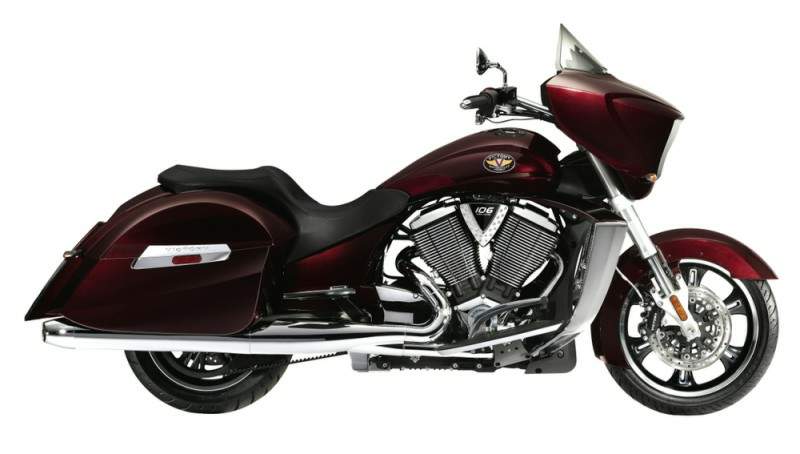
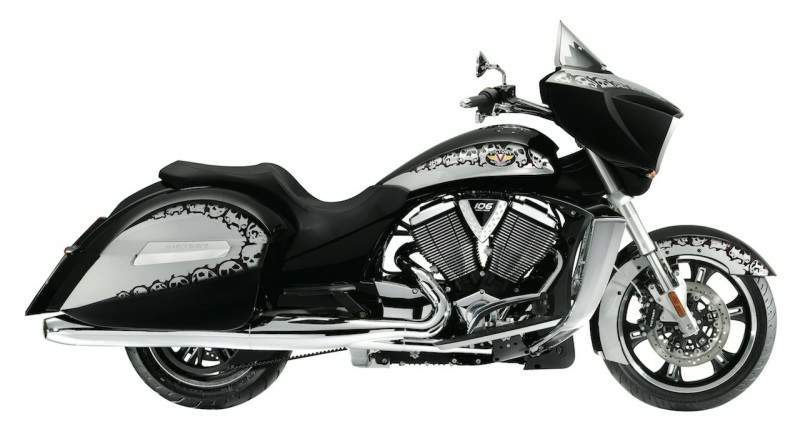
The Cross Country is available in Solid Black, Solid Midnight Cherry and the
Cross Country - exclusive Black and Graphite with Extreme Skulls.

Motorcycle Review
Before arriving in Austin, my wife Jane and I were given a few photos and a
brief description of the new 2010 Victory Cross Country motorcycle, so we had
formed an image of what to expect. First sight of the Victory Cross Country
revealed that our anticipation had not been nearly strong enough; a stunning
example of motorcycle artistry greeted us.
Painted metallic Midnight Cherry red, the Cross Country's sharp lines appear
faceted out of cultured ruby. Angular design elements bring to mind experimental
aircraft of the early jet era, yet defy placement in a specific period of the
motorcycling milieu. Triangles appear scattered throughout the motif, beginning
with the inverted triangle of the headlight cowl, continued in the triangle
circumscribed by the cylinders with the EFI cover wedged between, and finalized
in the tapered, flush-mount LED taillight.
Normally, I prefer to spend some time with a motorcycle before having Jane ride
with me. However, she is only in Austin for a single day, so there is little
time for such formalities. Fortunately, the Cross Country proves a delight to
pilot with a passenger. Its lightweight hollow cast aluminum frame, which uses
the engine as a stressed member, gives the Cross Country the lowest center of
gravity in its class. There is no hint of top heaviness, and the bike requires
little input to prevent wandering at slow speeds. The low seat height of just
over 26 inches (unladen), adds to rider control when dealing with stop-and-go
traffic or walking the bike through parking lots.
Possessing a map of the Texas Hill Country, I roll on the throttle. The
50-degree V-twin Victory Freedom 106 engine builds revs with a comforting growl
from the split dual exhaust, effectively applying its 96 horsepower and, most
importantly, 109 ft/lbs of torque to the Dunlop Elite 3 tires. Fed through EFI
with dual 45mm throttle bodies, the Victory Freedom 106 utilizes a single
overhead cam with four valves per cylinder. This supplies a high volume of air
through a light weight valve train, allowing the engine to produce a wide torque
curve from midrange to high rpm. Engine response is superb and shifting through
each of the six gears is smooth.
With the state capital in the rear-views, we head into the Texas Hill Country,
the region of Central Texas along the Balcones Escarpment, with Austin to the
east and San Antonio to the south. The topography is rolling, sometimes rugged,
limestone hills covered with oak and cedar. For our purposes, the Hill Country
is a series of meandering two- and four-lane roads linking a diverse collection
of small towns, each with its distinct interpretation of Texas culture while
conforming to the overriding theme of rugged individualism. These wonderful
little towns urge a stop to investigate and shop, making them a perfect proving
ground for our impeccable touring machine.
The 21 gallons of storage in the Cross Country's hard saddlebags should handle
the clothing and supplies required for this trip, as well as souvenirs picked up
along the way. All can be packed conveniently in the provided bag liners. The
Victory saddlebags have an internal locking latch that secures the top hinged
lid to the bag body. However, my overstuffing of the bag bulged the sides
outward. On several occasions, the overstuffing caused the saddlebag lids to
open while riding, even after I believed I had ensured that they were safely
clasped. Careful packing seems to be the key to keeping the lids closed.
Distance is deceiving here. Even with a 60 mph limit on many of the two lane
roads, the time it takes to get between two points on the map is blissfully
prolonged. Each crossroads provides new sights that must be scrutinized to
determine if they require further investigation. Every dip in the road leads
down to a creek running through culverts under the road with signs warning of
possible flooding. Around every hill a new scent greets us, distinctly earthy
and palatable. Travel by motorcycle encourages the use of all senses to envelop
oneself in the environment, and the Cross Country moves us through this
environment in an undisputedly enjoyable fashion.
As the evening approaches, Jane and I ride the Cross Country to our one firm
destination of the day, The Salt Lick Bar-B-Que, in Driftwood. The Salt Lick
restaurant is a local institution, borne out by the projected two-hour wait.
Buses loaded with University of Texas Longhorn fans are pulling into the
expansive parking lot as we arrive. The attendant directs us to pull into an
area normally reserved for employees to ensure the Victory is secure away from
the throng of vehicles coming and going. The crowd is daunting but the enticing
smell of smoked meat coming from the decades old pit barbeque draws us in.
The Salt Lick is a sprawling complex of stone and grey woodplank buildings with
a number of separate dining rooms and a large picnic area with a band. We learn
from observation and overheard conversation that the trick to a quick meal is
going directly to the pit house and ordering food to go. Jane and I both order a
combination plate, which is prepared in a few minutes, and take our food to the
picnic tables near the band. The atmosphere is lively and cheerful due to the
Longhorn victory over neighboring Oklahoma.
As she had been seduced by the comfort and rideability of the Cross Country,
Jane reluctantly boards her flight back to California, sorry that she cannot
accompany me for the rest of the trip. As a passenger, one criteria Jane looks
for in a motorcycle is the smoothness with which it transitions, be it between
gears or from start-to-stop and back. With a precise six-speed transmission, wet
multi-plate clutch, and carbon fiber reinforced drive belt, the Cross Country
scores high in this category. With its comfortable seat and backrest, it is easy
for Jane to imagine herself spending the next four days with me on the Cross
Country.
Preparing for my ride home to California, I decided on a course from Bandera to
Sonora, with as little time on major highways as possible. Bandera is an
authentic cowboy town surrounded by working cattle and guest ranches and is a
popular stop for motorcyclists making the circuit around the Three Twisted
Sisters, the loop consisting of Ranch Roads 335, 336, and 337.
I reach Bandera in time for an early lunch, so I order some food at the Dogleg
Coffee House on Main Street across from the general store. While the amenities
of the Dogleg are modern, the building itself is made of limestone block and
looks like it could have been a jail or bank in a previous incarnation. All the
shops and restaurants along Main Street are well maintained yet direct one's
mind back to a time before internal combustion. Each step through town leads to
a photo opportunity of some idyllic Americana. Each building looks to be hewn
from the history pages of the Old West.
With noontime approaching, I head west to experience some of the premier
motorcycling roads offered in the Hill Country. Just past Vanderpool, Ranch Road
337 starts to climb and twist as the rolling hills gain elevation and become
more severe, exposing faces of jutting limestone framed by oak and cedar. Long
vistas of the land north of the Balcones Escarpment can be seen. I head down to
the Frio River and the town of Leakey, where I pick up RR 336, arguably the most
thrilling of the Twisted Sisters. Initially, RR 336 follows the West Frio River
for a scenic ride through expansive ranges, marked by frequent cattle guard
crossings, which are effectively smoothed out with the air adjustable rear
suspension and the inverted cartridge forks with progressive springs; both ends
offer about five inches of welcome travel.
Soon, the road heads up to a broad ridge that borders the west bank of the
river, and then turns into a roller coaster of two-wheeled bliss. Climbing and
diving with frequent swooping turns, the scenery attempts to distract my
attention away from the road, but the tarmac is too inviting. Adrenalin claws at
my hand to twist harder, brake later, push for more lean. How far can I take the
Cross Country? The Victory's rigid frame, sport-aware suspension, and 300mm
floating rotor disk brakes with four-piston calipers give the Cross Country a
carving ability akin to a much lighter bike. Too soon I am approaching Sonora
and Interstate 10. I am told that riders often ride the Twisted Sisters a couple
of times in a day. Unfortunately, I must keep to my schedule.
The Interstate calls for a different state of mind, one that the Cross Country
accommodates. The stretch of I-10 that leads out of Texas through New Mexico
seems endless, but highway luxury is easily at hand without removing your grasp
from the grips. Operating a trigger switch on the left handlebar with your index
finger can change each mode of the trip LED display. You can flip the display to
read odometer, two trip meters, average fuel consumption, average speed, fuel
range, fuel mileage, and trip timer.
An integrated 40-watt audio system is controlled from a set of switches inside
the left grip, allowing me to set the system to AM, FM, weather band, and MP3
player. In MP3 player mode, I can select playlists or scroll through my files by
album or artist. The audio system also has an auto-fade feature that permits you
to set the volume while stopped, and the system will automatically increase the
volume as your speed increases.
Flexible body positioning is a great defense against fatigue, and the ergonomics
of the Cross Country provide many opportunities for personalization. The rider's
floorboards are long and offer a wide range of options for foot placement. The
foot controls are adjustable to accommodate different leg lengths.
Even without highway pegs installed, the forward swept wing shaped highway bars
provide a nice place to push your feet against to change the pressure points on
your gluteal muscles and lower back. The seat has extra padding and provides a
small amount of back support. Using the standard electronic cruise control makes
running the tank dry before having to stop to stretch your legs a regular
occurrence.
West of Las Cruces, the sky fades into the darkness of what is obviously a
storm. Just before reaching the Border Patrol checkpoint between Las Cruces and
Deming, I enter the brown wall of dust and rain that delineates the outflow
boundary of the tempest. I angle into the heavy crosswind as much as possible,
trying to dodge tumbleweeds and shrubs. The Cross Country handles the high
crosswind with the same confidence it displays during normal riding conditions.
A heavy downpour with hail hits just as I ride under the awning of the Border
Patrol checkpoint. The large awning does not protect from the wind, but does
provide some shelter from the heavy rain and hail. This gives me a chance to
pull a tumbleweed out of the forks while escaping the heaviest of the downpours
I encountered. The Cross Country's fairing is designed to channel rain away from
the rider's hands, and adding the tall touring windscreen delivers even more
protection.
The next morning, clear skies and a clean Interstate 10 greet me. Motorcycling
north through Arizona on US 191, I make Flagstaff for my final night on the
road, leaving me an eight-hour ride across the Mojave Desert to home. Over
dinner I consider the coming final day of my trip and how the Cross Country has
been a consummate companion. Whether riding solo or two-up, on Interstate or
rural road, the 2010 Victory Cross Country is a most appropriately named
motorcycle. Unique styling, well-designed accoutrements, and ample performance
position this American motorcycle as one of the premier distance killers
available.
Source
Motorcyclingmag.com
|