|
Moto Morini 500 Turbo

|
Make Model |
Moto Morini 500 Turbo |
|
Year |
1981 |
|
Engine |
Air cooled, four stroke, turbocharged, 72° V Twin, SOHC, 2 valve per cylinder
|
|
Capacity |
479 |
|
Bore x Stroke |
69 x 64.2 mm |
|
Compression Ratio |
|
|
Induction |
Single Dellorto PHB36BS |
|
Ignition /
Starting |
Electronic / electric |
|
Max Power |
70.5 hp @ 8300 rpm |
|
Max Torque |
64.5 Nm @ 5600
rpm |
|
Transmission /
Drive |
6 Speed / chain |
|
Front Suspension |
Telehydraulic fork 140mm wheel travel |
|
Rear Suspension |
Adjustable gas charged shocks 100mm wheel
travel |
|
Front Brakes |
2x 260 mm discs 2 piston
calipers |
|
Rear Brakes |
Single 260 mm disc 1 piston caliper |
|
Front Tyre |
100/90-18 |
|
Rear Tyre |
120/90-18 |
|
Dry-Weight |
182.5 kg |
|
Fuel Capacity |
|
|
Overview |
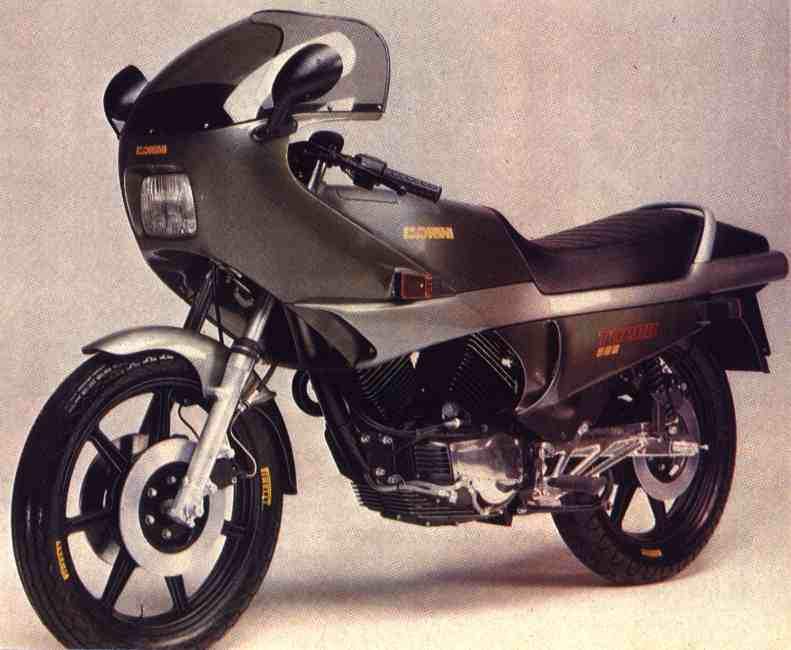
The Moto Morini 500 Turbo
(prototype) |

The Moto Morini 500 Turbo (prototype),
originally published
in "Bike" magazine, July 1982
"Bolognese Sauce"
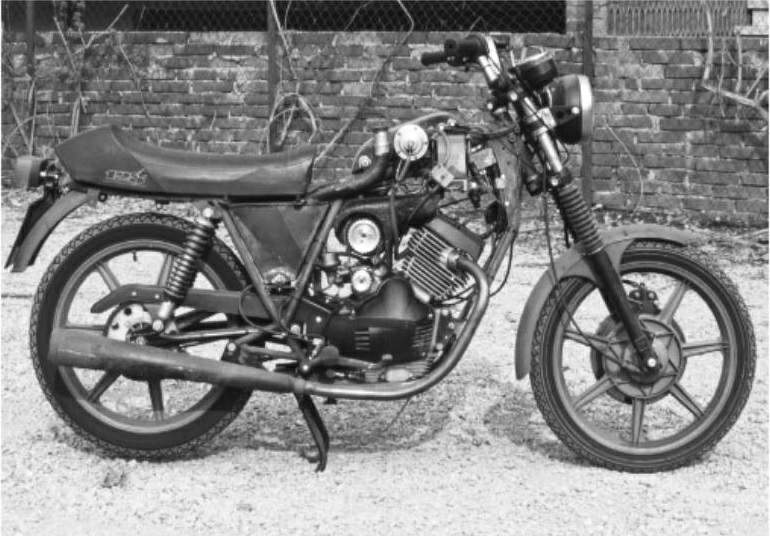
Throughout last year (1981) the residents of a quiet Bologna suburb were
regularly treated to the sight and sound of a scruffy black Morini V twin
growling along their streets to and from nearby dual carriageways. It obviously
wasn't just another 500cc prototype - it's motor appeared to breathe through a
collection of washing machine parts, the steering head was loaded with dials and
controls, and the tester riding it occasionally fiddled with various knobs on a
small electronic control box. Had those same residents visited the Milan
motorcycle show last November, it’s likely they'd have failed to make any
connection between the slickly finished machine grabbing all the attention on
the Morini stand and that ratty test bike tooling up and down the Via Alfredo
Bergami back home in Bologna.
Except that both bikes had
Turbo written on their side panels. Morini, the smallest of the Italian
motorcycle manufacturers making it’s own motors, just had to be the least
likely candidates for the title of First Non Japanese Production Turbo
Makers. Committed to moderate production of a standard range of machines of
no more than half litre capacity, using 72o V twin motors and a
single-pot derivative, the little Bologna factory’s philosophy hardly
included assaulting the problem-strewn heights of turbocharging - let alone
turbocharging a V twin; something supposedly so difficult Honda only did it
to show off. Yet the decisions which sent Morini down Turbo road were taken
nearly 10 years ago. In 1974, soon after introduction of the 350cc Sport,
Moto Morini began looking at what to do next.
Morini were determined to stick with the 72o
motor which had become their trademark but at the same time it was clear that
hogging Lambertini's design out to 500cc for the Maestro was pushing its ability
to produce horsepower in the required amounts.
In any case, the company whose early 175cc four stroke sportsters gave Agostini
a racing start in life harboured a deep rooted antipathy towards what the
Italians quaintly term maxi motos. In Morini's view, increasing engine capacity
and therefore mass to gain horsepower is a route which quickly runs into the law
of diminishing returns; power to weight ratios improve sure enough, but rarely
fast enough to match the weight increase, while the hassle of meeting noise and
emission regulations is something a small factory can well do without.
They even produced a chart to back up the
decision to opt for turbocharging. Claiming to show the general trend in maxi
moto design from 1973 to this year (1982), it plots a rise in big bore output
from around 70bhp to nearly 100, or a 30 per cent increase. At the same time big
bikes have become about 16 per cent heavier as a rule, say Morini. The crunch
comes when you do the sums and find power to weight ratios on the biggest multis
have only improved by 11 per cent (not to mention the fact that Alfonso Morini
would turn in his grave at the thought of a 550lb Morini hitting the streets.
Looking at conventional solutions lead the company up blind alleys for three
years. Until it considered turbocharging there didn't seem to be any way of
making an acceptably fast yet light medium capacity machine without designing a
new motor. And re-tooling to do that would have affected the whole range. In
1976 Morini finally decided to go for a turbo, aiming for 750cc performance from
their existing 500cc powerplant with similar fuel consumption and little more
weight than the standard bike. It was an ambitious project not least because the
only turbos available at the time were almost useless on engines smaller than
two litres but five years later they had their 500 Turbo. At least it looked as
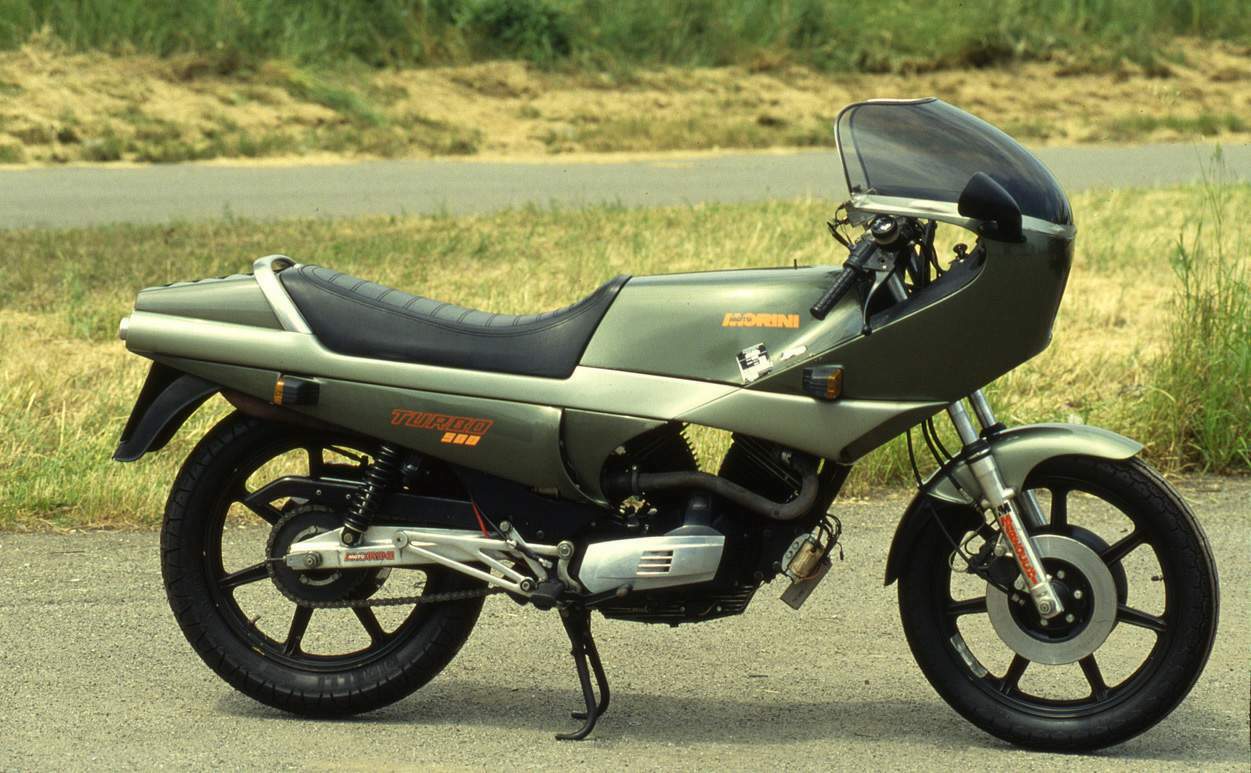
though they had. The pre-production model on show at Milan was strikingly
different from any previous Morini, but so well hidden behind the bodywork was
the rear of the motor that it really could have had a washing machine in there.
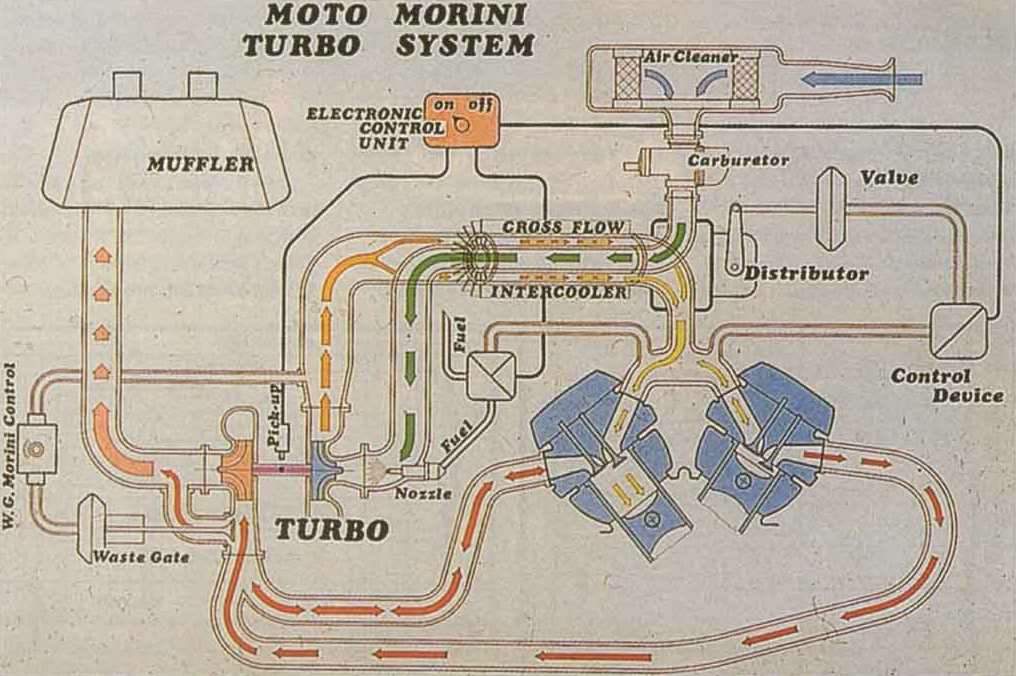
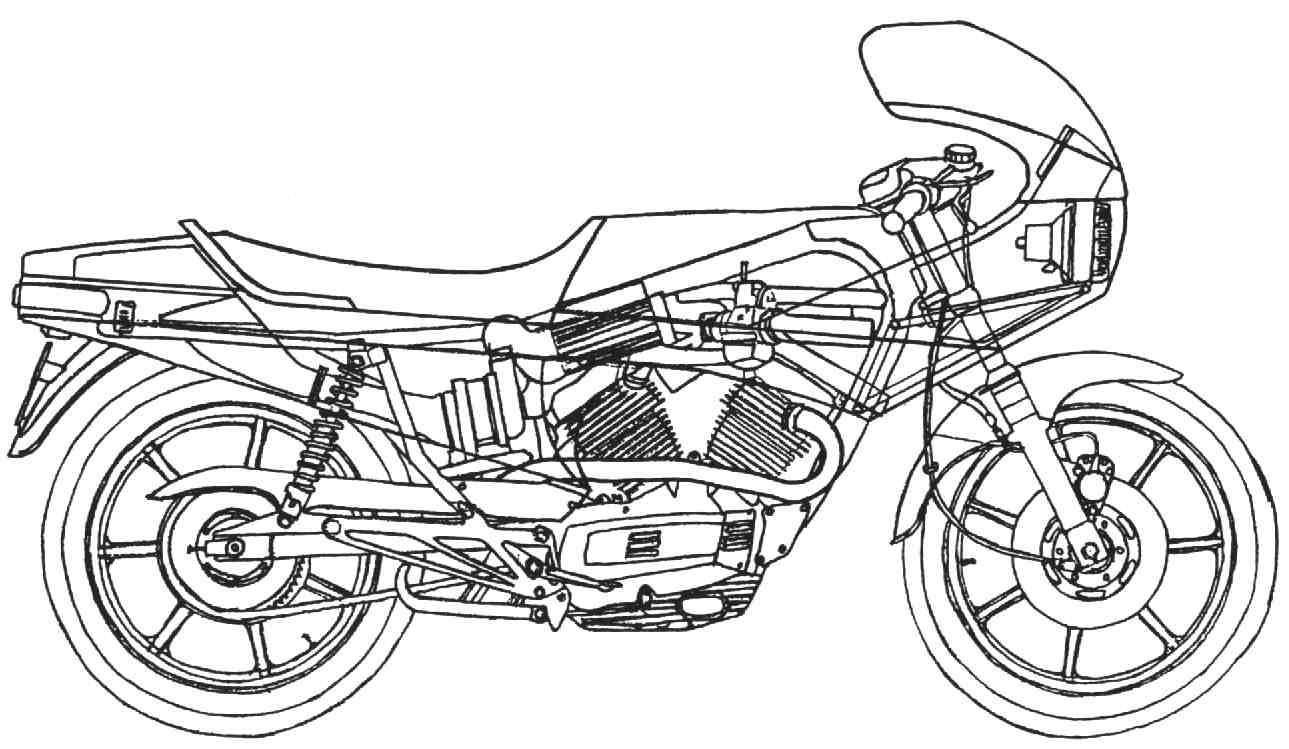
Only clue to its internals was an incomprehensible full colour diagram laying
bare the baffling complexities of the Moto Morini Turbo System.
Closer investigation was impossible with dozens of Milanese pressing in for a
better look and the sensible thing to do seemed to go back to the factory some
other time. Which is why I was crawling through Bologna a few months later,
nursing a hired Fiat 127 through the traffic and mentally composing a book
entitled: "101 Uses For A Dead Heathrow Baggage Handler". Yup, on strike again
for an increased Smarties allowance or something.
The Morini factory is a surprisingly small concrete building hemmed in on all
sides by apartment blocks. It's small entrance hall holds a display of racing
machinery from the '50s and '60s plus examples of the current range of models.
Design and admin offices occupy the main body of the building, and rolling road
testing, final checking and dispatch are in the basement.
After being introduced to Morini's director Gianni Marchetti, Jim Forrest and I
were shown round the works before being ushered into the Holy of Holies, the
development workshop. If Honda allows two per cent of its annual budget to R&D,
Morini allows about two percent of its space. The workshop was about the size of
a Jap R&D department's executive washroom although it was obviously ample for
the factory's needs, with a ramp leading down to a dyno room in the basement.
The Milan Show turbo was on a bench in the centre of the room, stripped of its
bodywork and turbo gear. Resting on the floor was a horrible battered object
which was none other than the original prototype - now completely knackered
after two years and 110,000 km of road testing round the city. If it hadn't been
for Big Four interest in turbocharging, which undoubtedly preceded the
introduction of really small turbines, the Morini project might still be waiting
in the wings. Last November Morini still hoped to find a home grown item for
production turbos but it hasn’t materialised and a Japanese IHI unit similar to
those used in the Oriental boosters will sit behind the rear cylinder when the
Italian turbo arrives in the showrooms.
Having found their turbocharger, Morini still had a bundle of problems to
overcome. The two main ones were getting a turbo system to work adequately given
the uneven exhaust pulses of a V twin, particularly at low rpm, and secondly
Lambertini and his development engineers Paolo Zaghi and Luciano Negroni had to
devise special methods of keeping the cylinders cool
 |
while all those hot, compressed gases were
being stuffed back into them. Honda, you'll remember, tackled the first of
these problems with a complex system of electronic controls, fuel injection
and a plenum chamber. Morini's solution was far simpler - simply cut the
turbo out of the system at low revs and feed mixture directly from a single
36mm Dellorto carburettor into the inlets.
Simple though it sounds in principle, in practise the Morini system calls
for a distributor between the turbine and inlets to direct the mixture flow.
This was designed and placed at the end of an intercooler between the turbo
and the cylinder heads. At low rpm the distributor closes the mouth of the
intercooler and mixture flows across it into the motor. Exhaust gases still
spin the turbine but the compressor on the other end of the shaft just pumps
the same captive charge of air round inside the intercooler.
When the revs rise higher than a couple of thousand, sensors measuring
depression in the inlet manifold tell the electronic control units it’s time
to operate the distributor, which opens the intercooler. |
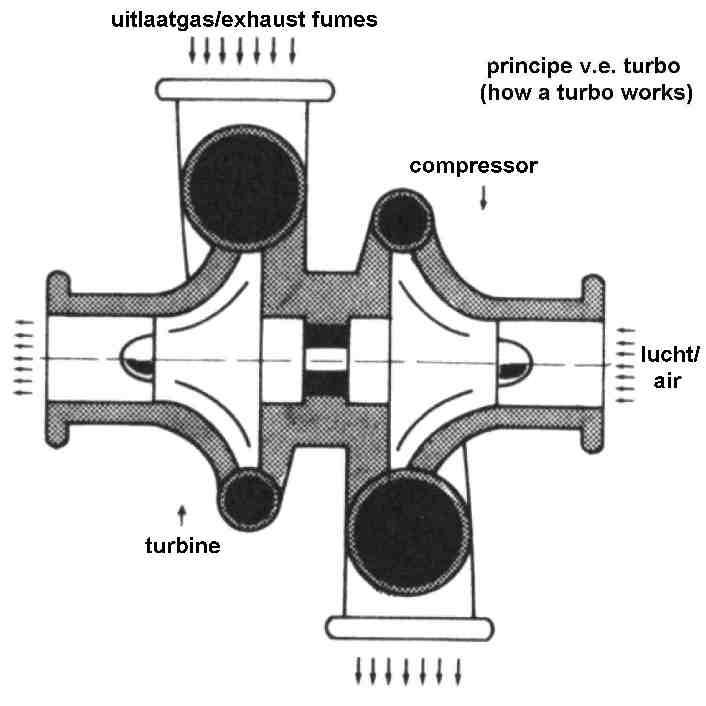
| Schematic diagram is
Morini’s own, showing the importance of the intercooler |
Mixture is diverted down its centre to the compressor, then pushed up the
outside to the inlets. To avoid momentary fuel starvation as the air already in
the intercooler is stuffed into the motor, a small injector nozzle working on
pressure from the head of the fuel in the tank squirts juice into the compressor
vanes.
The first prototype featured a fully adjustable distributor control on the
steering head which allowed Morini to find the optimum revs for the change from
normal to boosted breathing. Once they'd sorted this out, there was still the
problem of greatly increased heat to overcome. In faint hope that the Universe
still contains any sentient beings not already bored to tears by the theory of
turbocharging, I’ll briefly re-iterate the sordid details.
A conventional internal combustion engine is both limited and fairly wasteful.
It's limited by the ability of atmospheric pressure to fill its cylinders during
the intake cycle, then it just pours about 35 per cent of the energy it produces
during combustion away down the exhausts in the form of heat and gas momentum.
The function of a turbocharger is to harness some of this wasted energy by
making it spin a turbine which in turn spins a compressor which stuffs much more
mixture into the pots than atmospheric pressure could manage. The result is,
say, a 500cc motor which fills up with as much gas as a 750 or 900 and puts out
equivalent power and torque. All you have to do is make sure it breathes
properly and doesn't suffer from detonation, seizures, melted plugs or any other
penalties of overheating.
| Cooling the twin-pot mill
presented Morini with a major headache, especially as the rear pot is
partially masked by the front cylinder. Watercooling was out from the start:
the prime reason for adopting turbocharging was to end up with a bike which
made the maximum extra power for the minimum additional weight and bulk. So
an intercooler was designed into the system from the outset. Made, like all
the turbocharging hardware on the bike except for the turbine unit, by
Morini, the intercooler is really a simple heat exchanger. Fresh (cool)
mixture is ducted down the centre and the hot - around 700oC at max turbine
revs - compressed mixture travels up the outside losing heat to the incoming
mixture and through fins on the intercooler body. It’s a crude system
compared to some of the latest car turbos which actually have a
refridgeration unit, but it's the only intercooler on a turbo motorcycle.
Cooling the charge also increases its density, making for better burning and
less risk of detonation. The intercooler is hidden behind the sidepanels for
the sake of neatness which begs the question of what cools the intercooler? |
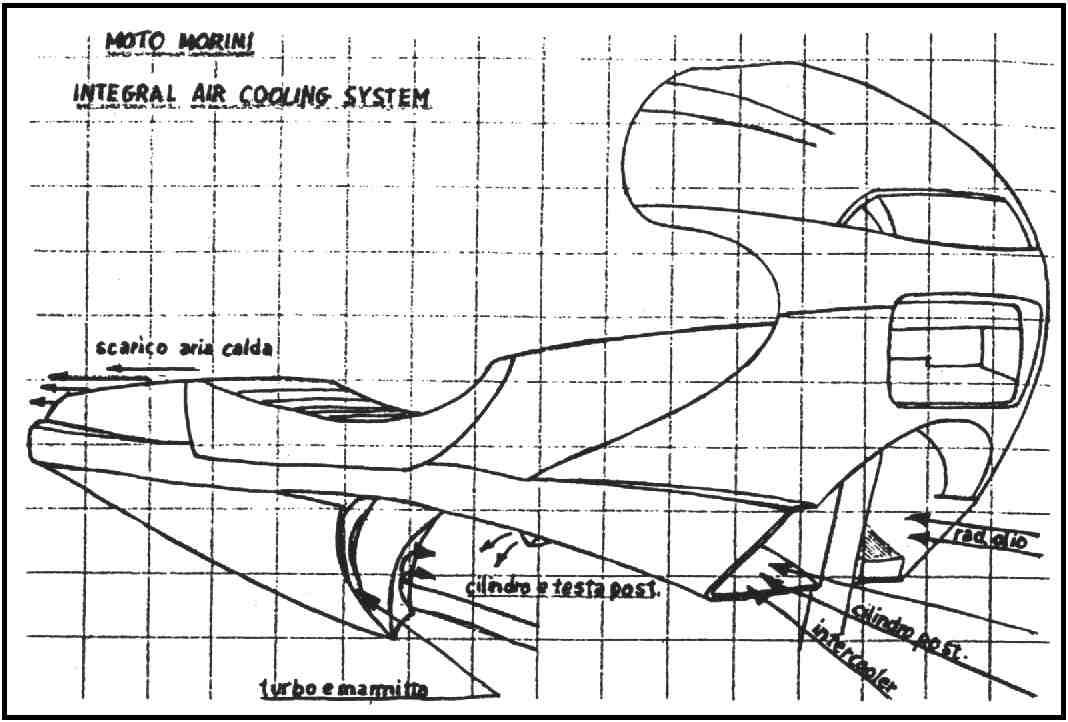
The answer is that the eight-piece glassfibre fairing/body unit isn't there just
to make the Morini Turbo look decorative at garage parties. When Franco
Marlenotti at RG Studies was given a design brief for the superstructure, it
included a stipulation that the lower section must function as part of the
cooling system by directing air over the cylinder heads and boosting bitz.
|
|
| the airintakes |
location of the turbo,
right above the centrestand; the intercooler above the rear cylinder |
So twin scoops were placed either side of the single front downtube; the right
one sending air over the front cylinder head, inlet manifold and intercooler and
the other sending air over an oil cooler lying almost horizontally in the
opening. A vent between the cylinders spills air on to the rear head while foils
on the side panels turn a cooling breeze on to the rear barrel.
Yet more scoops on the side panels are supposed to cool the turbo and a large
exhaust collector/silencer cradled in a frame extension under the tail. All this
hot air exits through a slatted vent on the tail. Aerodynamic considerations
also played a part in the fairing design. It's often said that your average,
unfaired motorcycle is an aerodynamically perfect as a flying brick.
Unfortunately, faired motorcycles are not necessarily much better. Parting the
air in front of the machine is less than half the battle because it’s the drag
and turbulence around the rear end and in the bike's wake which does most of the
damage. As the airflow breaks up over the bike and rider it creates an area of
low pressure holding the machine back, soaking up horsepower which ought to be
making it go faster.
Morini's half-fairing is nowhere near perfect but they say the Suzuki
RG500-style tail and through-flow of air reduce drag, while the blending of
fairing and petrol tank at the front gets rid of unwanted turbulence behind the
screen which, is where the air intake for the carb is situated. The crucial
factor in top speed though is still weight.
There's still one more unique feature on the Morini turbo. A wastegate control.
Lambertini was not content with a conventional springloaded wastegate which
opens when exhaust pressure reaches a pre-set level and bleeds off the excess,
thus limiting turbine speed and so preventing boost rising to dangerous levels.
So yet another electromechanical control was added. Taking it’s instruction from
pressure in the outlet side of the compressor venturi, the wastegate control
lets boost pressure rise to nearly 18psi as the motor spins to 5,500 rpm before
operating the wastegate, causing boost pressure to fall rapidly and level off at
12psi when 7,000 rpm is reached. From 2000 engine revolutions, cracking the
throttle open spins the turbo to maximum boost in 1 1/2 seconds. Then the
controlled opening of the wastegate cuts boost by 30 per cent.
Morini haven’t fully explained
the reasons for this but it seems the wastegate control makes plenty of
boost available in the mid-range for 60-70 mph cruising and rapid
acceleration but reduces the pressure at high rpm before the volume of hot
gas becomes too great for the elementary cooling arrangements to deal with.
If the dyno charts I was given are to be believed this doesn't hurt power
delivery, which climbs smoothly to its peak of a claimed 70bhp (at the
gearbox sprocket) at 8,500rpm – 1,000rpm higher than the peak power point on
the standard 500.
| After five years’ development and two
years’ road-testing, Morini appear to have come pretty close to the
target they set themselves. If that 70bhp claim is the truth, they’ve
extracted a 70 per cent power increase at the cost of only 10 per cent |
more weight – the 183kg (403lb) turbo is 16kg
(35lb) heavier than the latest standard 500. Unfortunately Morini won't let
anyone ride their turbo yet. In any case, when I visited the factory only
two Morini turbos existed: one of those was utterly knackered and the other
was in bits. It'll be interesting to see how well all the mechanical
controls work. Can that complicated arrangement of valves diverting mixture
round the |
system make the Morini as smooth and wellmannered on the road as Honda's
computerised fuel injection? A bike which matches the Honda Turbo's smoothness
and handling while giving its rider 120 fewer pounds to haul around would
certainly be worth all that effort.
If it lives up to the manufacturer’s claims it’ll be at least as fast as the
Honda Turbo at 210-215kph (130-133mph) flat out and purportedly infinitely less
thirsty at 55mpg overall going up to 60mpg at steady round-town speeds.
According to Negroni there's little noticeable ‘turbo lag’ because the
intercooler distributor switch allows a head of pressure to build up and come in
with a bang when it goes over to boost. When I was in Milan last year, however,
Paolo Zaghi said the switch operated at 4,000rpm. If that's correct then you’d
expect the motor to be struggling a little as the 8.6:1 compression pistons (as
opposed to 11.2: 1 in the standard mill) sucked mixture through the single carb,
long inlet manifold and round the sharp bends into the Heron heads.
Yet Morini's dyno charts claim a 10 per cent increase over power at four grand .
. . some mistake here, surely. Or maybe it's my total ignorance of Italian. Most
of the scepticism which has greeted the turbo stems from the few changes Morini
have made to the 500's internals. It runs a stock crank but the low compression
pistons are forged. Only other change specifically related to turbocharging is a
beefed-up version of the two-plate dry clutch, though the factory has finally
broken with tradition and linked the gear selector to a left foot lever. A sixth
ratio has been added to the gearbox as well - both these mods appearing on the
latest export versions of the 500 (the 500Sei).
To be fair turbocharging doesn't increase mechanical loads on the bottom half of
the motor, in fact the softer compression reduces the hammering, though the
whole transmission has to relay far more power to the rear wheel. Nor does
moving the power peak 1000rpm higher come near the very high revs which racing
Morini big ends were asked (but failed) to cope with in the Island some years
back. Those forged pistons are there because thermal loads on the top half of
the motor are so much higher than in a conventional motor and it's this problem
of cooling which is more likely to cause failures than mechanical stresses.
But Gianni Marchetti doesn't see arrival on the booster scene as having anything
to do with muscle-flexing or joining the tailchase Honda started with their
turbo. Morini has been at pains to point out that it started developing it’s
turbo in 1976 and it’s possible that if the company had had the clout to
persuade a European manufacturer to develop a suitably small turbocharger a few
years ago it might have had the world's first production turbocharged motorcycle
in the shops.
The Bologna factory decided long ago that there was sufficient demand for
120mph-plus machines to make it worth developing one of their own. Alongside the
turbo, Lambertini drew up designs for a 650cc Maestro (the Misstro?) and
experimented with different head designs - conceivably we might have been
offered something like a 72o version of the Ducati Pantah - but those
designs are still on the shelf. Look at it another way. Morini has neither the
desire nor the resources to make large, heavy machines. In Marchetti's view, the
cash spent on meeting increasingly restrictive noise and emission regulations,
on the back-room political infighting leading up their introduction and
promotion in the dwindling marketplace would be good money thrown after bad. Or:
there's no way 116 Italians can beat Hondawayamzuki.
If and when a few Morini turbos are delivered into the hands of the press for
evaluation it'll be clear once and for all how well the factory played its
cards. Until then the cynics will continue to claim Morini is merely making a
virtue out of a necessity, while more charitable individuals will no doubt reach
for their paperback copies of Small Is Beautiful.
Talking of small, Morini decided several years ago that it needed to move out of
the moped market. Now it’s not so sure. One project which is nearly ready to go
should the moment arise is a 50cc four-stroke motor. It'd be one hell of a
follow-up to a 130mph turbo.

presently also published by the
British Morini Riders Club
|