|
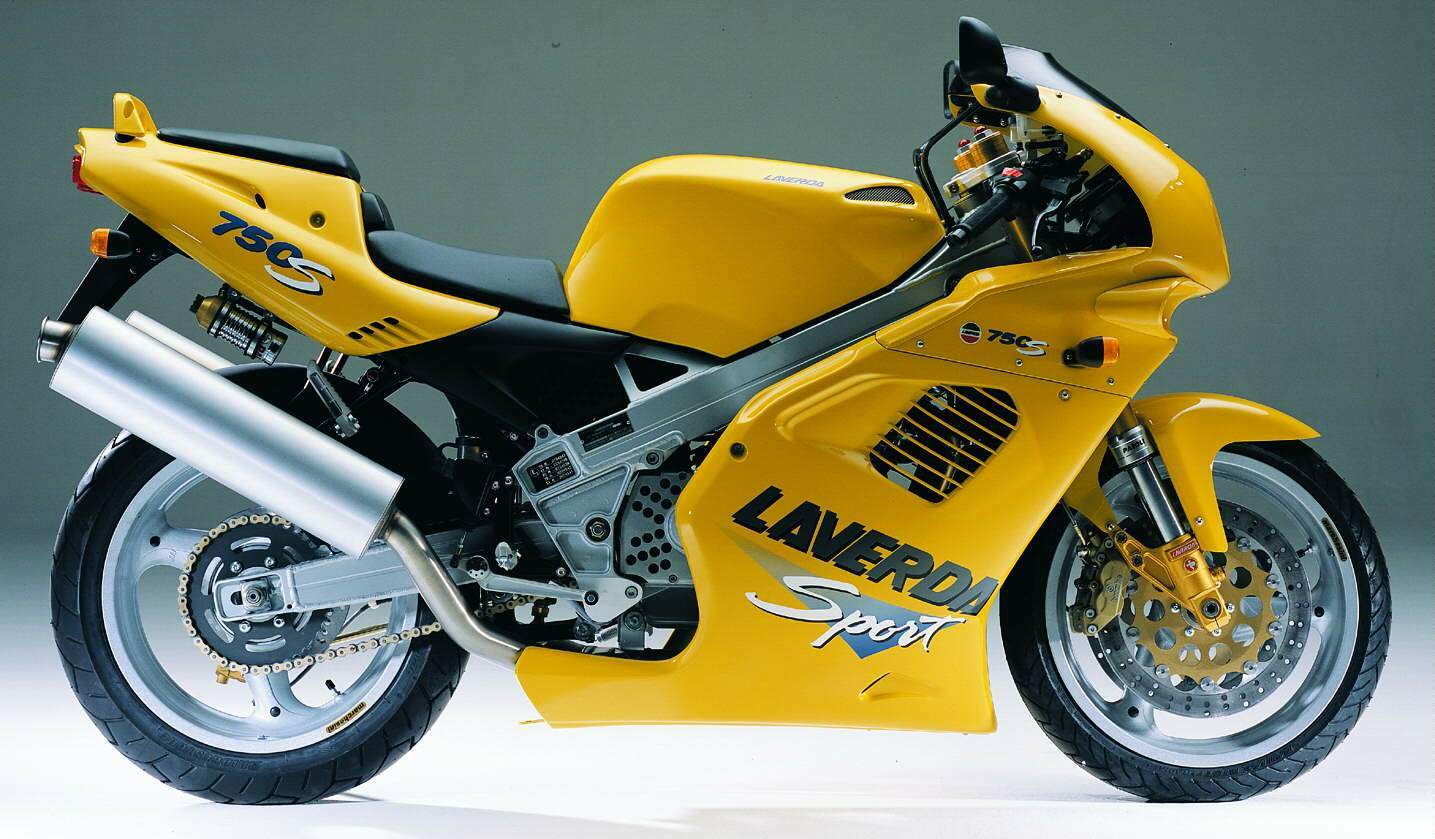
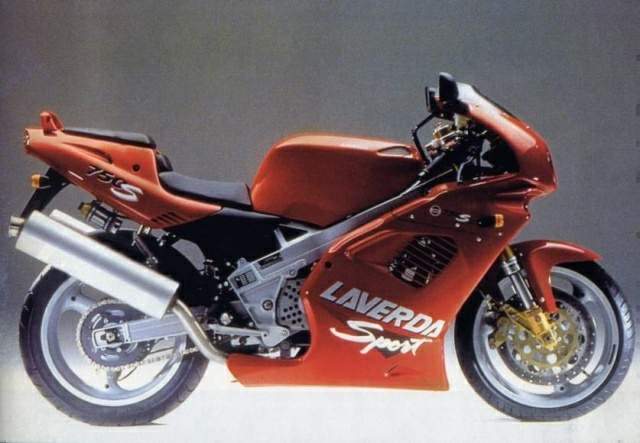
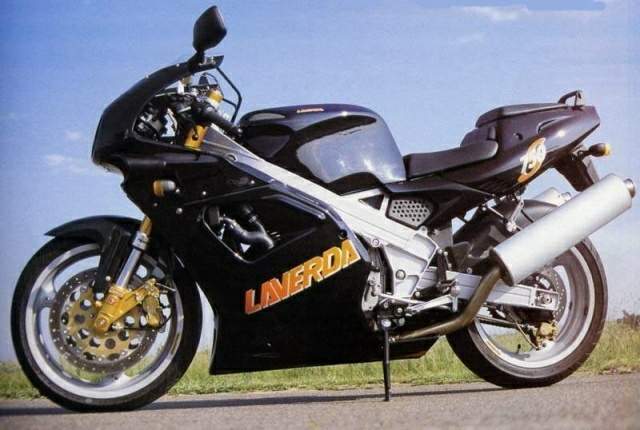
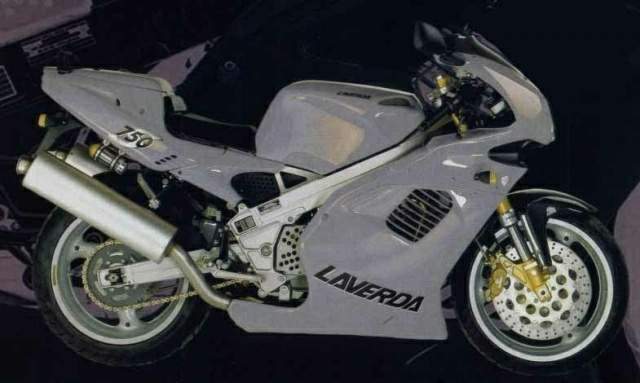
Laverda 750 Sport

|
Make Model |
Laverda 750 Sport |
|
Year |
1998 |
|
Engine |
Liquid cooled, four stroke, parallel twin. DOHC, 4 valve
per cylinder. |
|
Capacity |
748 |
|
Bore x Stroke |
83 X 69 mm |
|
Compression Ratio |
11.5:1 |
|
Induction |
Twin Weber-Marelli electronic injection |
|
Ignition /
Starting |
Weber-Marelli electronic /
electric |
|
Max Power |
85 hp @ 9200 rpm (rear
tyre 81.6 hp @ 8100 rpm) |
|
Max Torque |
75 Nm @ 7200 RPM |
|
Transmission /
Drive |
6 Speed / chain |
|
Front Suspension |
Paioli Racing Inverted adjustable preload, rebound
and
compression damping |
|
Rear Suspension |
Paioli Monoshock, spring preload, rebound and
compression damping adjustable. |
|
Front Brakes |
2x 320mm discs 4 piston calipers |
|
Rear Brakes |
Single 245mm disc 2 piston caliper |
|
Front Tyre |
120/60-17 |
|
Rear Tyre |
160/60-17 |
|
Dry-Weight / Wet-Weight |
185 kg / 202 kg |
|
Fuel Capacity |
16 Litres |
|
Consumption average |
15.8 km/lit |
|
Braking 60 - 0 / 100 - 0 |
13.7 m / 39.4 m |
|
Standing
¼ Mile |
11.9 sec / 180.8 km/h |
|
Top Speed |
217.2 km/h |
|
Overview |
Insidebikes.com |

The Laverda 750S was the last version of the bike which
relaunched Laverda in 1991, the 650 Sport. A heavily revised parallel twin
engine in an up-to-date chassis, the 750S captured many riders' hearts with
its high-class specification. The chassis was built around a twin-beam
aluminium frame. Paioli upside-down front forks, a Paioli monoshock,
Marchesini wheels and Brembo brakes are as fine as anything fitted to Ducati
or Bimota machines. The result is an exquisitely well-balanced machine, with
excellent handling. Unfortunately, the Laverda is let down by its engine.
Based on an extremely old design, it has a rewy, harsh delivery, despite its
fuel-injection.

Laverda 750S
Added on Friday 20th June 2008 at 09:57
By the late 1990s Laverda were developing their parallel twin sportster into a
decent bike, which was also getting cheaper in the UK as the pound got stronger.
An almost entirely new engine, watercooled and breathing through fuel injection,
boosted power to over 80bhp, plus vibration was reduced with balancer shafts.
The crude, twin cylinder motor had always been the Laverda’s weak point and now,
with a torquier, smoother mill, the twin spar chassis and Brembo brakes could
really shine. Suddenly, the old fashioned big twin concept seemed to make sense.
One quick blast up the road is all it takes to confirm that the 750S is the
start of something big for Laverda. At a glance the bike is very similar to the
firm’s previous parallel twins. Its chassis is almost identical, its styling
owes much to earlier models, and despite being watercooled the new,
grey-finished motor fires up with a mechanical whir and a familiar chuffing from
its twin pipes.
But the 750S motor responds more quickly to a blip of the throttle, its clutch
is notably lighter than before, and the new twin has a distinctly smoother feel
as it pulls away. There’s still plenty of Laverda twin character, but the whole
bike seems more refined. Then you crack open the throttle in first gear, and the
front wheel heads for the clouds to show that, despite its sophisticated
manners, this bike is much more of a hooligan than any of its predecessors.
If that hasn’t convinced you that the 750S is a brilliantly enjoyable motorbike,
the first tight bend will do the trick. Squeeze the Laverda’s big front Brembo
discs and you slow with tackle-crunching ferocity. Flick the clip-ons and the
bike cranks onto its side with suspension and tyres carving a precise line
through the corner. Wind open the throttle and the twin-pot motor revs smoothly
and hard towards its redline at just over nine grand.
Those first few hundred yards are what stick in my mind after a day spent
thrashing about on the new Lav mainly because I hadn’t expected the bike to be
anything like this good. Laverda have been steadily refining the age-old
parallel twin format since bike-mad local textile baron Francesco Tognon took
over and began rebuilding the firm a little over three years ago. But despite
that, the oil/aircooled parallel twin motors have always felt a bit crude, and
I’d expected the 750S to be just another small step in the process of evolution.
Instead the new bike takes Laverda a big leap forward, thanks largely to a
watercooled engine whose basic layout is similar to that of its predecessors,
but which shares few components and is a far more sophisticated piece of work.
The 750S is the first bike that the new company regards as its own design.
Tognon says it represents the second phase of Laverda’s recovery and riding it
shows that he ain’t exaggerating.
The five-strong design and engineering team at Laverda’s base in Zan in
north-eastern Italy left no stone unturned in their attempt to uprate the
twin-cam, eight-valve parallel twin unit that has helped put the firm back on
the map. Boring out the motor from 78.5 to 83mm increases capacity to 747cc from
the old lump’s 668cc.
The 180-degree crankshaft’s stroke remains at 69mm, but changes including a new
balancer shaft are intended to reduce vibration. A new pair of camshafts sit in
a narrower cylinder head that also features the novelty of watercooled seats for
the exhaust valves. Compression ratio is up from 9:1 to 10.5:1 which, along with
the new twin-pipe exhaust system, helps increase the claimed peak output from 70
to 82.5bhp at 7000rpm. The six-speed gearbox incorporates revised teeth and
dogs; changes to the clutch include a new master cylinder designed to give a
lighter feel at the lever.
The chassis is essentially that of the 668cc twins, based around a twin-spar
aluminium frame built for the original 650 model that appeared back in 1992.
Laverda have never skimped on cycle parts, and the new bike carries on the
tradition. Paioli supply the 41mm upside-down forks and the rear shock, both
multi-adjustable. Brembo provide brakes (four-pot calipers and 320mm discs up
front); wheels are three-spoke Marchesinis wearing Pirelli Dragons.
Fork-tops are pushed well through the yokes to quicken the steering compared to
the Ghost models (rake is still a less-than-racy 26.5 degrees, even so). At
192kg dry the Lav weighs a bit less than Ducati’s 748, the same as Honda’s
VTR1000 and slightly more than Suzuki’s TL1000. But the 750S is very slim and
low, and its under-seat fuel tank helps make for a very light and manoeuvrable
bike that immediately makes you feel at home.
The motor’s new-found smoothness is obvious, and you soon discover that there’s
extra power through most of the rev range too. At very low revs the bike judders
like a road drill, shaking the mirrors that are mounted to the flimsy fairing.
But the vibration fades by 3000rpm, and from then on the Laverda punches with a
force that is not exactly earth-shattering (Ducati’s 900SS probably has slightly
more midrange), but which is more than enough to make you grin.
Previous Laverda twins certainly don’t wheelie like this bike does given a
first-gear crack of the throttle and they don’t tempt you to keep thrashing them
in the same way either. Response from the revised, faster-reacting Weber
fuel-injection system is ace. And the motor’s added smoothness is just as
important as its extra power, because you’re more tempted to keep the revs in
the sweet zone between 6000 and 8000rpm.
Same goes for the new gearbox, which is a big improvement on previous Laverda
efforts. The box shifted cleanly at speed, and was let down only by an
occasional reluctance to find neutral at a standstill. Word from the factory is
that this was caused by this pre-production bike’s slightly dragging clutch, and
that a modification has already been found to prevent the same thing happening
to production machines. (What’s more, Laverda seem so on-the-ball these days
that it’s probably true...)
Provided it’s kept revving the 750S is respectably quick as it heads for a top
speed of close to 140mph. Granted, that makes it by no means the fastest sports
bike in the world. Acceleration above 120mph is pretty gentle, and many riders
would doubtless prefer a bit more poke for track days and serious Sunday morning
scratching. But the rest of the time that performance gives the perfect excuse
for plenty of full-throttle craziness.
Predictably the chassis copes effortlessly with everything the engine and rider
can throw at it. Laverda really got it right with the 668cc models a few years
ago, since when they’ve merely added a few refinements. The hefty twin-spar
frame doesn’t have to break sweat to keep 80 horses under control. Forks and
shock are firm enough to jar a bit over big bumps, and the riding position means
you wouldn’t want to ride in traffic for long (steering lock is pretty tight
too). But suspension control is superb and the bike feels better the harder it’s
ridden.
Despite its less than radical geometry the short, light 750S steers pretty
quickly. And it also has a stunningly stable, well-planted cornering feel, with
no sign of TL1000-style twitchiness. The rear Dragon is a fairly narrow
160-section cover on a five-inch rim, but for road use the 750S has heaps of
grip, and enough ground clearance to need it. The front tyre has to work hard,
too, when Brembo’s excellent stoppers are used in anger.
Not that I needed the brakes to slow down when, only a few miles after setting
off from importers Three Cross, the bike suddenly lost all life and coasted to a
halt at the roadside. It turned out that the sidestand cut-out switch was
killing the sparks, although the stand was fully retracted. A few turns of a
spanner from the toolkit soon had it sorted, but this is the sort of silly
problem that Laverda need to avoid if they’re going to steal sales from the big
boys.
Another electrics-related niggle was that the 19 litre fuel tank’s low warning
light had a habit of flashing on far too early, in typical Italian fashion. But
quality generally seemed good. Laverda boss Tognon has made a serious investment
in an attempt to improve reliability. Finish of parts such as the frame,
bodywork and paint (any colour you like as long as it’s black) is well up to
standard.
When you consider that only a few years ago Laverda seemed to be in a terminal
crisis, following the collapse of yet another attempted revival, the appearance
of the firm’s first truly new bike is a result in itself. That the 750S is so
good is a minor miracle. And what’s more, the normal Italian bike sting in the
tail a price several thousand quid higher than the Japanese competition doesn’t
apply.
Three Cross have pitched the 750S at a very competitive £7499 on the road,
hardly more than the 668cc Lavs and substantially cheaper than the TL1000S and
VTR1000, let alone Ducati’s 748. If you’re looking for a twin-cylinder sports
bike with a bit of character, the 750S is worth checking out. One quick blast up
the road is all it takes...
Source
Insidebikes.com

|