|
|
|
|
Classic Bikes
Custom Bikes
Individual
Racing Bikes AJP
AJS
Aprilia
Ariel
Avinton / Wakan
Bajaj
Benelli
Beta
Bimota
BMW
Brough Superior
BRP Cam-Am
BSA
Buell / EBR
Bultaco
Cagiva
Campagna
CCM
CF Moto
Combat Motors
Derbi
Deus
Ducati
Excelsior
GASGAS
Ghezzi Brian
Gilera
GIMA
Harley Davidson
Hero
Highland
Honda
Horex
Husaberg
Husqvarna
Hyosung
Indian
Jawa
Kawasaki
KTM
KYMCO
Laverda
Lazareth
Magni
Maico
Mash
Matchless
Mondial
Moto Guzzi
Moto Morini
MV Agusta
MZ / MuZ
NCR
Norton
NSU
Paton
Peugeot
Piaggio
Revival Cycles
Roland Sands
Royal Enfield
Sachs
Sherco
Sunbeam
Suzuki
SWM
SYM
Triumph
TVS
Ural
Velocette
Vespa
Victory
Vincent
VOR
Voxan
Vyrus
Walt Siegl
Walz
Wrenchmonkees
Wunderlich
XTR / Radical
Yamaha
Zero
Video
Technical
Complete Manufacturer List
|
Laverda 668 Sport
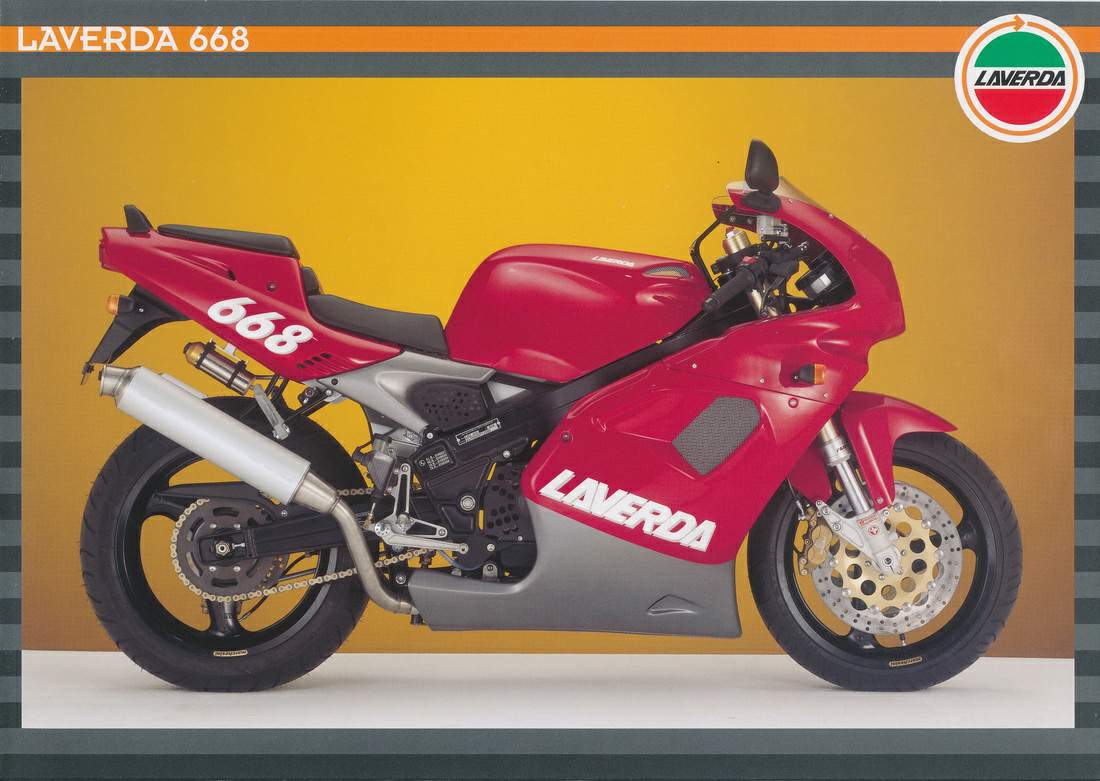
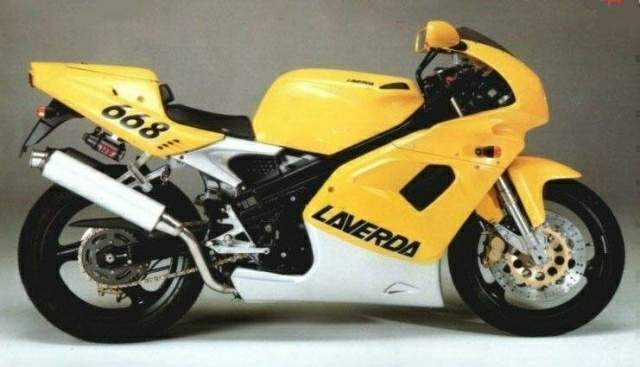
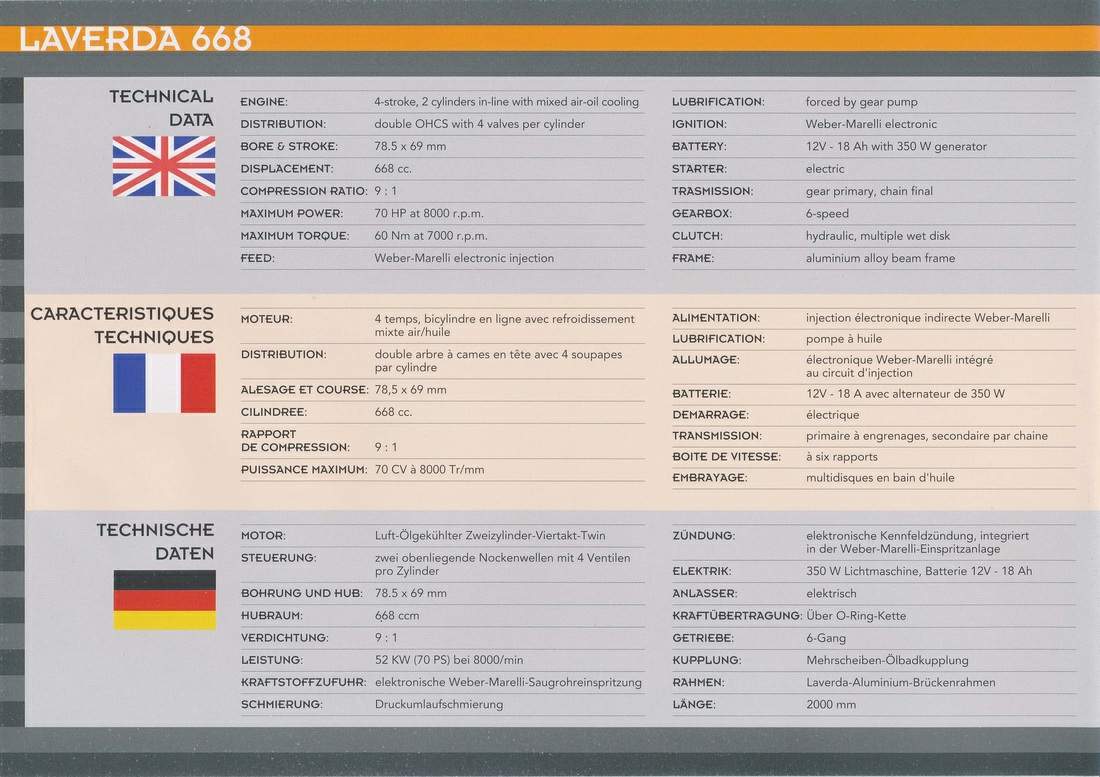
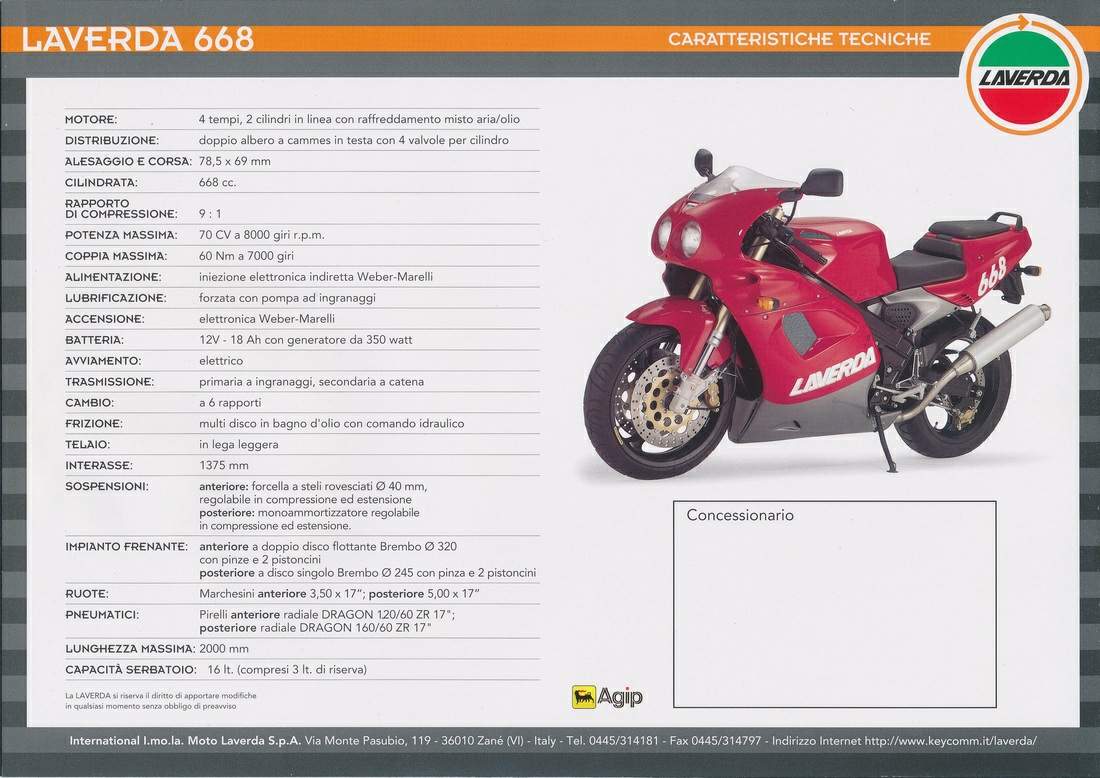
668 SPORTSTER The 668 sportster was marketed in yellow/black or red/black, with metallic grey on some areas, such as the bottom of the fairing and on the small side covers. Its main styling difference from the 650 Sport/Formula was its new twin (round) headlamp fairing, in place of the earlier model's single oblong light assembly. There was also a half-faired version of the 668, the Diamante, with a Ghost-type steel tubular chassis. Technically, the 668 was supposed to be superior to the 650. In fact, it not only used the same engine size (668cc), but also, except for improved engine components to erase problems that had been experienced on some 650s, was much the same. The early 668s had the 650/Ghost series exhaust with its ugly collector box, but the Ghost Legend/Strike revised exhaust pipes did provide a genuine improvement in mid-range power. Instead of making significant improvements to the 668, Laverda's engineering and marketing men preferred to keep their powder dry, waiting for the next stage in the evolution of the dohc parallel twin saga. Their seven-fifty water-cooled version debuted at shows around the world at the end of 1996 in prototype form, and entered production in late spring 1997. This important engine and the models it spawned are discussed in Chapter 15. Over the weekend of 17-20 July 1997, the existing owners of Laverda I.mo.la (in conjunction with Moto Club Breganze) celebrated the 50th anniversary of the marque. Over 1,400 enthusiasts were greeted at the gathering by the Mayor of Breganze, Dott. Francesco Crivellaro. 650/668 Technical Information All 650 and 668 models detailed here used the same basic 668cc (78.5 x 69mm) oil/air-cooled 4-valves-per-cylinder with dohc and Weber-Marelli electronic fuel injection. This was originally designed by Angelo Ferrari back in the late 1980s, and was based on the Alpino unit of a decade earlier. Few problems were experienced with the early 650 Sport models constructed from component parts already in stock after the Tognon takeover in 1993. However, with some later engines, mainly those built in late 1995 and early 1996, such as the 650 Sport and Formula and early 668 models, the following problems were experienced. They were put right under a programme carried out by Laverda and its local agents - in the UK, Three Cross Imports Ltd. 1 An improved cylinder head (manufactured by SCF of Reggio Emilia with new oil ways and new valve seats superseded the original design. It was usually supplied with valves, springs and buckets, but using existing cams and rockers. 2 Piston modification using different type of rings. 3 Original cylinder heads were thickly finished in paint. This was found to stifle the cooling process, so subsequent heads were finished in a fine sprinkling of metallic particles, to increase heat dissipation. 4 Alleged crankcase stud breakage - usually caused by incorrect torque figures. It is not recommended to exceed those advised in the official workshop manual for each model. 5 Generator, clutch and balancer shaft nuts. In the spring of 1996, the original castellated type were replaced by conventional hexagon type, to prevent them working loose, particularly the one keeping the alternator in place. 6 From Ghost engine number 2114, the oil pump set was changed for an upgraded type. Most 668s and all Diamantes had the improved type fitted as standard. 7 From late 1996, a new type of exhaust crossover pipe was fitted to replace the huge collector box on the 650 Sport, Formula and most Ghosts and 668s. This saw the two header pipes siamesed under the engine with no collector box. This change provided greatly improved mid/low-range engine-torque characteristics. 8 Electrical problems may be experienced on all the air-cooled 650/668 models. This can usually be traced to the fuse box and relays located under the rider's seat. To prevent this, these components need to be cleaned, and sealed with a silicon rubber sealant once everything is 100 per cent dry. Vaseline should be smeared on the blades of the fuses, and the relays fastened in place with cable ties. Finally, a small hole can be drilled in the base of the small plastic cover that fits over the fuses. This will prevent water collecting there.
|
|
|
Any corrections or more information on these motorcycles will be kindly appreciated. |