|
|
|
|
Classic Bikes
Custom Bikes
Individual
Racing Bikes AJP
AJS
Aprilia
Ariel
Avinton / Wakan
Bajaj
Benelli
Beta
Bimota
BMW
Brough Superior
BRP Cam-Am
BSA
Buell / EBR
Bultaco
Cagiva
Campagna
CCM
CF Moto
Combat Motors
Derbi
Deus
Ducati
Excelsior
GASGAS
Ghezzi Brian
Gilera
GIMA
Harley Davidson
Hero
Highland
Honda
Horex
Husaberg
Husqvarna
Hyosung
Indian
Jawa
Kawasaki
KTM
KYMCO
Laverda
Lazareth
Magni
Maico
Mash
Matchless
Mondial
Moto Guzzi
Moto Morini
MV Agusta
MZ / MuZ
NCR
Norton
NSU
Paton
Peugeot
Piaggio
Revival Cycles
Roland Sands
Royal Enfield
Sachs
Sherco
Sunbeam
Suzuki
SWM
SYM
Triumph
TVS
Ural
Velocette
Vespa
Victory
Vincent
VOR
Voxan
Vyrus
Walt Siegl
Walz
Wrenchmonkees
Wunderlich
XTR / Radical
Yamaha
Zero
Video
Technical
Complete Manufacturer List
|
Laverda 1200 America
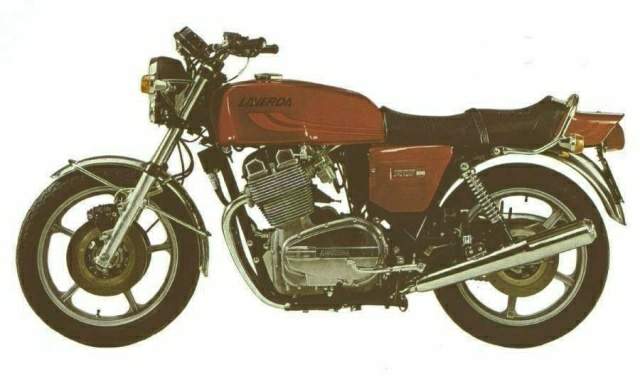
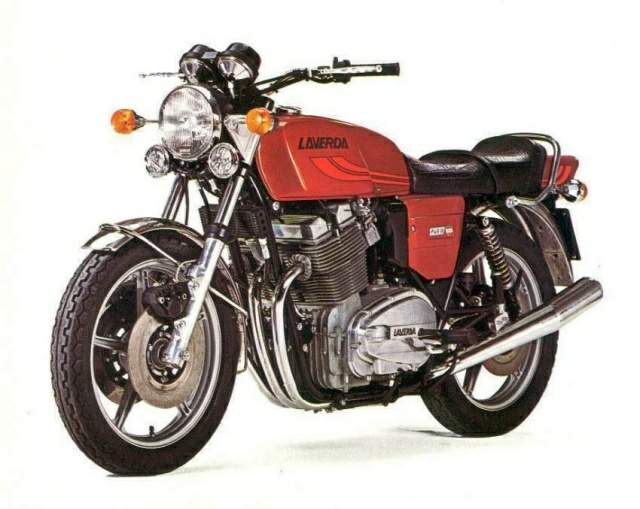
Scratch any street rider in Italy and you'll find a Giacomo Agostini seething beneath the surface. Scratch his Italian street bike and you'll find a spirited roadracer lurking inside. It's no wonder then, that despite not being technological front-runners, Italian motorcycles are able to arouse one's passions while going around corners. An Italobike may have a high-density seat, brutal suspension, numbing vibration and a price debilitating to all but the fattest of wallets, but you can bet your bottom Lira that it will dart over the twisty sections of blacktop like a slot car and make the raciest noises this side of a Grand Prix track. The Laverda Jota America 1200 is a perfect example. It is an exciting, highly emotional motorcycle that is thrilling to ride, fun to corner and stimulating just to be near, even though making it work is a high-effort proposition. On a Jota, you are a 100-percent participant, not a lifeless body just along for the ride. All the controls, whether worked by hand or by foot, require deliberate, forceful manipulation. Low-speed steering borders on the strenuous, yet at high speeds, handlebar movements must be delicate to prevent rider-induced twitches. And the rudeness of the seat and suspension will test the perseverence of even the most butt-calloused riders on trips of 100 miles or more. But creature comforts are not the stock and trade of the Laverda; emotion and excitement are, beginning with the 1116cc, DOHC three-cylinder engine. When the cold-start mixture enricheners on the trio of 32mm Dell'Orto accelerator-pump carbs are engaged, the big triple roars to life at the touch of the electric-start button. The Jota then settles into a staccato idle—a hammering, fast-paced booming of exhaust racket that, in cadence if not in volume, is something you'd expect to hear coming from the loud end of a AA/Fuel dragster, not from a mere three-cylinder street motorcycle. In that warm-up idling mode, the 1200 sounds as if it's able to consume the quarter-mile in about five seconds, which is about seven and a half seconds faster than the bike can really manage. Once up to operating temperature, the Laverda still sounds radical. Although the machine-gun idle goes away once the enricheners are turned off, a sundry selection of mechanical tickings and whirrings continues to at least imply raciness. But it is the raspy, high-strung exhaust note, playing in harmony with an uncommonly deep, resonating intake roar, that endows the 1200 with a symphony of sound unmatched by any other superbike.
The unique sound of the Jota's engine is a by-product of its odd crankshaft design. While developing the original 1000cc triple several years ago, Laverda's engineers experimented with conventional 120-degree three-cylinder crankshafts. But they finally settled on an unusual (for a triple) 180-degree "flat" crank, where the two outside pistons move up and down in unison, firing on alternate revolutions. The center cylinder's crank pin is offset 180 degrees from the other two, producing a firing sequence like that of an inline four with the No. 3 spark plug disconnected. The sequence is therefore uneven, with two firings occurring at 180-degree intervals and the third after a 360-degree interval. The flat crank helps eliminate a rocking-couple-induced vibration present in engines having 120-degree cranks, but secondary vibrations, which just about cancel out one another in a 120-degree layout, are intensified with the 180 crank. Laverda claims to have extracted more usable power from the triple with the 180, but we'd guess that the full-race exhaust note furnished by the flat crank greatly influenced its selection for the triple. The Jota America is a lower-compression, 5mm-overbored version of the 1000cc Laverda Threes. And while the added 135cc haven't markedly boosted acceleration, the extra displacement helps the 1200 meet current EPA emissions regulations while maintaining the same level of high performance established by the 1000. The America's quarter-mile times, respectable as they might be (12.54 seconds 105.0 mph), clearly reveal that the world's biggest-engined superbike is indeed neither the quickest nor the fastest. Which brings us right back to the Italian mystique once again: Drag racing is not all-important in Italy; roadracing is. Translation: A Laverda 1200 won't out-drag the likes of a Honda Six or a Yamaha 1100 on a dragstrip, but if you lure those same bikes onto a choice piece of winding mountain two-lane you'll teach them a lesson they won't soon forget. When the going gets twisted, the Jota America mirrors the pavement-scratching priorities of its creators in both power and handling. The 1200 feeds a massive dose of midrange torque through five well-staged gear ratios, providing usable power and snappy response in every normal cornering situation. The engine/gearbox match-up is so compatible that the selection of gears while briskly unwinding a crooked road isn't critical. Only when you're trying to make record time on that stretch of corner-laden blacktop is the right gear at precisely the right rpm of any import. When one of those mad asphalt dashes is in progress and you've put on your Sunday-best race face, it pays to have a chassis' that measures up to the engine. And the Laverda's does, at least within the limits of the cornering speeds you can attain on the road. The America just loves to be laid over into turns of all types, so it feels reassuringly stable and completely at home when the horizon begins to look more like the vertical. In addition, the Dunlop TT100 tires (they're called K81s on this side of The Pond) earn their keep when the lean angles get really racy by keeping both ends of the 1200 from stepping out of line. The Jota America may be the largest-displacement superbike of all, but with a comparatively low center of gravity for its 518 pounds, the 1200 triple physically feels—and is—no bulkier than the best 750 fours. The most conspicuous asset of such compactness is the ease with which the Laverda will bank over into a turn or flip from side to side in fast esses. Even during reasonably hard braking, the bike exhibits little tendency to sit up or otherwise resist being leaned over. Conversely, tapping the brake or closing the throttle while rushing through a turn doesn't cause the big Jota to drop inward and tighten up its line. The 1200 has an extremely narrow basic engine configuration, even for a triple, which helps account for the bike's low center of gravity. The engine's slenderness permits it to sit fairly low in the chassis compared to the location of the average four-cylinder engine. When you're seated on the bike, no part of the cylinder or head can be seen protruding from under the 5.1-gallon gas tank, which in itself is unusually slim by current big-bike standards. Only the thin cover for the triplex-chain primary drive is visible on the left, but it's a different story on the right, where a massive housing enclosing the 140-watt Bosch AC generator hangs out from the main case. Were it not for that generator-case appendage which pokes out into the wind just as far as the right footpeg, the engine could easily have been set even lower in the frame, further dropping the Jota's center of gravity. As it is, cornering clearance is still quite acceptable, with the sidestand and centerstand being the first things to graunch on the left and the generator cover obviously the first to touch down on the right. The Laverda's suspension pieces are crafted by Ceriani, a name once synonymous with impeccable wheel control. But if the unyielding behavior of the Jota America's fork and laid-down shocks is an accurate barometer that famous Italian firm has fallen behind the technology of the times. Motorcycles such as the Suzuki GS1000 and the Honda CX500 have proven that comfort and handling need not be mutually exclusive, but the Laverda reflects none of that philosophy. Rider comfort pays the dearest price for the Jota's taut suspension rates, since handling seems largely unbothered by the harshness. Rough corners can be rounded at virtually the same speed as smooth ones without incident, and the firm spring rates at least let the 1200 maintain good cornering clearance in hard bends. The America seemed to have no built-in, sure-fire wobbles, even though we occasionally experienced a few wiggles. But these were caused directly by the rider and indirectly by the suspension. If the rider was sitting bolt-upright and stiff-armed, and if a bump jarred the chassis in a roughly surfaced corner, the rider was jostled enough to move the handlebars ever so slightly. The front end has such hair-trigger sensitivity at moderate and high speeds that those small handlebar movements would often generate a mild, short-lived twitch. We found the best solution to forestall such behavior was for the rider to bend his arms and lean forward slightly when cornering, rather than sitting upright and stiff-armed. There's no such simple solution for the ride. Either Ceriani or Laverda has assumed that a Jota owner has no desire to be pampered like a dozen eggs, that he wants to "feel" the road. Well, not only do you feel it, your body gets a topographical readout of everything the wheels roll over, big or small. And the seat itself is so painfully short of easy-chair luxuriousness that the word "pamper" will never even enter your mind. The only comfort-saving grace is that the low-rise handle-bars and mildly rearset footpegs encourage a leaned-forward, quasi-café riding position which alleviates some of the abuse directed to the buttocks and lower spine. Only when in that comfortable position can you endure more than 75 to 100 miles a day on the 1200. The Jota, in this age of turbine-smooth multis, dynamic counterbalancers and rubber-mounted engines, can prove to be a bit of a vibrator. Fortunately, the worst of the shuddering, which is felt through the footpegs and handlebars, comes in above 4000 rpm (approximately 70 mph in high gear), permitting pleasantly smooth cruising at or near legal speeds. Above 4000 rpm the frequency of the vibes is not as annoyingly high as that felt on some four-cylinder motorcycles, but the intensity is greater. Thus, long stints above 4000 rpm will result in some tingling in the hands of the rider and in the feet of both the rider and his passenger. If you still harbor serious doubts as to whether comfort is a low-priority item at Laverda's factory in Breganze, Italy, consider the half-turn throttle that must pull against inordinately stiff return springs or the rear brake that requires a Paul Bunyonesque romp on the pedal to generate any perceptible stoppage. If that's not enough evidence, toss in a clutch lever that resists your pull like a hand exerciser and a long-throw shift lever that is so close to the footpeg that it only feels comfortable to a size-six shoe. On the other hand, reliability is a major concern at Laverda, which is why the 1200 is outfitted with a number of features to improve longevity. Prominent are the No. 630 chain superseding the smaller No. 530 used on the 1000, replaceable camshaft bushings, a solid-state ignition and voltage regulator, and Japanese-made instruments and switches. Needle bearings can be found at the swingarm pivot and tapered rollers at the steering head. And Laverda, like most European firms, prefers cast iron rather than stainless steel in its brake rotors for less fade and more consistent wet-weather stopping. The sole reliability concern our 1200 provoked involved the flip-up gas cap, which leaked like a coarse-pitch sieve. The Jota 1000 we tested in June of 1977 had the same problem, signaling that it's high time Laverda remedied this potentially dangerous design. We finally vented the cap on our Jota like on a dirt bike to solve this problem. At the time of our Laverda Jota test a year and a half ago, spending $4495 for a 1000cc Jota required some serious soul-searching. The same number of dollars could buy you the status of a BMW R100RS and 40 percent fewer dollars would slip you into a Japanese superbike. But now the big BeeEm has escalated to more than$6000 and the new Honda Six is pegged at four grand. The 1000cc Yamahas, Suzukis and Kawasakis are temporarily hovering near the $3500 mark while threatening to go even higher if the Dollar keeps getting kayoed by the Yen. But in the middle of this skyrocketing inflation is the Jota America, at $4250 a whole $245 cheaper than the Jota 1000. The big triple is no longer a breathtakingly overpriced exotibike. It's still exotic, but now it's practically as affordable as the Japanese monsterbikes. But don't let the Jota's suddenly reasonable price confuse the issue. The Jota America is still not ever man's motorcycle. It is not a pinnacle of sophistication, smoothness, effortless operation or infatuating gadgetry. You could easily get faster, better-suspended motorcycles for less money. But we're not talking bargains or economics here. We're talking excitement and passion; fast cornering, blood-curdling engine sounds and serious rider involvement. We're talking the language of Italian motorcycles. If your personal demographics match up with the Jota's profile, you'll like the bike a lot. And if you're unsure about it all, finding the answer is easy. Just scratch your throttle hand and see if anyone named Kenny or Giacomo is hiding in there. RIDE REVIEWA ride on the Jota convinced me that Laverda must specialize in the construction of farm equipment. The suspension hammered me on rough roads, the brakes demanded a mighty yank and a stomp, and the clutch required a peasant farmer's strength. Even the bellow from the engine sounded like it belonged to a tractor. The Jota is about as frivolous as a turnip. But as the spare, British-like lines of the Jota suggest, the best thing about this motorcycle is its lack of frivolity. Everything here works for a living. The gearing permits the 1200cc torquer to work at a sensible rpm. The stiff suspension swallows seed without hesitation. There's probably a reason that the Jota, unlike a Ducati Darmah or Honda CBX, turns heads wherever it goes. It's because even the man in the street admires a totally serious machine. And in the face of foolish styling and engineering exercises, the Jota's seriousness makes it pretty appealing to me, even though eight hours on this bike makes me feel like I've been plowing a field all day. —Michael Jordan The Laverda 1200 America is a brutish motorcycle. The enormous triple is surly in general. It makes low-rpm, throbbing torque, while also making a good deal of noise and vibration. The levers are sized for enormous hands, and require an equally enormous squeeze to make anything happen. The rear brake is pretty much nonfunctional unless you stand on the pedal with both feet. A downward blow on the shift lever with a sledge hammer may result in a downshift. Riding the Laverda is a real workout. Too much of a workout as far as I am concerned. It's like riding some kind of unruly animal; you have to make it do what you want it to do. Personally, I'd rather ride a horse.—Jeff Karr It doesn't take a master's from Moto-U to know this Laverda is something special. Not only does it act like a hewn-from-marble motorcycle, it looks like it—as the endless streams of wide-eyed onlookers proved. One guy in a commuter-brown Chevy wagon even slid up to me at a stoplight, gave it the once-over and asked if it was American-made. It has exactly that square-jawed look. Unfortunately, the payoff for me in the way it handled, rode, accelerated and shifted just didn't measure up to the looks. I found myself liking the idea of the bike— 1200cc overstatement—better than the stuff it delivered. A balky shifter, too-long throttle pull and ungainly ergonomics just plain made it uncomfortable. But the sound it makes tips the scales. Any motorcycle that makes noises like an angry ack-ack gun can't be all bad. —Steve Thompson Source Cycle Guide
|
|
|
Any corrections or more information on these motorcycles will be kindly appreciated. |