|
|

|
|
|
|
Classic Bikes
Custom Bikes
Individual
Racing Bikes AJP
AJS
Aprilia
Ariel
Avinton / Wakan
Bajaj
Benelli
Beta
Bimota
BMW
Brough Superior
BRP Cam-Am
BSA
Buell / EBR
Bultaco
Cagiva
Campagna
CCM
CF Moto
Combat Motors
Derbi
Deus
Ducati
Excelsior
GASGAS
Ghezzi Brian
Gilera
GIMA
Harley Davidson
Hero
Highland
Honda
Horex
Husaberg
Husqvarna
Hyosung
Indian
Jawa
Kawasaki
KTM
KYMCO
Laverda
Lazareth
Magni
Maico
Mash
Matchless
Mondial
Moto Guzzi
Moto Morini
MV Agusta
MZ / MuZ
NCR
Norton
NSU
Paton
Peugeot
Piaggio
Revival Cycles
Roland Sands
Royal Enfield
Sachs
Sherco
Sunbeam
Suzuki
SWM
SYM
Triumph
TVS
Ural
Velocette
Vespa
Victory
Vincent
VOR
Voxan
Vyrus
Walt Siegl
Walz
Wrenchmonkees
Wunderlich
XTR / Radical
Yamaha
Zero
Video
Technical
Complete Manufacturer List
|
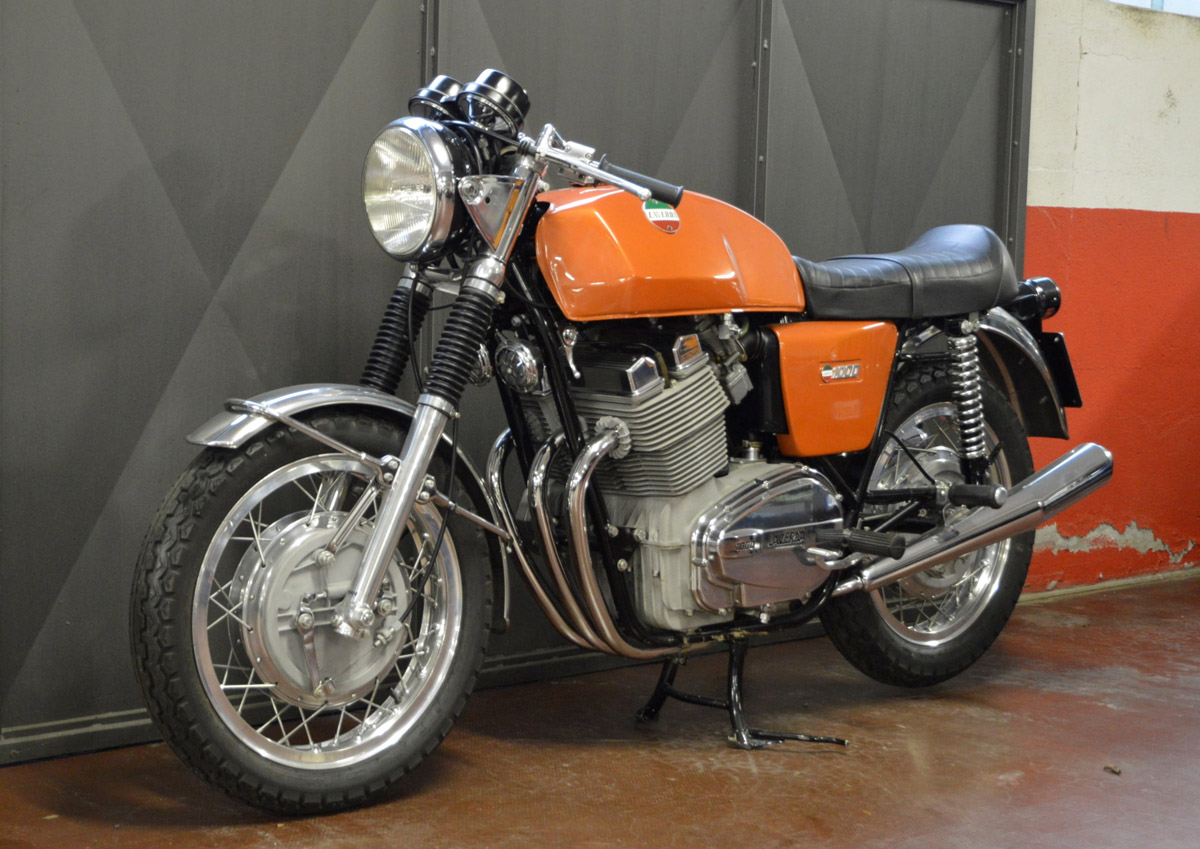
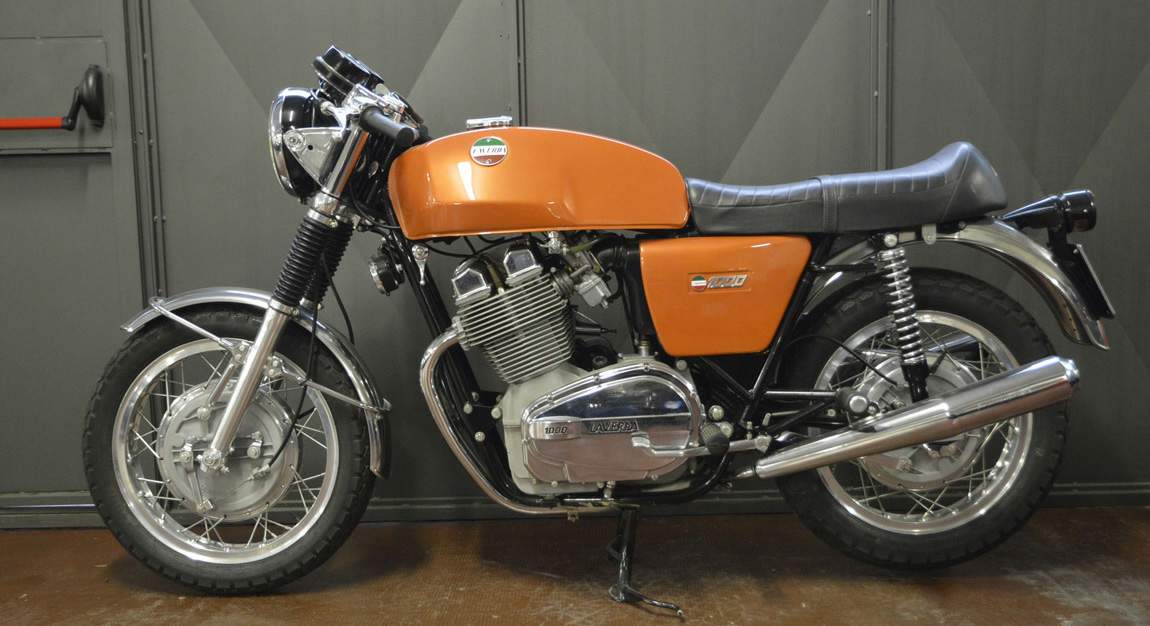
Laverda 1000 3C
So now you're thinking, "Wow! Clever Massimo Laverda should be able to sell thousands of the things." Indeed he should, but probably he won't. You see, the Laverda has a fatal flaw, which is its price. There's no firm figure, but the United States importers say it will be about $3000 and that's a cool thousand too much. Considered strictly on merit, the Laverda is a semi-rational alternative to Kawasaki's 903cc, four-cylinder Z-1: close for speed, not nearly as refined or smooth but better-handling. If you stop comparing right there you'd be faced with a hard choice. That extra grand just about eliminates the Laverda from consideration for all but Italiaphilic high-rollers, which is a pity because in most respects the triple is an extraordinarily good motorcycle. Traditionally Italian engineering has had a tendency to founder in a sticky passion for symmetry.. There have been many instances of engines designed as mirror images along both vertical planes, with cam drives originating right from the middle of the crankshaft and absolutely identical valves and ports on both the intake and exhaust sides of the head. All this in an emotional defiance of logic's stern laws. There was no reason for us to assume that Laverda would have avoided that trap with the 1000cc triple, or to have been innovative in any way. The only other Laverda we'd seen was the 750 twin, which visually is a photostatic enlargement of the old Honda CB-77. So we weren't expecting much more excitement from the triple than would be provided by sheer displacement (a factor not to be ignored: 61 cubic inches just won't take no for an answer even if its container isn't so brilliantly contrived).
In fact, Laverda's three-cylinder engine proves to be quite an imaginative piece of work. It contains, for example, a really elegant solution to the severe rocking vibration present in other inline triples. In the others the crankpins are disposed at 120 degrees, which gives reasonably evenly spaced power impulses but a tendency to teeter-totter along its longitudinal axis. In the Laverda triple, when the number-one crankpin is a TDC, number-two is down at BDC and number-three is up at TDC. In other words it's like a British vertical twin, with an extra cylinder inserted in the middle and working 180 degrees out of phase. In this arrangement the unbalanced forces are of a magnitude approximately equal to those in a 333cc single, but are reacting into such a large mass that relatively little shaking is transmitted into the Laverda's frame. Except at low engine speeds when it feels and sounds like a four with a fouled plug. The Laverda's ignition system is as offbeat as its firing order, and makes the same surprising kind of sense. Hidden away under the tank you'll find three coils, as expected, but they're wired together in a way that makes you almost believe half the laws of electricity have been repealed. These wires disappear into a pair of multiblade connectors and reappear down at an even more mystifying device on the righthand end of the crankshaft. Lacking the special puller needed to remove the magnetized flywheel shrouding the coils, we could only glimpse through holes in the flywheel's hub. It was impossible to trace all the circuitry and the owner's manual (in Italian) wasn't much help. But from what we could see the Laverda's Bosch ignition system basically is an energy transfer magneto, but with magnetic triggering instead of mechanical points. Being crank-speed driven, it delivers a waste spark at the end of each exhaust stroke. However this Bosch ignition works, it does deliver a magnificent spark and should need attention only infrequently. Still, it does have one shortcoming: its ability to produce sparks is in no way controlled by the key—only by a kill-button on the handlebar. The key itself activates the main electrical system when it's pushed in, making it possible to push-button start the engine, and twisting the key turns on the lights. That's all. You can push the Laverda and start it anytime, with or without a key—a distressing state of affairs for a hyper-expensive motorcycle in a world filled with rip-off artists. The Laverda owner's only protection against outlaw expropriations is a brass fork lock that seems fated to snap if unknown parties trouble themselves to pull hard at the handlebars. No amount of hauling at the handlebars is going to bend or even flex the Laverda's frame. This frame is fairly conventional with respect to layout, consisting of twin cradle tubes sweeping from the steering head, under the engine, and back up to the rear shock mountings, with a large backbone tube over the engine and smaller miscellaneous tubes bracing some of the corners. What you don't see, just looking at the bike, is that the backbone tube is almost two inches in diameter, and all the tubing is of waterpipe gauge. There are a couple of exposed tube ends where it is possible to measure wall thickness, and at those points it is .120-inch. Given enough sheer iron, a frame doesn't need to be brilliantly designed to provide the rigidity required for good handling, as is precisely the case with the Laverda, and was true of the revered Manx Norton. There's enough iron in the Laverda's frame to provide material for a railroad bridge across the Tiber, and it doesn't flex.
Attached to this very solid structure is a set of genuine, racing Ceriani forks and touring (but effective) Ceriani shocks. And you'll discover almost instantly in riding the Laverda that spring rates, suspension damping and steering geometry all are aimed dead-center at fast mountain road cruising. At low speeds the ride is quite stiff, almost jolting, and the steering is decidedly heavy. You could learn to dislike the Laverda 1000 if you were forced to ride it around town very long. Where the Laverda really lives is up in the hills, on swoopy roads. There the tall first gear becomes a convenience (it leads to a lot of clutch feathering in slow traffic) for hairpin turns, and the even staging of the other four ratios gives you a gear for every situation. Not that there is any need to pedal the Laverda around with the gear lever. Its engine has a lot of displacement, and makes excellent use of what it has, producing thunderous horsepower over a broad range and without a trace of temperament. Add to that the bike's good balance, which keeps it from trying to wheelie over backWards, and you've got an absolute rocketship for attacking mountain grades. There's a possibility that the Laverda 1000 will be getting a disc brake to replace the present twin leading shoe drum brake. We're not sure that's necessary. The bike's drums are 230mm (slightly over 9 inches) in diameter, massive alloy castings with iron liners, and have cast-in ventilation passages to hold things down to a working temperature even after repeated hard applications. Front and rear, the brake drums and wheels are identical, with different backing plates and covers to adapt them to their respective tasks. Laverda has, in this way, shown great cleverness in minimizing tooling costs, and we can admire that. Even so, the really admirable aspect of the bike's brakes is that they work extremely well. A finer touch is needed to hold the front brake just short of lockup than for most disc brakes, but it's nothing the average rider can't handle, and if there's any danger it will be from behind: only a very few cars, or motorcycles, will stop as quickly as the Laverda. Some of the Laverda's stopping capability should be credited to its Dunlop tires. These are 4.10 x 18 K81s, and they're the nearest thing to outright road racing tires we've seen. They may not be good for a jillion miles of Interstate cruising, like some of these hockey puck tires you can buy for $9.95 and a fistful of boxtops (we think maybe the rubber is too soft to be longlasting) but while they last they get a grip on the road like nothing else in the sport. The Dunlop tires also help make the Laverda a joy to flog around corners. They stick, and the chassis doesn't wiggle, so you can just go at it in a frenzy. The absolute test of handling is a very fast but decreasing radius esse-bend, which forces you to wrestle the bike from left to right while braking, or at least on trailing throttle. A lot of the other Superbikes become distinctly and unpleasantly unsuper in such modes, with their frames magically transformed from steel to rubber. The Laverda, by contrast, remains rock solid, and lets you press your luck pretty far before visions of gauze, plaster and liniment begin to dance in your head. It's a lot more fun to ride the Laverda fast than sensibly. The bike's long tank, rear-set seat and footpegs and flat bars insist that it be ridden in a kind of modified road racer's crouch. At brisk (that is to say illegal) speeds the wind pushing at your torso takes the load off your arms, but riding around town you'll start feeling a little like a man caught halfway through a pushup. Our test bike wasn't much good as a night-fighter, except for someone whose favorite tactic is sneaking up behind other vehicles. Despite having a Bosch electrical system and the biggest battery ever seen on anything this side of a police motorcycle, the Laverda's headlight pumped out only scarcely more lumens than you'd need to read your watch. It wasn't nearly bright enough to make anyone comfortable about any great rate of speed, even considering the effectiveness of the bike's brakes. Probably this shortage of illumination was due to some kind of live-voltage problem peculiar to this single motorcycle, as Bosch electrics enjoy a well-deserved reputation for quality and performance. But we're not sure. If a fully charged battery would have brought the headlight up to standard, a similar strengthening of the sound output from the horns would have made them absolutely dangerous. The Laverda has two Voxbell horns, and they put out enough noise to give a truck driver hives. No provision has been made for any kind of kick starter on the Laverda, and that's just fine. We are inclined to think that the prevalence of kick starters on electric-start motorcycles is more a nod to conservatism than logic, because if a bike's battery is too flat for the electric starter to work, its ignition usually will be weak enough to require pushing anyway. We think the kick pedal on motorcycles will go the way of cranks for automobiles. Certainly the Laverda's 27 amp-hour battery will have to be at death's door before you'll have to worry about alternative methods of starting. If appearance counts for anything, the Laverda's clutch isn't ever going to give anyone trouble. It has more diameter, more plates and stronger springs than just about any we've seen, and although it was brutalized by various of our test riders, it never slipped (unless the rider was doing a showy "Manx Norton" burnout and feathering the lever) and never needed adjustment. With all this it also is a very light (in pounds) clutch, being built inside an alloy outer housing and with thin, light plates—which by the way, make their engagement with the hub and housing through many small V-teeth, instead of the usual coarse dogs. The arrangement is familiar to anyone who has ever seen the clutches inside an automatic transmission, where it is used because it is simply more durable than any other. Clutch action never is exactly light on big displacement motorcycles (except the H-D big twins), and the Laverda hasn't broken with the tradition. Its clutch lever requires a fine, manly grip, (one that would impress everyone at the Yale Club), and after a day of riding the switchbacks and fanning the lever you're well on your way to having a left arm like a young Charley Atlas. Have no fear that your right arm will be allowed to languish unexercised. You can count on the brake lever for some muscle toning, but it will be the throttle that really keeps the old tendons taut. The Laverda has three 32mm Dell'Orto carburetors, and the return springs inside these make it clear that Dell'Orto, as a company, fears stuck throttle slides worse than Satan fears the True Cross. The throttle return springs are that strong, and trying to blip the engine for downshifts—squeezing the brake lever and rolling the throttle with the heel of your hand—would be hopeless, instead of merely difficult, but for the Dell'Orto carburetors' other outstanding feature. Each has an accelerator pump, and the engine gets a shot of fuel that really brings it snapping to attention even if the throttle is just sort of fumbled open. We had despaired of any other country creating a carburetor equal to Japan's Mikuni and Keihin. Indications are, that in this new carburetor, Italy may have done it. Our suggestions for improving the Laverda have mostly to do with subtleties: one thing we'd like to see is a sidestand, as it's a pain in the neck (and back, and arms) to have to heave the weighty rascal up on its centerstand every time you want to walk away from it for a minute. But we don't want a sidestand if the thing is going to drag when the Laverda's cranked over into a corner. Cornering is something the bike does better than any of its competition, and who wants to diminish that capability just to make parking easier? Better they should fiddle with the centerstand to make it retract a tad higher, as it now graunches when the bike is heeled over unless the rear spring setting is up at full-preload. Similarly we're not sure Laverda should alter the handlebars, tank and seat position to make the bike more comfortable around town if doing so will compromise its high speed cruising. But if the seat is going to stay where it is, the footpegs should be repositioned another couple of inches aft. Then it would feel even more like the closet road racer it is. It seems tragic to us that the Laverda 1000 should be doomed by circumstance to relative obscurity in the United States marketplace. It is, despite a few small and easily corrected flaws, a tremendously fine motorcycle. The three-cylinder engine isn't as smooth as a good four, but it's narrower and with all that displacement and twin overhead camshafts, it isn't giving away anything in horsepower. Handling? Most of the others aren't in the same league. Few people will ever be enthralled with the Laverda's fiberglass tank and stainless steel fenders, not to mention a lot of unpolished, sand-cast aluminum, but the primary quality is excellent. There's nothing basically shoddy anywhere. The same qualifications would absolutely guarantee success for any major manufacturer's product, but they're not going to do much for the Laverda. As it happens, Massimo Laverda's main business is making farm equipment; motorcycles are just a sideline. So the Laverda factory hasn't the production capacity to turn out many of these Superbikes, and because it can make only relatively few, a lot of unhappy consequences follow. Tooling costs, such as they are, work out to be a lot of dollars per unit produced, which raises the cost. And knowing that few motorcycles are to be built, Laverda must take a healthy profit on each or the whole thing isn't worth the investment. Distributors and importers inevitably come to the same conclusion, which prices an already expensive motorcycle even higher. After the dealer does the same the price is enough to bring tears. In the Laverda's case the situation is made even more dismal by the fact that the United States importer-presumptive doesn't think it has a chance, and the people angling to get their hands on the US franchise think its prospects of selling more than mere dozens are slender and its future almost non-existent. So why doesn't Laverda (among other Italian manufacturers) just tool up to build thousands and thousands of 1000cc triples? The answer is that things just don't work that way in Italy. There is no overriding concern for marketplaces, and there are no legions of marketing experts scurrying around the world's motorcycle markets trying to determine if room exists for a half-million projected new units. Italians are not Japanese and not Americans. In Italy, business is not life; life is life. Building specific products for specific markets is a concept which, though not alien to Italians, is an uncomfortable one. Italians build products which they like—then they go about finding customers. To the Anglo-Saxon mind, all of this "we build 'em the way we love 'em" stuff signals a grand indifference toward things which Americans hold dear: numbers, prices, profits and the American market. That's why Ferraris have ripply body panels, and why Laverdas cost $3000. The next question: is the Laverda worth $3000? The answer is no—if you use a 903cc Kawasaki as the standard of measure. The Z-1 is the obvious, unavoidable comparison. For someone who has three grand to drop on a motorcycle, the comparison probably isn't important. For example, a Datsun 240Z as a machine may do the same things that a Mercedes-Benz 450SL will do. Except for one big consideration. The fellow who buys a 450SL probably wouldn't own a Z-car on a bet. Which is to say: mechanical things may have the same capabilities, but they can still be in different leagues. But a healthy price should mean no rough edges in detailing. And like other Italian machines, the Laverda's quality in the paint department, the fiberglass work, and other small details remain behind the times and below the price tag. We might mention how the first Laverda 1000 in North America fell into our hands. Tom Lester in Bedford Heights, Ohio is an automobile and motorcycle enthusiast of enormous passion. A clue about his enthusiasm: one of his businesses is the Lester Tire Company which builds tires for classic cars. A second clue: Lester bought the 1000 sight unseen, out of Canada, on the strength of Laverda's reputation. He asked us if we wanted to test the machine. And you know what our reply was. So there the 1000 stands, cramped in Italy by its manufacturer's reluctance to produce it and its brothers in volume, and doomed in the United States by its high price and a lack of enthusiasm on the part of its importer. If Massimo Laverda decided to bite the financial bullet by committing himself to volume production, and if the US importer, whoever it turns out to be, pushed a little for the brilliant 1000, then in all likelihood the bike could be sold in quantity for maybe $2300, making a huge number on both sides of the price tag ecstatic. Then American enthusiasts could have the best of two worlds: a fresh Old World version of the Superbike concept with a made-in-the-Orient price sticker. But it's a good bet that it'll never happen. What a damnable shame. Source Cycle 1973
|
|
|
Any corrections or more information on these motorcycles will be kindly appreciated. |