|
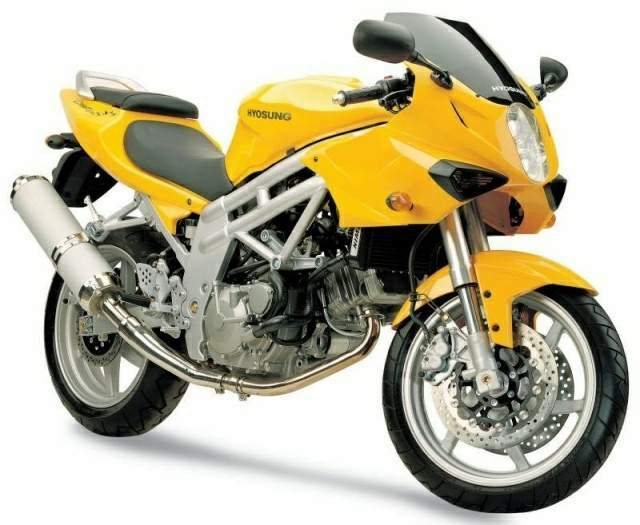
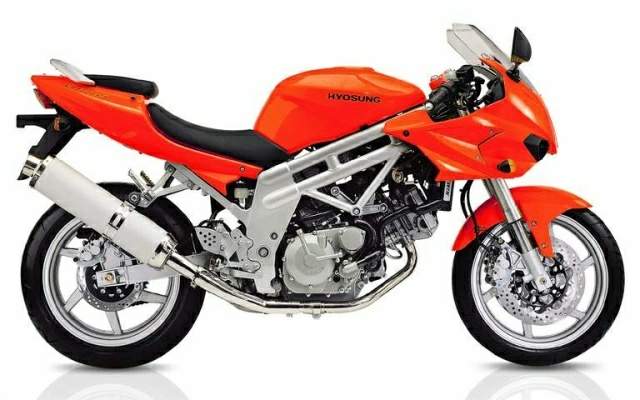
Hyosung GT 650S

|
Make Model |
Hyosung GT 650S |
|
Year |
2004-05 |
|
Engine |
Liquid cooled, four stroke, 90° V twin, DOHC,
4 valve |
|
Capacity |
647 |
|
Bore x Stroke |
81.5 x 62 mm |
|
Compression Ratio |
|
|
Induction |
2x 39mm carburetors |
|
Ignition /
Starting |
- / electric |
|
Max Power |
79 hp 58.9 KW @ 9000 rpm |
|
Max Torque |
68 Nm @ 7500 rpm |
|
Transmission /
Drive |
6 Speed / chain |
|
Frame |
Steel,
double pipe |
|
Front Suspension |
41mm Oil upside down forks, 120mm wheel
travel |
|
Rear Suspension |
Swinging arm, 100mm wheel travel. |
|
Front Brakes |
2x 300mm discs |
|
Rear Brakes |
Single 230mm disc |
|
Front Tyre |
120/60 -17 |
|
Rear Tyre |
160/60 -17 |
|
Seat Height |
780 mm |
|
Dry-Weight |
189 kg |
|
Fuel Capacity |
17 Litres |

One of the most remarkable economic turnarounds of the latter
half of the 20th century saw the phrase “Made in Japan” transformed from a
euphemism for “cheap and tinny” into the hallmark of some of the best
electronics, cars and motorcycles made. Now South Korea seems poised to follow
in Japan’s footsteps and assert itself as a world-class manufacturer of, among
other things, motorcycles. The Hyosung GT650S Comet proves one Korean bike maker
hasn’t caught up to Japan just yet, but has the raw material to start making its
move.
In 1979, a year after it was founded as a motorcycle manufacturer, Hyosung
Motors & Machinery Inc. formed a technical alliance with Suzuki of Japan, which
might account for the GT650S’s striking similarity to Suzuki’s SV650. The
GT650S’s 647cc V-twin engine is shared by the GT650R, a fully faired version of
the S, and the cruiser-styled GV650. Hyosung also makes a GV250 cruiser and a
GT250, as well as an ATV and several scooters.
I cadged a ride on a GT650S thanks to Hyosung dealer Rod Johnson, owner of Cycle
Parts in Eugene, Oregon. When I arrived, I found the bike waiting for me had
just a single mile on the odometer. Alongside the S sat Johnson’s personal
GT650R, which had an aftermarket exhaust and a jet kit, and 350 miles on the
clock. Photo model Paul and I took off on the bikes and headed for the country
on winding roads.
Advertisement The GT650S stood out immediately by virtue of its almost
non-existent front braking power. It took a manly squeeze of the lever just to
produce enough force to make the front end dive. It felt more like a poorly
adjusted drum brake than a modern disc brake. By contrast, the R model’s more
broken-in front brake worked much better, but still wasn’t up to class
standards. Both felt mushy, as if in need of bleeding or a good set of
aftermarket pads. Both, too, improved the more they were used, but not nearly
enough.
The lack of stopping power was doubly disheartening because the plucky little
carbureted V-twin engine was so eager. It’s very smooth throughout the
powerband, and revs willingly to its 10,500-rpm redline. But the bulk of its
torque lives between 4,000 and 8,000 rpm, with enough on tap to hustle along a
backroad so quickly you won’t miss spinning the tach needle to five digits.
Gearing seems tall for a middleweight—4,000 rpm in sixth gear corresponds to
about 60 mph.
The GT650S’s inverted cartridge-type front fork, which has adjustable rebound
and compression damping, works very well over a variety of surfaces, rounding
off hard-edged bumps with a minimum of fuss. The rear shock offers only spring
preload, but complements the fork’s response to road warts. Even with my 270
pounds aboard, the GT650S never bottomed or wallowed.
The riding position appears cramped, but the close spacing between the seat and
the bars makes it feel less so. The bars themselves are angled comfortably, and
the switchgear works well and is easy to operate even in heavy gloves. The foot
controls are adjustable to three positions, thanks to several holes on the
mounting plates. An analog tachometer accompanies the digital speedometer and
instrument panel, the readouts of which are so dim as to be all but invisible in
direct sunlight or when viewed from behind a dark face shield. The turn-signal
indicator is especially hard to see. Several times both Paul and I rode for
miles with our signals blinking before one of us alerted the other.
Out on the backroads the GT650S showed it has most of the right stuff to keep up
with the competition. It’s stable in corners though not especially flickable,
requiring a deliberate tug at the bar to initiate a turn. Repeated hard stops
eventually convinced the surly front binder to wake up and start acting sort of
like a twin-disc brake. Ridden within limits appropriate to the situation, the
GT650S was a hoot. Paul, aboard the kitted R, summed it up with a grin. “This
one’s a little troublemaker,” he said.
It’s apparent that Hyosung is onto something with the GT650S. At the same time
it’s clear that the bike needs brakes to match its engine, and instrumentation
that meets the same standard as its suspension and handling. And of course the
elephant in the attic is whether buying a Hyosung GT650S for just under a
thousand dollars less than a Suzuki SV650 (MSRP $6,449) is worth giving up the
Suzuki’s larger dealer network, parts availability and aftermarket coverage.
Remember, though, that early Japanese motorcycles had what many enthusiasts of
the time considered fatal flaws, and that Japan not only addressed them but rose
to a position of dominance in the world motorcycle market. Hyosung is no serious
threat to Japan just yet, but judging by the GT650S, it might not be long.
Source
ridermagazine.com
|