|
|
|
|
Classic Bikes
Custom Bikes
Individual
Racing Bikes AJP
AJS
Aprilia
Ariel
Avinton / Wakan
Bajaj
Benelli
Beta
Bimota
BMW
Brough Superior
BRP Cam-Am
BSA
Buell / EBR
Bultaco
Cagiva
Campagna
CCM
CF Moto
Combat Motors
Derbi
Deus
Ducati
Excelsior
GASGAS
Ghezzi Brian
Gilera
GIMA
Harley Davidson
Hero
Highland
Honda
Horex
Husaberg
Husqvarna
Hyosung
Indian
Jawa
Kawasaki
KTM
KYMCO
Laverda
Lazareth
Magni
Maico
Mash
Matchless
Mondial
Moto Guzzi
Moto Morini
MV Agusta
MZ / MuZ
NCR
Norton
NSU
Paton
Peugeot
Piaggio
Revival Cycles
Roland Sands
Royal Enfield
Sachs
Sherco
Sunbeam
Suzuki
SWM
SYM
Triumph
TVS
Ural
Velocette
Vespa
Victory
Vincent
VOR
Voxan
Vyrus
Walt Siegl
Walz
Wrenchmonkees
Wunderlich
XTR / Radical
Yamaha
Zero
Video
Technical
Complete Manufacturer List
|
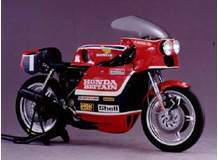
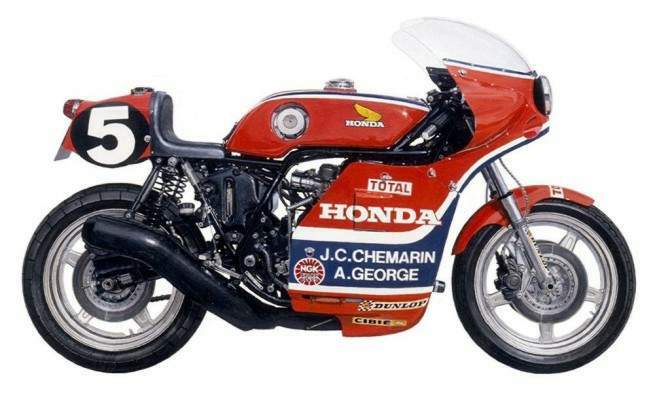
Honda RCB 1000 Racer
The history of Honda's works participation in the Coupe d'Endurance races during the years 1976 through 1980 is not as interesting and glamorous as the history of their "Golden Age" of Grand Prix racing during the sixties. There are a couple of reasons for that.
In the first place, the number of events per year, six, later, in 1980, when the series got world champion status, (1980) some more compared to the eleven to twelve events in the case of the GPs, and the fact that the Grand Prix series were about a world title - the Coupe d'Endurance was a European affair until 1980
Then there were the bikes. During the sixties, the racing scene was dominated by the three Japanese firms Honda, Suzuki and Yamaha, with MV struggling in the 350 and still winning in the 500 cc class, and a number of other factories still in the fight - Jawa, MZ, Benelli, AerMacchi, Norton, AJS and Matchless to name the most important. Razor sharp competition saw the emergence of screaming single, twin, three, four and even six cylinder engines, with ever rising engine speeds, which made it a time highly interesting not only to the spectators but also to the technically interested. Compared to those exotic machines, the endurance racing dominating Honda RCB racers, derived from the touring CB750 and later from the CB900 Bol d'Or, were rather straightforward and not half as exciting as their GP predecessors. And, lastly, there was indeed their dominance.
Participation in the Coupe d'Endurance was open to "improved" production motorcycles. However, the requirements were so vague, that the way was open to compete with practically completely new designs, and that possibility was rigorously exploited by Honda. Most teams in those days were "private", and to compete against the might of Honda was a daunting task. The result was that the series were totally dominated by the Honda RCBs, which in the end makes for less interesting racing. The only really interesting year proved to be 1980, but then Honda was plagued by stupid bad luck, especially with riders that fell off.
The engine of the Honda RCB1000 as it was known was based on the CB750 four, but with numerous modifications. A bore and stroke of 68 x 64.8 mm gave a total capacity of 941.3 cc (initially a capacity of 915 cc was mentioned). Compression ratio was 11 : 1, claimed power output 115 bhp at 9,500 rpm, although at least one bike was measured at 118 bhp with a torque of 10.2 kg.m at 8,500 rpm.
he original cylinder head with one ohc had been replaced with one with two overhead camshafts, which ran in plain bearings, and 4 valves per cylinder. Valve sizes: inlet 28 mm, exhaust 24 mm. Valve clearance was set with shims. The camshafts were coupled with gears, but the combination was driven by a duplex chain
Carburation was by 4 Kei-hin carburettors of the constant vacuum type with 34 mm diameter (some sources say 32 mm), cast in magnesium and provided with long bellmouths and transparent float bowls. The exhaust system consisted of a 4-into-1 system, that initially gave some problems because it exceeded the allowable noise level. The gearbox was a five-speeder. On the back of the engine was the traditional breather dome, well known from the old GP and production racers. The crankcases were painted black (as were the cylinder block and head) and were said to be cast in an aluminium-magnesium alloy. There was no electric starter, the bike was kick-started.
The dry-sump lubrication system contained 7 l oil, with an oil cooler under the steering head. The engine was housed in a well built, but traditional tubular frame, with telescopic forks and two conventional rear shock absorbers. The initially used French cast magnesium SMAC wheels were soon replaced with Honda's own "Comstar" wheels. Those wheels were built up from two-sided pressed stainless steel "spokes", riveted to spun aluminium rims. Brakes were double discs in front and a single disc at the rear. Tyre sizes 3.25/400 - 18 front, 3.50/5.75 - 18 rear. Total weight of the bikes was 187 kg, of which 87 kg was on account of the engine. Some sources say ten of these bikes were built, Source vf750fd.com
|
|
|
Any corrections or more information on these motorcycles will be kindly appreciated. |