|
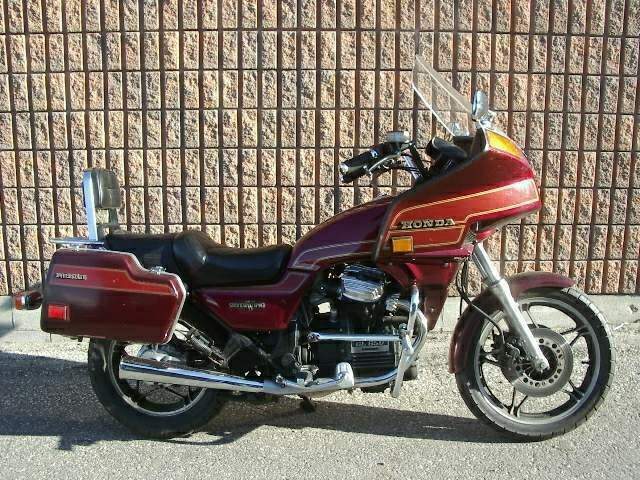
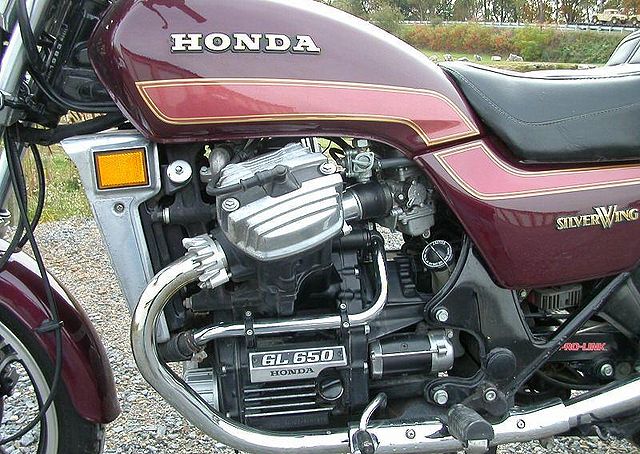
Honda GL 650 Silverwing Interstate

|
Make Model |
Honda GL 650 Silverwing Interstate |
|
Year |
1983 |
|
Engine |
Liquid cooled, four-stroke. longitudinal 800
V-twin. SOHC 4 valves per cylinder operated by pushrods |
|
Capacity |
673 |
|
Bore x Stroke |
82.5 x 63 mm |
|
Compression Ratio |
9.8:1 |
|
Induction |
2x 34mm keihin carbs. |
|
Ignition /
Starting |
Transistor / electric |
|
Max Power |
47.5 kW 64 hp @ 8000 rpm |
|
Max Torque |
62 Nm 6.2 kg-m @ 6000 rpm |
|
Transmission /
Drive |
5 Speed / shaft |
|
Front Suspension |
Telescopic coil spring air assisted |
|
Rear Suspension |
Swing arm compound linkage to single shock |
|
Front Brakes |
2x 240mm discs 2 piston calipers |
|
Rear Brakes |
Drum |
|
Front Tyre |
2.15-19 |
|
Rear Tyre |
130/90-16 |
|
Dry-Weight / Wet-Weight |
217 kg / 240 kg |
|
Fuel Capacity |
17.5 Litres (2.6 L) |
|
Consumption average |
45 mp/g |
|
Standing
¼ Mile |
13.6 sec |
|
Top Speed |
109 mp/h |
From the beginning,
Honda's CX500 defied stereotyping. Since its debut in 1978, this unusual
middleweight Vee has confounded those intent on pigeonholing the
bike—one-dimensional labels such as special, tourer or sport bike just don't
stick. The original CX was a multifaceted machine, a motorcyclist's
jack-of-all-trades.
Over the years Honda has capitalized on the standard model's versatility. By
altering its bodywork, adding accessories and injecting the engine with new
technology, Honda's engineers have successfully transformed the standard
into several clearly de-
fined models: the Custom, with stylish cosmetics and body pieces; the GL
Interstate, with full-on fairing and luggage system; and the Turbo, with
Superbike top-end punch and hightech allure. But the standard version for
1983, the GL650 Silver Wing, still offers all-around capabilities few
motorcycles can match.
This year Honda has broadened
the appeal of the CX/GL series by turning to a time-honored fix—increased
engine displacement. A cursory inspection of the engine reveals little; the
GL650 powerplant looks so much like the old CX500 engine you might think
Honda added 177cc with a simple bore job. But the transformation required
much more; although engine design remains unchanged, virtually all the 650's
engine pieces are new. The GL still uses water-cooled, crankcase-integral,
chrome-lined cylinders set in an 80-de-gree Vee, but Honda increased bore
and stroke from 78.0 x 52.0mm to 82.5 x 63.0mm, taking displacement to
674cc.
To ensure reliability with the elevated power output, Honda engineers
upgraded almost every engine component in the 650 series. They strengthened
the big end of the connecting rods, the rod bolts, main bearings,
cylinder studs, clutch and transmission,
increased both the water- and oil-pump flow rates, and replaced the cam-driven
radiator fan with a new electric, thermostatically triggered unit. The engine
cases are all new, and a finned oil pan boosts oil capacity 0.9 quart to a total
of 4.1 quarts.
Since the R&D people knew the extra displacement would practically ensure the
650 of better low-end and mid-range, they performed a mild hop-up job to
increase peak power as well. The four-valve heads still use a
cam-shaft-and-pushrod valve-actuation system, but the GL has more valve lift,
longer duration and more overlap than
the CX500.
The 32mm intake valves are one millimeter larger
than before, though the exhaust valves still measure 27mm across. Honda dropped
the compression ratio a touch, from 10.0:1 in the 500 to 9.8:1 in the 650, and
engine redline has edged downward over the years from 10,000 rpm in the original
CX to 9000 in the current model.
A pair of 35mm accelerator-pump-equipped Keihin CV carbs replaces the 34mm CV
pumpers used on the smaller V-twin. Honda moved the new carbs inboard a bit,
straightened the inlet tracts slightly to improve intake flow, and enlarged the
airbox.
Honda also altered the clutch and gear ratios to
better suit the GL's new power characteristics. The primary re-
duction ratio is taller than the pairing in last year's GL500, but not as tall
as the Turbo's. Like the CB1100F, the GL now uses a twin-gear clutch hub to
reduce gear noise and backlash. The clutch holds one more steel plate and one
more friction plate than the 500; additionally, to cope with the added loads,
the clutch springs are 19 percent stiffer than last year's and all transmission
gears are stronger than those in the 500 engine. While first through fourth
gears use the same ratios as the pairings in the 500 Turbo, the gears are not
interchangeable. The 650's overall gear ratios in first through fourth are a
little lower than those in last year's Turbo, but a bigger jump between fourth
and fifth gives the 650 an identical calcu-
lated top-end speed of 120 mph.
The 500 Vee never was a drag-strip terror, and
though stirring the gearbox would extract a reasonable response for sport
riders, the half-liter engine lacked the torquey grunt tourers demand. That's
changed. The substantial displacement boost toughens the basic nature of the GL,
and riders of all sorts will welcome the 650's extra punch. The GL pulls well
down low and in most cases has enough mid-range oomph to pass on the freeway
without a downshift. Our Silver Wing ran through the quarter-mile in 12.96
seconds at 99.55 mph, the best drag-strip performance we've obtained from a
normally aspirated CX/GL. Still, the GL trails the leader of the 650 class,
coming a slight wallow in very bumpy corners. The GL's steering feels remarkably
light and responsive considering the bike's size: 515.5 pounds spread over a
58.9-inch wheelbase. Honda further improved the running gear by upgrading the
tires from "S"-rated to "H"-rated items and replacing the old single-disc front
brake with a dual-disc setup; the new brake provides plenty of stopping power
with excellent feel and a linear response at the brake lever.
The GL's new suspension will please most
riders—especially sport riders— but long-range purists may protest. Despite the
fork's compliance, the new rear suspension is much less responsive than last
year's; it gives a firm ride even when the shock is charged with minimal air
pressure. Heavier (185-pound) testers did not object to the taut rear end;
lighter (140-pound) riders thought it a little harsh for truly comfort-
able riding over extended periods.
All riders, regardless of size, found fault with the Silver Wing's riding
position. Though less radical than some of Honda's newest Specials, the GL does
incorporate cruiser styling. The bar reaches back much too far for comfortable
riding and bends at an awkward angle; the pegs sit too far forward to offer good
support. Consequently, at freeway speeds the rider must use his back, shoulder
and arm muscles to fight the wind—a losing battle. After coming a slight wallow
in very bumpy corners. The GL's steering feels remarkably light and responsive
considering the bike's size: 515.5 pounds spread over a 58.9-inch wheelbase.
Honda further improved the running gear by upgrading the tires from "S"-rated to
"H"-rated items and replacing the old single-disc front brake with a dual-disc
setup; the new brake provides plenty of stopping power with ex-
cellent feel and a linear response at the brake lever.
The GL's new suspension will please most
riders—especially sport riders— but long-range purists may protest. Despite the
fork's compliance, the new rear suspension is much less responsive than last
year's; it gives a firm ride even when the shock is charged with minimal air
pressure. Heavier (185-pound) testers did not object to the taut rear end;
lighter (140-pound) riders thought it a little harsh for truly comfort-
able riding over extended periods.
All riders, regardless of size, found fault with the Silver Wing's riding
position. Though less radical than some of Honda's newest Specials, the GL does
incorporate cruiser styling. The bar reaches back much too far for comfortable
riding and bends at an awkward angle; the pegs sit too far forward to offer good
support. Consequently, at freeway speeds the rider must use his back, shoulder
and arm muscles to fight the wind—a losing battle. After about 40 minutes
fatigue sets in, usually in the form of shoulder pain.
Several small amenities help the GL maintain its
role as a fine touring bike. The seat is padded and well shaped, and its fairly
long front section allows the rider to shift position. When not holding a
passenger, the rear portion of the seat can be replaced with a 15-liter
(900-cubic-inch) tail trunk—having about the capacity of a medium-sized tank
bag. Although too small for full-fledged touring, the little trunk does hold
enough for an overnight trip, and it's great for carrying lunches, papers, small
tools and other commuter-related items. A new seal on the lid improves water
resistance, and the ignition key operates the trunk lock as well as the two
helmet locks which fasten the trunk in place. For $88.95 you can nearly double
your carrying capacity with an optional 28.5-liter trunk. It comes as
standard-issue on the Silver Wing Interstate and is available through Hondaline.
Despite the increase in engine displacement and
carb size, our 650's average of 45.5 mpg nearly matched the GL500's 46.3 mpg;
the bike covers
about 200 miles between fill-ups. Our 650 always started readily on chilly
mornings, and the choke lever is located up by the instruments for easy access.
The GL carburets well, hot or cold, and is not fussy about gasoline. Honda
simplified maintenance
More is not always better, but in the case of Honda's CX/GL series the
displacement increase equals improvement. The 650's added horsepower and torque,
as well as its firmer suspension, do produce a better machine. Sure, some riders
will dislike the increased engine vibration, and touring purists will mourn the
loss of the 500's
Cadillac-like ride, but for the vast majority of motorcyclists the GL is now a
more desirable—by virtue of being a more versatile—machine. Honda has three
other versions of the 650 for those with specialized needs; for the rest, the
1983 Silver Wing is as well-rounded a machine as the middleweight class offers.
Source Cycle Guide 1983
|