|
|
|
|
Classic Bikes
Custom Bikes
Individual
Racing Bikes AJP
AJS
Aprilia
Ariel
Avinton / Wakan
Bajaj
Benelli
Beta
Bimota
BMW
Brough Superior
BRP Cam-Am
BSA
Buell / EBR
Bullit
Bultaco
Cagiva
Campagna
CCM
CF Moto
Combat Motors
Derbi
Deus
Ducati
Excelsior
Fantic
GASGAS
Ghezzi Brian
Gilera
GIMA
Harley Davidson
Hero
Highland
Honda
Horex
Husaberg
Husqvarna
Hyosung
Indian
Jawa
Kawasaki
KTM
KYMCO
Laverda
Lazareth
Magni
Maico
Mash
Matchless
Mondial
Moto Guzzi
Moto Morini
MV Agusta
MZ / MuZ
NCR
Norton
NSU
Paton
Peugeot
Piaggio
Revival Cycles
Roland Sands
Royal Enfield
Sachs
Sherco
Sunbeam
Suzuki
SWM
SYM
Triumph
TVS
Ural
Velocette
Vespa
Victory
Vincent
VOR
Voxan
Vyrus
Walt Siegl
Walz
Wrenchmonkees
Wunderlich
XTR / Radical
Yamaha
Zero
Video
Technical
Manufacturer List Contact
|
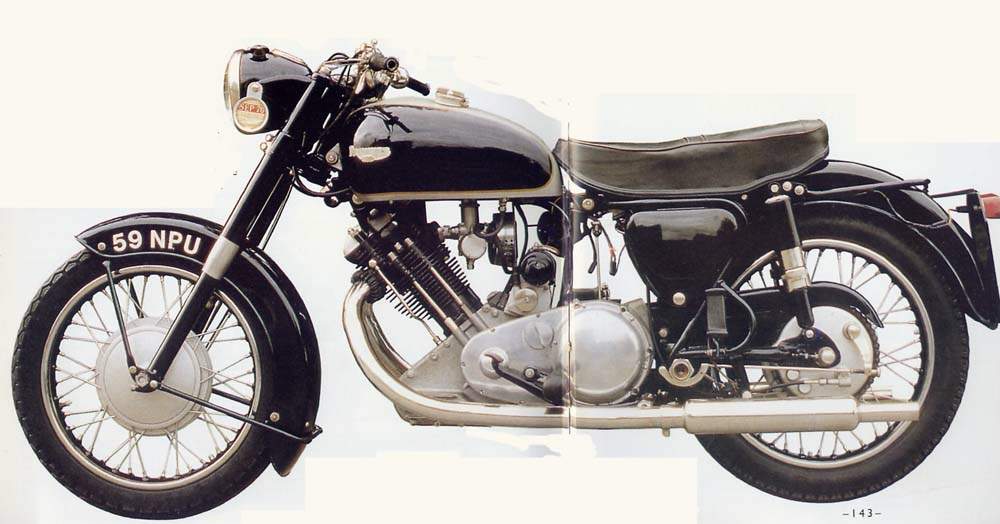
hPanther Ml20
For many years the biggest single-cylinder machine in the world, Panther's 650 sloper announced that fact with a deep, lazy engine beat, which was said to 'fire every other lamppost'. With enormous torque and incredible economy, it was ideally suited to pulling the enormous sidecars that formed budget family transport. The Model 120 was the final product of P&M of Cleckheaton, Yorkshire - the factory that had built its first motorcycle at the beginning of the 20th century with the revolutionary idea of using a sloping engine, instead of the front portion of a conventional frame. From first to last, it was this concept that defined Panthers, with gradual concessions to the engine and suspension designs of the changing years. By the 1930s the form of the big single Panther
had pretty much settled, and the firm also survived through the lean early years
of the decade, thanks to the excellent volume sales of the ultra-cheap Red
Panther 250cc lightweight which sold for under £30. In 1947 Dowty Oleomatic air-sprung telescopic forks were fitted - a form of front suspension that was very efficient when new, but gave problems when older as the seals wore. There were minor improvements to various parts of the bike until 1954 when a new, conventionally sprung fork and a swinging-arm frame were adopted. Styling changes followed, and the rigid model was discontinued in 1957. The main news for 1958 was the development of the larger Model 120, closely based on the 600cc. But prototypes had engine problems, largely due to the increased stress and problems with Panther's unusual lubrication system. The production bikes were substantially improved, and offered lower fuel consumption - 70 mpg with a sidecar - than their predecessor. The Model 120 was ideally suited to sidecar use. In 1959 Panther's own sidecar chassis was an option - and this even included a towbar for a trailer. The simple, generally understressed big Panthers offered vintage values in a changing world. But sales of all Panther's range had been falling since the end of the 1950s, and by 1962 the firm was in receivership. An enlightened receiver kept them in production for a few years, mainly using up existing spares. But when difficulties arose obtaining major components - the separate Lucas Magdyno and Burman gearbox, which were by then virtually outmoded - there was no realistic way forward. The last Panthers were built in 1966, although they remained on sale for at least a year after that. They were extremely cheap, but times had moved on and there was no longer any demand for the big sidecar outfit, as cheap cars took over that role and big bikes began the move towards becoming leisure vehicles. Specs Panther Model 120
|
|
|
Any corrections or more information on these motorcycles will be kindly appreciated. |