|
|
|
|
Classic Bikes
Custom Bikes
Individual
Racing Bikes AJP
AJS
Aprilia
Ariel
Avinton / Wakan
Bajaj
Benelli
Beta
Bimota
BMW
Brough Superior
BRP Cam-Am
BSA
Buell / EBR
Bultaco
Cagiva
Campagna
CCM
CF Moto
Combat Motors
Derbi
Deus
Ducati
Excelsior
GASGAS
Ghezzi Brian
Gilera
GIMA
Harley Davidson
Hero
Highland
Honda
Horex
Husaberg
Husqvarna
Hyosung
Indian
Jawa
Kawasaki
KTM
KYMCO
Laverda
Lazareth
Magni
Maico
Mash
Matchless
Mondial
Moto Guzzi
Moto Morini
MV Agusta
MZ / MuZ
NCR
Norton
NSU
Paton
Peugeot
Piaggio
Revival Cycles
Roland Sands
Royal Enfield
Sachs
Sherco
Sunbeam
Suzuki
SWM
SYM
Triumph
TVS
Ural
Velocette
Vespa
Victory
Vincent
VOR
Voxan
Vyrus
Walt Siegl
Walz
Wrenchmonkees
Wunderlich
XTR / Radical
Yamaha
Zero
Video
Technical
Complete Manufacturer List
|
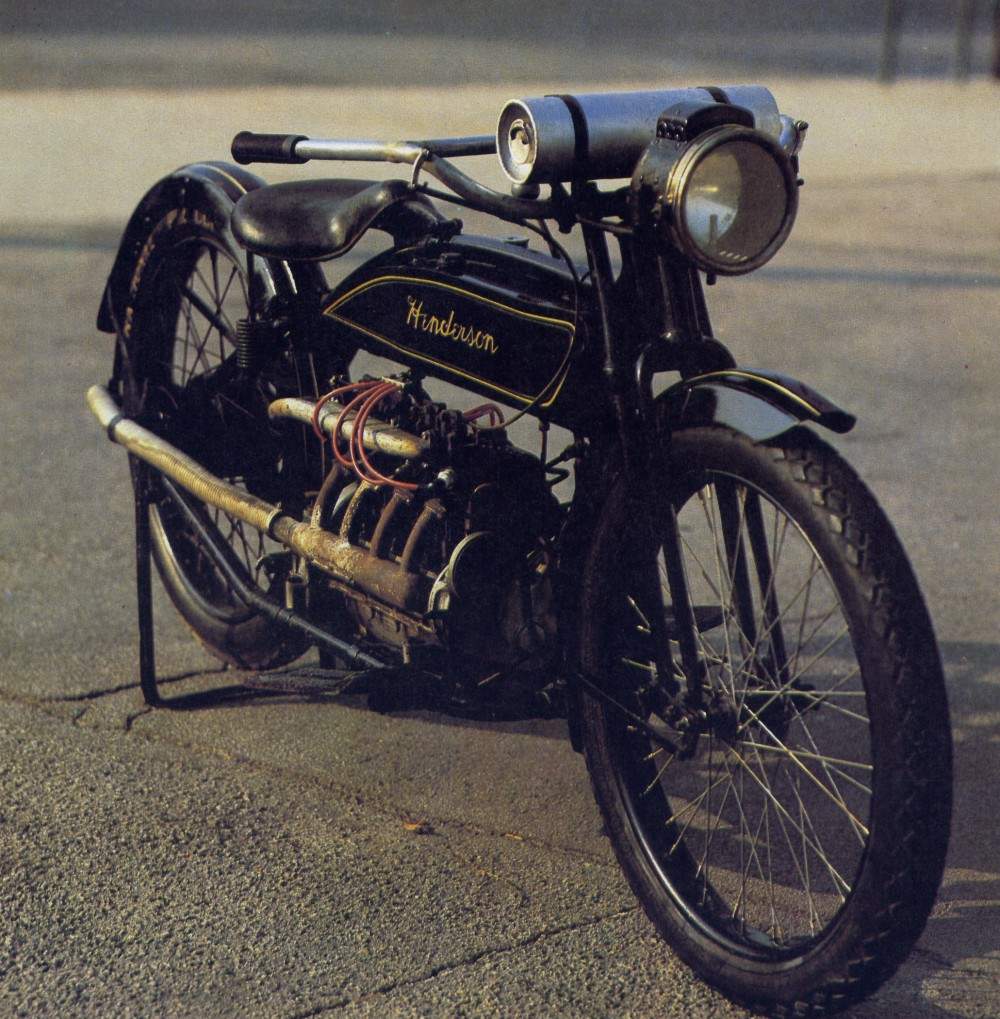
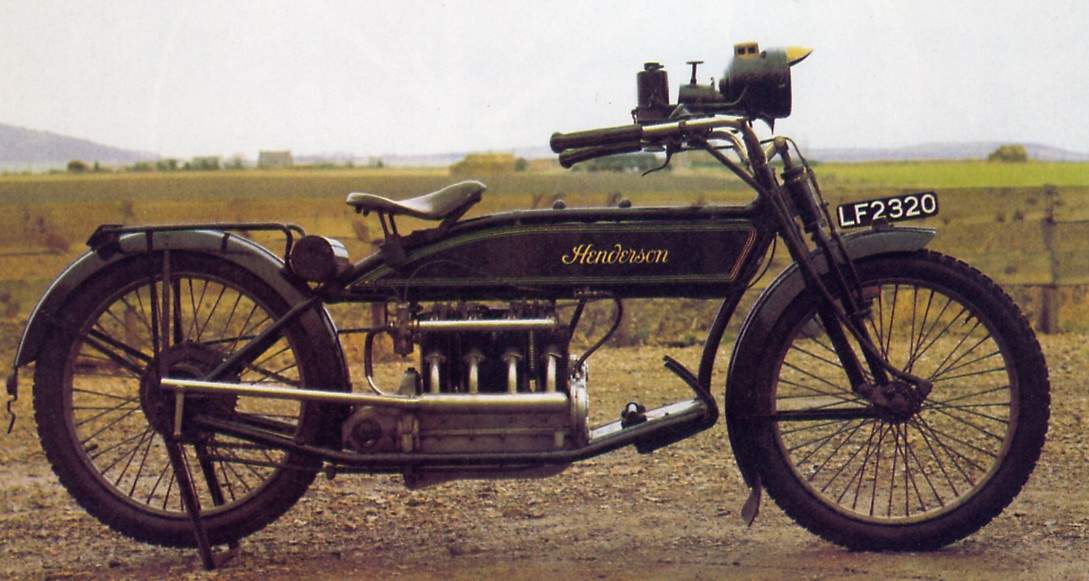
Henderson Four
Of all the four-cylinder motor cycles ever manufactured in the United States of America during the earlier part of the 20th Century, the Henderson Fours were perhaps the most successful. During their nineteen year production lifespan, they also became the world's most famous fours. It was in 1911 that the Henderson brothers, William G. and Thomas, first announced their intention of going into motor cycle production. A year later they wheeled out the first of their models. The strikingly impressive machines had four-cylinder, in-line engines, mounted longitudinally, with mechanically operated inlet and exhaust valves and crude splash lubrication. The flywheel was enclosed in the crankcase and the ignition was by means of a Bosch magneto. The Henderson had a clutch but no gearbox and was
started by the unusual means of a crank handle at the rear side of the engine.
Final drive was by chain. The machine was enormous, as might be expected with a
longitudinal four, the wheelbase measuring no less Before long the Henderson models were being used for various successful endurance records. Carl Clancy of New York became the first man to circle the earth on a motor cycle, his Henderson covering a total of 18,000 miles with no major problems. Consequently the Henderson became very popular with the motor cycling public. By 1913 the company had made substantial improvements to the forks, frame and tank shape and a year later the first two-speed Hendersons appeared, the two-speed gear being incorporated in the rear hub and having a hand operated change. In 1915, the machine's wheelbase was reduced to 59 inches by removing the foot board in front of the engine (the pillion seat had long since disappeared). This improved the handling considerably. By 1919, the original Henderson Four models had been phased out of production and replaced by the new Model K designed by Arthur Lemon. The model K had a new, larger (1300cc) engine and was the first motor cycle to use full pressure lubrication. The cylinders were of a new type, with both inlet and exhaust valves placed side by side, while the drive chain was now fully enclosed and these various modifications ensured the new Henderson became even more popular. By this time, however, the Henderson brothers had become thoroughly frustrated by their new roles within the Schwinn organization and they left for other fields. Tom went into the export business while William G. set about establishing another new motor cycle manufacturing concern. Soon afterwards he produced his new masterpiece—the Ace Four —which also became a classic in motor cycle history.
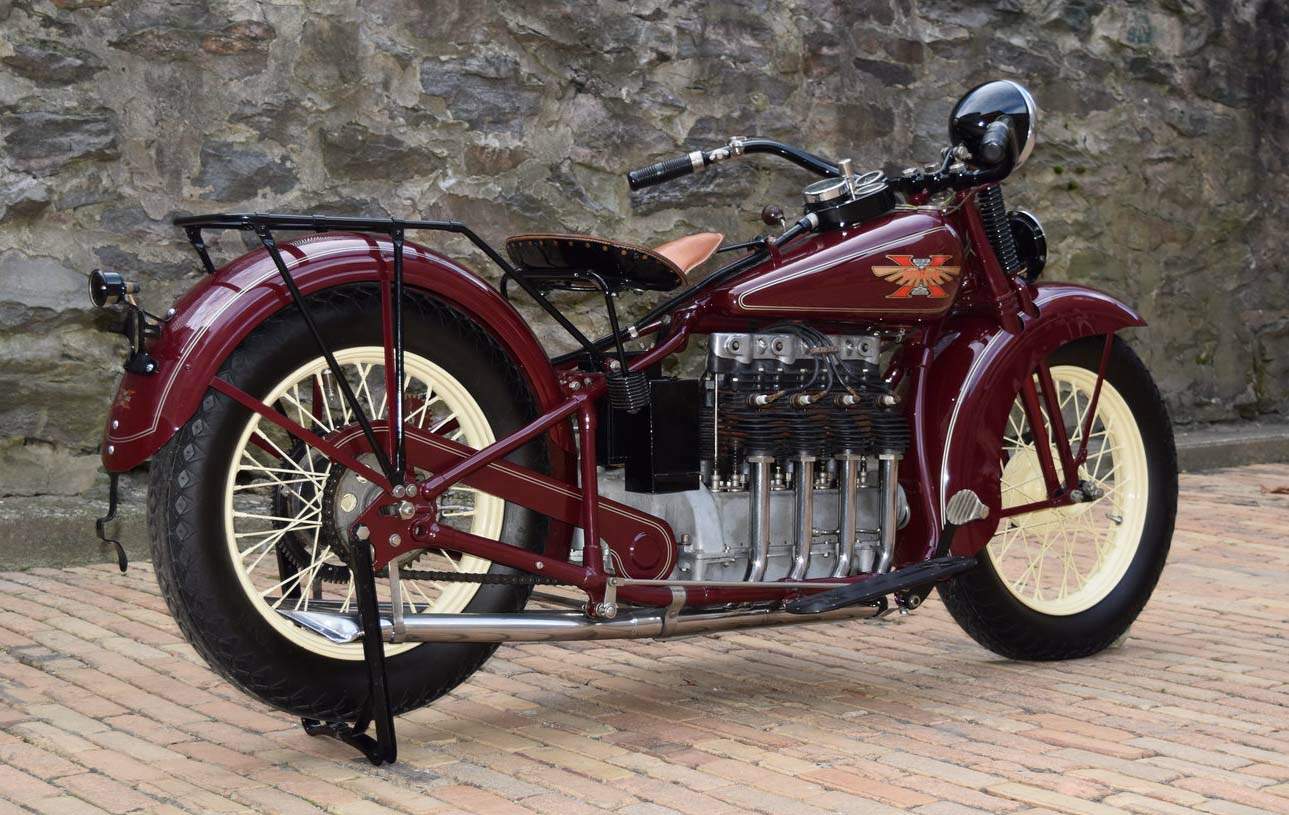
The Excelsior-Henderson company meanwhile continued production of the Model K until 1922 when it was superseded by the improved De Luxe model. The De Luxe model was the most refined Henderson model ever produced up to that date and it ensured that the Henderson name continued to grow and prosper. Then, in 1928, came an even better Henderson, the Model KJ. The KJ, designed by Arthur Constantine, was a
handsome beast. The familiar four-cylinder engine now had a five-bearing
crankshaft and the valvegear had been redesigned and improved. Very soon it was
being heralded as the finest four-cylinder motor cycle ever made. The engine,
which produced 40 bhp at 4000 rpm, gave the machine a Production of the KJ and KL models continued until 1931. Then one day Ignaz Schwinn walked into his office following a business trip to Washington and announced: "Gentleman—today we stop", and production of all Excelsior and Henderson models stopped. Schwinn had realised that the worldwide depression of the 1930s would have devasting effects on the American economy and decided to quit while he was ahead. In one dramatic moment a company died and a legend was born. Specification 1928 model Engine Air-cooled, four-stroke,
four-cylinder. 68-3 mm (2-63in) bore X 89 mm (3-50in) stroke = 1304cc (80cu in).
Maximum power 40 bhp at 4000 rpm. Compression ratio not known. Two valves per
cylinder, overhead inlet, side exhaust, Source Super by Bikes Loure Caddell
1931
|
|
|
Any corrections or more information on these motorcycles will be kindly appreciated. |