|
|
|
|
Classic Bikes
Custom Bikes
Individual
Racing Bikes AJP
AJS
Aprilia
Ariel
Avinton / Wakan
Bajaj
Benelli
Beta
Bimota
BMW
Brough Superior
BRP Cam-Am
BSA
Buell / EBR
Bultaco
Cagiva
Campagna
CCM
CF Moto
Combat Motors
Derbi
Deus
Ducati
Excelsior
GASGAS
Ghezzi Brian
Gilera
GIMA
Harley Davidson
Hero
Highland
Honda
Horex
Husaberg
Husqvarna
Hyosung
Indian
Jawa
Kawasaki
KTM
KYMCO
Laverda
Lazareth
Magni
Maico
Mash
Matchless
Mondial
Moto Guzzi
Moto Morini
MV Agusta
MZ / MuZ
NCR
Norton
NSU
Paton
Peugeot
Piaggio
Revival Cycles
Roland Sands
Royal Enfield
Sachs
Sherco
Sunbeam
Suzuki
SWM
SYM
Triumph
TVS
Ural
Velocette
Vespa
Victory
Vincent
VOR
Voxan
Vyrus
Walt Siegl
Walz
Wrenchmonkees
Wunderlich
XTR / Radical
Yamaha
Zero
Video
Technical
Complete Manufacturer List
|
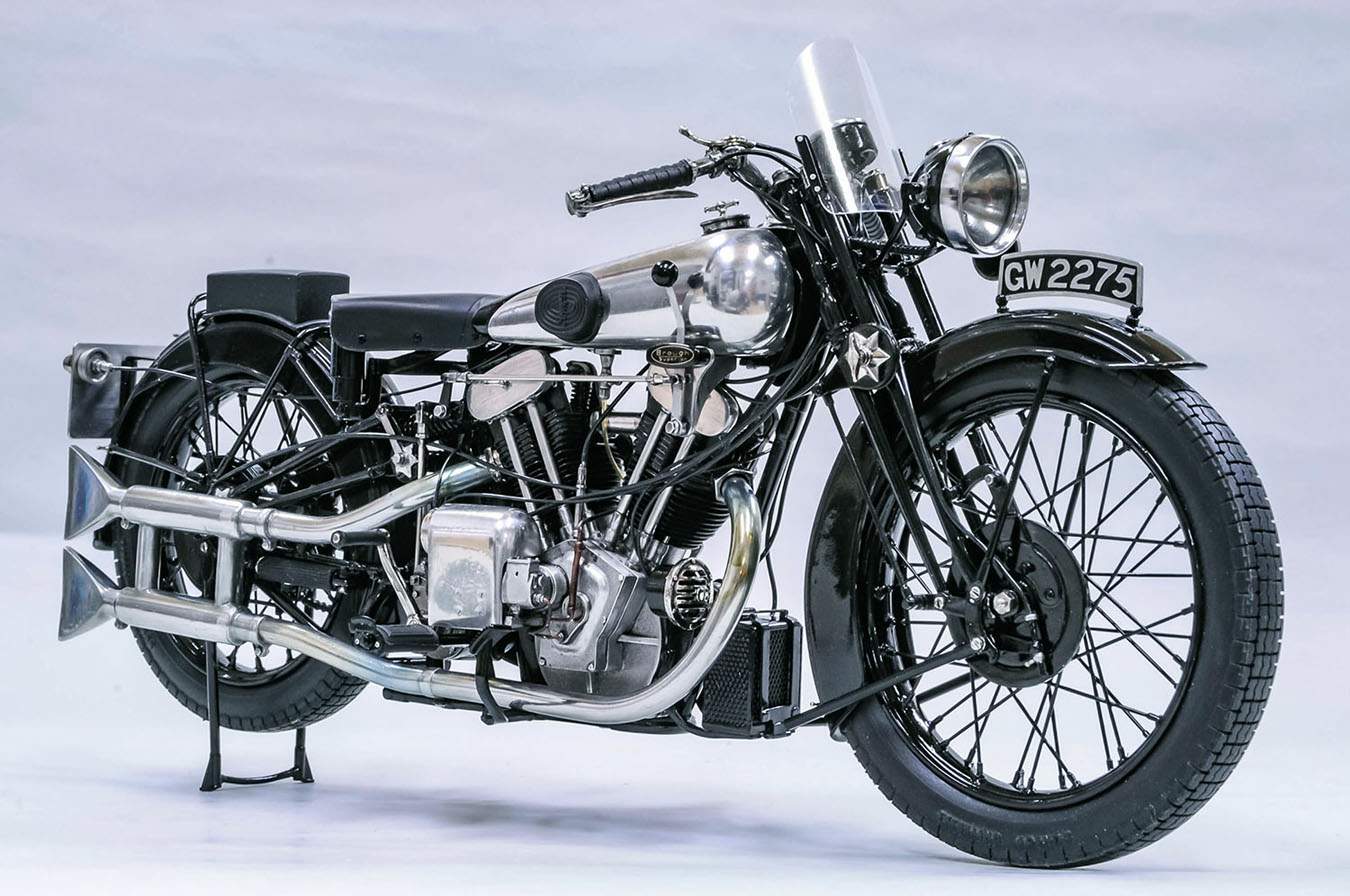
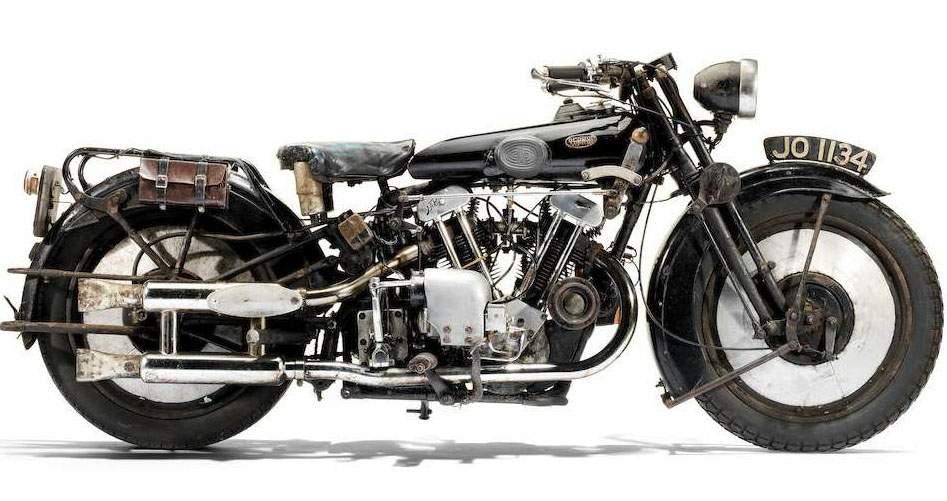
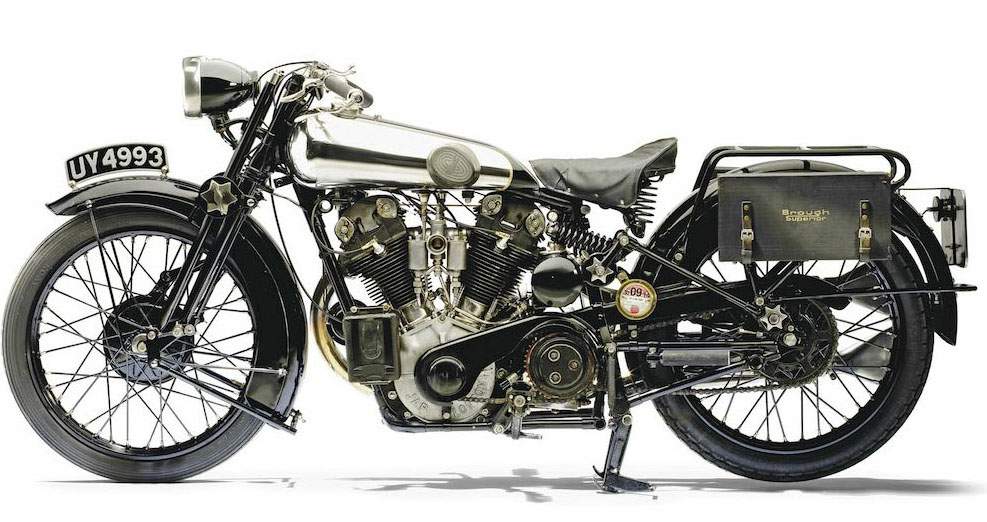
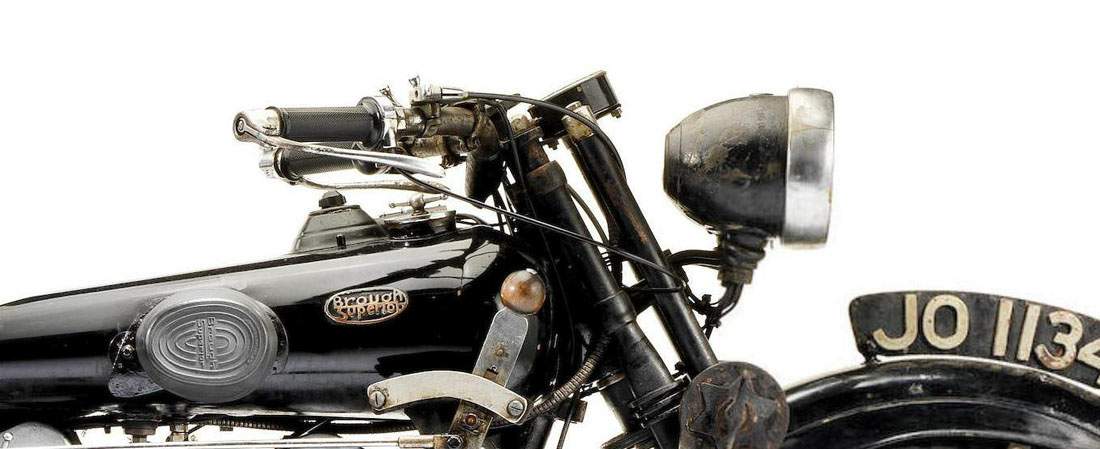
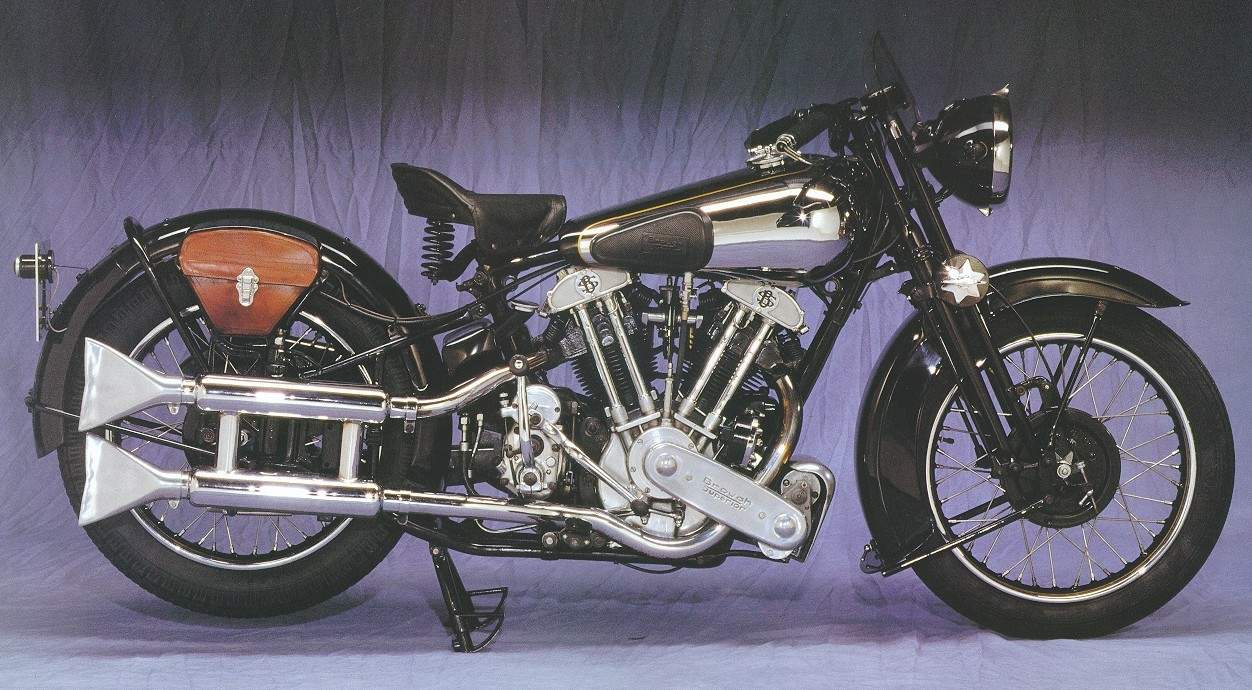
Brough Superior SS100
In the company's advertising of the early 1920s the Brough Superior was hailed as the 'Rolls-Royce of motor cycles'; after the men from that famous marque's Crewe factory had examined the bike they had to concede that it did indeed live up to the title and they gave the Brough company permission to use the slogan. The motorcycle's performance was, however, quite different from that of the luxurious car to whose reputation it alluded. While the Rolls-Royce was more noted for its grace than its performance, the Brough could reach a genuine 100 mph, a speed that was thought to be far beyond the capabilities and safety limits of road bikes of this time.
The power unit of the first SS100 was a specially
built, fifty degree vee-twin JAP of 988cc. What was most interesting about the
engine was its valvegear which featured four separate little camshafts actuating
the overhead valves through pushrods. The power output was claimed to be 45 bhp
at A four-plate clutch and three-speed Sturmey Archer gearbox were employed, the box giving speeds of 30, 65 and 100 mph in the three ratios, although the Brough could pull away from rest in top gear with just a little slipping of the sturdy clutch. Fuel consumption of the bike could drop to as little as 40mpg if all the performance was used, but a touring figure of between 50 and 55mpg was obtainable by most riders, who were content to let the SS100 purr along on a hint of throttle.
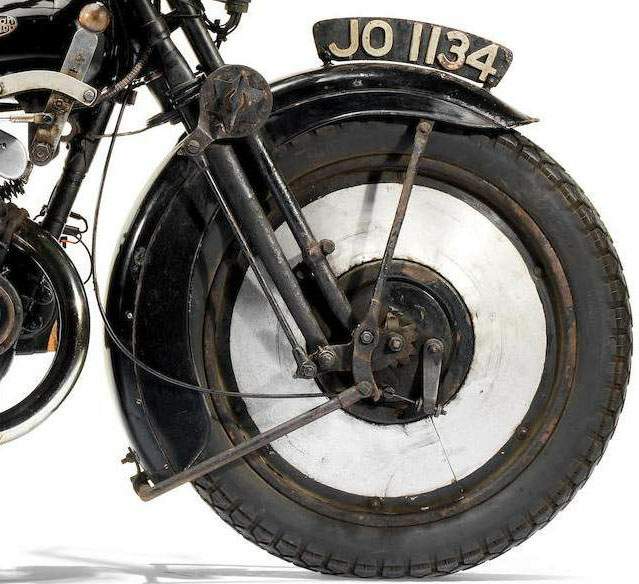
Early SS100s used a leading-link front fork of Harley-Davidson type, while the rear was completely rigid. The front design was chosen by George Brough as ideal for a high-speed bike, but it also dictated that if an effective front brake was fitted it would lock the forks in the fully extended position when applied with vigour. Needless to say, the internal expanding unit actually fitted was so weak as to be useless, so this problem never arose. On the other hand, the 8in rear brake was extremely powerful and much care was needed not to lock the back end up.
With the bike weighing a mere 340 lb with good
ground clearance, it could be thought that the SS100 was ideal for country-lane
riding, but the ponderously heavy steering and long wheelbase meant that it was
much more suited to high-speed road work. The heavy steering also hampered town
riding but that was more than made up for by the lusty engine that made light
work of pottering along at low speeds in top gear. In 1933, the SS100 was redesigned with a different JAP engine, a four-speed gearbox and various minor alterations. Then, two years later, a Matchless power unit was installed, but to connoisseurs of the marque neither of these later models rated as highly as the original, 100 mph 'Rolls-Royce of motor cycles.'
Specifications
(1933 model) engine Air-cooled, four stroke, JAP vee-twin-cylinder.
85-5 mm (3-36in) bore X 86 mm (3-38in) stroke = 988cc (60-27cu in). Maximum
power 45bhp at 4500 rpm. Two valves per cylinder operated via pushrods and
rockers by four camshafts. Single carburettor transmission Source Super by Bikes Loure Caddell
|
|
|
Any corrections or more information on these motorcycles will be kindly appreciated. |