|
|

|
|
|
|
Classic Bikes
Custom Bikes
Individual
Racing Bikes AJP
AJS
Aprilia
Ariel
Avinton / Wakan
Bajaj
Benelli
Beta
Bimota
BMW
Brough Superior
BRP Cam-Am
BSA
Buell / EBR
Bultaco
Cagiva
Campagna
CCM
CF Moto
Combat Motors
Derbi
Deus
Ducati
Excelsior
GASGAS
Ghezzi Brian
Gilera
GIMA
Harley Davidson
Hero
Highland
Honda
Horex
Husaberg
Husqvarna
Hyosung
Indian
Jawa
Kawasaki
KTM
KYMCO
Laverda
Lazareth
Magni
Maico
Mash
Matchless
Mondial
Moto Guzzi
Moto Morini
MV Agusta
MZ / MuZ
NCR
Norton
NSU
Paton
Peugeot
Piaggio
Revival Cycles
Roland Sands
Royal Enfield
Sachs
Sherco
Sunbeam
Suzuki
SWM
SYM
Triumph
TVS
Ural
Velocette
Vespa
Victory
Vincent
VOR
Voxan
Vyrus
Walt Siegl
Walz
Wrenchmonkees
Wunderlich
XTR / Radical
Yamaha
Zero
Video
Technical
Complete Manufacturer List
|
Yamaha XS 1100 Martini
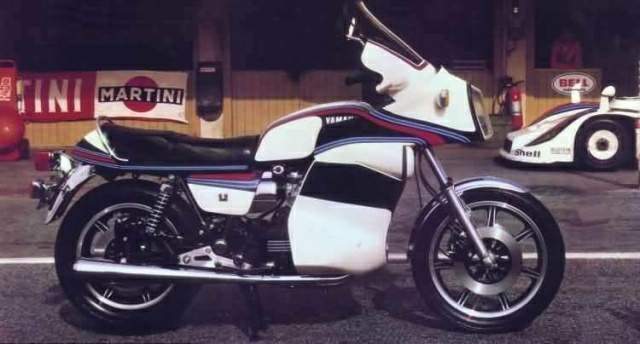
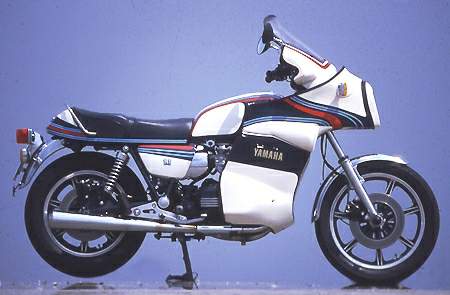
In 1976, in an art-work feature on streamlining, designer John Mockett had been bemoaning the fact that the motorcycle fairings produced then, fell into two categories: Dolphins: such as those from BMW and Dunstall, were good at cutting through the air but gave the rider little protection. Snow ploughs: such as Vetter gave good protection but at the expense of performance due to the sheer size of them and the increased drag. What was needed was a combination of the two and in 1977, John was contacted by Paul Butler from Yamaha's Design & Development department in Amsterdam. He was willing to offer John 'free reign' in designing a fairing for an upcoming 1000cc plus tourer. The only stipulation Yamaha insisted upon was that the bike should remain as standard as possible. Enlisting the help of sculptor Steve Furlonger and industrial designer Dave Weightman, they set to trying to design something which hadn't been done before. The power of the engine wasn't going to be a problem so the No.1 priority was going to be rider protection. Enlisting the help of sculptor Steve Furlonger and industrial designer Dave Weightman, they set to trying to design something which hadn't been done before. The power of the engine wasn't going to be a problem so the No.1 priority was going to be rider protection. "We relied on Steve as a 'maker' but he had more to offer than that. He had a sculptor's eye, that is an understanding of 3D form and all consuming energy. By the way in the last year two of the principles in this work have died; David Bean, the test rider, and Nieto-san the chief engineer. Those guys were interested in pushing the envelope, not like today, copying existing models." - John Mockett (1999) Work soon began in the wind-tunnel at Lanchester Polytechnic in Coventry on a 1/5th scale model of the new bike. A one-piece fairing was on the cards at this stage but when a full size 'never to be run' prototype arrived, it soon became apparent that a rethink was needed because of the size of the arc drawn by the handlebars plus controls travelling from one lock to the other. An earlier 2 piece concept was adopted as this combined the potential benefits of a handlebar mounted screen with the aerodynamic stability of a compact frame mounted dolphin. After more than 100 wind-tunnel tests, two prototypes were made, one for display at the Isle of Man T.T. and the other for the launch of the XS1100 at Senegal. Initially, production was rumoured to have been by Harland & Wolff in Northern Ireland but it was Composite Laminate Products (CLP) of Durrington, Wiltshire who gained the contract. It was available in 1979 as an accessory costing £360 and came in the two colours that the XS1100 was being produced in, namely Crystal Silver and Macho Maroon. The finished fairing gave the bike: Better lights with the Cibiè Tango 55 spotlights fitted into recesses at the base of the main body. Two lockable, easy-access side pockets in the main body. The ability to outdrag the standard XS11 (and the later 'S' model) due to the decreased drag of 15% and reduced front wheel lift of up to 32% (I'm talking from experience here) Protection for the engine in accidents (and legs too) Source xs1100.co.uk
|
|
|
Any corrections or more information on these motorcycles will be kindly appreciated. |