|
|

|
|
|
|
Classic Bikes
Custom Bikes
Individual
Racing Bikes AJP
AJS
Aprilia
Ariel
Avinton / Wakan
Bajaj
Benelli
Beta
Bimota
BMW
Brough Superior
BRP Cam-Am
BSA
Buell / EBR
Bultaco
Cagiva
Campagna
CCM
CF Moto
Combat Motors
Derbi
Deus
Ducati
Excelsior
GASGAS
Ghezzi Brian
Gilera
GIMA
Harley Davidson
Hero
Highland
Honda
Horex
Husaberg
Husqvarna
Hyosung
Indian
Jawa
Kawasaki
KTM
KYMCO
Laverda
Lazareth
Magni
Maico
Mash
Matchless
Mondial
Moto Guzzi
Moto Morini
MV Agusta
MZ / MuZ
NCR
Norton
NSU
Paton
Peugeot
Piaggio
Revival Cycles
Roland Sands
Royal Enfield
Sachs
Sherco
Sunbeam
Suzuki
SWM
SYM
Triumph
TVS
Ural
Velocette
Vespa
Victory
Vincent
VOR
Voxan
Vyrus
Walt Siegl
Walz
Wrenchmonkees
Wunderlich
XTR / Radical
Yamaha
Zero
Video
Technical
Complete Manufacturer List
|
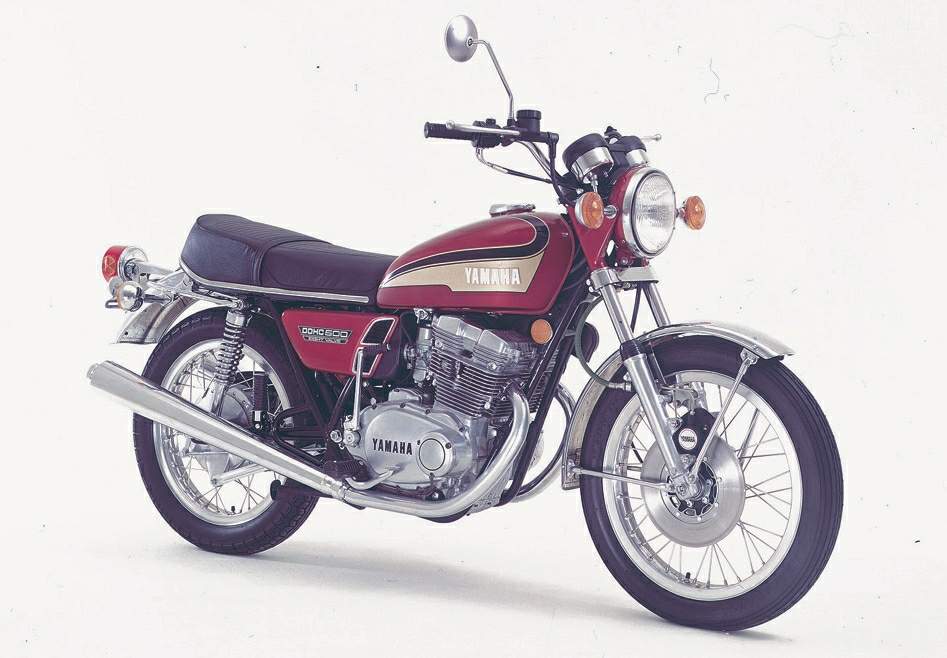
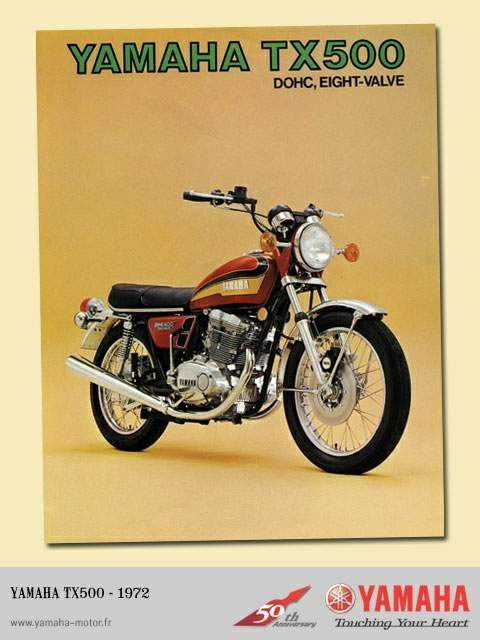
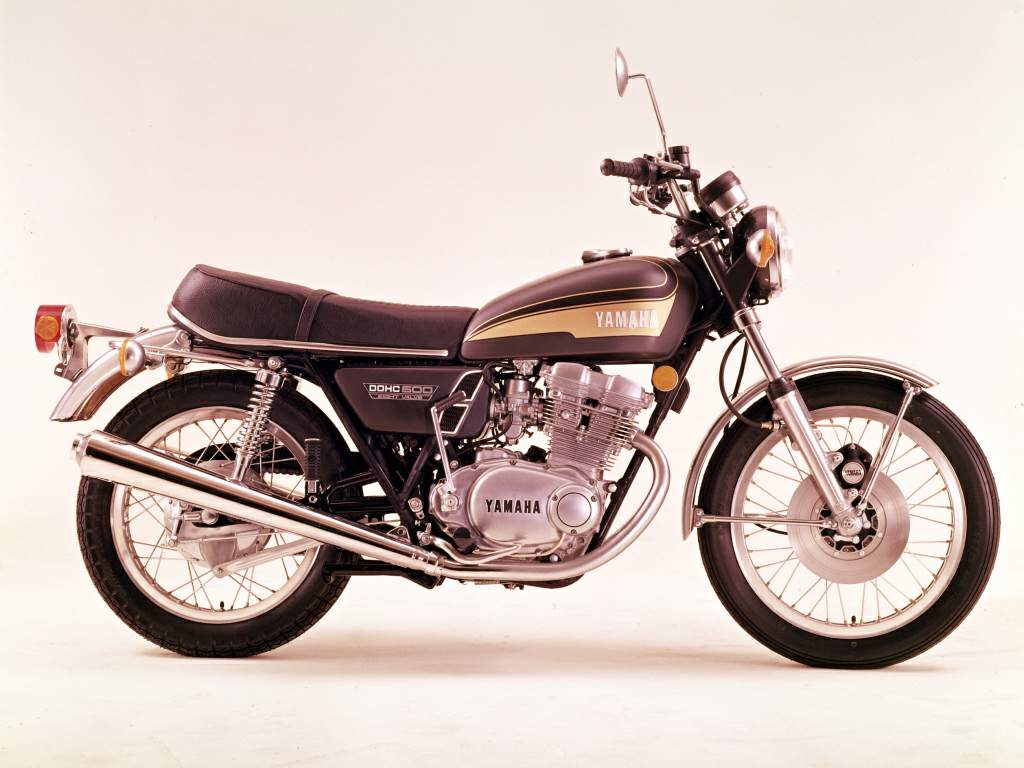
Yamaha TX 500 Sport
The third model of Yamaha’s 4-stroke road sports category, this racy Super
Sports model was, very different from its predecessors, the 650 and 750,
being the first road bike to have a DOHC 4-valve per cylinder high output
engine. Functions such as the worldユs first IC regulator, a CV carburetor,
an full cradle frame - Duplex type" and is 100% of
Road Test 1973 Yamaha recently introduced a very special motorcycle in their freshly unveiled TX-500. If you are a street enthusiast who has seen one and done a quick double-take, you know the real thing when you see it. Yamaha is reluctant to classify their neat and complete 500cc pedigree as a "tourer," "sporty transport," or "son of a superbike," nor is Yamaha talking horsepower, so important in the marketplace just a short time ago. Then what is it? That is probably an irrevelant question, for this unique machine stands firm on its merits. Very few explanations are needed considering its multiple qualities: power, comfort, looks, prestige, handling, dependability, and a reasonable price. The TX-500 is not a lopsided motor cycle. Unlike some of the more hoggish tourers, which give away responsive performance to running boards and camper-like paraphrenalia; and unlike the early "superbikes" which often traded athletic handling for buckets of teeth-clattering horsepower, the TX-500 is a "no dead bark" machine, superb as is, but also adaptable to the specific preferences of different enthusiasts. Off the floor it is balanced in appearance and has a spark of style. It does not forsake a single valuable asset for superfluous accessories. At least part of Yamaha's motive in producing the TX-500 is to offer a high-quality light heavyweight with the heart of their big machines and the agile roadability of their middleweight two-stroke twins — all for a reasonable price. The outcome, strangely, is not a corn-promise. It is a strong double-overheadcam four-stroke twin that if handled properly will out-weave the heavies and out-torque the quickees and still retain the smoothness and stable reserve so important to the long-distance road rider. Engineering sophistication is immediately noticeable on observation of the engine, which is similar to the old CR93 and CR77 Honda roadracers. These were rare twin cylinder doubleoverhead-cam eight-valve screamers which developed their horsepower at very high rpms. The CR77 was a hefty, exotic 305, wherein lies an interesting parallel. The old 305 Superhawk was a street-running CR77 derivation, and that's what the TX-500 first reminds you of — an old Honda 305. Granted, this impression quickly dwindles because of the latter-day superiority of the TX. But when you first kick over and then rev the TX, that same familiar staggered piston firing brings you back a few years. The TX, like the above-mentioned Hondas, has a 180-degree crankshaft: while one piston is on the upstroke, the other is on its way down. This creates the impression of a weak throttle response until you adapt yourself to this engine, which seems to develop its horsepower from an accumulation of rpms. The Yamaha TX-500 is so smooth and docile in its idle that it seems but half of its displacement. Things quickly change when first gear is selected and power is applied! This motorcycle is a production "sleeper." But the basic design of the engine is definitely not a new one. It is an effective variation on a relatively familiar theme. The overall layout of the motorcycle can best be described as slick and businesslike. Outside of the fake air scoops on the snap-off side panels (which look good, by the way), every facet meshes visually and serves a useful purpose. The instruments are mounted concisely onto an attractive matte-black front panel. The warning and blinker lights are mounted on this panel between the tachometer and speedometer, and a stop lamp indicator is also included. An obscure but positive convenience is the universal ignition key, which does not have to be turned a special way for acceptance into the ignition switch. Just pop it in, turn till it clicks, hit the starter, and go. The same key opens and locks both the gas cap and seat latch. Efficiency of the powerplant is impressive. The cylinder heads, for example, which have four valves each, are of "pentroof" design and are similar to those of the racing Offenhauser. The more common "hemi" does not lend itself to a multi-valve head. A one-piece forged crankshaft incorporates three split-shell main bearings (as opposed to rollers), and with the 180-degree crank has rod journals connecting opposite each other. The unique "Omni-Phase Balancing System," as described in our TX-750 test (MCW, June 1973) is featured on the TX-500 but is less complicated. Mounted inside the crankcase directly behind the cylinders, the balancer is reminiscent of a mini-crankshaft with opposed weights on each end. Driven with a chain and sprocket from the left end of the crankshaft it rotates simultaneously but in the opposite direction of the crankshaft. Camshafts are driven via chain on the right side of the engine. Two things are important here. First, gearing reduction from crankshaft revolutions to camshaft revs is accomplished by two gears at the end of the crankshaft. This eliminates the need for large camshaft sprockets, thereby reducing weight and area on the upper end in addition to easing problems of uneven stress on the end of the crankshaft. Second, a chain drive on the side of the engine gives better access when disassembling the bike than a center-situated chain drive. Power is put to the Yamaha rear wheel through a smooth, five-speed, constant-mesh gearbox. Ratios are reasonably close except for low gear, which is a fair distance from second. A maximum of about 37 horsepower is attained at 8,000 rpm, which is chipper to say the least. Further, the TX-500 can be wound comfortably to 9,000 revs with almost no noticeable power loss, which puts you into the next gear with a good two-thirds maximum horsepower. It's smooth, strong and clean from first gear through fifth. The TX evokes an immediate riding urge. The width of the motorcycle, height of the seat, expanse of the handlebars and location of controls all come together in "let's go" fashion. You have to try to feel awkWard on the TX-500. Pulling away for the first time can result in an abrupt jolt due to a small amount of low gear slack in the drive train. Once the rider becomes accustomed, however, this is not a problem. Shifting is smooth and effortless from gear to gear, and a useable power band of from 5,500 to 9,000 rpm is available. Though somewhat heavy for a 500, the TX does not feel weighty when ridden with verve; in fact, it responds like a roadracer when thrown back and forth through a series of S turns. Circular freeway on-ramps are especially enjoyable! Accelerating from 65 mph only seems to increase stability (barring a bitter crosswind) and it is deceptive because 85 mph just does not feel like 85 mph. The suspension is comfortable but somewhat soft at the one-up position. The shocks are adjustable four ways, however, so this is changeable. Laying hard into the binders is something of a no-no on the TX because (like those of other Yamaha road bikes) they're very effective. The 10.5-inch front disc, also used on the RD 350, is ample for the 500 (its extravagant on the 350), while the rear single-leading-shoe drum-type is less efficient but strong. Though the brakes are not abrupt, its still easy to lock up the TX.
Steering is sure, almost heavy on the Yamaha 500. Neither tight nor draggy, it is responsive and secure. The TX tracks with an unfailing stability through weirdly cambered corners and over pock-marked asphalt. MCW's only problem came in a fast, decreasing-radius downhill turn. Here, on early acceleration from the turn, we experienced a continual wheel skip that was later attributed to the soft shocks, which were probably letting the tire go under stress. Proper adjustment might well have relieved the problem. The TX- 500 is not time-consuming to maintain. Its air and oil filters, both easily accessible, are simply thrown away and replaced anew when necessary, at minimal expense. Ignition timing is accomplished on the right side of the crankcase where only a single cover need be removed. The gas tank must come off for valve clearance care, but-- outside of carefully disconnecting the gas lines this is an easy job. Once the tank is off, removal of the head cap reveals jam-nut and screw adjusters at each valve which regulate the camshaft follower clearance. They're right there; easy maintenance with no strings attached. Incidentally, since the TX does not leak oil or other dirt-gathering liquids, general cleaning is less frustrating than on some of the more traditional four-stroke road bikes. Instrumentation on the Yamaha 500 is logically organized and can be readily adapted to. The front panel—housing the tachometer, speedometer, and signal lights—is mounted at an easily readable angle while all switches are clearly labeled and well-coordinated. The starter button, for example, is mounted on the right handlebar just in front of the handgrip where you can easily reach it with your thumb. In nearly the same position on the opposite bar is the turn signal switch, which is easily operated with the left thumb and labeled with a clear L and R for left and right flashers. Other switches are as easily accessible and easily identified. While seemingly comparable in marketability to present European four-stroke road bikes of similar displacement, the Yamaha TX - 500 actually stands by itself. It is a new-model motorcycle that will appeal largely to a new crowd. We think Yamaha has a winner. Source Cycle 1973
|
|
|
Any corrections or more information on these motorcycles will be kindly appreciated. |