|
Yamaha
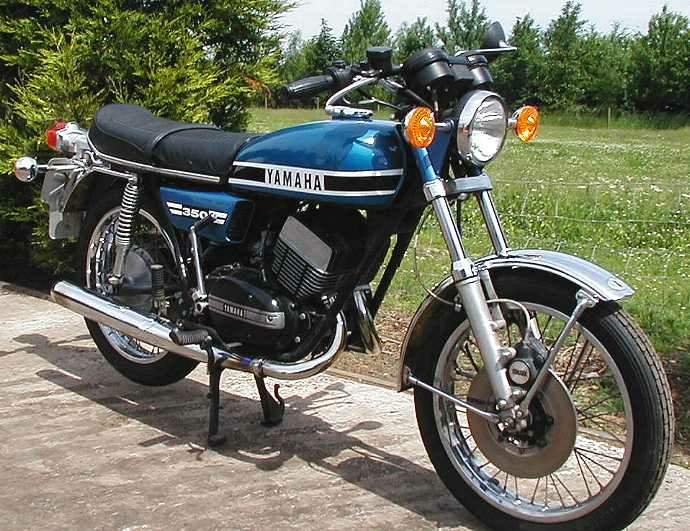
RD 350

|
Model |
Yamaha RD 350 |
|
Year |
1977-79 |
|
Engine |
Air cooled, two stroke, parallel twin cylinder. |
|
Capacity |
347 |
|
Bore x Stroke |
64 х 54 mm |
|
Compression Ratio |
6.8:1 |
|
Induction |
2, Mikuni VM28 SC |
|
Ignition /
Starting |
Battery, dual coils, breaker points
/ kick |
|
Max Power |
39 hp 28.5 KW @ 7500 rpm |
|
Max Torque |
|
|
Transmission /
Drive |
6 Speed / chain |
|
Front Suspension |
Telescopic forks |
|
Rear Suspension |
Swing arm, dual shocks |
|
Front Brakes |
Single 267mm disc 2 piston caliper |
|
Rear Brakes |
178mm Drum |
|
Front Tyre |
3.00-18 |
|
Rear Tyre |
3.25-18 |
|
Seat Height |
800 mm / 31.5 in |
|
Wet-Weight |
162 kg / 357 lb |
|
Fuel Capacity |
15.9 Litres |
|
Standing
¼ Mile |
14.48 sec / 89.8 mp/h |
|
Top Speed |
106 mp/h |
The guy at the bar looked dazed, staring out of the
1975 Yamaha RD350 ad with bitter embarrassment. The copywriter's headline served
up a little back-handed solace to wash down with that last swallow of beer from
the mug in his hand. "Don't feel bad. You're not the first 750 rider to get
blown off by a Yamaha 350."
Anybody old enough to read a bike magazine back in '75 knew it was true.
Return with us now to the blissful ignorance of pre-politically correct,
mid-'70s America. Before we had any clue about the myriad dangers of triple
cheeseburgers, saturated fat, unburned hydrocarbons and street-going
two-strokes, there was the RD350. Dirty, foul-mouthed, deliciously quick and
relatively affordable, it was (is?) a Giant Killer for the ages.
From the first '73 RD350 to the last 1975 RD350B, Yamaha's overachieving pocket
rocket humiliated triples and fours packing over twice its 347ccs on racetracks
and backroads all over the planet. Back when bell-bottoms were cool and Harley's
weren't, most anybody's big-bore multi roasted the RD in a straight line.
Horsepower was cheap, and any fool could twist a throttle.
But motorcycle handling was still an oxymoron in Japan...except at Yamaha. When
seventh-morning services convened at the shrine of the divine apex, street or
track, all bowed to the RD. For the proletarian canyon commando, laying down
$3000-plus for one of 50 1974 750SS Ducatis was like Led Zeppelin playing the
next freshman/sophomore mixer: very bitchin', and highly unlikely. Kawasaki's
very fast, very large Z-1 wore a $1995 price tag. But a 1974 RD350 sold for
$908: Moet Chandon on a Schlitz budget. Racetrack handling for the masses.
No surprise there. Look up production racer in the dictionary and it says
"...see Yamaha." Or at least it should; nobody before or since has built a more
accessible, successful roadracing tool available to J.Q. Public.
The RD350's street roots stretch back to February 1967, and the YR1--Yamaha's
first street-legal 350. But the 1970 R5 350 drew a straight line from brand Y's
TR production racers to the street.
Fast forward from the YR1 to the mercifully cleaner lines of the 1970 R5 350.
Adding new seven-port, reed-valve cylinders and a few other refinements turned
the '72 R5C into the 1973 RD350. Now we're on to something. Even in '73, RD
styling was still parked somewhere between tawdry and garish. But 0.010-inch
thick spring steel reed valves between 28mm carburetors and the new, seven-port
cylinders made all the difference. The 347cc RD twin used classical 64x54 bore
and stroke numbers to spin out about 35 horses at 7500 rpm.
Pushing 352 pounds fully fueled, Motorcyclist's admittedly rough-running 1973
test bike covered the quarter-mile in 14.48 seconds at 89.8 mph. Cycle
magazine's RD ran closer to its potential with a 14.12-second/93.2-mph blast.
Those numbers were underwhelming alongside beasts like Kawasaki's 12-second
triples and fours. You could fluster 'Vettes and Hemi 'Cudas roosting away from
a light, but the RD wasn't a dragster.
Agile, light, simple and reliable (see "Yamaha RD350/RD400: Charting the
Changes" sidebar, p. 64), the RD would take you from work and back Monday
through Friday with Clark Kent gentility, offering only the odd oil-fouled B8HS
spark plug in protest. It was smooth and comfy enough for freeway travel,
allowing gas station pit stops at 100-mile intervals; the thirsty little twin's
3.2-gallon fuel tank called up reserve every 70 miles. Two quarts of oil flowed
through the Autolube system every 500 miles or so. But turn up the volume and
fuel mileage fit the bike's Bad Boy image. Figure about 26 miles to the gallon
if you were loose with the loud handle.
Back when gas and thrills were cheap, the RD's minimalist approach was more
suited to eating up twisty pavement than straight stretches. The engine and
frame were what made corner-carvers nuts. Both were born on the racetrack,
derived from the 750-slaying TR2 production racer's heart and bones. The
streetbike's frame used thicker-wall steel tubing, but the geometry was
track-spec. Aside from details like a dry clutch and a longer transmission input
shaft, the '73 RD350's cases and crankshaft were effectively identical to the
liquid-cooled '73 TZ350 (which was basically a liquid-cooled version of the
familiar TR350 Don Vesco used to win the 1972 Daytona 200 ahead of two other TR
Yamahas).
From its birth until Yamaha's FZR400 took over in 1988, the 350 Yamaha
two-strokes were pretty much the dominant tool for 400-class production racing
on the cheap. San Francisco Bay area RD aficionado Dale Alexander remembers the
350 as a potent, reliable tool once it was set up correctly. "I could race my RD
all season for the price of a new FZR400," he says. Before moving on to TZ
Yamahas, Formula 1 Suzukis and such, Thousand Oaks, California's Thad Wolff
routinely clobbered all comers in the 1979 AFM 400 production title aboard a
very rapid RD375 (extra displacement courtesy of TZ750 pistons in chromed bores,
spinning a TZ250 crankshaft). "The only competition for a well-set-up RD was
another RD," Wolff remembers.
In the hands of guys like racer/tuner/team owner/internal-combustion mastermind
Don Vesco (the man went 251.924 mph on the Bonneville salt in an 18-foot-long
streamliner motivated by twin TR2 350cc racing engines in 1970), relatively
cheap, interchangeable TR/TZ parts made RD Yamahas the production racing force
to be reckoned with--on (or off) the cheap.
After swapping the stock exhaust for expansion chambers, raising the exhaust
ports, opening the intakes, widening the boost ports, slipping a 5/8-inch spacer
between the reed valve block and the cylinders (breathing room, baby...),
swapping out the stock 28mm carbs and maybe single-ring pistons, milling the
heads for more compression and maybe adding slotted connecting rods, a
full-house RD made 50-plus horsepower. "You could make 'em run almost as quick
as a TZ with all the good stuff," Vesco says.
Even without all the good stuff, nothing got through a tight set of corners any
quicker than a savvy RD pilot. Motorcyclist's November 1974 test of the RD350B
said, "...in everything but all-out acceleration, the Yamaha 350 will probably
outperform just about anything on the market in box-stock trim." We griped about
hard grips, a little too much engine vibration and footpeg mounts that eroded
rapidly at maximum lean. Otherwise, the RD was a gem.
Despite an "incontinent" Autolube oil-injection pump, excessive intake honk and
a grabby clutch, Cycle magazine was equally enamored of its first RD test bike.
Brakes? The 10.5-inch front disc and rear drum proved to be the most potent
braking system Cycle had tested. "The little 350 generates enough decelerative
force to jerk your eyeballs out--and it does it without a lot of lever
pressure," saideth Cycle's stone tablets. What about handling? The words came
down from Cycle's Westlake Village stronghold in a flurry of granite chips:
"...the bike can burn through switchbacks and carve around sweepers like few in
its displacement class and few in any other class."
Even a pristine example of the breed (like the 1975 RD350C pictured) will
underwhelm derrieres calibrated to current four-stroke sporting weaponry. Still,
novelties like really light weight and the two-stroke's rush of dirty little
explosions every time a piston heads earthward ("Dang the ozone layer, Scotty,
give me acceleration!"). Eco issues aside, it's a deceptively quick little beast
to ride.
The RD looks tiny by 1996 standards because it is. Even so, nice flat bars and a
seat to match keep six-footers comfy for 100 miles or so between fuel stops.
Twenty-year-old suspension bits feel...well, about 20 years old. The little 350
still corners on rails, even if it does wallow and grind its low-slung
undercarriage at relatively mild lean angles. But keep rowing the cliche-smooth
transmission's six tightly bunched ratios to keep the hydrocarbons burning
between 6000 and 8000 rpm and the RD flat out roosts--60 mph arrives in less
than four seconds. Even through the tastefully muted stock mufflers, the
weed-whacker-on-benzedrine exhaust note is pure heaven.
Careful, though--some things never change. Since most of its 352 pounds rest on
the rear wheel, the 350's front hoop enjoys pointing out interesting cloud
formations under full throttle. The Habitually Dim still risk wearing it as a
hat in the first two gears.
The RD was the official bike of working-class curvy road cognoscenti in the
mid-'70s. As Yamaha product planner Ed Burke says, "The RD was a cult bike if
there ever was one." All it took to initiate membership was that velvet shriek
rising into your Bell Star. Once you knew what it could do to a perfect road on
a perfect morning, nothing else was even close. But all good things must come to
an end. Neither the cleaner, more "civilized" 1980 RD400F or the liquid-cooled
RZ350 (a story for another day) of 1984 could win the war against progressively
faster, more sophisticated heathen four-strokes. Riders demanded bigger, faster
bikes. The EPA wanted cleaner ones. The handwriting was on the wall. The RD350
begat the RD400 in 1976, and by the end of 1980 the 400 disappeared from Yamaha
showrooms as well.
If the hair on the back of your neck still stands at attention at the sound of a
crisp RD, take heart. Plenty of good ones still live under the "Yamaha" section
of your local classifieds. For very little money (see "Used RDs" sidebar, p.
70), you can take a trip back to the good old days, when two strokes were better
than four. >
For further reading, try Yamaha, by Mick Walker, and Yamaha Racing Motorcycles,
both available through Classic Motorbooks, (800) 826-6600.
Source
yamaha-motor.com
|