|
Make Model |
Yamaha
YZF-R 125
|
|
Year |
2012 |
|
Engine |
Liquid cooled, four stroke, single
cylinder, DOHC, SOHC, 4 valve |
|
Capacity |
124 |
|
Bore x Stroke |
57 × 58.7mm |
|
Compression Ratio |
10.4:1 |
|
Induction |
Fuel Injection |
|
Ignition /
Starting |
TCI / electric |
|
Clutch |
Wet Multiple-disc |
|
Max Power |
12.6 KW 17 hp @ 8500 rpm |
|
Max Torque |
15 Nm @ 7500 rpm |
|
Transmission /
Drive |
6 Speed / chain |
|
Frame |
Delta box |
|
Caster / Trail |
26° / 98mm |
|
Front Suspension |
Telescopic forks, 130mm wheel travel |
|
Rear Suspension |
Swinging arm, 125mm wheel travel |
|
Front Brakes |
Single 292mm disc |
|
Rear Brakes |
Single 230mm disc |
|
Front Tyre |
90/80 -17 |
|
Rear Tyre |
130/70 -17 |
|
Seat Height |
800 mm |
|
Wet-Weight |
136 kg |
|
Fuel Capacity |
13.8 Litres |

The
YZF-R1 and YZF-R6 are equipped with under cowls that are based on the image of a
diffuser, to give them the best form for aero-management. These are not cowls
for simply enclosing the engine, but forms composed of blade surfaces that
actively control airflow. This spirit has been directly inherited by the YZF-R15
version 2.0.
“Harmony between rider
and machine.” YAMAHA's Human Technology involves studying the form of the
motorcycle actually in motion with the rider on it. The R series is the
embodiment of 1) a wide frontal space that protects the rider, 2) an easy to
ride seating area that gives riders the freedom of movement and allows them to
steer effectively, 3) the glamorous tail treatment that takes into account the
management of airflow behind the rider, and 4) a sensual racing form that brings
all 3 of these elements together in a harmonious package. These characteristics
have been splendidly reproduced in the YZF-R15 version 2.0.
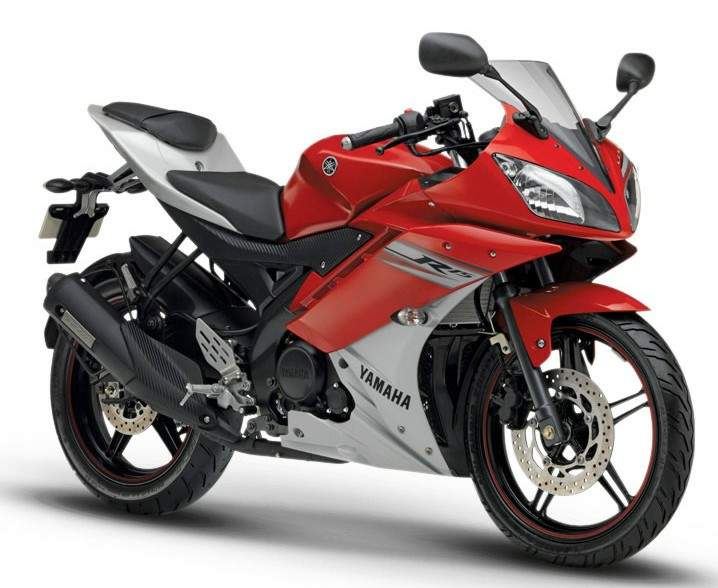
The YZF-R15 version 2.0
is a new model that has been developed under the concept of a “Graded Up R15.”
While maintaining the proven ease of handling of the existing R15, the R15
version 2.0 boasts of spruced up looks and better performance in circuit riding.
The design elements are borrowed from the supersport model YZF-R1 that is
adapted from YZR-M1 MotoGP race machine.
The YZF-R15 version 2.0
– is a 150cc liquid-cooled 4-stroke fuel injected bike. The R15 version 2.0 has
undergone changes as compared to the present YZF-R15 in the specs of the Engine
Control unit (ECU), drivetrain unit, a long aluminum swing arm, wider front and
rear tires (radial tire for the rear), split seat, LED taillights and new-design
middle cowl & tail cowl.
Liquid-cooled
First Indian made model with cooled Engine. Liquid Cooled Engine provide stable
performance, reduce vibrations, and offer a high quality ride.
The engine is surrounded by a water jacket in which coolant liquid circulates to
cool the engine. While this method is widely used in automobiles and large
capacity motorcycles, there are very few examples of motorcycles of this class
due to increased weight from components such as radiators. YZF-R15 uses a
special compact and lightweight aluminum radiator and a body design that
utilizes airflow for heat dissipation. This has enabled us to create a
lightweight, compact body while retaining its stable performance.
The benefits of using this method include stable performance during
long-distance, high-speed riding and hill climbing. A liquid-cooled engine does
not need heat-dissipating fins and therefore the engine is able to deliver its
best performance without being affected by temperature. Additionally, because
the head and cylinder are enclosed in a water jacket, mechanical noise from the
engine is reduced dramatically. The newly developed engine delivers agile riding
performance, and excellent performance on straight stretches of road as well as
on winding roads. YZF-R15 also delivers excellent environmental performance.
These traits are a must for an “urban supersport.” The ride is unprecedented in
terms of both excitement and quality.
Chassis
New-design middle cowl
The newly designed middle cowl features improved aerodynamic performance at
higher speeds while also giving a more dynamic look to the body styling. The
aerodynamic resistance value is 4% better than that on the existing YZF-R15 for
improved high-speed performance.
The new cowl is characterized by a layered structure and is designed to actively
draw in airflow for cooling effect, while also contributing to rider comfort by
directing the outflow away with greater efficiency.
Deltabox Frame
The frame, which forms the basis for riding comfort and handling performance, is
a Deltabox frame which delivers superior rigidity balance.
This frame was designed to provide the best balance in longitudinal, lateral,
and torsional rigidity. The synergy created by optimizing each dimension
delivers a solid riding feel as well as comfort and agile riding performance.
The Deltabox frame was commercialized based on the experience and know-how
accumulated through YAMAHA’s involvement in Moto GP since the early 1980s. This
type of frame is currently used in YAMAHA’s R series of sport models. The engine
is mounted on rigid supports; one on the head side and two on the case side; so
that the engine itself becomes a structural member contributing to body strength
and rigidity. The engine’s low vibration makes rigid supports possible, ensuring
low vibrations and excellent balance of rigidity. Torsional rigidity refers to
the frame’s resistance to deformation when a twisting force is applied to the
pivot with the frame’s head pipe held in place.
Linked type Monocross suspension
YZF-R15 is equipped with a linked type monocross suspension that delivers a
comfortable ride and a cushioning performance that is less prone to bottoming
out. In particular, it reduces annoying “sinking” when riding tandem.
The linked monocross suspension consists of a link mechanism sandwiched between
the rear arm and cushion unit to create changes in the lever ratio based on the
lever effect. When the shock absorber is almost fully extended, the lever ratio
is high and therefore the spring is soft, and the damper works softly as well.
As the shock absorber strokes in, the lever ratio gradually decreases and the
spring rate increases. Eventually, when it is nearly fully stroked in, the lever
ratio becomes small and the spring becomes hard and strong. The damper also
becomes hard. By making changes to the lever ratio in this way, we were able to
achieve soft riding comfort as well as excellent damping under intense load
conditions.
The optimization of the frame and rear arm rigidity of the Deltabox Frame
combined with the effects of the linked type monocross suspension achieve good
riding comfort, agile handling, and turnability, hardly ever causing bottoming
out.
As the heir to the YAMAHA R series, YZF-R15 has inherited the series’ agile
handling performance.
Aluminium Swingarm
First Indian made model with aluminium long rear arm which improves handling in
the turns. It has a truss structure that enables greater rigidity. This rear arm
is cast in one piece by the gravity casting technique that enables a quality
cast with great freedom in sectional thickness.
The chain adjustment assembly at the end of the rear arm is the same type used
on Super sports models to improve adjustment capability.
The long swing arm design is a feature fed back from Yamaha’s YZR-M1 MotoGP race
machine and it is effective for ensuring outstanding rear tire traction. It
serves to minimize excessive chassis movement when drive force is applied and is
thus effective in stabilizing the machine.
Split Seat
A separate-section seat enables a better feeling of seat grip in sporty riding.
This new seat design features a slip-resistant seat cover material, excellent
cushion qualities, optimized shape for the inner thigh contact area and the
cushioned front edge of the rear seat that supports the rider’s rear.
The 800mm seat height lets the rider maintain a more relaxed riding posture,
while the shape of the area that contacts the rider’s inner thighs has been
shaped to provide easy leg reach to the ground. The design also features a
storage compartment under the rear seat for holding things like tools and
documents.
Wider Radial Rear Tyre
With a width of 130 mm, the rear tire adds to the sense of machine volume A
radial tire is a tire formed around a “carcass” consisting of a radial ply with
cords that run in a perpendicular to rolling direction, as if “radiating” out
from the center of the tire to the two rims.
The advantages of a radial tire are: (1) a high level of rigidity that reduces
excessive flexing of the tread and increases grip and (2) reduced rolling
resistance that contributes to better fuel economy.
The rubber compound and tread pattern, the crossing angle of the belts and the
amount of turn-up in the radial carcass are designed for the optimum mutual
balance to achieve excellent handling characteristics.
LED taillights adds cadence to the
styling. Long-life LED lamps are adopted to help create a rear view suggestive
of the super sport class YZF-R6 model.
New tail cowl
The exterior parts from the side to the tail cowl have been designed to create a
dynamic leaping appearance toward the rear that gives a sense of cadence to the
body lines. A dynamic line of carbon coloring is added along the fuel tank and
lower edge of the seat that accentuates the mechanical look.
Large 220 mm diameter - Rear disc
brake
A larger 220mm diameter rear disc brake has been adopted to achieve a better
balance with the new rear tire size and ensure good braking power and
operability. This larger disc is coupled with the piston-slide type single-pot
caliper.
New-design 5-spoke type wheels
Newly designed cast wheels are adopted front and rear. The design creates a
5-spoke image by grouping the ten thinner spokes two by two to form five pairs.
This design achieves the necessary strength balance while creating a sense of
lightness at the same time.
Exhaust System Design
Exhaust system design contributing to the high performance image. The angle at
which the silencer is mounted accentuates the feeling of upward thrust toward
the rear. The newly designed silencer protector adds cadence to overall styling.
It adopts a carbon-look pattern on the surface as well as a model nameplate to
add to the high-performance image and the feeling of quality. The design of the
end cap is also new.
Source
Yamaha Motor]