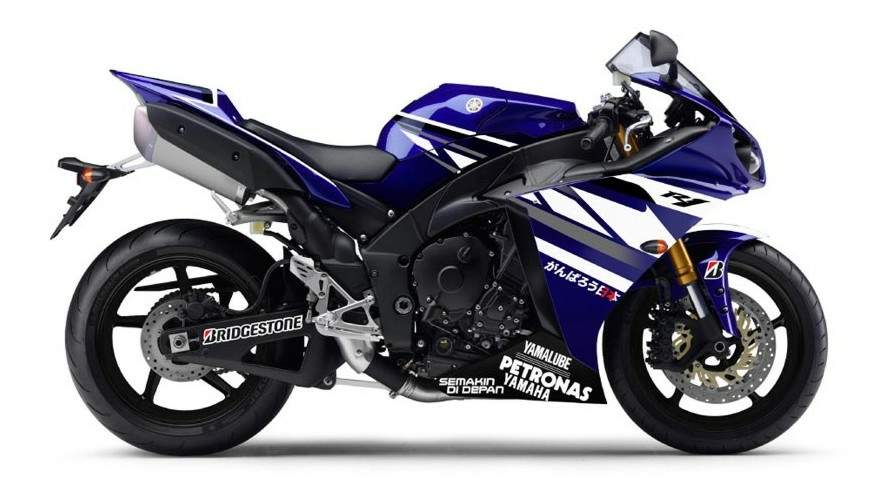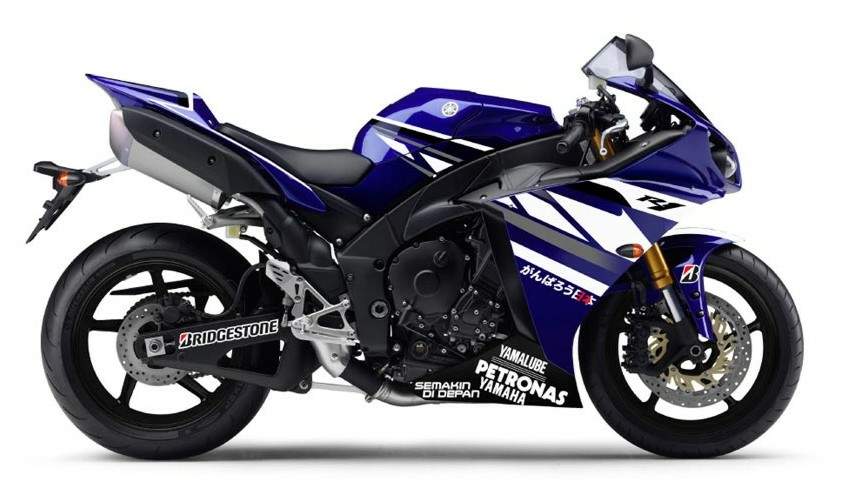
The MotoGP-inspired R1 is the most
advanced Open-class production motorcycle.
The 2011 Yamaha R1 represents a paradigm shift in technology, performance and
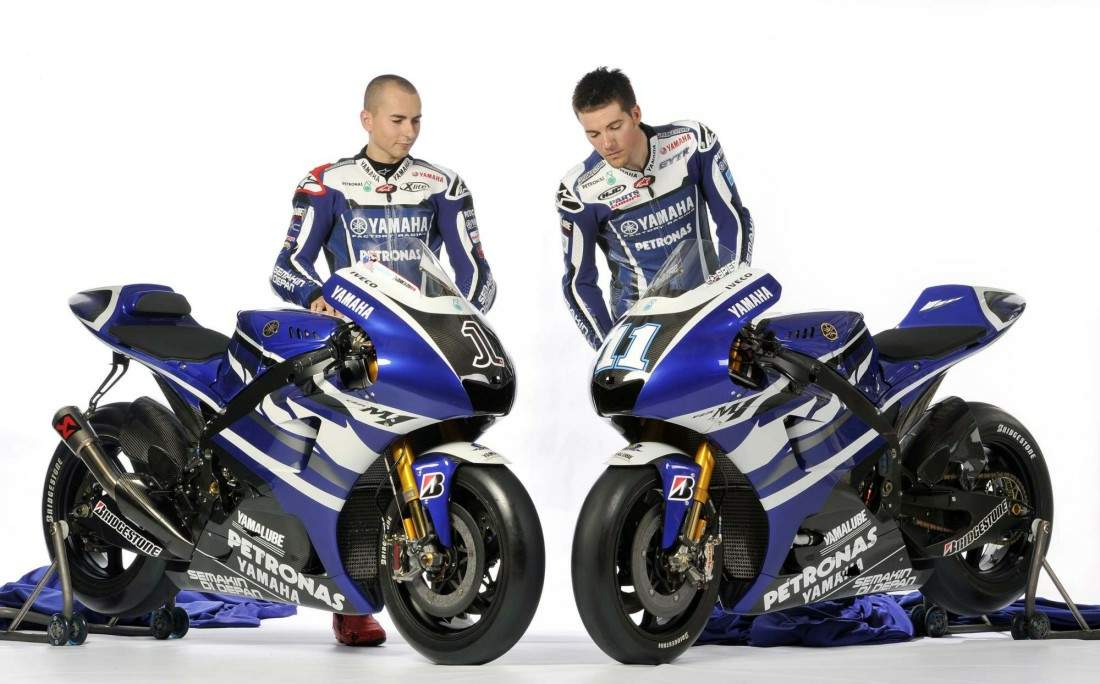
controllability among litre class sport bikes. Inspired by Yamaha's M1 MotoGP
race bike, this latest generation R1 features a crossplane crankshaft design
with an uneven firing order to provide outstanding yet easy to control torque
and an exceptionally linear throttle feel never experience before. But there is
far more to the 2011 Yamaha R1 than just a revolutionary engine.
The 2011 R1 … Yamaha's technical "Tour de Force."
The R1 has been designed to be the "Ultimate Cornering Master" of the open super
sport class and one of the keys to incredible handling lies partly in the
chassis but equally as important, in its ability to put useable power to the
ground. This revolutionary cross-plane crank R1 delivers as much power as the
rider wants, exactly when the rider wants it … by a simple twist of the right
wrist; leaving the rider feeling like they are directly connected to the rear
wheel of the revolutionary R1.
The Bark is bad. The bite is badder.
Forget everything you ever knew about the supersport litre class. The all new
2011 Yamaha YZF-R1 is unlike anything before. That's because it's the world's
first production motorcycle with a crossplane crankshaft. The result? Incredibly
smooth power delivery and outrageous torque for a rush like you've never
experienced.
2011 Yamaha YZF-R1 model Features
Fuel Consumption * 14kpl/40mpg(Imp)
998cc, DOHC, 4-valve, in-line 4 with revolutionary "crossplane" crankshaft
Compact Deltabox chassis with fully adjustable suspension
The key components of this cutting edge engine design are the "crossplane"
crankshaft and an uneven firing order. Both of these features are used on
Yamaha's championship winning M1 MotoGP racer. Please note … this is not a "big
bang" engine. The R1 departs from the norm for in-line 4 cylinder engines and
the 180 degree alignment of the crank pins (where the connecting rods attach to
the crankshaft), and locates the center two rods at a 90 degree plane from the
outer cylinders. This means instead of the crank pins aligned on the same plane
(a straight line drawn through the center of the crankshaft), they align on 2
planes in the form of a cross ... or "crossplane". Working in conjunction with
the crossplane crank is an uneven firing order. A traditional in-line 4
cylinder's firing order is normally 1,2,4,3 with a 180 degree interval. This R1
engine fires 1,3,2,4 cylinders and the firing intervals are uneven at 270 / 180/
90 /180 degrees. What all this means to the rider is the most linear torque
possible and amazing throttle control. This engine design allows a whole new
level of rider - machine communication. One of the most important benefits is
the outstanding cornering performance that increased engine control allows.
The engineering goal for the R1 is controllability … not just an increase in
horsepower. If that was the case, we could have simply increased the power
output of the existing engine design resulting in a peaky, hard to use power
band.
The 4-valve cylinder head design features a compact combustion chamber that
utilizes lightweight, trick, titanium valves on the intake side. The 4-valve
design maximizes breathing efficiency and overall engine performance.
The titanium intake valves are 31mm in diameter while the steel exhaust valves
are 25mm in diameter. Lightweight yet super strong VX alloy valve springs
control valve movement.
Steep valve angles, 11.5 degrees on the intake side and 12.5 degrees on the
exhaust produce a compact combustion chamber.
The lightweight titanium intake valves reduce the reciprocating weight of the
intake valves allowing for higher rpms without the concern of valve float. The
use of lightweight "Ti" valves has allowed the engineers at Yamaha to use a
4-valve format. In the past, the use of 5 smaller valves allowed a higher rpm
limit since each of the "smaller" valves was relatively light. The use of light
weight titanium now means the engineers no longer have to use the 5-valve design
to achieve the same high rpms.
Combustion chambers have been optimized for maximum engine performance. The
compression ratio is 12.7:1.
Compact automatic cam chain tensioner reduces both maintenance and engine
mechanical noise.
Short skirt, forged aluminium pistons offer light weight, fast throttle response
and great reliability.
Crossplane crankshaft features 36mm journals for increased strength, while the
inertial moment of the crank has been increased by 20% versus the last
generation R1.
Connecting rods are carburized and use a nut less design. The lower end "cap" of
the rod is made from the same piece of material as the upper portion and is
cracked away in a process known as "fracture splitting". This process aids true
big end roundness and greater precision in con rod dimensions.
Ceramic composite cylinder "bores" are a "liner less" design with the ceramic
coating applied directly to the aluminium block to ensure uniform heat
dissipation for consistent power delivery, reduced oil consumption, reduced
friction and reduced weight.
Closed deck cylinder design allows
the cylinders to be spaced more closely together, allowing a narrower engine.
The cylinder block is a stand-alone piece (not integrated into the upper crank
case). The benefit is reduced weight and a less tall engine which lowers the
centre of gravity.
A "coupling force balancer" is used to quell engine vibration for excellent
rider comfort.
Compact ACM (alternator) is mounted directly to the crankshaft. The compact ACM
uses rare earth magnets which produce more power for a given size than
conventional magnets, therefore reducing size and weight.
Mikuni fuel injection system features twin injectors (one set of primary & one
set of secondary injectors). This type of twin injector system is also used on
our M1 MotoGP race bike and the R6. One set of injectors (primary) are located
in the 45mm throttle bodies while the secondary injectors are located in the air
box very near the computer controlled intake funnels. The primary injectors
utilize 12 spray holes to maximize the fuel atomization process. The secondary
injectors, located inside the air box, begin to function at mid rpms onwards to
supply more fuel as required.
The F.I. system features separate dual track TPS (throttle position sensor) and
APS (accelerator position sensor) sensors
An oxygen sensor is fitted into the exhaust collector making this a "closed
loop" type FI system, which feeds back info to the ECU so adjustments can be
constantly made to the fuel-air mixture for improved performance and reduced
emissions.
The benefits of fuel injection include excellent throttle response, great fuel
economy, reduced emissions, stable idling and no choke to fuss with during start
up.
The fuel injection's lightweight Electronic Control Unit (ECU) utilizes a
powerful 32-bit processor for fast control of the injection process. The compact
design also reduces weight.
YCC-I or Yamaha's Chip Controlled Intake means the intake funnels / stacks vary
in length (2 positions) depending on engine rpm. An electronic servo motor
varies the funnel length from the tall position at low to mid rpms to the
shorter setting for improved high rpm power. The transition rpm between the 2
lengths is approx. 9,400 rpms. The revolutionary YCC-I provides the best of both
worlds …solid low rpm torque and power combined with an amazing high rpm rush.
It takes only 0.3 of a second for the funnels to move from the tall to the short
position.
Yamaha's exclusive YCC-I
electric-control servo motor-driven variable intake funnel system is a world's
1st on a production motorcycle and works in conjunction with Yamaha's
fly-by-wire technology and FI Systems.
Yamaha Chip Control Throttle (YCC-T) electronically controls the throttle valves
for outstanding response and improved controllability at all rpms. The YCC-T is
used to provide even more control of the intake air volume for smoother torque
character. Similar to the R6 design, the YCC-T features 3 - ECU's inside the
main ECU to control ignition, fuel injection and the YCC-T. This special ECU is
capable of responding to changes at a speed of 1000th of a second.
The rider can "mechanically close" the throttles by simply closing the throttle
twist grip.
Long life Iridium twin electrode spark plugs are used.
Compact close-ratio 6-speed transmission features optimized gear ratios for
maximum performance. The "stacked" 3-axis gearbox / clutch design stacks
input/output shafts to create a low center of gravity and keeps overall engine
size shorter front to back. As a result, the stacked design gives the engineers
the freedom to place the engine in the "sweet spot" of the frame for optimum
weight balance for awesome handling.
The slipper or back limiter clutch assembly reduces rear wheel hop when making
hard down shifts when under hard braking. Key benefit is reduced lap times and
smoother control when riding aggressively during a race or track day.
A multi plate clutch is used, utilizing coil springs and paper based fibre
plates.
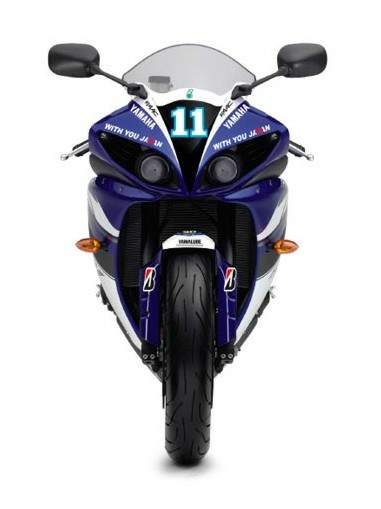
"Ram Air" system "force feeds" outside air via dual ducts located beside the
projector headlights into the intake system. As speed increases the air velocity
in the system increases and pressurizes the air box. This "force fed" air helps
the engine develop maximum power.
Computer optimized large capacity air box maximizes performance. A viscous type,
high flow air filter is utilized.
4 into 2 into 1 into 2 titanium exhaust system maximizes power output, reduces
weight and improves aerodynamics. The dual under seat mufflers provide an
aggressive sound as well as a great styling highlight. This system contains a
3-way honeycomb catalyser and an oxygen sensor. The catalytic converters reduces
harmful CO and HC exhaust emissions while the oxygen sensor provides feedback to
the ECU to maintain optimum fuel/air mixture at all times.
Dual shorty, large diameter triangle shaped mufflers are a "single expansion"
type that create a throaty exhaust note and help emphasize engine character. The
exhaust note is much different than on previous R1 models due to the crossplane
crank and uneven firing order … it sounds very similar to Yamaha's M1 MotoGP
race bike.
Compact, high-efficiency curved radiator features dual ring-type fans for
maximum cooling efficiency. This curved rad and twin fan design produces more
airflow than conventional flat designs to maintain optimum engine temperatures
for consistent power output.
Large liquid-cooled oil cooler maintains stable lubricant temperatures for
extended engine life. Convenient cartridge style spin-off oil filter.
High performance direct ignition coils (ignition coil is built into the spark
plug cap) reduce weight while iridium spark plugs and high-output magneto
deliver increased spark energy.
Yamaha D-Mode variable throttle control enables the rider to adjust the
performance characteristics of the engine based on riding preferences or
conditions. Standard mode emphasises the very linear throttle and torque feel of
the engine. The A mode allows the rider to enjoy sportier engine performance in
the low to mid rpms. While the B Mode reduces the power response for riding
situations that require softer power characteristics. The switch mechanism is
located on the RHS handle bar switch gear.
CHASSIS/SUSPENSION
Aluminium Deltabox frame has been designed to offer an optimized rigidity
balance to maximize handling performance. This frame is very rigid or stiff at
the head pipe, engine mounts and swingarm pivot point. In other areas, material
has been carefully removed to allow "tuned flex". Finished in black, this frame
boasts a compact 1415mm (55.7") wheelbase. The swingarm pivot location has been
optimized to minimize the chain tension effect under hard acceleration,
providing more stable handling. The engine is a fully stressed chassis member to
maximize handling. Stability, a key to great handling, is unsurpassed while the
ability to hold a line under hard acceleration is excellent. This frame features
a mix of gravity cast (head stock & front engine mounts & swingarm pivot area),
CF (controlled filling) die cast (outer tank rails) and aluminium panels (inner
tank rails). Each of these aluminium parts has different flex characteristics in
order to provide the rigidity balance the engineers desired.
The engine mounting location in the aluminium frame is different than previous
R1 models. The engine incline (9 degrees) and location (12mm forward) has been
changed to improve the weight balance, front to rear weight ratio and the centre
of gravity.
Detachable magnesium CF die cast rear subframe reduces weight. The detachable
design allows rear shock access and is less costly to repair if accidentally
damaged.
Extra-long, lightweight aluminium "truss-type" swingarm provides great torsional
rigidity for class leading handling, agility and manoeuvrability. This
lightweight swingarm is made up of cast aluminium and CF die cast parts. The
distance between the swingarm pivot and the rear axle has been optimized (597
mm) for excellent "turn-in" abilities and rear wheel traction.
This Deltabox chassis offers an incredible 56 degree lean angle.
Fully adjustable 43mm inverted fork features independent left and right damping
system. The compression damping is adjusted via the left fork leg, while rebound
damping is adjusted on the right fork leg. This system simplifies the flow of
oil through the fork and minimizes oil cavitation (aeration of the oil) for more
stable suspension performance. Adjustments include 5-way spring preload, 25-way
rebound and 25-way compression damping. Front wheel travel is 120mm (4.7"). The
thickness of the inner fork tubes and the shape of the outer tubes have been
optimized. The adjustable design allows the rider to tailor suspension settings
to match rider weight and road /track conditions to maximize handling and
suspension performance.
Bottom link Motocross rear suspension utilizes a fully adjustable
piggyback-style rear shock. Adjustments include 16-way spring preload, 18-way
rebound and 20-way hi speed compression damping and 4-way low speed compression
damping. The bottom link design lowers the centre of gravity for excellent
handling. This shock features 2-way (hi speed & low speed) compression
adjustment plus rebound and spring preload adjustability too. This is a rising
rate or progressive system. The adjustable design allows the rider to tailor
suspension settings to match rider weight and road /track conditions to maximize
handling and suspension performance. Rear wheel travel is 120mm (4.7").
Radial mount 6-piston calipers squeeze fully floating 310mm dual front rotors.
The result is incredible braking performance with excellent control and lever
feedback.
Brembo radial pump master cylinder with 16mm piston is a direct GP race
innovation. The lever is adjustable for various hand sizes.
Single piston (aluminium) slide-type Nissin rear caliper squeezes a lightweight
220mm rotor.
Rugged yet lightweight 5-spoke mag wheels front and rear. The wheels utilize
hollow "spokes" to reduce unsprung weight for superior handling. Front rim size
is a MT3.50 x 17 while the rear is MT6.00 x17.
Premium sport spec radial tires front and rear.
18 litre fuel tank provides excellent knee grip for hard braking and great rider
manoeuvrability. The elongated shape helps to centralize mass and reduces the
variance in riding feel as the fuel load (weight) changes.
Race inspired lightweight instrumentation includes an analog tach plus digital
speedo, dual tripmeters, clock, coolant temperature and fuel trip meter. This
console also features adjustable back lighting, adjustable shift light and a low
fuel warning light. Other key features include a gear position indicator,
accelerator opening angle indicator, engine mode indicator integrated stop
watch, lap timer with split time mode and an air intake temperature display. The
lap timer is controlled by the starter switch button for added convenience and
ease of use.
Dual 55-watt halogen projector headlights are compact and thereby allow the ram
air intake ducts to be integrated into the framework of the headlight assembly.
The lights not only cast a very bright beam of light, but also add a unique
styling touch.
LED taillight reduces weight and power consumption while providing a brilliant
eye catching light. The lens is white while the LEDs are red.
ADDITIONAL FEATURES
Adjustable footrests can be raised 15mm upward and 3mm backward if desired.
Immobilizer ignition system is designed to reduce the possibility of "ride away"
theft. This system must recognize the "coded ignition key" in order for the unit
to start. If the immobilizer ignition does not recognize the key (or a thief's
screwdriver or other type of "jimmy tool") the bike will not start even if the
ignition is turned or forced into the on position. If the system does not
recognize the coded chip in the ignition key, it will not allow the ignition
system, fuel pump or starter motor to function.
Race inspired fairing improves both aerodynamics and style. The fairing features
a slant nose front profile for aerodynamic streamlining, with engine revealing
side cut outs.
Windshield features a "screw less" design for a cleaner, more trick appearance.
Slim design rear tail section.
The seating position offers a very sporty yet comfortable riding position.
Lightweight forged footpegs for high strength.
Extensive use of hollow bolts and lightweight fasteners help trim overall
weight.
Heavy-duty 50 series "O" ring drive chain.
Low maintenance, lightweight, sealed battery.
Convenient fold out under seat bungee cord straps.
The YZF-R1 offers a significant level of power and performance. It is not
intended for novice or inexperienced riders.
NOTE: Some of the photos on
Motorcycle Specs are owned by somebody. If you see any of your
photos, you can let me know so that I can acknowledge it, or if
you object to it, I can remove it altogether. If any copyright
holder objects to their articles being placed on Motorcycle
Specs, it will be removed upon request. Any correction or more
info on these bikes will kindly beappreciated
Contact MePrivacy
Policy
Website Stats