|
|

|
|
|
|
Classic Bikes
Custom Bikes
Individual
Racing Bikes AJP
AJS
Aprilia
Ariel
Avinton / Wakan
Bajaj
Benelli
Beta
Bimota
BMW
Brough Superior
BRP Cam-Am
BSA
Buell / EBR
Bultaco
Cagiva
Campagna
CCM
CF Moto
Combat Motors
Derbi
Deus
Ducati
Excelsior
GASGAS
Ghezzi Brian
Gilera
GIMA
Harley Davidson
Hero
Highland
Honda
Horex
Husaberg
Husqvarna
Hyosung
Indian
Jawa
Kawasaki
KTM
KYMCO
Laverda
Lazareth
Magni
Maico
Mash
Matchless
Mondial
Moto Guzzi
Moto Morini
MV Agusta
MZ / MuZ
NCR
Norton
NSU
Paton
Peugeot
Piaggio
Revival Cycles
Roland Sands
Royal Enfield
Sachs
Sherco
Sunbeam
Suzuki
SWM
SYM
Triumph
TVS
Ural
Velocette
Vespa
Victory
Vincent
VOR
Voxan
Vyrus
Walt Siegl
Walz
Wrenchmonkees
Wunderlich
XTR / Radical
Yamaha
Zero
Video
Technical
Complete Manufacturer List
|
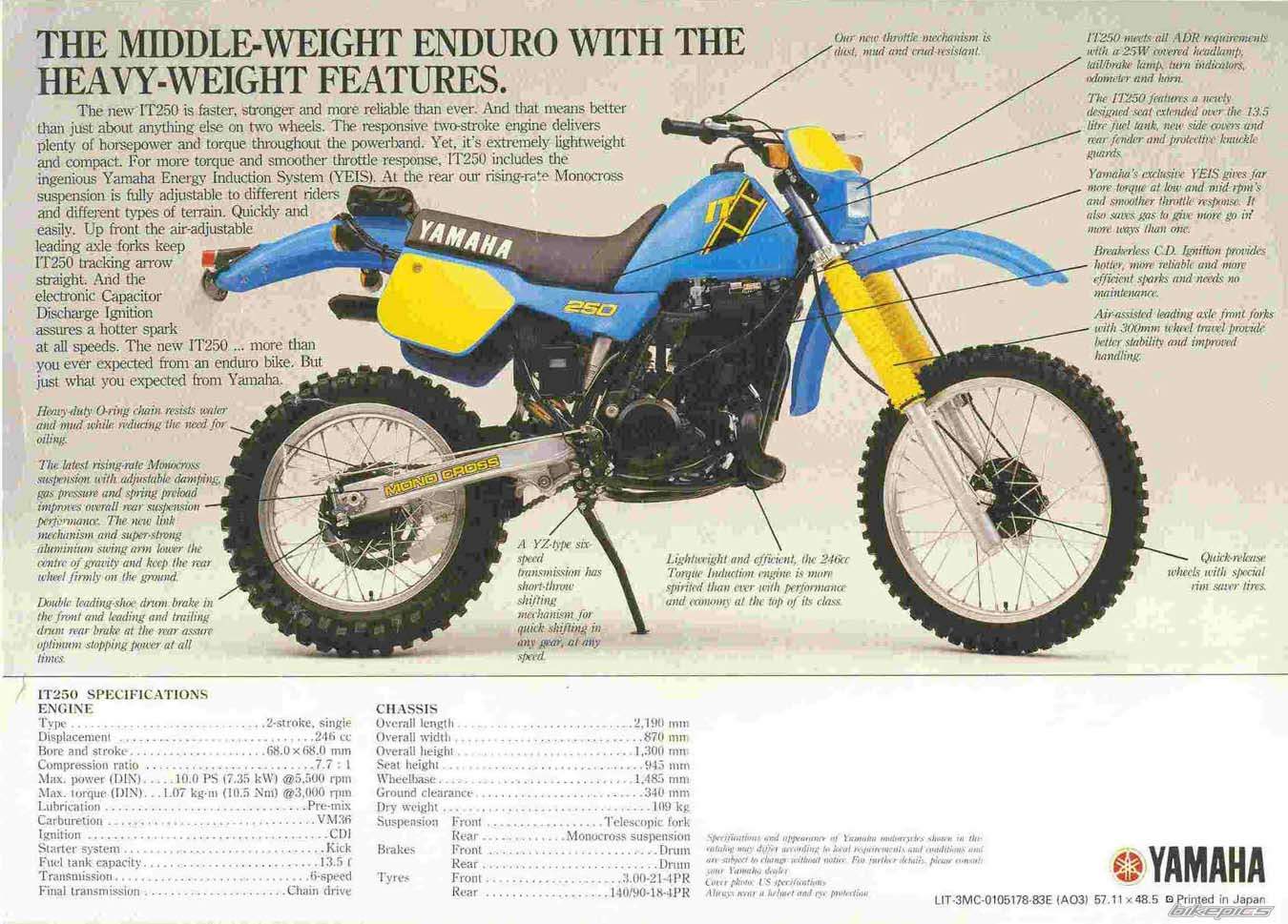
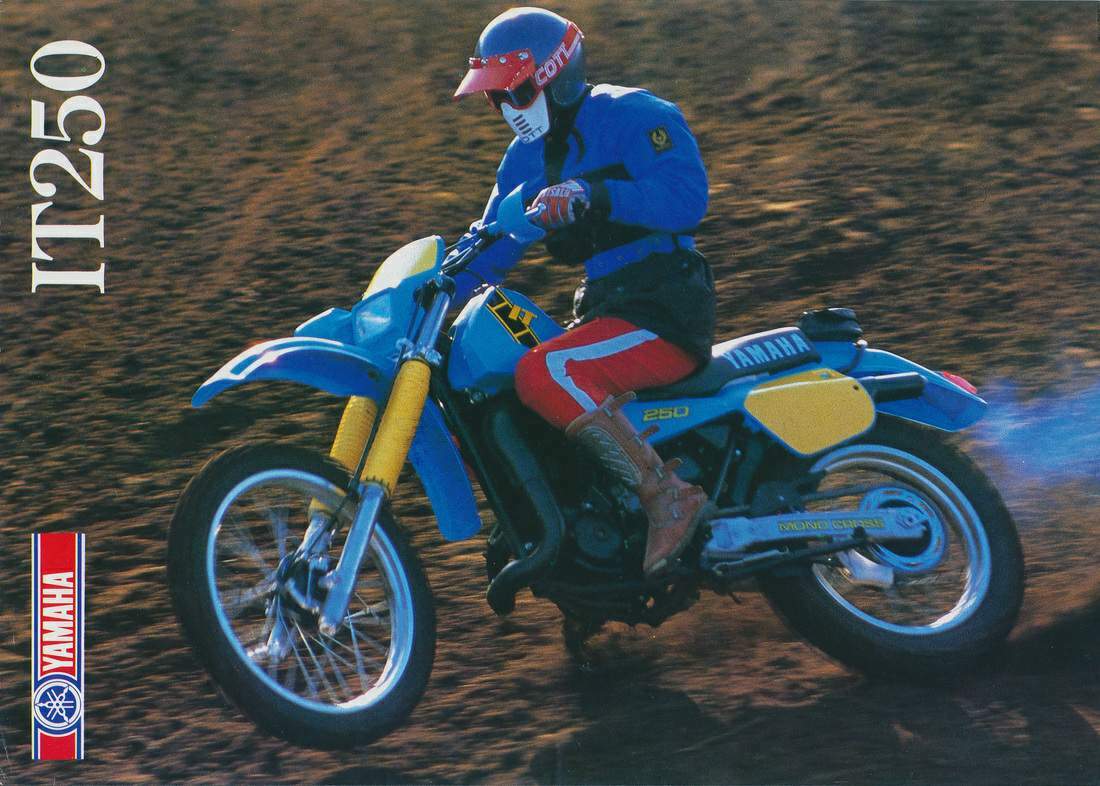
Yamaha IT 250
Although we pride ourselves on doing thorough, honest and informative tests, nothing short of living with a machine for several months can reflect things like operating costs, maintenance, and most of all, reliability. Every year we keep some test machines for extended, or long-range testing. Some of these bikes become almost personal machines, and their care and feeding, so to speak, is assigned to one person. Some go into our pool. They get used by staff members, ad sales people, and photographers. The pool bikes usually have the roughest life. Since a personal interest is absent, maintenance usually amounts to a hurried few minutes prior to use. Most street bikes survive this kind of treatment without complaint; few dirt bikes will survive on an occasional ten minute maintenance period. Our IT250 and IT400 long-range test machines proved an exception.
The 1978 1T250 was tested in the April, 1978 issue of Cycle World. We were impressed with many of its features and it became a long-range test bike. Our Associate Publisher expressed a desire for an IT400, so it also was added to the extended test pool. The 250 proved the most popular, logging almost four times the mileage in roughly the same time period. All of the users but one preferred the 250. Several reasons were given; invariably, the first was the weight difference. The 250 does have a much lighter, agile feeling, but actually is only about 10 lb. lighter than the 400. The person who preferred the 400 has a stocky build and thought the extra weight a reasonable trade for the beautiful low-end pulling power. Low-end pulling is about the only thing the 400 did better than the 250 though. The 250 was fastest in a straight line drag race, had the highest top speed (it humbled many MX test bikes throughout the year, some of them open-class bikes), and was the easiest to ride in the woods. Both were incredibly reliable and neither bike failed to finish a ride. During the 568 mi. put on the IT400, the only parts replaced were clutch and brake levers damaged in a crash and one footpeg bolt which fell out. Thread sealant applied to the replacement kept the bolt from falling out a second time. With 2236 mi. on the IT250, the report is more revealing. Clutch and brake levers were replaced with MTD Power Levers shortly after the clutch lever was broken in our shop when the bike fell over. The seat was ripped during the same fall and Yamaha supplied a new seat when we asked for a new seat cover.
At 400 mi. a Uni filter replaced the stock air cleaner. At 1500 mi. both tires were replaced. At 2200 mi. the chain and both sprockets were replaced. Two spark plugs went in during the test, not because of fouling but as preventative maintenance. Three sets of American Pro grips were used during the test. That's it. The head never came off, nor did the side case on either bike. Fork seals and fork oil was never changed, no spokes or cables were replaced and even the throttle cable went the entire distance. Sure isn't much for the hard use the bikes received. We used Bel-Ray MC-1 mixed 60:1 in both machines and never fouled a spark plug or had any engine gumming. Chain lobes were mostly Bel-Ray and PJ-1. The 250 pre-ran one Baja 500, one Mexican 1000 and survived three other trail rides into Baja. It also participated in numerous trail and photo rides into the San Bernardino Mountains and Mojave Desert. The ITs were reliable, dependable and trustworthy. They never failed to finish an outing, and we began to trust them to take us anywhere, at anytime, with little or no preparation. Complaints? Only one. Lack of steering precision. We tried bolt-on cures and fooled around with stanchion tube height hut nothing could compensate for a Steering Head Angle set for straight line stability, instead of turning. Art Director Paul Zeek probably explained the IT's steering best: "There is only one way to miss a rock while at speed on an IT—aim for it. The lack of steering precision was noticed more by motocrossers and experienced off-roaders than first timers and novices. This complaint has been cured on the '79 ITs by pulling the rake angle back 2°. A good shop could modify the '77 and '78s by cutting the backbone and pulling the rake angle back the same amount. Anyone who likes to ride dirt bikes but hates to work on them should take a good hard look at Yamaha's ITs. They are fast, tough, ready-to-ride hikes that will give an owner thousands of carefree miles on the trail and be ready to go any place, anytime, without days of preparation and preventative maintenance.
|
|
|
Any corrections or more information on these motorcycles will be kindly appreciated. |