HOME   CONTACT  |  TECHNICAL  |  CONVERTER  |  VIDEO  |  LINKS  


Classic Bikes
Custom Bikes
Racing Bikes


AC Schnitzer
AJS
Alfer
Aprilia
Ariel
Arlen Ness
ATK
Bajaj
Bakker
Barigo
Benelli
Beta
Big Bear
BigDog
Bimota
BMS Choppers
BMW
Borile
Boss Hoss
Boxer
Brammo
Britten
BRP Can-am
BSA
Buell
Bultaco
Cagiva
CCM
Confederate
CR&S
Daelim
Deus
Derbi
DP Customs
Drysdale
Ducati
Dunstall
Exile Cycles
Factory Bike
Fischer
Foggy Petronas
GASGAS
Ghezzi Brain
Gilera
Harris
Harley Davidson
HDT
Hesketh
Highland
Honda
HPN
Horex
Husqvarna
Husaberg
Hyosung
Indian
Italjet
Jawa
Kawasaki
KTM
Kymco
Laverda
Lazareth
Lehman Trikes
LIFAN
Magni
Maico
Matchless
Matt Hotch
Megelli
Midual
Mondial
Moto Guzzi
Moto Morini
MotoCzysz
Mr Martini
MTT
Münch
MV Agusta
MZ
NCR
Norton
Oberdan Bezzi
OCC
Paul Jr. Designs
Piaggio
Radical Ducati
Richman
Ridley
Roehr
Roland Sands
Royal Enfield
Rucker
Sachs
Saxon
Sherco
Suzuki
Terra Modena
Titan
TM Racing
Triumph
Victory
Vincent
Viper
VOR
Voxen
Vyrus
Waken
Wrenchmonkees
Wunderlich
Yamaha

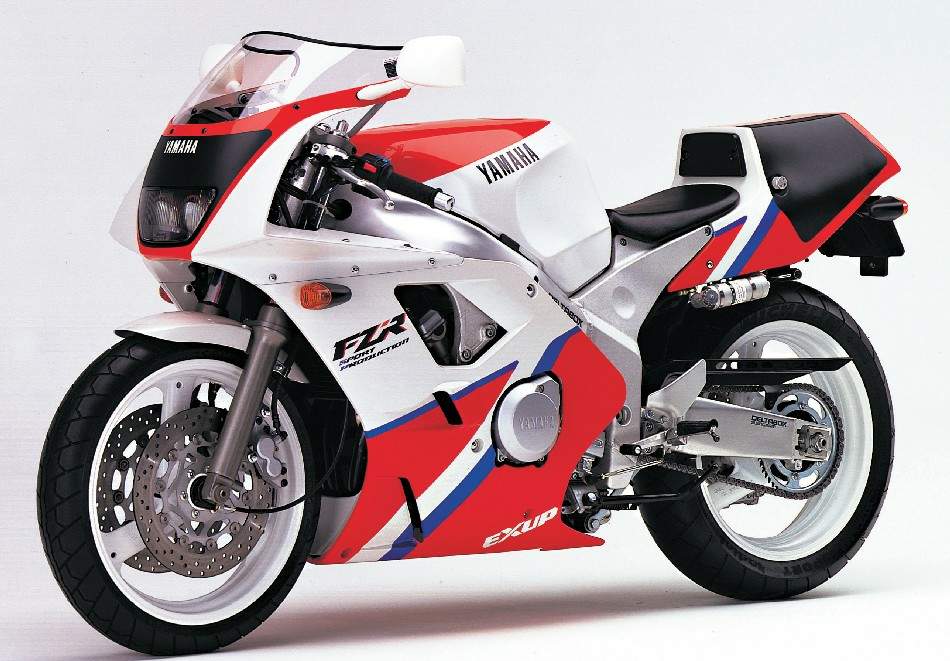
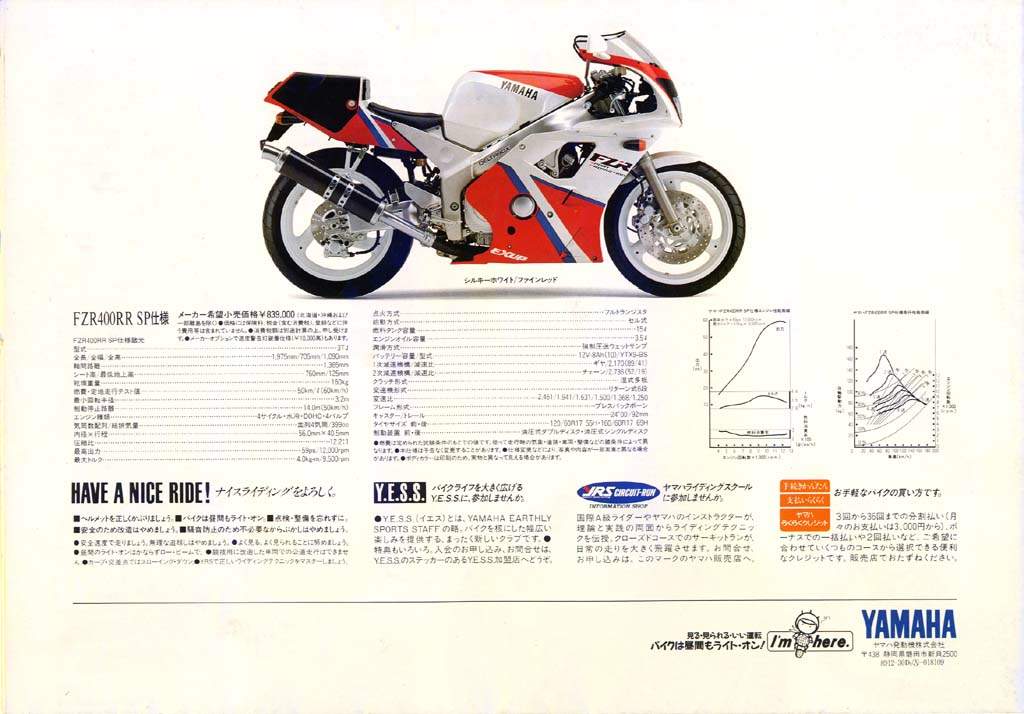
Yamaha FZR 400R SP EXUP


Make Model

Yamaha FZR 400R SP EXUP 2TK

Year

1989

Engine

Liquid cooled, four stroke, transverse four cylinder, DOHC, 4 valves per cylinder.

Capacity

399
Bore x Stroke 54 x 43.6 mm
Compression Ratio 11.5:1

Induction

Ignition  /  Starting

-  /  electric
Clutch Wet multiple plates

Max Power

59 hp @ 12000 rpm  (rear tyre 50 hp @ 11500 rpm )

Max Torque

3.7 kg-m @ 10000 rpm

Transmission  /  Drive

6 Speed  /  chain
Gear Ratio 1st 2.461  2nd 1.941  3rd 1.631  4th 1.5  5th 1.368  6th 1.25
Frame Aluminium delta box

Front Suspension

Up righting telescopic

Rear Suspension

Aluminium swing arm

Front Brakes

2x discs 4 piston caliper

Rear Brakes

Single disc2 piston caliper

Front Tyre

110/70 R-17

Rear Tyre

140/60R-17
Seat Height 785mm

Dry-Weight

152 kg

Fuel Capacity


Consumption  average

21.6 km/lit

Braking 60 - 0 / 100 - 0

14.0 m / 42.3 m

Standing ¼ Mile  

12.9 sec / 162. km/h

Top Speed

197.5 km/h
Manual

diff.ru:8000  /  blackbears.ru  /  Fzrarchives.com

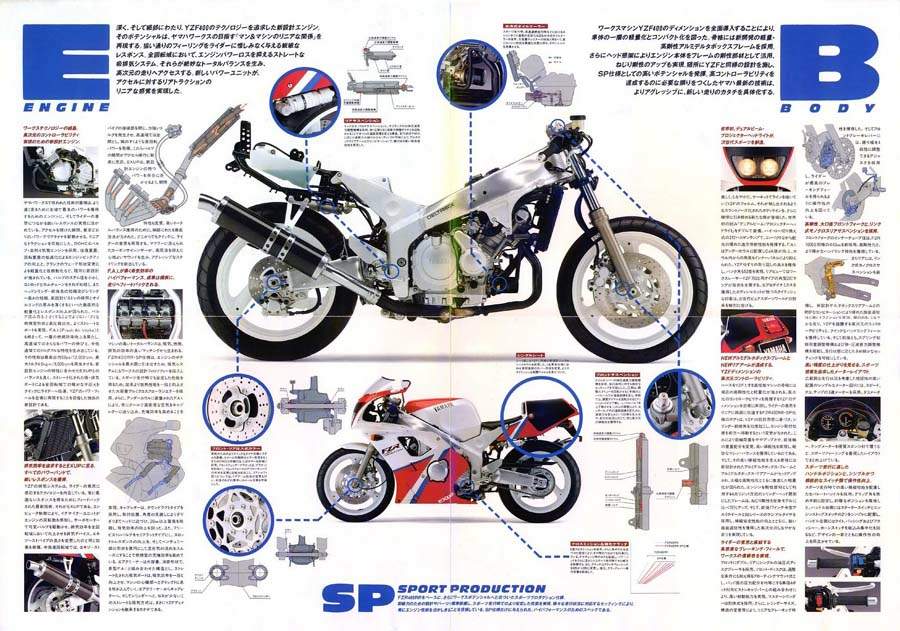
Adjustable preload on front forks, fully adjustable rear shock, oil cooler is fitted as standard, close ratio gearbox, different pistons, longer con rods, sp cams, CDI, round slide oval venturi carbs. Final drive is via a 525 chain with sprocket sizes of 15 front and 41 rear as standard.

The voice of Yamaha's Jeff Turner seeped out of the earpiece. "You want to try the 400 SP EXUP? It's the one Nick Jefferies came fourth on in the Super-sport 400 TT."

It was like being accosted in Cairo by a white slave trader. "Eeee, you want buy Nubian virgin?" The same elements could belong to either scenario: total lack of responsibility, intense desirability, a short period of wild pleasure and no consideration of long-term involvement.

For you see, the FZR400RR SP EXUP is tailor-made for the rider who doesn't have to worry about tyre wear, chain adjustment or the price of a new set of crankcases  ie, the common or garden hack. It is the perfect journalist's bike.

Can you imagine what it'll be like when the rear suspension linkages wear out? What would it look like after five winters? Stupid question. The bike's designed for a brief, brilliant, shining season in Japan's 1990 home market. By the time it's old and knackered Yamaha will have raped another few square miles of the earth's crust, extracted fresh supplies of rare metals and fashioned them into an even more exquisite two-wheeled laser beam than this one.

It's very hard to write about the FZR400's qualities. Braking, acceleration, flexibility, build quality, stability — just think of a cliche and double it. For steering and suspension, think of a cliche and treble it.

The 400 had just done a TT so Yamaha returned it completely to standard for the test, apart from a set of Michelin Hi-Sport radials, lightly frazzled by Geoff Johnson in practice.

In this state, the suspension's incredibly soft. Bounce the front end and the bike feels like a moped — there's no discernible friction and the damping is lightest of the light. With everything set as soft as possible the FZR copes with manhole covers better than most trail bikes. With standard settings it's stable at any angle, any speed, on just about any surface.

For such a small, light bike this suspension quality is extraordinary — at least as good as Suzuki's far heavier GSX-R750L, maybe better. The run-up to the main straight at Brunting-thorpe is a 180 degree bend surfaced by concrete slabs with grass and tar bulging out at the seams. Last month, at 70-80mph in second gear, the Norton Fl was jarring violently over every bump, as if the back wheel was skipping off the ground. The 400 rattled across the same surface lOmph faster with no real disturbance to the rider. As even the worst public roads are considerably better than Brun-tingthorpe's perimeter track, you should get an idea of how advanced the FZR is. Nick Jefferies fitted a steering damper for the TT but for normal road use it would be unnecessary extra weight.

Like the '87 EXUP 400 (see PB April 1990) the 1990 version steers faster than fast. In the totally artificial environment of the photo session the bike could go from full upright to grazing the footrest tips, at 40mph, in about 30 feet. With a proper rider it'd probably do this a lot quicker still.

The '87 400 gave 60bhp on Moss's dyno. We only had the 1990 model for four days so we couldn't get a comparison, and neither the quarter mile nor the top speed offered a clue as to what the true output is. First gear is so much higher than a normal roadbike's that the 13.7 quarter mile time doesn't really mean anything. Nor does the top speed; in the last two years Japanese 400s and 250s have had ignition cutout systems fitted, which chime in at 180km/h. For the TT, Mitsui had disconnected the speedo to bypass this unpleasant Japanese legal necessity and the bike went to 16,500, with raised gearing, in the race. Back in stock trim it couldn't do more than 12,500 in top or 13,500 in fifth which works out at HOmph in old money. There are rich pickings in Japan for the manufacturers of rev booster chips. In this country, specialist importers like Bat Motorcycles supply them for £35 or thereabouts. Unfortunately we only found out about the disconnected speedo trick after the speed testing.

The motor is ridiculously flexible. It's equally happy running at 4 - 6,000rpm round car parks or 13 - 14,000 out in the country. The close ratios give a choice of three gears most of the time, sometimes more. 62mph is possible at anything from 13,000 in first to 6,500 in sixth, with 2,000rpm separating the top four gears.

Sixty-plus bhp is an amazing output from a 400 four stroke -150bhp/litre, enough to take an equivalent l,000cc motor to 150bhp. The trouble is it's spread over a 14,000rpm rev range so acceleration isn't devastating. Maximum cruising peed is only hampered by the ignition cutout.

The only fault the motor has is a slight hesitancy picking up if you roll it off at high revs and immediately roll it on again. There's a period of vibration around 6,000rpm but most people found this a not altogether unpleasant experience.

Fuel consumption was 42, 42 and 40mpg over three tankfuls, considerably less than the 49mpg average we got from the '87 400. I blame this on dry roads and Michelin Hi-Sport Radials.


The FZR is no comfy chair. The long tank stretches your arms to lowish bars — paradise for daily thrashings but torture in heavy traffic where frothing at the mouth and screaming, "Geddoudadafakkinway" is all too easy. One of the pains of riding such an agile, aggressive machine is how dull-witted every other road user appears. Not a recipe for increased harmony on the roads.

Sitting behind rows of juggernauts also shows up the tall first gear. The clutch slips beautifully to minimise the effect but even after 1,000 miles there was a hint of future slop in the backplate shock absorbers.

Brakes are perfection — cata-strophically powerful and feel-able at the front, nice and weedy at the rear. You will not find better on a sports bike.

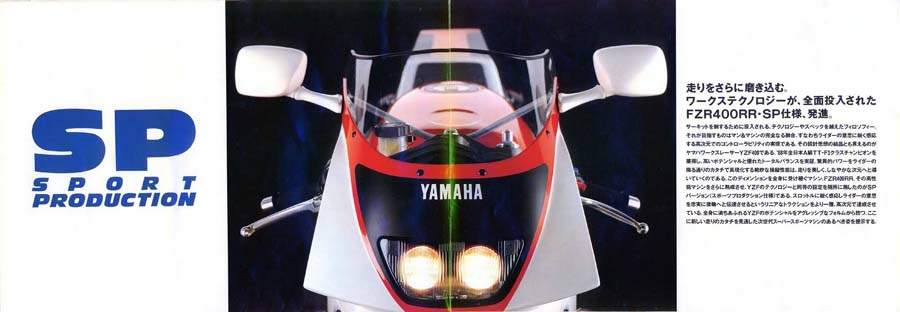
Yamaha have expended almost unbelievable effort to make the 400 more droolworthy than its competitors in Japan. The twin, red-rimmed micro-headlights and bolt-on tail lens are very Suzuka Eight Hour and the curved teardrop indicators are too much. The multicoloured switchgear isn't so hot, though. The dip switch is right next to the on/off switch, leading to the possible and unexpected nocturnal withdrawal of a reasonably useful pool of light. All road ancillaries such as carbon fibre silencer, speedo, lights, mirrors and switchgear are designed to come off with the minimum of effort to reveal a tailor-made proddy racer.

The one concession to road practicality is the lunch box in the seat hump. If you owned an unlined oversuit, and you were really good at folding it up, you could just about cram it in there next to the toolkit. There are four bungee hooks under the subframe rails but their function is debatable.

It is worth expending all this effort on 400cc of engine? Definitely. A 1,000 EXUP goes faster, seats two and pulls bigger wheelies but otherwise it doesn't come close. Even an OW01 isn't as well made as the 400 SP. And the relatively low power output is probably a long-term advantage because when you finally do get slammed against a wall by the police you'll only have been doing llOmph instead of 150. RP

Source  PERFORMANCE BIKES 1990


NOTE: Some of the photos on Motorcycle Specs are owned by somebody. If you see any of your photos, you can let me know so that I can acknowledge it, or if you object to it, I can remove it altogether. If any copyright holder objects  to their articles being placed on Motorcycle Specs, it will be removed upon request.  Any correction or more info on these bikes will kindly beappreciated                                          Contact Me      Privacy Policy     Website Stats