|
|

|
|
|
|
Classic Bikes
Custom Bikes
Individual
Racing Bikes AJP
AJS
Aprilia
Ariel
Avinton / Wakan
Bajaj
Benelli
Beta
Bimota
BMW
Brough Superior
BRP Cam-Am
BSA
Buell / EBR
Bultaco
Cagiva
Campagna
CCM
CF Moto
Combat Motors
Derbi
Deus
Ducati
Excelsior
GASGAS
Ghezzi Brian
Gilera
GIMA
Harley Davidson
Hero
Highland
Honda
Horex
Husaberg
Husqvarna
Hyosung
Indian
Jawa
Kawasaki
KTM
KYMCO
Laverda
Lazareth
Magni
Maico
Mash
Matchless
Mondial
Moto Guzzi
Moto Morini
MV Agusta
MZ / MuZ
NCR
Norton
NSU
Paton
Peugeot
Piaggio
Revival Cycles
Roland Sands
Royal Enfield
Sachs
Sherco
Sunbeam
Suzuki
SWM
SYM
Triumph
TVS
Ural
Velocette
Vespa
Victory
Vincent
VOR
Voxan
Vyrus
Walt Siegl
Walz
Wrenchmonkees
Wunderlich
XTR / Radical
Yamaha
Zero
Video
Technical
Complete Manufacturer List
|
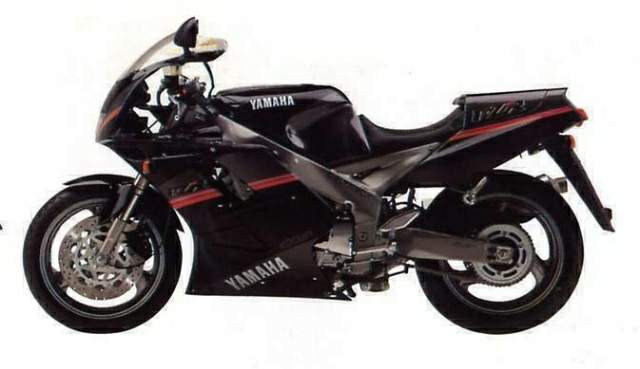
Yamaha FZR 1000 EXUP |
| . |
|
Make Model |
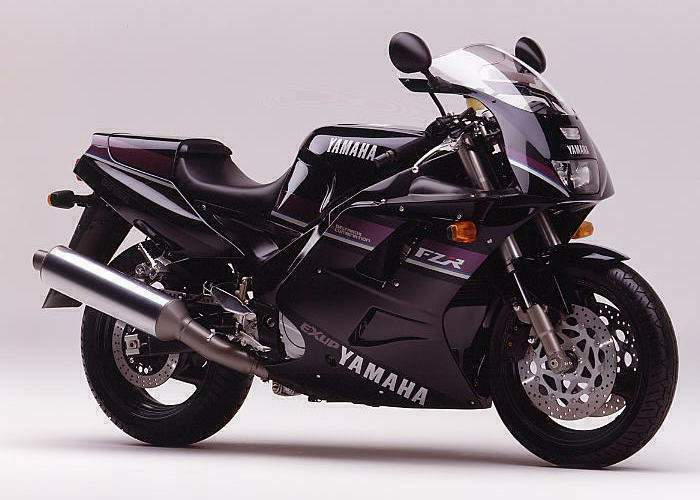
Yamaha FZR 1000 EXUP |
|
Year |
1992 |
|
Engine |
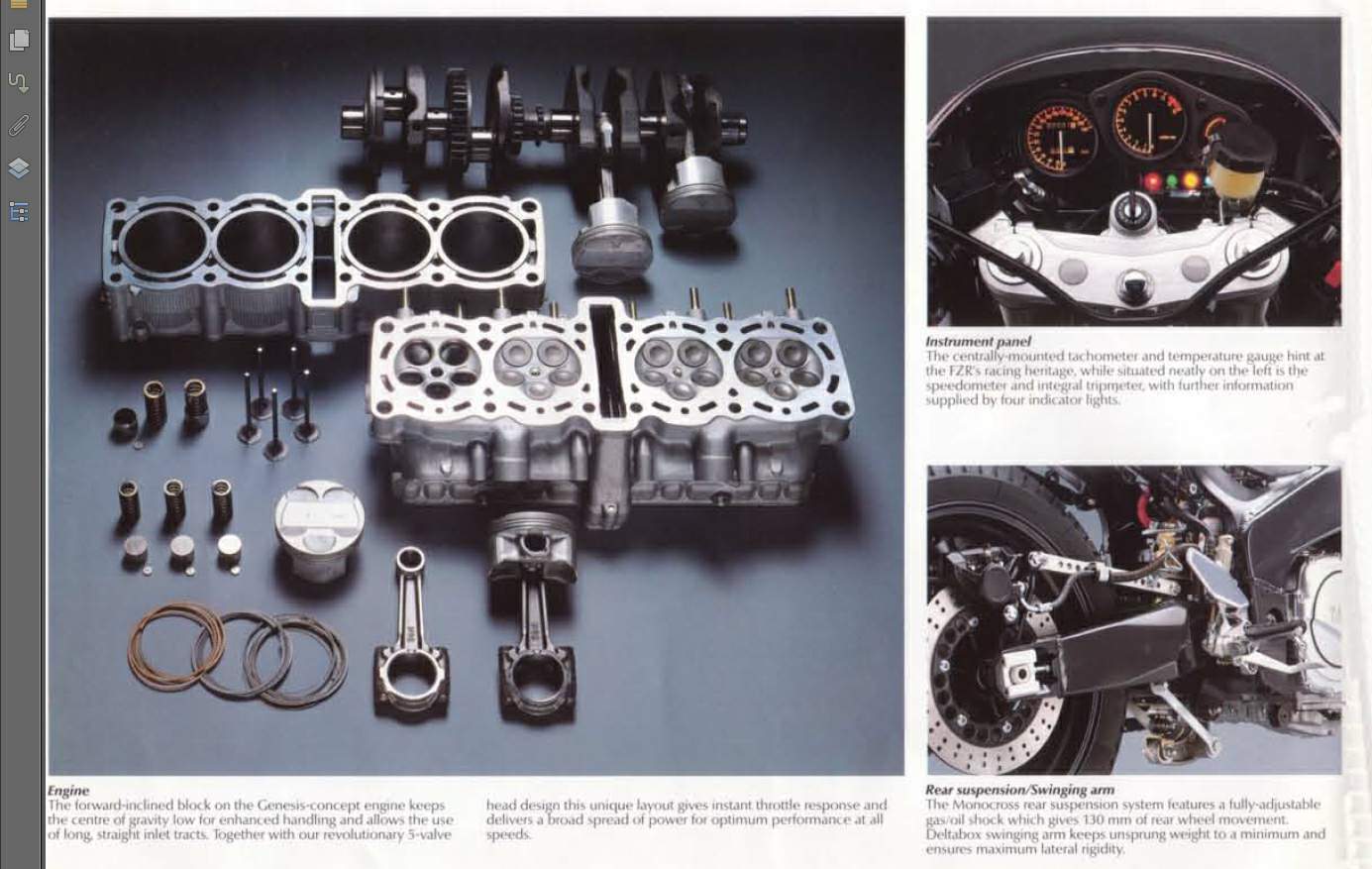
Four stroke, 35° forward inclined transverse four cylinder, DOHC, 5 valves per cylinder |
|
Capacity |
1002 cc / 61.2 cu/in |
| Bore x Stroke | 75.5 x 56 mm |
| Cooling System | Liquid cooled |
| Compression Ratio | 12.0:1 |
| Compression Pressure | 14kg/cm2 (1400kPa, 199 psi) |
| Compression Range |
13.6kg/cm2 (1360kPa, 194psi) minimum 14.8kg/cm2 (1480kPa, 210psi) maximum |
| Lubrications | Wet sump |
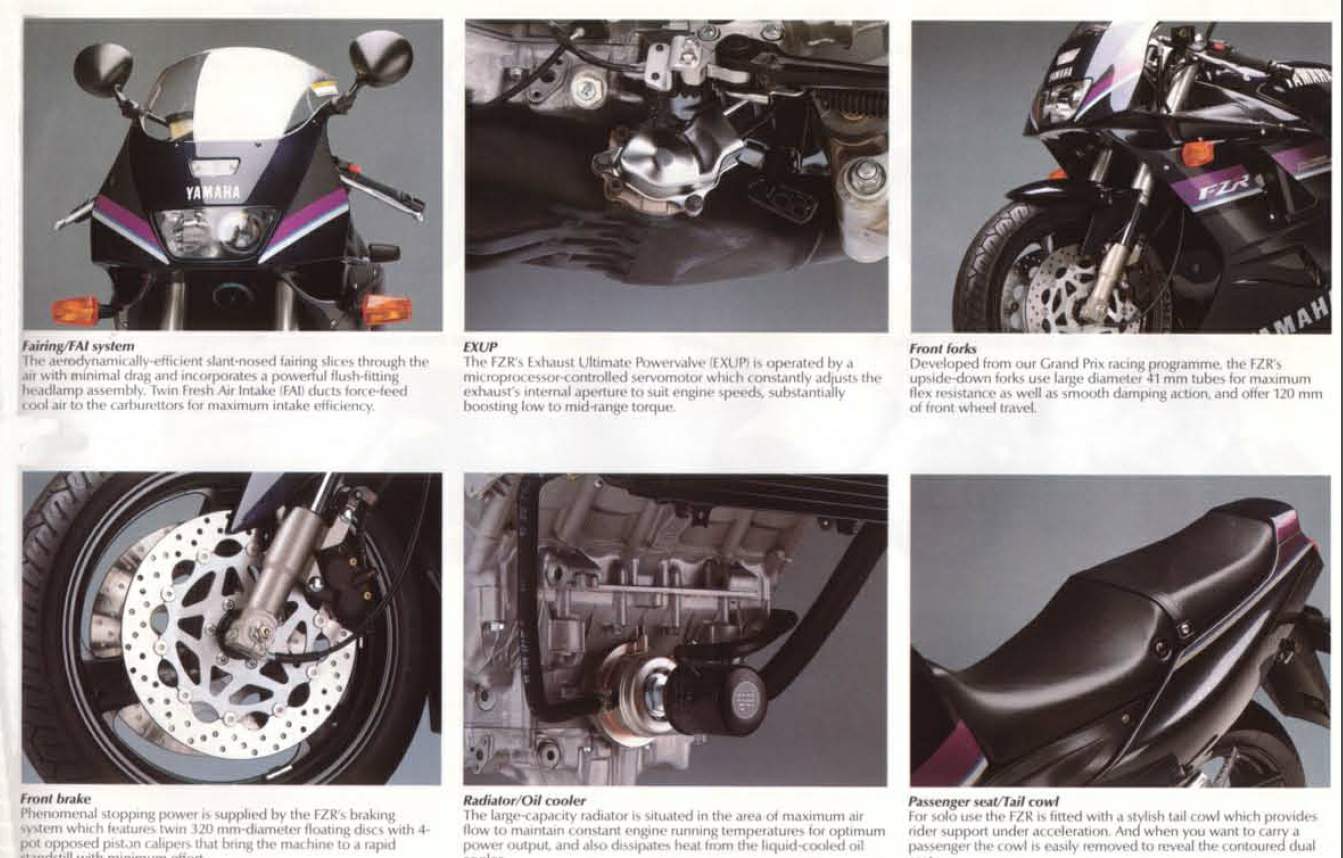
| Exhaust | EXUP exhaust control system |
| Engine Oil |
SAE 20W40 engine oil in temperatures above 5C/40F SAE 10W30 engine oil in temperatures below 15C/60F |
| Oil Capacity |
3.5 Litres total 3.0 Litres change with filter replacement 2.7 Litres periodic oil change |
|
Induction |
4x 38mm Mikuni BDST |
|
Ignition |
TCI digital ignition |
| Spark Plug | DR8ES-L (NGK) |
| Spark Plug Gap | 0.6 ~ 0.7mm (0.024 ~ 0.028 ins |
| Generator | AC generator |
| Battery | YB14L 12V 14AH |
| Starting | Electric |
|
Max Power |
145 hp / 105.7 kW @ 10000 rpm |
|
Max Power Rear Tyre |
131.7 hp @ 10500 rpm |
|
Max Torque |
10.9 kgf-m / 107 Nm @ 8500 rpm |
| Clutch | Wet, multi-disc |
|
Transmission |
5 Speed |
| Final Drive | Chain 532ZLV |
| Number of links | 110 |
| Free play | 15-20mm (0.6-0.8 ins) |
| Primary Reduction System | Spur gear |
| Secondary Reduction Ratio | 68/41 (1.659) |
| Frame | Ddiamond Deltabox |
|
Front Suspension |
43mm Telehydraulic for adjustable preload, |
| Fork oil grade | 10W |
| Front Wheel Travel | 120 mm / 4.7 in |
|
Rear Suspension |
Gas/oil single shock, rising rate adjustable preload and damping. |
| Rear Wheel Travel | 130 mm / 5.1 in |
|
Front Brakes |
2x 320mm discs 4 piston calipers |
|
Rear Brakes |
Single 267mm disc 1 piston caliper |
| Brake Fluid Type | DOT4 or DOT3 |
|
Front Tyre |
130/60 VR17 |
|
Rear Tyre |
170/60 VR17 |
| Rake | 26.7° |
| Trail | 110mm / 4.33 in |
| Dimensions |
Length
2200 mm / 86.8 in Width 730 mm / 28.7 in Height 1160 mm / 45.7 in |
| Wheelbase | 1460 mm / 57.5 in |
| Ground Clearance | 135 mm / 5.3 in |
| Seat Height | 765 mm / 30.1 in |
| Dry Weight | 209l kg / 460 lbs |
| Wet Weight | 236 kg / 520 lbs |
|
Fuel Capacity |
19 Litres / 4.2 gal |
|
Consumption Average |
16.3 km/lit |
|
Braking 60 - 0 / 100 - 0 |
13.1 m / 37.0m |
|
Standing ¼ Mile |
10.1 sec / 216.8 km/h |
|
Top Speed |
273.4 km/h / 169.8 mph |
|
Road Test |
Motosprint Superbike Group Test 1991 |
Road Test GSX-R1100 vs FZR 1000
Color us fickle. Denigrate our long-term memories: Lecture us about steadfastness, devotion to purpose and commitment. Take us to task and beat us roundly; if a relationship with a sport bike were a marriage, our testers would all be divorced.
The year started simply enough with the six-shooter showdown, a five-way dash-off between the latest 600s, with the CBR winning the game, set and match with balance, power and flash. We loved those 600s: light, nimble, rev-happy and relatively inexpensive. What more could you want? Next up was a two-way battle between the GSXR750 and ZX-7, so heated we instantly forgot the 600 class and joined ranks with the thousands of American sport riders currently piloting three-quarter-liter sport bikes. After all, the GSXR sprinted in the 10s at the dragstrip, and both bikes handled well enough to warrant number plates and slicks. "Yep," we all said, "these 750s are it. What more could you want?"
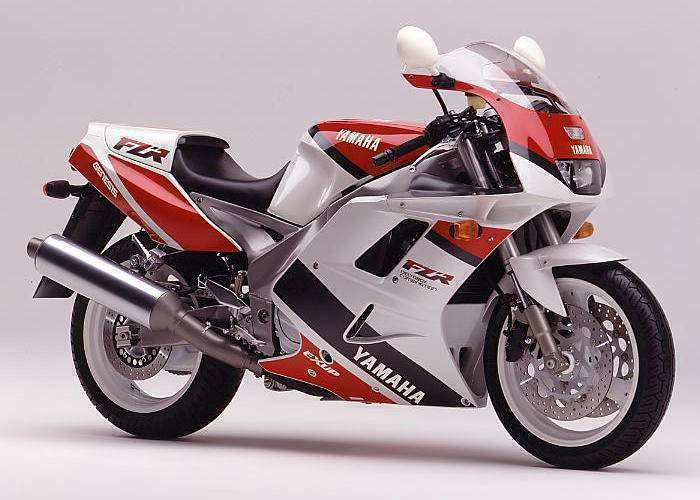
Well, if what you want is more, the 1991 Excess Express just pulled into town and now we're mumbling, "What 750s?" We've again changed horses in the middle of the stream, and we've slid onto a couple of thoroughbreds. We cut the two most serious open-classers from the herd, lassoing Suzuki's GSXR1100 and Yamaha's FZR1000 for this month and saving the more sport-touring-oriented ponies for our next issue. As we did with the 600s and 750s, we visited the racetrack, dragstrip, top-speed location and public streets with these two and came away starry-eyed for the third month in a row.
FICKLE WITH GOOD REASON
But don't be too harsh on us. Consider this before passing judgment: The Streets of Willow packs nine turns into about 1 mile, with only one 400-yard straight to stretch a bike's legs. If you aren't pointing the bike out of a tight corner, you're standing it on its nose to get into a corner. This course offers more turns than a Robert Ludlum novel, and because it's so tight and technically demanding, the fastest bikes are the ones able to get into and out of corners in minimum time. Grab the brakes, nail a downshift and flick the bike to a late apex, dial in enough throttle to arrest the lean but not enough to slide the rear tire, then do it eight more times before the lap is over. The best our light, lithe FZR600 could manage was an ultraquick 1:03.21-minute lap time on a pair of race-compound Pirelli radials. Imagine our surprise when the GSXR1100 stopped the watch with a 1:02.90 run, followed with an impressive 1:03.10 lap by the FZR1000. Aren't these liter bikes supposed to be cumbersome, hard to handle, overweight, overpowered? To put these times in perspective, consider that we've only gone faster on the Moriwaki Zero RC30 and a Yamaha TZ250, neither of which is street-legal.
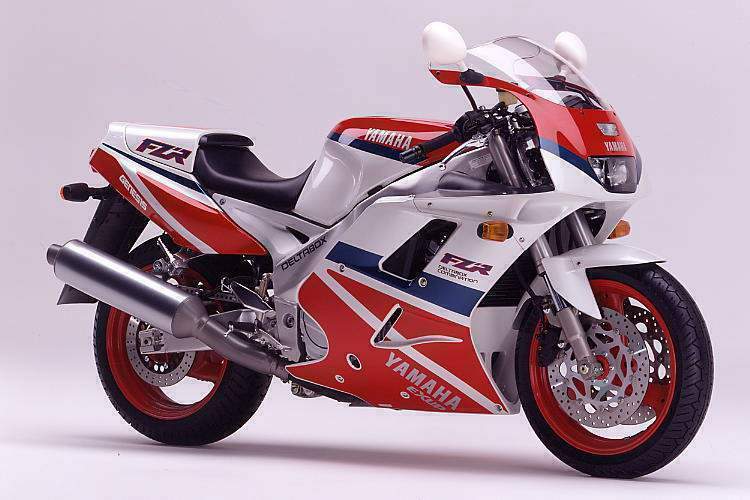
What these two accomplished at the Streets of Willow flew in the face of common knowledge: big bikes are fast, little bikes maneuverable. Motorcycle manufacturers work hard to blur the line between big and little, attempting to blend big horsepower with a nimble chassis while keeping mass and dimensions low and tight. Yamaha's FZR1000 is 14 pounds lighter than Suzuki's GSXR1100, and Yamaha has done a better job of incorporating the smaller profile of a 750 in an open-classer. Few will mistake the GSXR for anything but an 1100, unless they just stepped off a mid-'80s superbike such as a VFR1000 or GS1150ES; compared to the Yamaha, the Suzuki has a higher seat and bars, with a wider, taller fuel tank between the knees; Suzuki hasn't masked the bigness of a liter sport bike as well as Yamaha.
The Yamaha feels like a traditional racer, with clip-ons mounted beneath the upper triple clamp to stretch the rider out over the large fuel tank, a real steel tank as opposed to the plastic tank cover on the FZR600. The foot-peg placement provides an extra inch of distance between the seat and pegs compared to the GSXR's layout, though the passenger pegs offer minimal legroom to anyone perched out back. The front seat's width makes up for its lack of padding, offering a relatively comfortable perch and affording a low 30.5-inch seat height.
On the other end of the ergonomic spectrum sits the Suzuki, with a short reach to the relatively high-placed clip-ons (mounted above the upper triple clamp), slightly less room between seat and pegs and a wider, comfier seat, 32.1 inches off the pavement; passengers get more legroom, plus a grab rail the Yamaha lacks. Suzuki's devotion to function so evident in the GSXR750 isn't as apparent here. Instead, an almost sport-touring riding position greets the pilot. The stubby screen and full fairing deflect most of the wind attacking the rider, leaving a clear stream of air contacting his chest and helmet; the Yamaha does a bit better here because of its lower bar placement and fuller bubble, deflecting air over the rider's chest, leaving only the helmet in the breeze. Both bikes offer adequate if not luxurious comfort during a day-long ride.
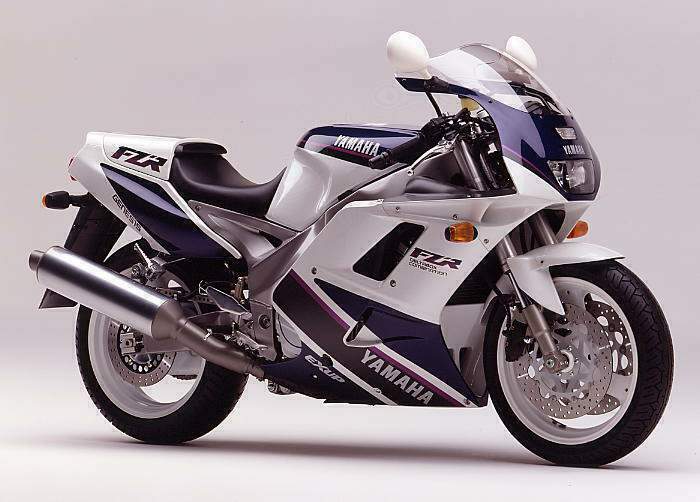
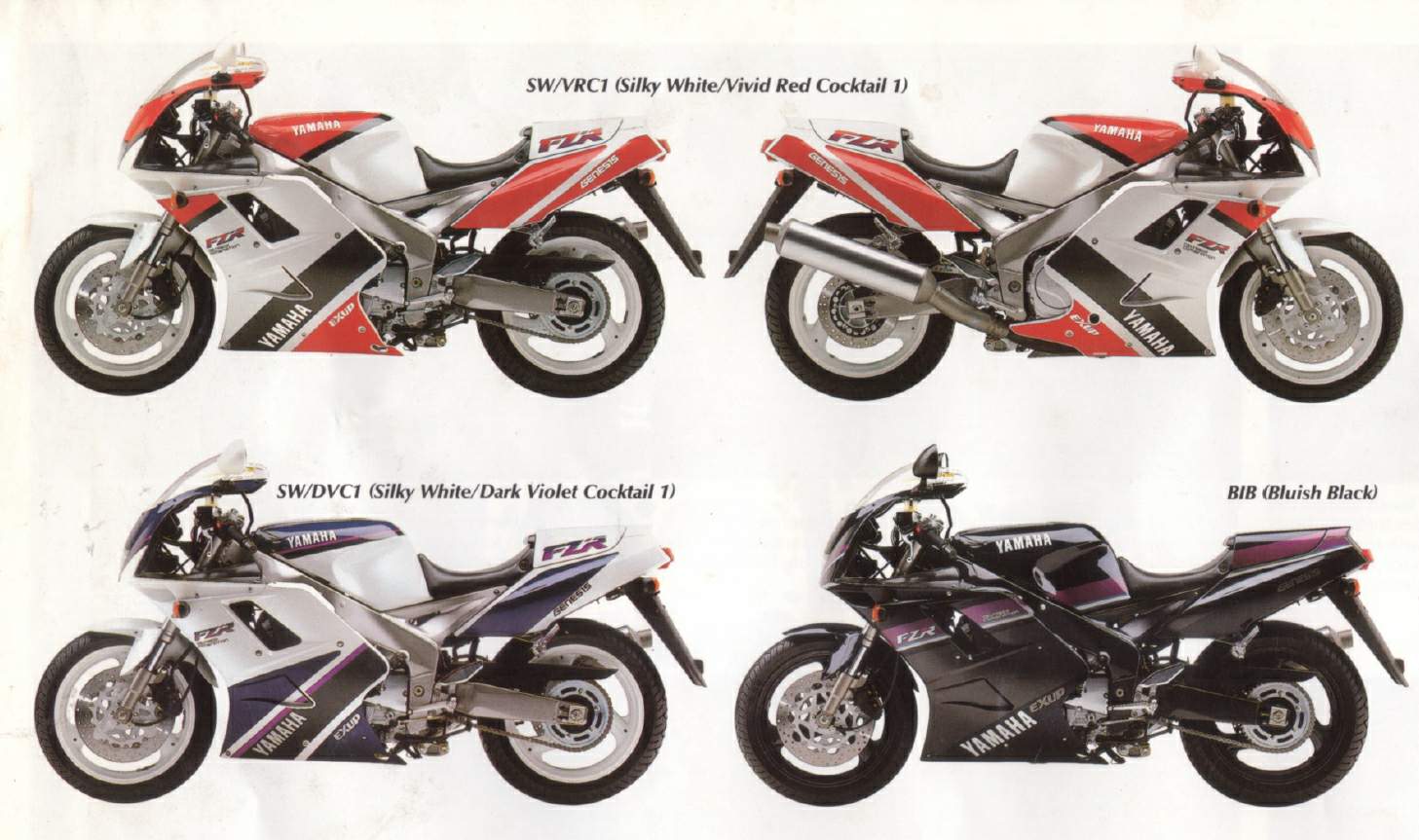
Both Yamaha and Suzuki enter 1991 with resculpted bodywork, the Yamaha featuring a single headlight where last year there were two; we're happy to report the single headlight illuminates well, and Yamaha deserves credit for including running lights in the front turn signals, a feature that helps drivers identify motorcycles at night. The Suzuki lacks this feature but adds a small running/parking light above the twin headlights hidden behind a pane of real glass. Aside from the racier front ends, both bikes have restyled body panels, most notably the Yamaha which displays part of the frame on each flank and comes from the factory with a subtle blue, gray and white paint job; the Suzuki is available in boy-racer blue and white or red and black.
Amateur aerodynamicists love the sleeker fairings on this year's
bikes, so we plugged in our radar gun to see what the results would be in simple
numbers. Both bikes surpassed last year's best efforts, the Yamaha stretching to
166 mph in the desert morning, the Suzuki a tick behind at 163 mph. The FZR's
tall, arcing bubble 5 provides a wonderful spot from which to watch the pavement
rush by, considering erably less turbulent than the GSXR's comparatively blunt
windscreen. Nei-8 ther screen is optically correct, blurring I badly near the
upper lip; racers will certainly change screens. Other than the distortion, both
bikes work perfectly at the upper limit: stable, secure and at home.
TOSSING AND TURNING
Getting the 547 pounds of the GSXR and the 533 of the FZR stopped and turned takes plenty of bar effort; coun-tersteering forces applied with plenty of muscle will get either bike turning quickly, though the Yamaha takes more muscle for the same rate of turn-in. A few factors contribute to this, including the 57.9-inch wheelbase, .2 inch longer than the Suzuki (and .8 inch longer than last year's FZR), and relatively slow trail and rake numbers of 4.3 inches with 26.7 degrees (last year's figures were 4.2 inches, 26.0 degrees), compared to the Suzuki's 3.6 inches of trail and 25.9 degrees of rake. Both bikes wear big 17-inch hoops, the rears measuring 5.5 inches across, the fronts 3.5 inches; getting big, wide tires to turn up on their edges usually takes more muscle at the bar, and these two bikes are no exception. The Yamaha's conservative rake and trail figures, combined with the longish wheelbase, add an unflappable stability the Suzuki can't quite match in the fast stuff. More on that later.
The Suzuki turns quicker with less effort and requires continued counter-steering to increase the lean angle. The Yamaha displays a frightening tendency to fall in suddenly approaching extreme lean angles, so suddenly that you'd swear the front end was letting go. This action takes your breath away the first few times, but our testers adapted soon enough by getting on the throttle early in the corner; previous FZRI000s were substantially more neutral, so look to the new steering-head numbers as the reason for this tendency. It's most noticeable in slower corners when the bike has less gyroscopic effect from the wheels and tires and the bike reaches full lean quicker, yet it could be felt in the fast stuff too. As much as we like the Pirelli radials, we would try a tire change in an effort to cure this fall-in tendency. Additionally, the FZR's 130/60 Pirelli radial felt quite harsh when asked to track over bumps at full lean; we suspect the 60-series sidewall doesn't provide the resiliency to bumps a 70-series tire would. Something to think about if you shop for tires.
Apart from the Yamaha's full-lean anomaly, both parts of the Excess Express perform as one might expect. The weight and speed place enormous demands on the brake systems of both bikes, but even during racetrack testing the Yamaha's 320mm rotors and Sumitomo four-pot calipers consistently outperformed the Suzuki's 310mm rotors and Nissin four-piston calipers. Both bikes could be stopped with excellent power, but the Suzuki's front system faded, the lever coming back closer to the bar than we would like. We could always stop the Suzuki, but the inconsistency of the lever travel had to be taken into account; Yamaha's front brake exhibited all the power of the Suzuki's, but a stronger squeeze was needed to get equal results, though the lever travel remained consistent from one stop to the next.
The bikes' astonishing performances on the small track point out how manageable the factories have made them, controlling the horsepower with excellent chassis rigidity and enough brakes to put the bite on these 160-mph behemoths. The Suzuki offers full adjustability on both ends of the suspension, pointing out the comparative crudeness of the Yamaha's fork that only adjusts for preload and rear shock that adjusts for preload and rebound damping. We used the adjustments on both these heavy bikes during the track testing in an effort to control wheel movement, and our efforts were better rewarded on the Suzuki due to the wide variety of adjustments. Fortunately, the Yamaha comes with acceptable damping rates from the factory. We ran the Suzuki near the light side on the fork compression throughout the test and even found the lightest setting a bit too harsh around town; we ran the fork preload and rebound damping smack in the middle of the adjustments. In the rear, we backed a lot of the preload out of the spring in an attempt to get the bike to track a bit better, with full rebound damping and medium compression damping.
Dial the aggression meter to redline, and the Suzuki will touch down the fairing lightly, especially on the right side; by the time it drags, you're leaned over so far your mother would do better not knowing about it. The Yamaha will touch down the peg feelers quite easily, and after they're removed, the leading edge of the muffler touches on the right side. We ran the Yamaha near the maximum rear preload and rebound damping and only medium fork preload. Adding preload to the fork overwhelms the Kayaba's rebound damping, so we chose to run the fork a bit softer than optimum; for $8799 riders should get a fully adjustable fork.
FAST AND FURIOUS
Maximum speed on the Streets of Willow is just over 120 mph; maximum speed on Willow Springs' main track is well over 140 mph, and that's where the Yamaha shines. The higher corner speeds reduced the fall-in at full lean, and Yamaha's Deltabox frame and swingarm combined with the inverted Kayaba fork made for smooth, secure sailing at any spot on the track. The Suzuki never felt as planted, especially in fast turn seven where the rider leans the bike slightly to the left to prepare for sweeping turn eight. We tried a variety of suspension settings on the GSXR, but it never matched the FZR's stability and dedication to line.
Either bike offers a choice of two gears per corner exit, the taller choice leaning heavily on the midrange grunt of the monster mills, the shorter choice taking advantage of the nitrouslike boost near redline. The GSXR loved to reach down low and muscle out of a turn at 5500 rpm, while the Yamaha couldn't quite match the Suzuki's mid-range but gave away nothing on top. (A visit to Los Angeles County Raceway gave us an indication of the Suzuki's midrange when it pulled to 86.4 mph in a 200-yard, top-gear roll-on, burying the Yamaha's 84.3-mph effort.) That midrange strength undoubtedly helped the Suzuki win at the Streets of Willow but wasn't quite enough to overcome the Yamaha's tremendous rigidity, great brakes and top-end kick needed on the larger track. When the stopwatches were put away, the Yamaha was credited with a 1:34.13 lap, the Suzuki with a 1:34.83 effort. We left Willow Springs certain of one fact This Excess Express is one fast train.
EQUALLY IMPRESSIVE
The bikes ran so evenly that only a stopwatch or the dragstrip's eye could note a difference; our street testing put the two in a dead heat, though the Suzuki was noticeably stronger in the middle of the rev range. At the dragstrip, both bikes blistered the track, the Yamaha outsprinting the Suzuki, but only barely. The FZR left the line well despite an abrupt clutch engagement and bombed to a 10.54-second, 131.0-mph blast, a tick quicker than the Suzuki's best effort, a 10.58 at 130.2 mph. It doesn't get much more even than that.
During the passes we made at LACR, neither bike ran slower than a 10-second quarter-mile and seemed content to do so all day. As owners have discovered over the years, the GSXR and FZR lines are known for their outstanding longevity as well as power. We've put 10,000 miles on both the FZR1000 (see "Extended Play," May '90 issue) and GSXR1100 (look for an "Extended Play" article soon) with excellent results. Both bikes take hard running in stride.
It was obvious we wouldn't pick a winner at the racetrack; neither bike disgraced itself, both turned respectable lap times considering the stock tires, mirrors, turn signals and a rider running without competition. The track helped illustrate how close Yamaha's liquid-cooled, five-valve-per-cylinder FZR and Suzuki's oil-cooled four-valv-er were to each other. Two bikes with completely different feels and styles, yet each one able to shine in the right element. The Suzuki loved to flick and wing it, at home on the tight, technically demanding Streets, while the Yamaha took to the fast track (the slowest corner is 65 mph) like a swallow to a certain town in California. We offer the following advice to racers looking for a big bike (not a bad idea since both Yamaha and Suzuki are offering contingency money in several clubs across the nation): We lean toward the Yamaha for a production racer, though the Suzuki (due to the fully adjustable fork, easily hot-rodded engine and strong af-termarket backing) would be a better choice for building an Open Superbike or Formula One machine.
A STREET TALE
Subtle differences between the two emerged as the miles stacked up. Both Suzuki and Yamaha provide the basics to hammer around a track or down a dragstrip, but day-to-day life points to the Yamaha as the winner of this high-strung comparison. The five-valve plant runs smoother and quieter, and while it lacks the midrange punch of the GSXR, it's still plenty strong for us mortals. The FZR's fairing-mounted choke lever isn't as handy as the Suzuki's bar-mounted lever, but the electric fuel-petcock switch, also fairing mounted, is easier to reach than the Suzuki's under-tank unit. The Yamaha buzzes the bars less than the Suzuki (and we prefer the thinner Yamaha grips), and we appreciate the extra legroom despite a seat that isn't quite the Suzuki's equal. Yamaha needs to update the FZR mirrors, however; the GSXR provides a better view rearward and a smaller blind spot. Neither bike offers a centerstand or horn worth a beep, but keep in mind that the Yamaha's $1500 higher price tag carries a year of full-coverage insurance. The FZR habitually returned better fuel mileage than the GSXR, but only by two or three miles per gallon.
The Suzuki's diaphragm-spring clutch, while strong and willing to accept abuse, feels nonlinear at the lever; the pull is relatively heavy and the engagement point difficult to judge. Combined with the Suzuki's inconsistent front brake, neither hand is too sure of what it's doing all the time. Veteran riders will find themselves concentrating on the clutch engagement point just as though it were their first ride. The Yamaha feels better at the bars, thanks in part to the newly contoured switches but mainly to the consistent control action. While it's true the Yamaha's bars are lower, the seat is lower as well, which reduces the pressure on the rider's hands and wrists to a level close to that of the more-upright Suzuki.
In the end, it's refinement that sets the Yamaha ahead, and refinement isn't measurable in any finite terms we know of. Given the choice, the majority of our testers side with the Yamaha, though not without plenty of feet shuffling, qualification and second thoughts. It comes down to a pair of motorcycles tied together during performance testing so closely that the dragstrip session was decided by .04 second and even the street testing left us without a solid resolution. After stacking over 4000 miles on the GSXR and FZR we did reach one solid, inescapable conclusion: liter-bike fans will love the 1991 Excess Exp
Source Motorcyclist 1991
|
Any corrections or more information on these motorcycles will be kindly appreciated. |