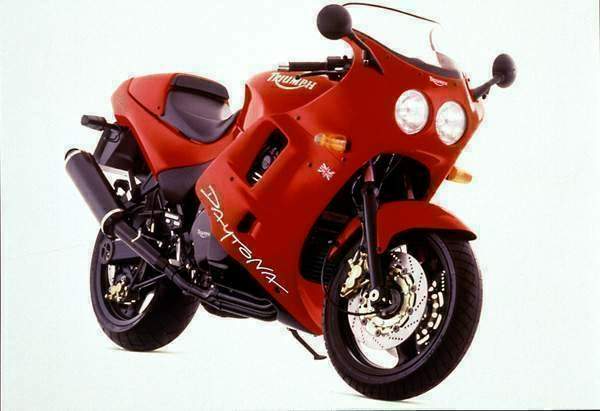
The three-cylinder Daytona
(there's also a 1200cc four-cylinder version) is touted as the sportbike of
the Triumph range. It certainly looks the part: The full coverage bodywork
is available in two screaming colors, bright 'Racing' yellow and 'Pimento'
red, plus a pure 'Diablo' black. The Daytona name was used by the old
Triumph company on the tank of a 500 twin, once a Daytona 200 winner. Now
the name is back on Triumph's 900cc triple, and Triumph may be back on the
Superbike trail next year. How would the Daytona Triumph do at Daytona
(Florida)? Read on.
Underneath the full fairing, the three-cylinder 885cc engine breathes
through a trio of 36mm flatslide carburetors.
With a compression ratio of 10.6 to 1 the engine delivers a claimed 98hp at
9000 rpm. The triple is redlined at 9700 rpm, and transmission is Triumph's
well proven six-speed unit. Triumph fans will know that the marque's seven
year rebirth came after the British engineers toured the most advanced
Japanese factories and garnered some help from the land of the rising sun.
Triumph's new heavily automated Hinckley site is only a few miles from the
former Triumph's old Meriden home in the English Midlands, once the heart of
Brit-iron. Since the British manufacturing industry has all but vanished,
advanced tooling was bought from abroad. Now, over 40 percent of Triumph's
parts are imported over the English Channel. Despite the foreign inspiration
and content, nostalgia still sells. The highly successful launch of the new
"Thunderbird" custom has taxed the capacity of the original factory to the
limit. A second, larger factory will soon be built.
Rave reviews and good sales of the new Triumphs have vindicated the company
policy of building its entire range based around the "modular concept."
Cruiser, dualsport or sportbike, all the three-cylinder models are the same
under the hood. The Trident roadster, Thunderbird cruiser, Trophy tourer,
Speed Triple Retro racer, Tiger trailie and the Daytona sports bike were all
born from the modular design concept. Though specifications and ergonomics
vary, they all have the same frame and three-cylinder 900cc engine. Other
models are available with a four-cylinder 1200cc motor.
Traditionalists and technophiles can't argue with the company's success.
Triumph has quickly became a major European force, and its new range of
machines are worthy contenders in every category. But can they build a
sportbike?
"In sudden high speed line changes the Daytona belies its bulk, reacting
with confidence and surprising agility for a machine of its size."
In the highly competitive sportbike market, Hinckley Triumph faced tough
odds. The modular design that works so well with the other machines couldn't
compete with the purpose-built CBR900RR. As a sportbike the Daytona carries
a significant weight handicap, weighing 466 pounds dry, over 500 fully
fueled. That weight is carried high in the chassis, far away from the center
of mass, meaning that razor sharp handling is difficult to achieve, so you
won't see the Daytona beat a 916 Ducati in the twisties. Still, within the
limitations of a modular design, Triumph have worked wonders.
Since the Daytona 900 triple is the hot rod of the bunch, it misses the
user-friendly mid-range of the other Triumphs but makes up for that with a
real eagerness to rev. In comparison to the low down stomp of the other
triples, power seems lacking below 7000 rpm but really takes off above that,
soaring towards the rev limiter like a four cylinder but with a triple howl
to remind you that this is a three. Peak power is a claimed 98 bhp at 9700
rpm, and the motor will pull clean into the red above 10,000 until the rev
limiter cuts in..
Like the other Triumph triples, the Daytona is cold blooded. It can take a
while to warm up, and on this particular model the gear action was stiffer
than other examples of the range. In traffic the lack of mid range means
gear changes are frequent but the smoothness of the motor captivates the
rider. Vibration is at the same level as the average four-cylinder yet
somehow still allows the rider to feel the character of the soulful
three-cylinder engine .
At rest, the hefty weight and tall seat give the Daytona a bulky feel. On
the move, the handling transforms. Even faced with the fastest of corners,
once you are used to swooping the high mass from side to side the machine
responds predictably. In sudden high speed line changes the Daytona belies
its bulk, reacting with confidence and surprising agility for a machine of
its size.
With the Triumph engined Saxon racer about to enter AMA racing backed by
Triumph America, potential Triumph buyers may ask how the Daytona stacks up
as a sport bike.
One big improvement over the previous softly suspended models is in the lack
of brake dive; stiffer damping stops the front from flopping, and the forks
offer adjustable rebound damping. The brakes themselves are powerful. Steel
brake hoses offer ultimate feel and four pot calipers grip gradually, then
powerfully. The tires, Bridgestone BT50's, are another massive improvement
over the Michelin M89's previously fitted. The Michelins may offer longer
life on the street, but the Bridgestones offer true sportbike grip.
That fairing has classic looks although is less aerodynamic than the king of
speed, the Kawasaki ZX11. But side by side the Daytona's looks overwhelm the
ugly purposefulness of the ZX. The Daytona's plastic seems like a good
compromise between practicality and style.
The raked forward riding position is certainly more sporty than the rest of
Triumph's range but touring is possible, although if you had to carry a
passenger and luggage over any great distance you would probably be better
off with the more luxurious accommodations of the standard styled Triumph
Trophy. Even so, passengers were particularly impressed by the comfort of
the seat and the plush suspension, which rated an 8 out of 10 from our
daredevil pillion rider, Mel Mellis.
"Controls are all very accessible and the bar mounted choke is a plus."
Mirrors are the usual fairing-mounted joke. The clocks are a gorgeous cream
color highlighted by bright red needles. In general the Trophy looks
impressive, especially in "Diablo" black with matt black wheels, swingarm,
and black "900" embossed on the black bodywork. Nostalgia buffs will notice
the prominent Triumph triangular patent plate, mounted above the rider's
peg. It's just one more reminder of Triumph's history.
Like most new Triumphs (with the exception of the lowered Thunderbird
cruiser) low speed maneuvering is a nightmare for those short of leg because
of the high weight and high seat. You can get used to it - it's just a case
of getting your feet down early and using body english around tight slow
corners, although some smaller riders simply can't ride Triumphs. Other
nitpicks? Well, the engine might be a modern classic but at 40 mpg at best
it is thirstier than many modern four-cylinders. The stylish fairing can get
in the way of your knees, if you are particularly long of leg or wear
racer-type knee pads. But as we said, this is no race replica.
A comparison between the high tech 916 and the conservative Daytona
highlights the real Hinckley design priority. Reliability and longevity. No
one re-starting a motorcycle company with a name besmirched by a reputation
for unreliability is going to gamble on leading edge technology. Comparing
the Daytona with a Ducati 916 is like comparing a Mazda Miata with a
Lamborghini Diablo. Sure, it won't go around corners the same way, but it'll
do everything else just as well, and it'll even go down to the corner
grocery store without complaint. Don't try that with a 916. As a pure sports
bike the Triumph Daytona is not so much a CBR900RR-beater as a
GPz1100-beater, and what's wrong with that?
The Triumph Daytona 900s classic looks and style trade on the old Daytona
name to create a challenging and loveable sports retro. If you can deal with
the weight and the lack of space age gadgetry, it's a solid machine. Perhaps
most importantly, five years of European experience with the new Triumphs
show that they are built for reliability and hold their value extremely well
As for the real Triumph Superbike contender - watch this space.
Source Motorcycle.com
NOTE: Some of the photos on
Motorcycle Specs are owned by somebody. If you see any of your
photos, you can let me know so that I can acknowledge it, or if
you object to it, I can remove it altogether. If any copyright
holder objects to their articles being placed on Motorcycle
Specs, it will be removed upon request. Any correction or more
info on these bikes will kindly beappreciated
Contact MePrivacy
Policy
Website Stats