|
|

|
|
|
|
Classic Bikes
Custom Bikes
Individual
Racing Bikes AJP
AJS
Aprilia
Ariel
Avinton / Wakan
Bajaj
Benelli
Beta
Bimota
BMW
Brough Superior
BRP Cam-Am
BSA
Buell / EBR
Bultaco
Cagiva
Campagna
CCM
CF Moto
Combat Motors
Derbi
Deus
Ducati
Excelsior
GASGAS
Ghezzi Brian
Gilera
GIMA
Harley Davidson
Hero
Highland
Honda
Horex
Husaberg
Husqvarna
Hyosung
Indian
Jawa
Kawasaki
KTM
KYMCO
Laverda
Lazareth
Magni
Maico
Mash
Matchless
Mondial
Moto Guzzi
Moto Morini
MV Agusta
MZ / MuZ
NCR
Norton
NSU
Paton
Peugeot
Piaggio
Revival Cycles
Roland Sands
Royal Enfield
Sachs
Sherco
Sunbeam
Suzuki
SWM
SYM
Triumph
TVS
Ural
Velocette
Vespa
Victory
Vincent
VOR
Voxan
Vyrus
Walt Siegl
Walz
Wrenchmonkees
Wunderlich
XTR / Radical
Yamaha
Zero
Video
Technical
Complete Manufacturer List
|
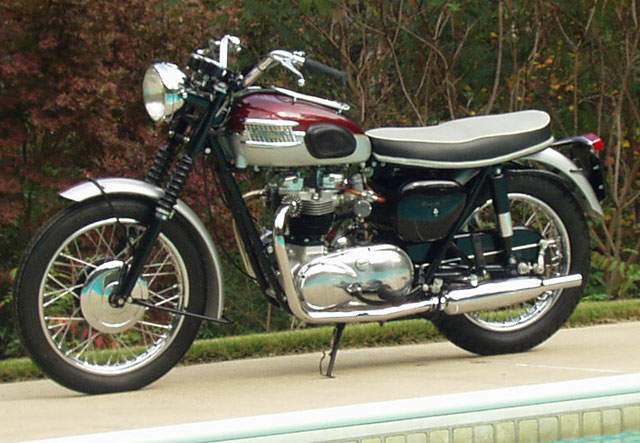
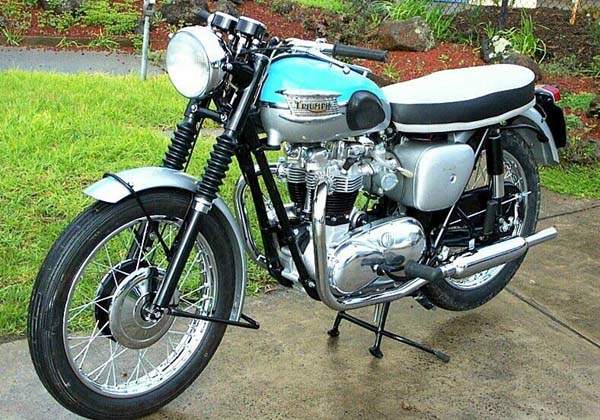
Triumph T120 Bonneville 650
Triumph announced the ultimate expression of Edward Turner's 650cc pre unit twin in September 1958 ready for the 1959 season. Named the Bonneville in recognition of Triumph's record breaking success at the salt flats of the same name, the new machine replaced the Tiger 110 at the head of the sporting Triumph range. The significant difference between it and the Tiger 110 concerned the cylinder head which was fed by two carburettors on splayed inlets together with a higher compression ratio, resulting in a claimed 46bhp. The 1960 season machines adopted a new duplex frame and lighter styling, losing the headlamp nacelle and partially valanced mudguards which had graced the 1959 models, with further detail revisions to the frame occurring for the 1961 model season.
Triumph's Speed Twin had been one of the bikes that helped to set the pace before the war. After the conflict, the 500cc Speed Twin spawned many descendants, from 350 to 750cc capacity. Above all others, the 650cc Bonneville became the bike that set the standard throughout the late 1950s and 1960s - the era of the Rockers and Cafe Racers. The first 650cc Triumph appeared in 1949, when the softly tuned 6T Thunderbird showed its pace at the Monthlery speed bowl before going on sale the next year. The model was an excellent tourer. In 1951, a Thunderbird racer, equipped with twin carburettors, hot cams and high-compression pistons, reached 132mph at Utah's Bonneville Salt Flats. A few years later, in 1956, Johnny Allen achieved 214.4mph, a record accepted by the US authorities, but the world governing body refused to acknowledge it. Americans continued their efforts, and two years later a specially prepared Tiger I 10 managed to achieve over I47mph, ridden by Bill Johnson. The speed was good enough for a class record. That was in 1958, and the venue once again was Bonneville. The first Triumph machine to bear the Bonneville name appeared in 1959. Based heavily on the Tiger I 10, the T120 was fitted with the twin carburettors, together with the hot E3134 inlet cam. With a power rated at 46 bhp, the model was already good for a comfortable I I5mph - but the engine had the potential to be tuned a lot hotter. From 1963 they gained a new frame, with extra bracing for the swinging arm and steering head and a new compact power unit. The steering angle was changed and improved forks were adopted. All these improvements helped the Bonneville to match its rivals' all-round performance. In the styling stakes, however, it had no equal. Where the contemporary BSA was worthy but perhaps a little stolid, and Norton's offering lacked the absolute glamour of its racing forebears, the 650 Bonneville oozed get-up-and-go. On the race track, it got up and went! In 1967 and 1969 it won Production TTs and British 500 mile races. In 1969 the works TI00R achieved a 1/2/3 in the Thruxton 500-miler, covering three more of the top seven places. In the opinion of many, the 1968 Bonneville is the best of the breed. With good handling and more reliable electrics than its predecessors (including a new ignition), all the good features were there in a package that was hard to beat. But it was almost the end of the line. The 650 twin would only survive a scant three years before it was replaced by a new 750cc and Triumph began its slow slide.
|
|
|
Any corrections or more information on these motorcycles will be kindly appreciated. |