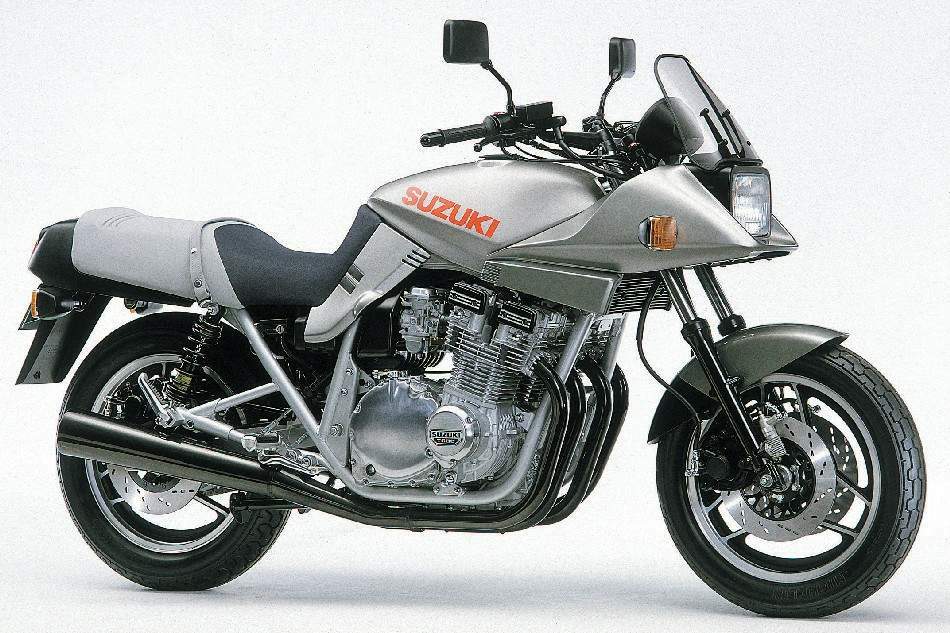
Tr HE roaring success for Suzuki 3f (he Katana line can be put town lo one
reason that bold, unique styling. So distinctive is the Kalana profile that
the breed would have sold well with a James Watt steam engine for power, a boat
anchor for brakes and a rubberised frame. To some it looks like a humped-back
grasshopper, to others it embodies the spirit of motorcycling, but there is
little disagreement on one point. A Katana looks like it's going fast, even at a
crawl and thai sells bikes.
Aside from the styling. Kalanas until now have had some other distinctive
characteristics. The race-style riding position demanded a real stretch to the
bars, the whsts took a goodly amount of body weight and tall riders would find
the legs bent at an uncomfortably acute angle. A firm seat and harsh suspension
ensured that you were treated to a fair amount of pounding from every direction.
But still this is part of the Katana appeal it is a macho bike in a very real
sense.
Considering the tradition of the breed we were interested to see whether the
new GSX750SE carried on in the same vein. The styling, although obviously
Katanaesque. gave an indication that perhaps there was something different in
store. The aggressive lines of the earlier models have been mellowed to produce
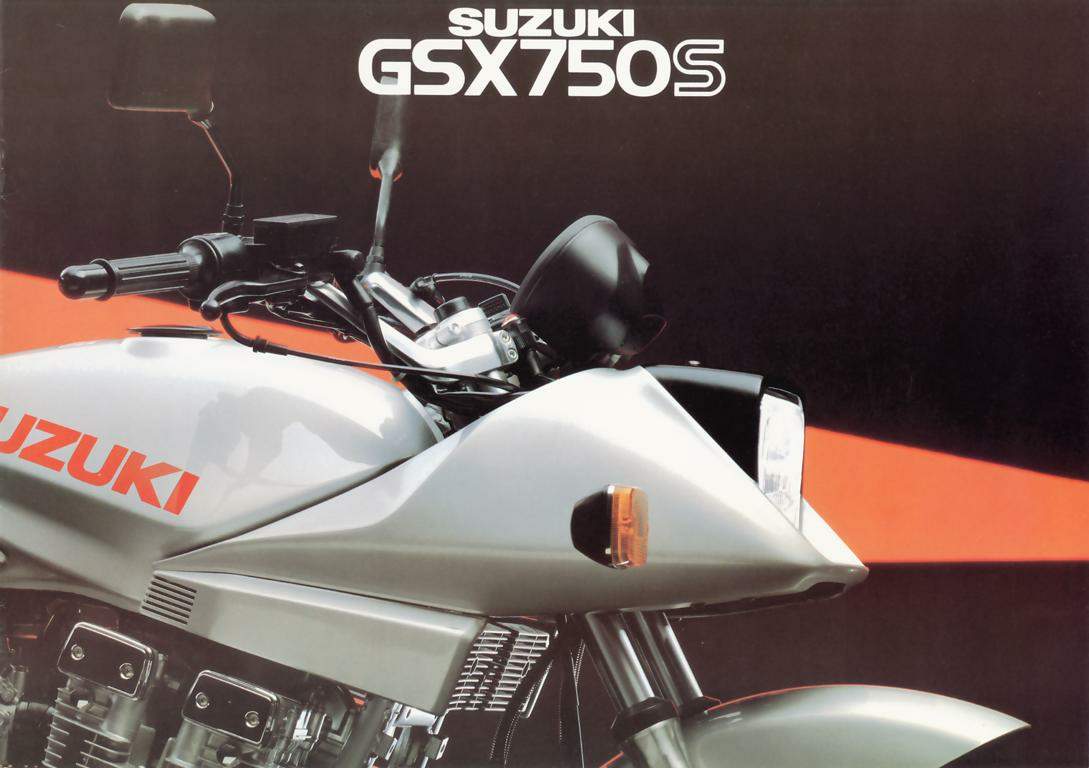
a package with greater universal appeal. The long, sloping nose of the
frame-mounted fairing gives the bike that Katana arrogance, but overall the
lines are cleaner and smoother. It looks more refined, and it is.
Throwing a leg over the saddle demonstrates that much more than the styling
has been softened. The seat is lower, the handlebars higher, the stretch to the
bars and bend at the knees are gone. Ride comfort has been improved immensely.
The racer crouch has been replaced by a more relaxed posture very much like the
riding position of the 'conventional" GSX750EFE. There's a trace of weight on
the wrists at town speeds but that's all it is a trace. Rider comfort has
risen dramatically without compromising any other aspects.
Looking more closely, it's not at all surprising that the new Katana is so
much different from earlier models. The bike has been the subject of a very
comprehensive redesign, to the extent that the SE is more a Katana-styted GSX750
than a derivative of the original 750 Katana. The frame is the EFE ESD mixture
of rectangular and oval section steel, the twin strut rear end has given way to
a Full Floater system, the front end sports Suzuki's new Posi-Oamp forks and a
16-inch wheel, while the brakes are now the twin piston fixed caliper type. The
motor is based on that used on the standard 750, but has some slight tweaks to
give it a little more power. Weight has
been dropped from 228 kg ('82 Katana) to a petite 212 kg, making the new
model the lightest member of the four-cylinder 750 cm3 sportster class.
Modifications to jetting, camshafts and airbox have lead to the power
increase over the EFE, the Katana producing a claimed maximum of 66.2 kW at 9500
rpm against the EFE's peak of 63.3 kW. This is not quite up to the Honda
CBX750's 669 kW. but it's the equal of the VF750 and is a couple of kilowatts up
on Kawasaki s GPz75G and Yamaha's XJ750.
On the dyno the truth comes out. In terms of rear wheel power, the Katana.
with a peak of 50.8 kW at 9500 rpm, has been pipped by the CBX (51.2 kW) but is
slightly more powerful than the VF (49.2 kW) and the GPz (48.5 kW). It has an
even better edge on the XJ (47.5 kW} and the last GSX we dyno-tested; the 1983
ESD with 47.3 kW.
Top end tearaway
So, in terms of peak power the new Katana is right up there with the best of
them. It has a superb top end which means that once the tacho needle swings past
7500 rpm the fireworks are unleashed. There'd be little difference on the road
betweek King CBX and the new contender and although we didn't have the
opportunity for a head-lo-head confrontation, the sligh
Suzuki would al least match and possibly even outaccelerate the Honda at road
speeds between 140 and 190 knvh. On the other hand the Honda, with its taller
gearing and slightly greater power output, will stretch out to a higher top
speed 220 knvh versus 206 knvh but as (ar as point-to-point fanging goes
there would be precious little difference.
Apart from being a bit stronger at low revs, the new Suzuki shows a great
similarity to the Honda right through the range, with a brisk but not overly
exciting midrange and a boomer of a top end. Roll on acceleration is OK from
4000 rpm, good from 6000 rpm and excellent above 7500 rpm. Quick overtaking
manoeuvres from road speeds below 120 knvh do require a downshift or two but
Irom 140 km/h and above there's rarely any need for the left foot shuffle.
The new motor feels quite different from its predecessor in several ways. It
spins more freely and is smoother as well. At low engine speeds (below 4000 rpm)
the solidly mounted motor is silky smooth and provides the vibration-free
attributes of the rubber-mounted GPz engine. There is a broad band of midrange
buzz extending from 5000 to 7000 rpm which peaks al around 6500 rpm {140 km/h in
top) but the intensity is low and cruising at the roughest engine speeds is not
in the least bothersome. Above 7000 rpm the vibes die down again and at redline
the motor is
surprisingly calm.
The refinement doesn't stop here. In true Suzuki fashion it starts readily,
needs little warmup, is mechanically quiet (for an air-cooled four) and well
muffled. It's a very civilised package and without a doubt the best of any
GSX750 to date. The good news doesn't stop here, as the appetite for fuel is
quite miserly, varying from 20.2 km/titre at a moderate highway pace to 15.2
km'litre during thorough thrashing. Around town about 17.6 km/litre is the norm.
The economy is as good as the GPz and better than any of the other 750 fours.
With the 21-Hire tank the bike can run to almost 400 km if ridden patiently.
Suzukis have traditionally rated highly in the quality of the transmission
system and the new Katana is no exception. The gearbox offers short, sharp and
positive shifting while the drivetrain freeplay is well' controlled. The spread
of ratios is well matched to the motor's power characteristics and since the
Katana runs just past the maximum power revs in top (to 9800 rpm) you could say
the overall gearing is close to spot on.
Not so squishy clutch
Joining the current trend, Suzuki has fitted an hydraulic clutch, which ■
typical of the breed combines a very smooth and progressive action with a
narrow takeup zone. This can take some getting
used to if you're accustomed to cable-actuated varieties but the SE has
enough low rpm power to allow trouble-free takeofts without too much slip.
In the frame, suspension and braking departments the bike has gained most of
the components in the current Suzuki inventory. The double cradle frame is
shared with the EFE, as is the 16-inch front wheel, but numerous changes have
occurred in other areas. The rear suspension linkages have been revised; fork
rake and trail plus wheelbase have all been increased (27.2 to 29.4 degrees. 105
to 112 mm and 1500 to 1510 mm respectively); and the front forks are
progressively damped and now offer four rather than two spring preload settings.
Strangely, the rear suspension unit has lost its rebound damping adjustability
but at least the excellent remote hydraulic preload adjustment mechanism has
been retained.
These changes have conspired to produce a motorcycle which handles better
than the standard GSX750 in a number of ways. The alterations in geometry have
slowed the steering a little; as a result the Katana doesn't display the
twitchiness of the earlier small front wheeled GSX750S while high speed
stability has been improved almost to CBX standard. Some, but not all, of the
low speed self-steering has been removed in the revamp.
Don'I get the idea that the bigger numbers in the front end have dramatically
slowed the steering, however. The Katana responds very quickly to rider input at
any speed, making it delightfully easy to change line or correct a mid-corner
blunder. Through the tight stuff the agility and lightness of the bike were well
received and the only obstacle to hard charging was the poor standard rubber, fl
was very difficult to explore the limits of cornering clearance with confidence
and that's unusual. Of late standard rubber at its best has generally been
beyond criticism; this may have been on example of the inconsistent quality
which seems to still affect even the most respected tyre manufacturers.
Apart from the tyres the SE has all the attributes of a great sportster,
offering agility, fine steering and top rate roadholding over the smooth and the
rough. Sure, there's a tendency for the front end to get a tittle excitable over
bumps but the Katana joins a select group in which this behaviour never reaches
desperation levels. Fun with finesse just about sums it up.
Limo-style Kalana?
The suspension probably represents the area of greatest divergence from
previous Katanas. Harshness has been replaced by plushness. Up front the new
forks have a quite soft action initially but unlike others (notably Yamaha's)
which are just plain flimsy, the Suzuki's forks firm up noticeably in the last
hall of the stroke. This is what progressively damped forks are all about. The
Katana forks have balance, being beautifully compliant over slightly rough
patches and not overly harsh over any type of horrible road surface.
The four-way spring preload gives not a
great deal of difference between softest and hardest. Nor is variation
between the four settings on the Posi-Damp unit immediately noticeable,
especially during braking. This is probably because, unlike normal anlidive
systems, the compression damping is not boosted in the first half of Ihe fork
stroke. Slamming on the brakes will induce more front end plummet than bikes
fitted with a good mechanical or hydraulic anlidive. But if you pay a bit more
attention you'll notice that fork compression in Ihe fatter half of the stroke
is slowed by incrementally larger amounts as the unit is adjusted from the first
through to the fourth setting.
The excellence of the forks is by and large mirrored by the rear suspension,
H is typical of what we've come to expect from the Suzuki monoshock systems,
with excellent initial compliance, smooth action throughout the long available
travel and a nicely progressive rising rate.
There are a few whinges. The unil needs to be adjusted to at least
three-quarters of the way through its preload range to cope with very rough
roads when blasting along solo so there could be a need for firmer springing 10
cope wilh the liveliest of our highways, especially lwo up. And why Suzuki did
not offer adjustable rebound damping as found on the ESD/EFE is a mystery. Over
very bumpy strelches at high speed with the suspension on Ihe firmer sellings
the bum spends too much lime in the air. It's a bit underdamped.
As a first for a Suzuki 750 the Katana has twin piston calipers on the two
Iront and single rear discs. As far as power is concerned !he brakes are very
well endowed but feel is not what it should be. Both ends arc loo insensitive so
crash slops are quite often accompanied by a screech as the tyres lock up. A
belter rubber would probably help but there is definite room for improvement.
Oh well, one failing can be forgiven when the rest of the bike is lops.
What? A comfortable Katana? As unbelievable as il may sound, it's true. The
combinaiion of supple suspension, relaxed riding position, and reasonably well
padded seat makes the bike an effortless distance-eater. The fairing is not
overly effective and tends to direct some of the airstream at visor level and
the seat could be plusher and wider. But all in all the Katana comes close to
being the most comfortable in the class one-up at least. The story is not so
rosy for the pillion passenger who has to contend with the narrowest part of the
seat and the absence of a grabrail.
A touch of the louds
There's no argument that styling and finish are above reproach but perhaps a
few comments on the subject of finer detailing may be appropriate. Possibly the
gold paintwork on the frame and wheels and the various stickers advertising the
prowess of the bike are a little on the crass side? And then of course there's
the popup headlight. The cynics among us may regard this pioneering device as
another example of unnecessary complexity and pandering to the gods of gizmotogy.
and it probably is. But it will sell bikes, and gadget value aside the
headlight itself is very good, giving a broad spread of light on low and
excellent penetration on high. Only the overly sharp cutoff on low beam mars the
picture.
Other lights vary in quality from satisfactory to good. The rear indicators
are bright but the tront ones, incorporated into the fairing sides, are too dull
as is Ihe small taillight.
The instrument console, in true Katana
tradition, is simple. Centrepiece is the speedo which is flanked on the right
by a smaller tachometer and on the left by a circular cluster of warning lights
for turn. skJestand retraction, high beam, oil pressure and neutral.
Neither the speedo nor tacho are overly large but the graduations make them
quite readable all the same. They could be better in one respect, though. The
colour ol the pointers matches Ihe numbers and the speedo (in green) is
difficult to read quickly at night.
Swilchgear is Ihe usual Suzuki stuff, the combination indicator lights
(lasher unit and horn control on the left with the headlights-on and kill switch
on the right. It's about time the combo was sent to the b>g bike park m the sky
as it s vague in action and hopelessly out ot date. Also on the negative side is
ihe absence ol a starter lockout, while the mirrors are sited too far forward of
the rider lis very
difficult to see other vehicles following close behind in adjacent lanes. The
horns and stands are excellent though.
Wilh the GSX750SE the Katana concept has been given a new lease on life. It
is different from the earlier examples in all but looks and even then you'd
have to stand a couple of hundred metres away to confuse the new wilh the old.
Virtually every facet has been improved, especially the performance, handling
and comfort. The revamp brings the Suzuki right up to the front of the 750
sportster class. Il is nol as fast as the CBX. but any small degree of
performance inferiority may well be outweighed by Ihe better comfort. And of
course you have to consider the agility and the high speed stability and the
popup headlight...
It is without doubl the best Katana: it is arguably the best 750.
Source Two Wheels 19'84