|
|

|
|
|
|
Classic Bikes
Custom Bikes
Individual
Racing Bikes AJP
AJS
Aprilia
Ariel
Avinton / Wakan
Bajaj
Benelli
Beta
Bimota
BMW
Brough Superior
BRP Cam-Am
BSA
Buell / EBR
Bultaco
Cagiva
Campagna
CCM
CF Moto
Combat Motors
Derbi
Deus
Ducati
Excelsior
GASGAS
Ghezzi Brian
Gilera
GIMA
Harley Davidson
Hero
Highland
Honda
Horex
Husaberg
Husqvarna
Hyosung
Indian
Jawa
Kawasaki
KTM
KYMCO
Laverda
Lazareth
Magni
Maico
Mash
Matchless
Mondial
Moto Guzzi
Moto Morini
MV Agusta
MZ / MuZ
NCR
Norton
NSU
Paton
Peugeot
Piaggio
Revival Cycles
Roland Sands
Royal Enfield
Sachs
Sherco
Sunbeam
Suzuki
SWM
SYM
Triumph
TVS
Ural
Velocette
Vespa
Victory
Vincent
VOR
Voxan
Vyrus
Walt Siegl
Walz
Wrenchmonkees
Wunderlich
XTR / Radical
Yamaha
Zero
Video
Technical
Complete Manufacturer List
|
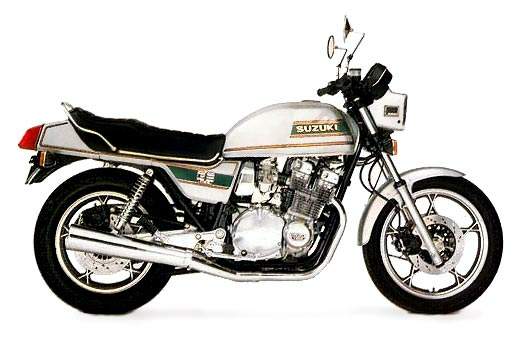
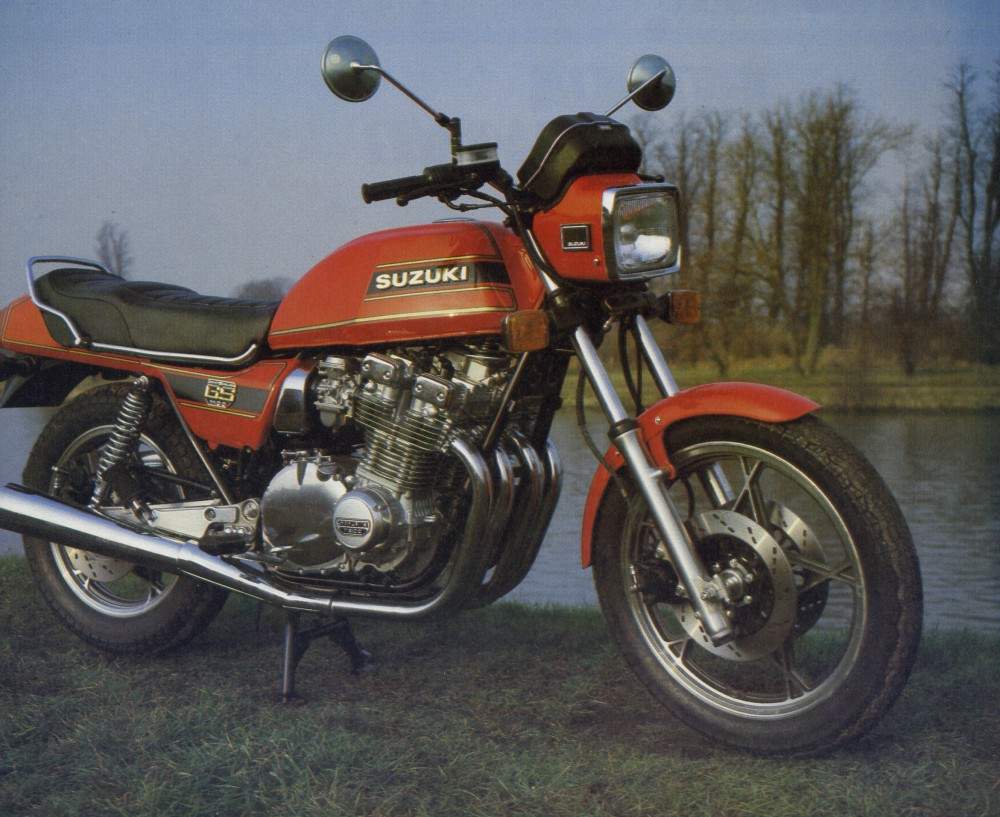
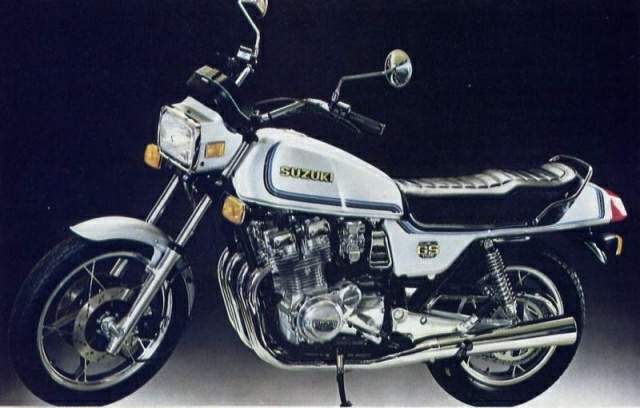
Suzuki GSX 1100E
At the time of the introduction of the Suzuki 16
valve GS1100E in 1980, Honda was ruling the Superbike world with its’ stunning 6
cylinder CBX. The big GS was designed to knock the CBX off the throne and
securely hold the fastest and quickest motorcycle crown for Suzuki. It did this
almost without effort. The motorcycle press in the United States raved about not
only its’ power but also how well it handled for a Japanese liter plus bike.
Unfortunately, the GS was also introduced at a time when the motorcycle industry
was facing a downturn in the market. Many sat in the showroom, collecting dust,
until someone would finally come in and buy the bike for a ridiculously low
price.
Other features were a roller bearing supported main crank which
allowed prodigious amounts of power to be built into the engine without fear of
bearing failure, screw-type tappet valve adjusters which eliminated the need for
valve shims, a five speed transmission, and plenty of over-engineering which
made the engine the drag racer’s choice for over 25 years.
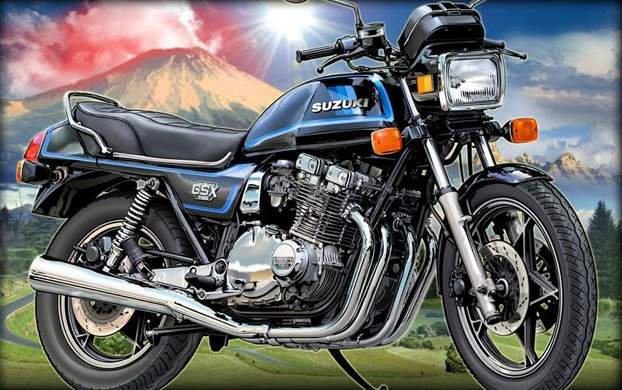
Review AT LEAST ONCE IN YOUR LIFE, YOU MUST have found yourself almost choking on a hysterical giggle. It generally bubbles up spontaneously when something outrageous happens. Remember the first time you rode on a tall, fast, rickety roller coaster? You probably came off of it wide-eyed but with a sinister smirk of survival on your face, even though five minutes earlier you had had to make a conscious effort to draw one breath after another. Nonetheless, you went back to ride the roller coaster again and again, just to repeat the thrill. Suzuki's GS1100EX can have the same effect. No matter how many times we rode it, the big 16-valver always provided Direct Adrenaline Injection into the bloodstream. Of course, the GS1100 can be a pussycat, but it also can be DAI exciting. Cycle tested the GS in February 1980, concluding that the Suzuki was the quickest and strongest production Superbike of all time. So why run back to test this motorcycle again so soon? Two reasons. First, historically some manufacturers produce their strongest engine the first model year subsequent models, in response to EPA requirements or other factors, have less performance. Would Suzuki back down the GS1100? There was another reason for the revisit. Honda and Kawasaki have been waiting in the wings with either totally revamped or completely new Superbikes. Before testing those motorcycles, it seemed reasonable to do a GS reality check as a state-of-the-art starting point. Suzuki has not backed down the 1100. On the contrary, the 1981 bike is even quicker and faster than the 1980 version. The present bike, after being thrashed around on the roads for a 600-mile weekend, went straight to the drag strip and thence ran the quarter-mile in 11.18 seconds at 119.84 mph! (The February bike clocked 11.49 seconds at 116.88 mph.) If you find yourself becoming bored with "Name a road and the GS1100 can be tuned for it: slow, winding roads; high-speed mountain and canyon pavement; broad, flat freeways.... The Suzuki is at home anywhere." he performance of the GS, maybe you had better take up another hobby. But see your analyst first. Don't let these descriptions mislead you. The GS1100EX is not some kind of primal beast, waiting to devour you the first moment your attention wanders. Nothing of the sort. The Suzuki is the most civilized, adaptable motorcycle we've seen to date. Differences between the 1980 and 1981 models are both subtle and superficial. A switch in paint changes the 1100's colors from '80's silver or red to '81's blue or black. Somehow, last year's silver paint and striping caused the bike to appear bulky and chunky. This year, much to the big bike's benefit, new pinstriping on the tank and side covers helps down-size the motorcycle visually, making it easy to mistake for the smaller 750. Mechanically, the motorcycle has gone unchanged, and there's no need to repeat the extensive technical recitation provided in our February issue when the 1100 was introduced. Often the mountain of important technical information together with the magazine's space limits can result in tightly worded riding reviews. So it's a welcome chore to return to an excellent motorcycle with an empty odometer and blank copy paper. Although Suzuki has not modified the GS1100's running gear, they have made small additions to the bike's convenience items. Suzuki has retained the warning display panel, but they've replaced the brake-fluid warning light with a sidestand warning light. The warning light is bright enough to be seen easily in all conditions except direct sunlight, where you have to look more closely. The lack of direct-sunlight visibility is no big matter; having such a warning light will heighten your awareness of the sidestand to the point where checking becomes routine. The substitution of the sidestand-down light for the brake-fluid light strikes us as reasonable since the sidestand presents a greater everyday danger to most riders. The brake-fluid light was somewhat superfluous anyway, because the translucent plastic brake containers allow the rider to inspect the fluid levels at a glance. The other warning lights are the same as last year's, monitoring the headlight, taillight and stoplight bulbs and the battery fluid level. The rest of the instrument panel is unchanged from 1980. Those who worried about the wisdom of having a fuel gauge without having a fuel petcock will find comfort in Suzuki's addition of a petcock this year. Suzuki claims a 1.1-gallon reserve capacity, but our test bike actually held two gallons in reserve. The bike would go on reserve faithfully with the gauge needle indicating about one-third full, and it took only three gallons to top off the tank, demonstrating that the gauge could be trusted for ballpark accuracy. With its extremely adjustable suspension, the GS1100 is at home anywhere; it's the complete Superbike. Name a road and the GS1100 can be tuned for it: slow, winding roads; high-speed mountain and canyon pavement; broad, flat freeways. Other one-liter road burners currently lack the all-around suitability that the Suzuki has.
The Suzuki's multi-adjustable suspension system explains its great versatility. Its air-assisted fork allows you a multitude of adjustments with a minimum of trouble. The rider can have anything from a taut, nicely damped fork for mountain riding to a compliant, soft-riding fork for touring. The air valve is located on the left fork tube beneath a chrome cap right above the bottom triple clamp. When you add air, the air-bleed screws, at the front of each air collar, should be backed off a couple of turns to ensure that an equal amount of air is admitted to each fork tube. After the adjustment is made, the rider should lightly seat the screws so air will be less likely to escape, and the need to review the fork air pressure will be reduced significantly. Damping adjustments can be made by rotating the knurled knobs at the base of each slider. There are four possible damping settings, numbered one (lightest damping) through four (heaviest). This adjustment alters rebound damping; compression damping is constant. Spring preload adjusters located in each of the two fork caps provide a third channel to adjust the front fork action. We never used them, in part because we prefer the infinitely variable properties of air as a spring and in part because to get at the preload adjusters you must remove the handlebar. We suspect that the fork preload adjuster would be" useful to riders who would want to mount heavy fairings. In that case the air pressure necessary to preload the front end adequately might result in a very harsh fork action toward the end of fork travel in any event, you'll not be changing spring preload at roadside. With five preload positions for the springs and four positions for the rebound damping, the shocks are also widely adjustable to suit rider and road. Compression damping, however, isn't adjustable. The Suzuki GS1100 has a genuinely useful range of suspension dialings; there are no throwaway settings that no one would ever find useful under any circumstances. In one day, one tester tried the GS1100 across a 300-mile panorama of road conditions. The first leg consisted of a favorite isolated road with a very smooth surface and corners ranging from 40 to 90 mph. Obviously we selected the heavier suspension settings, boosting the fork air pressure to 28 psi, and dialing the damping full-on at the number-four setting. The shock preload rings were rotated to their middle setting, and the dampers were clicked in at the third step. With the suspension set as such, the mountain road performance of the motorcycle was good but not quite spot on. Although the handling was neutral, the GS would get into a steady medium wobble at partial lean angles. When thrown into a turn at maximum lean angle, the GS was stable; but ridden semi-deliberately, it could be somewhat unsettling. To correct the problem, we tried two things. First, we increased the shock damping to the heaviest possible setting and jacked up the spring preload to the fourth position. Second, we added air to the rear tire, bringing the cold-inflation pressure up to 34 psi, four pounds above the recommended 30 psi. After these changes, the bike was as close to perfect as any big-bore street bike we've tried under similar road conditions. To isolate the cause of the original wobble, we back-tracked the changes starting with tire pressure. The wiggle reappeared with the lower tire pressure, indicating that the carcass of the tire was deflecting under the cornering loads being fed into it. Ground clearance proved more than adequate with a 145-pound pilot; the bike would touch the footpegs on rare occasions, and on hard bumps it would touch down the feet of the centerstand. One of the beauties of the air fork is that it allows the rider to adjust the ride height of the bike, making generous cornering clearance a possibility. The GS's tunable suspension guarantees a willing-and-able rider a graduate degree in motorcycle handling. Self-taught at that. To tune a suspension a few years ago the numerous ways you can tune the GS today would have required four different sets of shocks, a machinist to weld and drill four sets of damper rods, four sets of spacers to set fork spring preload and a pair of aftermarket air caps for the fork tubes. And a lot of time and patience. Suzuki has simplified the task. What effect will more damping in the rear shocks have on the bike's handling on your favorite corner? Just turn a knob. Will less compression damping in the fork allow the bike to respond more quickly to those ripples in the street around the corner from your house? Turn a knob. Want less fork dive when getting on the binders hard? Add a little air. The list goes on and on. If you have a question about suspension, the GS1100 allows you to ask it and then go ahead and find the answer. For the freeway, you might want to recalibrate the suspension, as we did, to give a softer ride. Here, lowering the fork pressure down to eight psi, setting the respective front and rear damping adjustments on the number two notch and changing the rear preload to the middle position will give you a soft, compliant ride. The only hitch in our GS's smooth freeway message was a minute amount of stiction in the fork that showed up rolling across freeway expansion joints. Up front, lighting comes courtesy of a rectangular H4 Halogen headlamp. The lamp has a strong beam, but its mounting system precludes aiming the beam by moving the housing. Often when you add a passenger, the headlight beam will shoot off into the sky as a result of the change in attitude of the motorcycle. With the pivotal mounting system employed on most bikes, you can reach around and re-aim the light easily. With the GS1100 you find yourself trying to get the high beam down by adjusting the suspension. Should Suzuki stay with its present nacelle, a headlamp adjustment knob would be a welcome addition. Double-filament bulbs have been added to the turn signals to facilitate the inclusion of running lights, which presumably make it easier to identify the GS as a motorcycle. The combined high/low beam and turn signal switch also incorporates a self-cancelling turn signal timer. Operating when the motorcycle is moving at 10 mph or more, the timer shuts off the signal after approximately 10 seconds. Soft red light emanates from the edges of the instrument faces. While we really can't quarrel with the GS's face lighting, we think Honda's translucent face lighting is superior. Honda's light is softer, but still retains.superb night readability. Maintenance on the Suzuki is simple. With its electronic ignition, owner-serviceable (no shims) valve adjustment and O-ring chain, the Suzuki won't keep you in the garage Saturday night preparing for Sunday's ride. Suzuki recommends that you inspect the valve clearance roughly every 3500 miles. Aside from changing,the oil and spark plugs at the prescribed intervals, the Suzuki requires you to do little other than adjust the chain, keep an eye on all of the nuts and bolts and prepare for the inevitable rear tire replacement, which could depending on your throttle wrist—occur at 2000-mile intervals. The Suzuki's engine matches up wonderfully to the rest of the motorcycle. You can look at it this way: Any motorcycle that has effortless power at 3000 rpm which the Suzuki does is very likely to have eye-bulging top-end as almost a casual and incidental by-product. The GS has a huge amount of torque, producing 37.1 pounds-feet at just 2000 rpm. Many four-cylinder engines in earlier Japanese bikes had steepish power curves requiring something over 6000 rpm to make any serious power. That was fine on the computer tape; out in the real world of hills and dales, the engine wouldn't put out any serious power in most actual riding situations. For most conditions you need not spin the 1100's engine much over 4000 rpm. The GS simply trolls at supra-legal speeds on the freeway; somehow it seems as if the rider can dial the engine to "freeway" or "interstate" just as surely as clicking the dampers and spring ramps. If you need a little more gusto for backroad or mountain work, exercise the tach needle to 7000 rpm. Assuming you want to explore your outer limits, run it up to 9000. At that speed, you'll find the scenery blowing by at a positively gut-tightening rate. Rarely did staffers have to spin the engine over 7000 rpm. At that speed, the power available can compress time and space so fast that the rider absolutely must be at his best, without any distraction. A motorcycle that can generate the GS1100's kind of speed and acceleration must have good brakes to match. The GS will stop as hard as its tire traction will allow. Initially the front brake had a very spongy feel at the hand lever, a telltale sign that the brake fluid had bubbles somewhere in the system. An hour spent bleeding the system restored a firm feel which lasted a couple of days. Then some sponginess returned. A second bleeding cured the problem for the duration of the test; at that point the twin-disc brake came up to the excellent standard of the 1980 model. Two fingers would haul the bike down from speed, without any pulsing or fade, allowing the rider the comfort of knowing that he could stop the motorcycle from the exhilarating speeds the GS so cheerfully provides. Suzuki constructed the spacious seat of two densities of foam and positioned the lighter layer on top where its softness gives the rider's seat a very cushy ride. The firmness of the lower foam layer keeps the rider's body from springing up off the seat when the bike meets the far side of a bump. Combined with the adjustable suspension the GSHOO's saddle makes a 400-mile day possible without giving the mobile-novocaine treatment. The handlebar-seat-footpeg relationship will fit most riders. Cycle's staffers range in height from five-eight to six-one. No staffer found the riding position drastically uncomfortable, but taller editors felt that the handlebar came too far back toward the rider, causing a too-upright riding position. Overall, the generous amount of seating room enables the rider and passenger enough latitude to find a comfortable position. The GS1100 is the finest example to date of one-liter-and-up Superbikes. Its versatility makes it the king. Here's a motorcycle that can run low, low elevens in the quarter-mile and have 120 mph in hand at the traps. It can gobble down the miles on an open-highway tour with a ride quality topped only by a couple of specialty touring bikes. And, assuming you're willing to use its suspension adjustability to maximum effect and its engine to nine grand, you'll be on the front line of any canyon war. All it takes to get full-spectrum use out of the 1100 is some knowledge and a little time to make a few suspension adjustments. The engine, mind you, requires only right-wrist adjustments. Even after 1500 miles of testing, a full twist of throttle would still provoke a sinister laugh. Source CYCLE
|
|
|
Any corrections or more information on these motorcycles will be kindly appreciated. |