|
|

|
|
|
|
Classic Bikes
Custom Bikes
Individual
Racing Bikes AJP
AJS
Aprilia
Ariel
Avinton / Wakan
Bajaj
Benelli
Beta
Bimota
BMW
Brough Superior
BRP Cam-Am
BSA
Buell / EBR
Bultaco
Cagiva
Campagna
CCM
CF Moto
Combat Motors
Derbi
Deus
Ducati
Excelsior
GASGAS
Ghezzi Brian
Gilera
GIMA
Harley Davidson
Hero
Highland
Honda
Horex
Husaberg
Husqvarna
Hyosung
Indian
Jawa
Kawasaki
KTM
KYMCO
Laverda
Lazareth
Magni
Maico
Mash
Matchless
Mondial
Moto Guzzi
Moto Morini
MV Agusta
MZ / MuZ
NCR
Norton
NSU
Paton
Peugeot
Piaggio
Revival Cycles
Roland Sands
Royal Enfield
Sachs
Sherco
Sunbeam
Suzuki
SWM
SYM
Triumph
TVS
Ural
Velocette
Vespa
Victory
Vincent
VOR
Voxan
Vyrus
Walt Siegl
Walz
Wrenchmonkees
Wunderlich
XTR / Radical
Yamaha
Zero
Video
Technical
Complete Manufacturer List
|
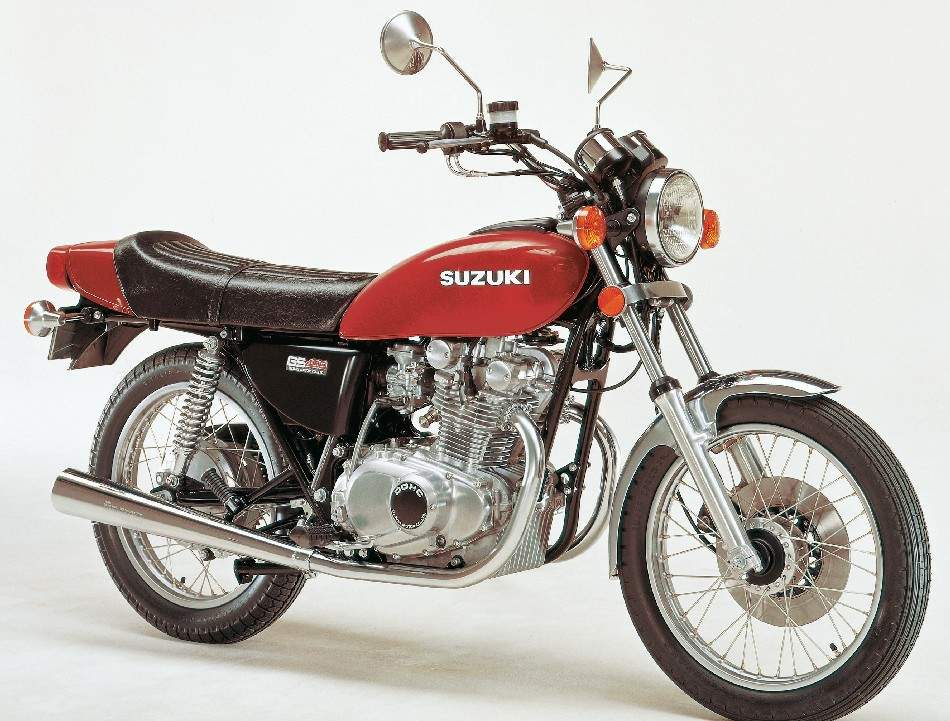
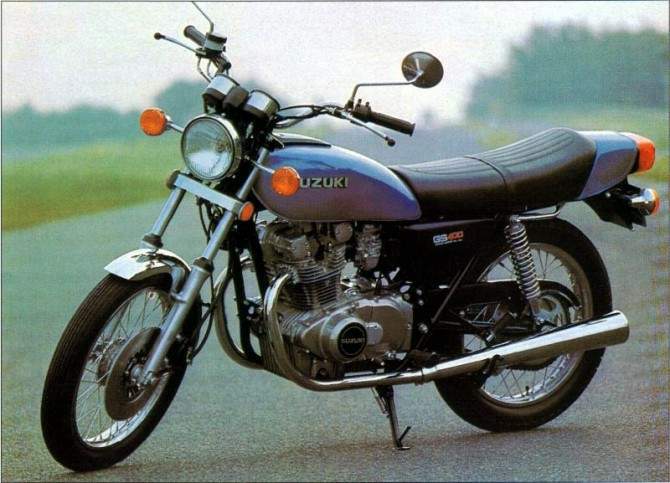
Suzuki GS 400
Suzuki was the last of the Japanese motorbike-factories to aim for 4-stroked engines and the GS400 was together with the GS750 the very first 4-stroked Suzuki's to be launched on the market, quickly followed by the GS550. The new GS series was technically quite similar to the Kawasaki Z1, something not previously seen in the smaller displacement classes. As such, the GS550 and in particular the GS400 were of a more modern construction than that of the competition at the time. Whereas the larger 550 and 750 were both inline fours, the GS400 was a parallel twin with a 180-degree crank and a gear driven balancer to reduce the vibrations reaching the chassis and rider. Unlike the larger GS engines, the 400 had CV carbs from its introduction, but they all shared points ignition, wire wheels and disc front brakes. The 400 and 550 had drum rear brakes, whereas the 750 also had a disc rear brake. Soon, all versions appeared in an optional high end version, designated with an E, as in GS400E, that came with cast wheels and a mildly stepped seat. Only the 400 retained the drum rear brake for the cast wheel version. The Suzuki GS400 twin was presented in October 1976, being one of the first four-stroke Suzukis since the Colleda COX in the 1950's. To set the Suzuki GS400 apart from its competition, it had double overhead cams, two valves per cylinder, roller bearing crank, a 6-speed transmission, a gear indicator and compliant suspension supported by a tubular double cradle frame. Nothing of this was new, but nobody had ever put all these features into a 400-class motorcycle before. Hence the GS400 was the most advanced motorcycle available in its class when it was introduced to the market. The Suzuki wasn't the best handling 400, nor the fastest or the one with the best brakes or most compliant suspension. However, it was arguably the most balanced motorcycle in its class. Only the Honda CB400 Four had a smoother engine, and being physically larger than the rest the GS400 offered more room and comfort for large riders or those riding two-up. The suspension offered the best compromise between handling and comfort of the class, and the chassis allowed for decent stability even during brisk riding. In order to grab as much of the market as possible, Suzuki soon introduced two more versions of the GS400 to accompany the standard wire wheel model and exclusive cast wheel edition; the GS400L Low Slinger cruiser and a low-cost version with less equipment and only a drum front brake to go along with the drum rear brake. For some markets, the little Suzuki grew to a 425 for 1979. This was Suzuki's answer as the competition grew stiffer, and the extra displacement gave the GS a little extra power and torque. However, the days of the original GS design was numbered, and for 1980 Suzuki launched a fully reworked version of the GS, now sporting 450cc and a plain bearing crank. Also, stroke was reduced and bore increased so that the engine would be less stressed at high rpm as well as being able to produce more power. While the GS450 retained the two valves per cylinder design, albeit in improved form, some markets received a 400cc version sharing the bottom end with the new GS450, but fitted with new TSCC 4-valve cylinder heads. Although Suzuki had earlier been known as
the home of two-strokes and for years let other manufacturers go
ahead with their complicated and not-always-that-reliable
four-strokes. Honda presented its CB750 already in the late
sixties being an immediate success. Suzuki's answer, in form of
the great new two-strokes in the T and later in the GT family,
were great bikes in the early seventies, but were soon hopefully
out-of-date. And when also the RE5 with rotary engine turned out
to be unsuccessful, it was time for Suzuki to think again. New,
harder emission regulations were arriving in the USA, killing
the eventual plans of making even more powerful two-stroke
machines. The name of the game was now four-stroke
engines.
|
|
|
Any corrections or more information on these motorcycles will be kindly appreciated. |