Liquid cooled, four stroke, twin cylinder,
DOHC, 4 valve per cylinder.
Capacity
638
Bore x Stroke
75.5 x 71.3 mm
Compression Ratio
11.2:1
Induction
Electronic fuel injection
Ignition /
Starting
Digital electronic
Max Power
55 hp 40 KW @ 7000 rpm
Max Torque
62 Nm 6.3 kg-m @ 5000 rpm
Transmission /
Drive
Electronically-controlled, CVT- automatic
Front Suspension
Telescopic front fork with 41mm inner tubes,
provides 105mm of wheel travel
Rear Suspension
Swingarm-style, twin preload-adjustable shock
absorbers and a separate aluminium swingarm
Front Brakes
2x 260mm discs 2
piston calipers
Rear Brakes
Single 250mm disc 2 piston caliper
Front Tyre
120/70 R15
Rear Tyre
160/70 R14
Dry-Weight
238 kg
Fuel Capacity
15 Litres
Road Test
Riding into Princeton the smell of
fresh cut hay from roadside ranches wafts through my helmet’s vents. It is hot
for June, after a sodden spring the sun is pushing the temperature to 34°C and
the hay into midlife. It’s a combination of events that makes this early harvest
and the accompanying aroma of fresh cut alfalfa possible. For me, having grown
up in British Columbia’s ranching interior, this is the smell of summer – one
that I’d not realized I’d missed until this tour, or should I say, “scoot-tour”.
Our metal steeds are not the usual sort of back roads companions, they are the
Honda Silverwing and Suzuki Burgman 650 Executive, two big displacement scooters
that have purred through the past 800km and laid to rest any doubts I have about
their touring proficiency.
Three days ago back in Vancouver I had a few doubts. Sitting in the underground
pre-loading, neither the Burgman 650 Executive nor the Honda Silverwing struck
me as particularly appealing pieces of road ordnance.
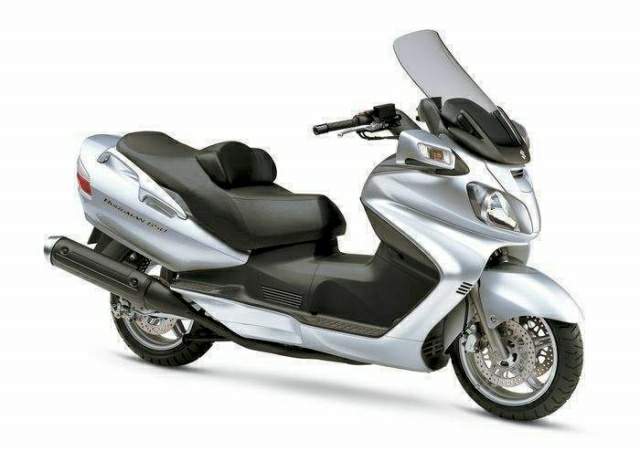
From the front the Burgman 650 Executive invokes thoughts of the FRJ 1300’s
functional styling, while the back is reminiscent of a Goldwing’s wide-load. The
Burgman 650 Executive’s control pods are festooned with buttons for its CVT
transmission’s manual mode, power mode, fold in mirrors, and electrically
adjustable windscreen. It has all the toys; ABS, sliding back bolster for the
rider, back rest for the passenger, and a total of three glove boxes (only one
locking). In short this is a bike for Bruce Wayne in his dotage, cruising the
streets of Gotham in automatic gadgeteer comfort after running about the mansion
all day on a wispa-lift. Maybe a cynical view, but I can’t help but feeling a
bit young for this bike’s demographic.
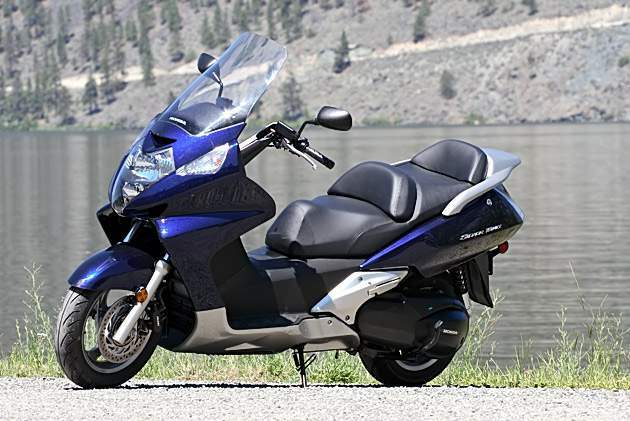
The Honda? It’s styling is the lovechild of an odd ménage a trios between
CBR1000XX, an ST1300 and a Reflex. The result is sleek and sci-fi, the rear
looking like a Cylon-raider but distinctly cuter, the gauges stylish and easy to
read, the front looking windswept and vaguely predatory. The Silverwing has a
more unified and European design sense to it, compared to the collection of
functional lines, boxes and blobs that compose the Burgman 650 Executive. Honda
has gone a simpler, cleaner route. ABS is standard, the windscreen is fixed, and
there are only two glove boxes, one locked and one not. In getting out on tour,
one only spends so much time pondering appearances before it’s time to wedge too
much luggage into too little space.
Capacious, voluminous, roomy, ample - all these words and much more fit
under-seat on either the Burgman or the Silverwing. Here you are exempt from the
normal jiggery-pokery of loading for a ride. Just pop open the seat, done by
turning the ignition all the ways clockwise on the Burgman or in the left hand
side trunk lock for the Silverwing, and start stuffing. At 55L and 56L
respectively, the Silverwing and Burgman have ample space for a weekend tour.
That is unless you’re traveling OWD style; a laptop, two cameras, three lenses,
video equipment (we keep meaning to use it), clothes for four days (just in case
we run long), two sets of spare shoes, towels (we may want to swim along the
way), rain gear (in case the swimming isn’t the only water we encounter), and a
spare helmet. Many people travel with less for a month. We took the liberty of
bumping the twin shocks on each bike up a couple notches to keep the rear ends
from dragging across the asphalt as we exit town.
As usual it’s a late start, and we’re leaving to the honking snarling tune of
Vancouver’s lunchtime traffic – it is rush hour without the sense of order as
drivers frantically try to run an hour and forty-five minutes worth of errands
in an hour. Hooligan time, then, as we filter, split, and abruptly lane change
our way thru. We get away with it too; these big scoots are “so darn cute,” as
occasional OWD photographer Justin Mastin-Frost puts it, “you just want to cut
them a little”. Ok, maybe not cute, but at least innocuous enough they fail to
offend the caged masses.
In the traffic melee, the Silverwing feels smaller, lighter and more manageable,
moving like twist-and-go liquid through the auto-bloat; the Burgman is still
effective but it ends up feeling bulkier and more bike-like. This is despite
both mega-scooters sharing the same 1,595mm wheelbase, and similar claimed dry
weights - the Burgman comes in at whopping 238kg (524 lbs.) while the Silverwing
is 6kg less at 232kg (511 lb).
The Silverwing’s perceived traffic agility may come from its smaller tires,
120/80-14 front and 150/70-13 rear versus the Brugman’s 160/60-15 front and
120/70-14 rear, those make for quicker turn in and less rotating mass. Just as
likely it’s the Burgman’s girth, a whopping 810mm wide compared to the
Silverwing’s slender 770mms. When it comes lane-splitting time the Executive
editions “blue button” comes into play. Press it the mirrors fold in, an act
that prompted one wag to exclaim, “Oh my God! It does yoga!” At a stop the
Silverwing’s narrower seat and floorboard arrangement also make it easier to
paddle about. The reality of these clutchless-wonders is they will embarrass any
sportbike in traffic and leave the big tourers gasping, even loaded to the
gunnels.
Part of this in-traffic alacrity is the simplicity of engaging “warp” both bikes
offer. Free of clutches, gear selection and shifting, you simply crank the
throttle and are gone, leaving hot hatchback owners agape, owners of Italian
super-cars stymied, and sport-bike riders frustrated. I don’t think the novelty
of hiking my trousers up to the nipples, pretending to gum food in my helmet,
and then taking the race boys off the line will ever wear thin - welcome to the
joys of a CVT transmission.
The Suzuki benefits from its transmission’s “power mode”, which keeps the CVT in
lower ratios and slides the engine 1500RPM higher in the range, making for
better pickup and stronger compression braking. Even in the default automatic
mode, the Burgman is no slouch though. Suzuki has equipped the 650 with a manual
mode embedded in the shotgun spray of buttons cluttering the left control
cluster, which lets one shift through 5-preset ratios using thumb accessible
up-shift and down-shift buttons. Out on the road you quickly realize the
Burgman’s automatic modes are far better at managing this bike than any human
ministration though. The Honda’s shifting is a simpler affair, you get to twist,
you get to go, no fancy options and no added complexity.
Out on the open road we cruise through the sweepers of the reinvented
Sea-to-Sky. This is a highway whose beautiful twisted soul has been sold cheap
to the 2010 Winter Olympic masses. We join drivers flooring it like brain
damaged lemmings on a quest for their personal edge in Whistler and prove both
bikes are more than adequate at freeway speeds. An at speed limit clip is
relaxed, freeway speeds effortless, and holding with traffic comfortable.
Both bikes feature torquey parallel twins, with the Silverwing displacing 582cc
and the Burgman weighing in at 683cc. Output wise both beasties are quite
comparable; the Burgman’s plant develops a claimed 54hp at 7,000 RPM and
32.5lb-ft of torque at 5,000RPM, while the Silverwing lays claim to 50hp at
7500RPM and 37lb-ft of torque at 6000RPM. Still, thanks to the power mode the
Burgman feels slightly spritelier.
Out of traffic, late lunch stop done in Whistler and past Pemberton we’re into
B.C.’s most convenient set of mountain carousels, turns, and twists – the Duffy
Lake Road. Time’s been cruel to the Duffy, at points the road is more patchwork,
potholes and heaves than unified whole, but if a bike can make it here it can
make it anywhere. Giovanni Di Marino is accompanying us astride my own VFR800
and it seems these “scooters” may have taken him by surprise on the Duffy’s chop
and bump.
Suddenly, someone lights a firecracker under my arse, and astride the Silverwing
I’m off. Is this a scooter with sporting aspirations? Do we have to rename the
article to “Sport-Scoot-Touring”? Perhaps, but pushing hard is tricky work on
the Silverwing.
To get speed out of the blue scoot requires liberal application of the throttle.
Into the corners you need to trail brake in order to settle out the bouncing
suspension, while laying on the throttle for all its worth to avoid losing
speed. Hit a bump or pothole and the impact is transmitted directly up your
spine – in this both bikes are equal. In the Silverwing’s vibrating bar mounted
rear-views I see Kevin on the Burgman and he’s gaining slowly.
On the straights we shoot along full out a step-through cruise missile,
embarrassing local drivers. These scooters may look like Grandma’s practical
reinterpretation of a motorcycle, but guess what? Grandma has a sense of humor
and fun. Pulling on the brakes, valuable velocity is burnt off before the road
goes snaky again.
Either bikes’ combined braking is decidedly abrupt, offering up little feel.
Hauling down from speed the Honda’s braking, relying on a single 256mm disc with
three-piston caliper out front and a 240mm disc twin-piston caliper set up in
the rear, is decidedly weaker than the Burgman’s but is ample for most
situations.
The Burgman’s setup consists of dual front disc brakes with 260mm rotors and
twin-piston calipers and a single rear disc brake with 250mm rotor and
twin-piston caliper. By big tourer specifications these numbers may seem a bit
weak, but one doesn’t really head out to stoppie these bikes.
Should things get dicey both bikes are equipped with ABS (in Canada at least).
The Silverwing’s system seems less easily engaged and far more refined once it
does, with only minimal pulse felt through either brake lever. The Burgman’s
system shows that Suzuki is a bit new to this game. It’s easier to engage over
washboard, and once active the pulses are much more obvious. Still, on a long
day touring, however comfortably, should Bambie decide to make the leap in front
of you either system lets you maintain control while slewing to a halt.
In the twists the Burgman, surprisingly despite its mass, is having an easier
time of it, with its power mode Kevin can make better use of the engine’s
compression braking and then torque out of the corners with better pickup. If
this were a race, rather than a frolic there would be no losing the Suzuki. For
a while Kevin’s even switched to manual mode, but futzing with the buttons
becomes bothersome. The Burgman’s suspension is a bit more settled through here
too, taking up the bumps and wallows better – it’s a more refined experience.
Eventually things settle down and we pull into a rest stop for a bike switch,
gales of laughter, and conversation as to how the scooters, an advised use of
the term, fare when thoroughly “tested”. Giovanni puts it best, “I’m shocked.
I’d say you were doing 80% of a sportbike’s pace.” Suddenly it’s hard to see
these as mere “scooters”, let’s drop the pretense and call them “bikes” – that
will certainly make the guys at Honda and Suzuki happy won’t it?
Both the bikes are nimble in a way that makes you wonder about the efficacy of
sportbike design. In “automatic motorcycle” land, the center of gravity is mere
inches off the ground with the engines and transmissions of each bike lying in
their bases. On these tight and twisting roads either the Burgman or the
Silverwing can bruise the ego of any cruiser and should the spirit take you,
even a few sport bikes.
Saturday morning we wake up to sun, a fresh day and with the serious “sport
riding” behind us we decide to engage our inner scooterness – it’s a good day to
tour. We reset our “cognitive frameworks” and give up on the playground logic of
“more is always better” in terms of displacement over a dubious breakfast of
grease, eggs, grease, and hash browns.
“We used to do entire week long tours not breaking 130kph,” Kevin says smearing
aerosol whipped cream and canned “fresh” strawberries across a pancake, “when
you had your ST1100.” He’s right, and the act of travel wasn’t diminished, only
enriched, once you give up the drive to hurry.
Cruising down Highway 12 from Lillooet to Lytton drives this point home. The
Silverwing frees me from the fascinations of velocity. Ambling along at 110kph,
I’m noticing scenery, looking at wildlife, taking in the smell of summer flowers
blooming, and truly enjoying the ride. Have I slipped over the edge and become
some nice young man on a really big scooter? You know the type the neighbors
respect and strangers ask for directions? Well for part of the weekend, yes.
Either of these bikes removes the onus of “sportbike performance anxiety” and
that makes them a vacation regardless of the destination. At this pace I notice
more about the bikes too. The Honda’s engine is a bit lumpier and vibier than
the Burgman's. The screen narrow enough that bugs are periodically impacting my
shoulders, and my helmet is caught in a gentle and perpetual buffet.
Switching over to the Burgman other points become obvious. It feels eerily
smooth by comparison, which is not to say the Silverwing isn’t – it’s like
comparing silk to moderate thread count linen. There is less buffeting, but a
backdraft tapping the back of my helmet even with the windscreen at maximum
extension. I’m a tall one at 6”2’ and need a screen to match. That said I often
find myself pulling the screen out of my line of vision for technical roadwork
and in traffic. The Silverwing’s screen may be smaller and more rakishly angled,
but I think it has better optical quality. Wind protection across the shoulders
is better than the Silverwing too, indeed as the day warms I “blue button” the
mirrors out of the way to increase airflow.
Again, being tall I find the Burgman’s more relaxed seating position preferable
– it’s being just a bit looser in the leg and bit more upright with the bars
seeming to come back further. These ergonomic differences definitely benefit
folks over 6 feet tall. Both bikes feature short seat heights, 750mm (29.5 in.)
for the Burgman and 739mm (29.1 inches) for the Silverwing, so my knees are bent
and I feel a bit like I’m riding though the world on a classroom chair that’s
just a bit to small. That said I’m sure I can do an 800km day on either bike in
comfort by comparison to any sportier fair – or even my own VFR.
At Lytton, we head north on Trans-Canada Highway though the latter portion of
the Fraser Canyon, and the embracement of this new found “scoot-topia” has worn
off a little. In the distance I see a Harley ripping along to the big noise of
straight pipes, I just can’t help myself. I hunch down behind the Silverwing’s
screen and give it the berries and we run up towards top speed through the
sweepers and straights.
Having overtaken the Harley… waving… in a tuck… I realize from his expression
that he doesn’t actually see the amusement in “jap-crap” passing him, let alone
a “jap-crap” scooter. I now feel a strong motivation to stay in front of him,
and more importantly put some distance between he and I. He is no longer
cruising, I am no longer scootering, and I can only hope that Kevin is still
taking pictures from the Burgman.
Though the Harley Rider lost the battle, the moment we hit some of the tighter
curves, if machismo is at stake I’ve lost the war. There is no way to look macho
or tough on the Silverwing or Burgman. Your name can be “Bruiser”, you can be
300lbs of pure tattoos and muscle, and you may as well be wearing a tutu. There
will be no respect, from anyone… curiosity maybe but not respect.
The tour winds on and the temperatures continue to climb as we cruise the 5A at
a comfortable 130kph clip. Both bikes feel like they could do this all day
without breaking a sweat, and then I realize something is missing from this
touring experience – engine heat. The last time I was out on the Honda ST1300 or
the Yamaha FJR1300 both featured heat output as hefty as their displacements.
The Burgman and the Silverwing are just plain cool by comparison. The smaller
engines seem to vent less heat onto the rider, and on hazy summer days or while
sitting in traffic being I’m more than willing to pass on some power to avoid
slowly roasting.
Day three sees us winding back into town along the Lower Mainland’s Highway 7, a
pleasant alternate to the heavily trafficked Highway One connecting Hope to
Vancouver. Unfortunately, everyone else who’s been out of town has had a similar
idea and traffic is now clumping with slow moving vehicles at the helm. It’s a
game of strategic overtaking, and the bikes each comes into their own.
Passing on the Silverwing takes a bit of judicious planning and RPM play, the
meat of the bike’s pull lies at 4500RPM followed by a gentle drop off. Things
heat up again at 6500RPM though, and that’s good enough to occasionally haul my
McMeaty carcass and cargo up to 165kph. The run up is decidedly unsportbike
though, taking its linear time. The real surprise is a sweeping uphill passing
lane coming out of Harrison Lake – the Silverwing lets me slide through traffic
under full throttle, easily out maneuvering the auto-bloat, though the “tetch”
of the center stand lets me know that my MotoGP inspired pass may be a little
aggressive.
Meanwhile, the Burgman has the edge in overtaking. Press the yellow button
engaging the “power mode” and the engine’s revs slide about 1500RPM upwards, the
diesel-electric whir becoming a whine, and your pass is executed with ease. With
the Burgman, it’s easier to execute “classic” motorcycle multi-car passes, while
the Silverwing works better if your strategy is to skip though traffic in
multiple hops like a stone across the
I settle a bit as we continue our hopscotch though traffic into Vancouver
proper. It would be easy to lump either of these bikes into a mere commuting
roll, coming in from the far flung suburbs on a daily basis and laughing at
every single-occupant Escalade chained to the service stations as you go. The
only insult you really need to hurl their way would be the mileages; “4.5L/100km
(62mpg)” from the Silverwing and “5.5 L/100 km (51 mpg)” from the Burgman –
results vary with throttle action of course. Nipping by the SmartCars, and just
about anything else four-wheeled, completes these bikes as near perfect dry
weather commuter.
Still, taken as a city commuter alone, the argument for a $11,899.00 CDN
scooter, in the case of the Executive garbed Burgman ($10,999.00 CDN for the
plain-Jane edition), comes across as improbably unconvincing. The Silverwing at
$10,299.00 is equally credible. Where though, outside Kawasaki’s exhaustedly
long in the tooth $12,299 CDN Concourse (or as we like to call it the bike that
time forgot), can you get a proper touring bike in that price range?
In the context of a small displacement tourer, the Honda Silverwing and the
Suzuki Burgman start to make sense, real sense for someone who can swallow
horsepower pride, be realistic about touring goals and then factor in current of
fuel prices. Those factors in play the large barges aren’t sitting quite so
comfortably on the top of the pyramid.
I’ve got a couple peeves with both these bikes though. The biggest is automotive
style gas caps - there is no place to put them. In the Suzuki’s case at one fill
up photographer Kevin Miklossy places it on the ground, then forgetting where it
was managed to step on the cap and bend the key. A holder of some type would be
in order, or acknowledge these are bikes and ditch the automotive detail. Then
there are the Executive’s folding mirrors, on something aspiring to be
“executive” these seem toys – why not a more useful option like heated grips, a
choice would put the big Burgman into the “mini-RT” territory.
While both bikes rise to touring aspirations there is a subtle difference in
flavors to them. Out on the road the Silverwing’s disposition seems that of a
scooter with aspirations of being a motorcycle. It feels lighter, is narrower,
and less cumbersome at low speed, making it the in-city choice. The Burgman 650
Executive on the other hand is a motorcycle aspiring to be a scooter, and you’re
left wondering why. Drop the charade of a step-through design and you have a
sweetly natured low-displacement touring bike – a Goldwing-lite, or low-cal FJR.
It has weather protection in spades, the electric windscreen, feels more planted
at speed, and that “power mode” which gives it the edge in overtakes. That, to
my mind, makes Suzuki’s 650 Burgman Executive a prime choice for Scoot-touring
regardless of destination, weekend away or month along the west coast.
NOTE: Some of the photos on
Motorcycle Specs are owned by somebody. If you see any of your
photos, you can let me know so that I can acknowledge it, or if
you object to it, I can remove it altogether. If any copyright
holder objects to their articles being placed on Motorcycle
Specs, it will be removed upon request. Any correction or more
info on these bikes will kindly beappreciated
Contact MePrivacy
Policy
Website Stats
NOTE: Some of the photos on
Motorcycle Specs are owned by somebody. If you see any of your
photos, you can let me know so that I can acknowledge it, or if
you object to it, I can remove it altogether. If any copyright
holder objects to their articles being placed on Motorcycle
Specs, it will be removed upon request. Any correction or more
info on these bikes will kindly beappreciated
Contact MePrivacy
Policy
Website Stats