|
|

|
|
|
|
Classic Bikes
Custom Bikes
Individual
Racing Bikes AJP
AJS
Aprilia
Ariel
Avinton / Wakan
Bajaj
Benelli
Beta
Bimota
BMW
Brough Superior
BRP Cam-Am
BSA
Buell / EBR
Bultaco
Cagiva
Campagna
CCM
CF Moto
Combat Motors
Derbi
Deus
Ducati
Excelsior
GASGAS
Ghezzi Brian
Gilera
GIMA
Harley Davidson
Hero
Highland
Honda
Horex
Husaberg
Husqvarna
Hyosung
Indian
Jawa
Kawasaki
KTM
KYMCO
Laverda
Lazareth
Magni
Maico
Mash
Matchless
Mondial
Moto Guzzi
Moto Morini
MV Agusta
MZ / MuZ
NCR
Norton
NSU
Paton
Peugeot
Piaggio
Revival Cycles
Roland Sands
Royal Enfield
Sachs
Sherco
Sunbeam
Suzuki
SWM
SYM
Triumph
TVS
Ural
Velocette
Vespa
Victory
Vincent
VOR
Voxan
Vyrus
Walt Siegl
Walz
Wrenchmonkees
Wunderlich
XTR / Radical
Yamaha
Zero
Video
Technical
Complete Manufacturer List
|
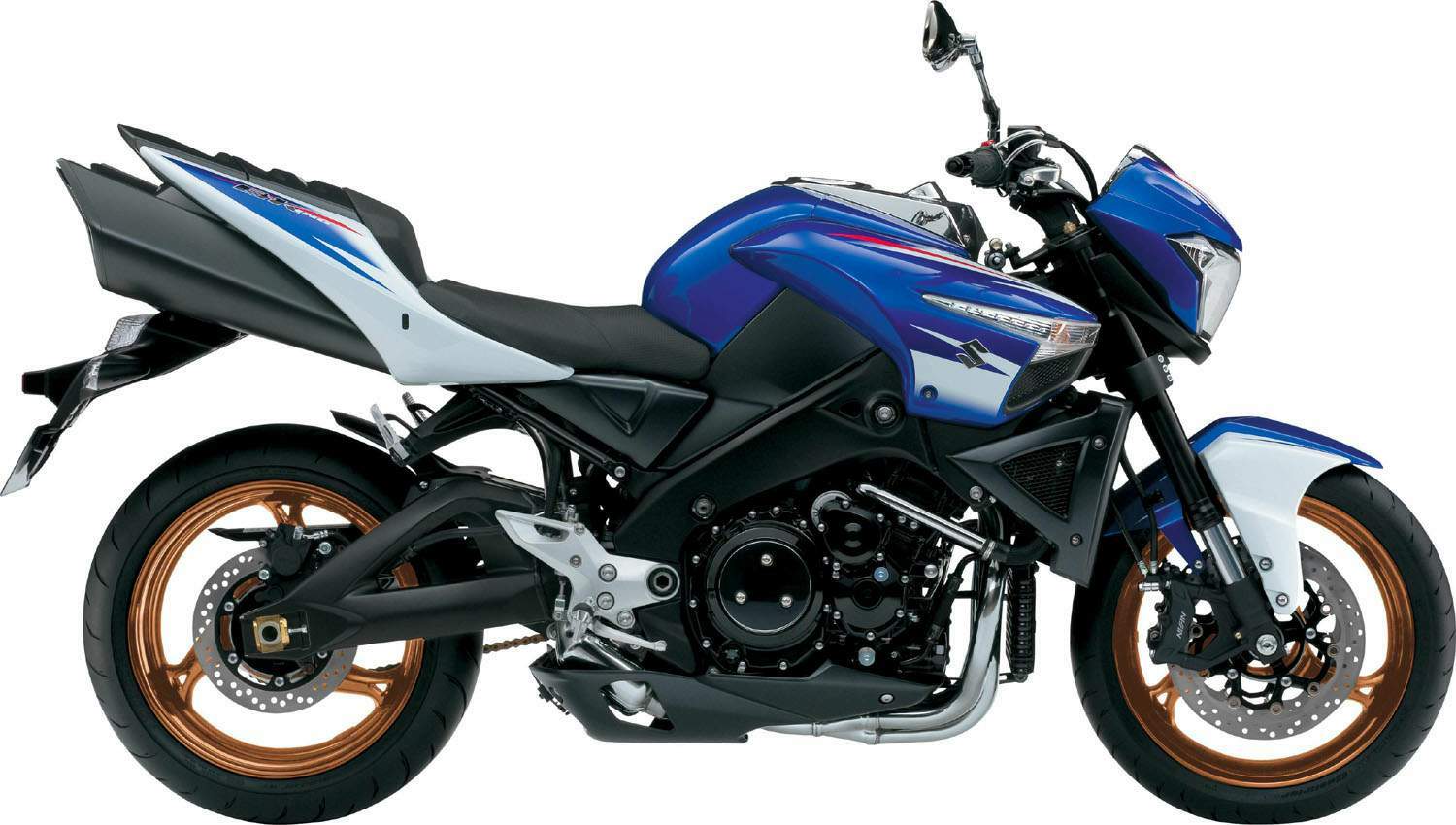
Suzuki GSX 1300 B-King
|
| . |
|
Make Model |
Suzuki GSX 1300 B-King |
|
Year |
2009 |
|
Engine |
Four stroke, transverse four cylinder, DOHC, 4 valves per cylinder |
|
Capacity |
1340 cc / 81.8 cu-in |
| Bore x Stroke | 81 x 65 mm |
| Cooling System | Liquid cooled |
| Compression Ratio | 12.5:1 |
| Lubrication | Wet sump |
| Exhaust | 4-into-2-into-1 exhaust system with a large capacity catalyzer, oxygen sensors and an oval cross section canister with dual openings that meets Euro 3 and Tier 2 regulation |
|
Induction |
Fuel injection . Suzuki SDTV fuel injection system with dual injectors per cylinder and ram air intake with large volume airbox |
|
Ignition |
Electronic |
| Starting | Electric |
|
Max Power |
132.1 kW / 181.5 hp @ 9500 rpm |
|
Max Torque |
146 Nm / 14.9 kgf-m / 108 lb-ft @ 7200 rpm |
| Clutch | Wet, multiple discs, hydraulic operated |
|
Transmission |
6 Speed |
| Final Drive | Chain, RK GB50GSV Z4, 118 links |
| Frame | Twin-spar cast aluminum alloy |
|
Front Suspension |
Inverted telescopic coil springs, spring preload, rebound and compression damping fully adjustable. |
| Front Wheel Travel | 120 mm / 4.7 in |
|
Rear Suspension |
Link type, oil damped, coil springs, spring preload, rebound and compression damping fully adjustable. |
| Rear Wheel Travel | 137 mm / 5.4 in |
|
Front Brakes |
2 x 310 mm Discs, 4 piston calipers |
|
Rear Brakes |
Single 260m disc, 1 piston caliper |
|
Front Wheel |
3.50 x 17 |
|
Rear Wheel |
6.00 x 17 |
|
Front Tyre |
120/70 ZR17 |
|
Rear Tyre |
200/50 ZR17 |
| Rake | 25.7° |
| Trail | 107 mm / 4.2 in |
| Dimensions |
Length 2245 mm / 88.4 in Width 800 mm / 31.5 in |
| Wheelbase | 1525 mm / 60.0 in |
| Seat Height | 805 mm / 31.7 in |
| Ground Clearance | 120 mm / 4.7 in |
|
Dry Weight |
235.0 kg / 518.1 lbs |
|
Fuel Capacity |
16.5 Litres / 4.4 US gal / 3.6 Imp gal |
| Consumption Average | 6.2 L/100 km / 16.1 km/l / 38 US mpg / 45 Imp mpg |
|
Standing ¼ Mile |
10.4 sec |
|
Top Speed |
252.9 km/h / 157.1 mph |
| . |
Suzuki first introduced the B-king as a concept bike in 2001 at the Tokyo Motor Show. In it's original form, the B-King sported a Hayabusa 1300 engine equipped with a supercharger. At that time the Hayabusa engine produced 175 bhp. Brake Horse Power is the HP at the crank prior to loss that would come from the gearbox, exhaust etc. With the addition of the supercharger the engine muscled up an enormous 240 bhp. Some of the materials used in construction of the B-King were carbon fiber, stainless steel, aluminum and leather.
The rear tire was a whopping 240mm wide. The B-King had an alarm system with on board audio so that the owner could contact the bike via cell phone and be heard over the audio system. I'm not sure at that point what use this would be other then to beg the thief not to take it or if he did, to treat it right.
In 2007 Suzuki introduces the B-King to the world as their new production muscle bike. Over the years the B-king had a few changes. The original 1300 supercharged Hayabusa engine was replaced with the 2008 Hayabusa 1340cc engine. The engine was not left untouched. Suzuki changed the valve dimensions, intake and exhaust dropping the Horsepower at the wheel by 9.4 hp. Torque was reduced by 6 ft. Lbs. as well. In the grand scheme of things these reductions are minor as the power plant still generates enormous toque and hp at the rear wheel. On the road, torque is king. The B-King produces approximately 70 ft. Lbs. of torque @ 2,500 RPM. This low end torque reduces the need for shifting and provides for quicker times off the line.
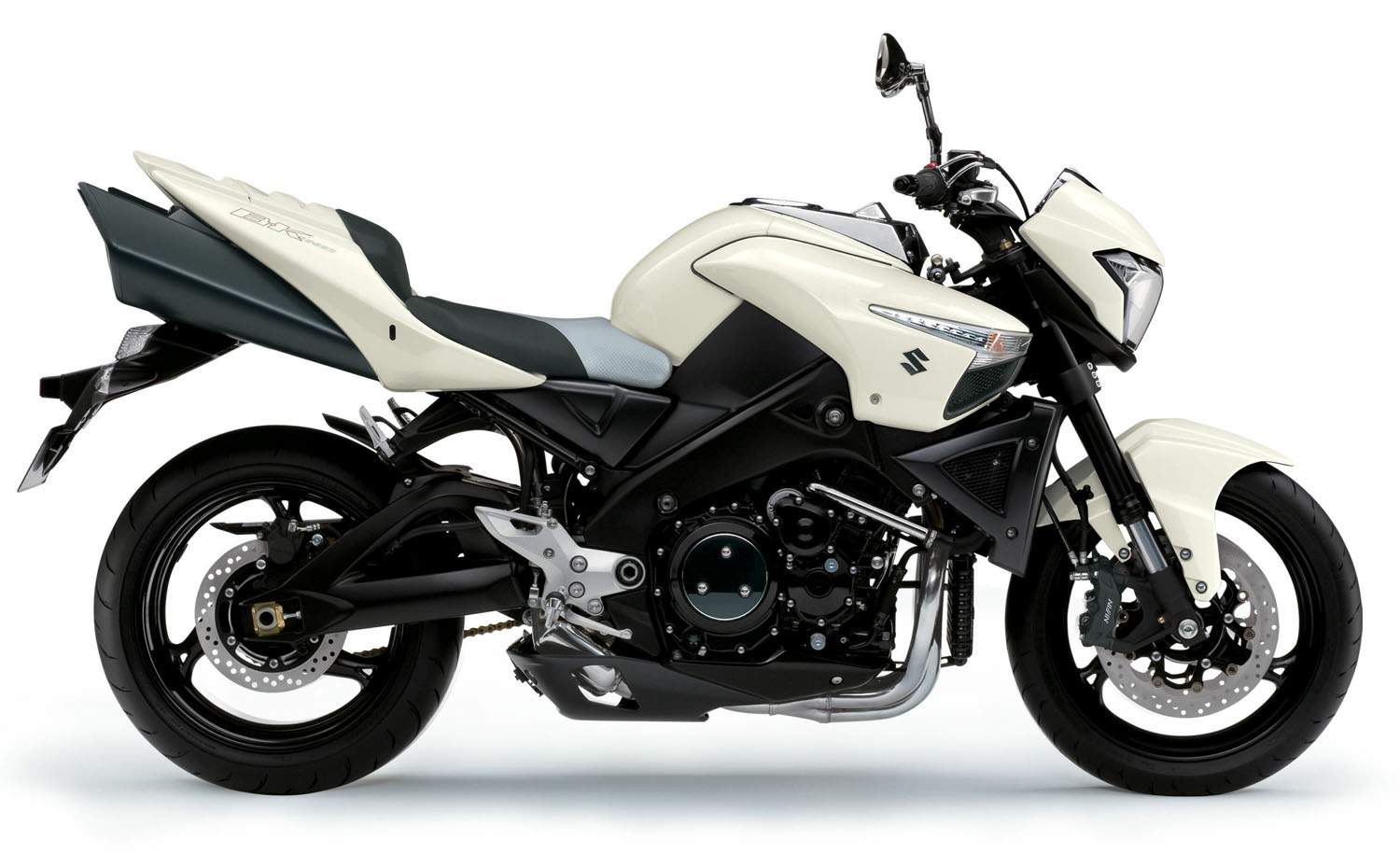
Suzuki went way over the top with the bold futuristic design of the B-King. The
body style and colors are very polarizing. This is evident if you stand around
any show room or cycle show long enough to listen to people's reactions or read
the forums for that matter. Bottom line is that people either like the bold
style or they hate it. I personally like it and found that the all black model
seemed to draw me in.
Brakes - Suzuki gave the B-King Radial mount front brake calipers which feature
an all new design built specifically for the B-King and work with 310mm brake
rotors to provide superior braking performance. On the rear a lightweight single
piston brake caliper works with a 260mm rear disc. The front brake master
cylinder has its own reservoir tank as well as the clutch master cylinder. Both
of these components were designed specifically for the the B-King.
Chassis - The B-King got an all new twin-spar cast aluminum alloy frame that
provides optimum rigidity balance and superb handling. The swing arm is newly
made of cast aluminum alloy constructed of 3 main sections for minimal welding
lines and a clean overall look. The front forks are new as well. The KYB
inverted front forks are specifically designed for the B-King and are fully
adjustable for compression, rebound damping and spring preload to suit rider
preferences. As for the rear suspension, it's new aluminum alloy rear shock
absorber features three-way adjustability with excellent damping characteristics
of Suzuki's super sport models. One really nice feature is the standard steering
dampener that sucks up any energy from the road and provides added stability.
Instruments - Suzuki gave the B-King an all new
instrument cluster with an analog tachometer, digital speedometer, fuel gauge,
water temperature gauge, twin trip meters, clock, maintenance interval, running
time, average speed, gear position indicator, and a S-DMS mode indicator. The S-DMS
mode switch allows the rider to select A or B mode. Each mode provides a
different fuel and ignition mapping. A mode is the full mode and the default. B
mode limits the Hp to approximately 114 Hp. This would be used in a wet pavement
situation. As for the instrument cluster, it's one of the nicest gauge cluster's
I have come across.
Ergonomics' - The rider position is closer to upright with a slight lean into
the bars. The rider position is similar to that of a sport touring bike. The
pegs are a bit high for a rider with a 32" + inseam but still comfortable. The
bike is beautifully balanced. The B-King weighs in at 518 lbs. but feels as if
it weighs much less. The bike is very easy to maneuver at low speeds and feels
like it's riding on rails in the turns. The wide cowls on each side of the tank
actually play a positive role in reducing wind on the riders lower extremities.
In fact, the wind felt on the rider is from the mid chest up.
It's big,
it's intimidating and it turns about as many heads as an NBA
player at Grandma's Bingo night. Now, we're not talking about an
oversized jewelry-clad basketball player; we're talking about
Suzuki's B-King. Originally debuted seven years ago at the Tokyo
Motor Show, the B-King
is one ultra-cool streetfighter prototype that actually made it
into production.
The B-King is proof of Suzuki's unequivocal embrace of America's
'bigger is better' mantra. It is the largest, most powerful
muscle bike ever manufactured, period. With this one it's hard
to find anything that isn't big: big power, big brakes, big
proportions and big weight.
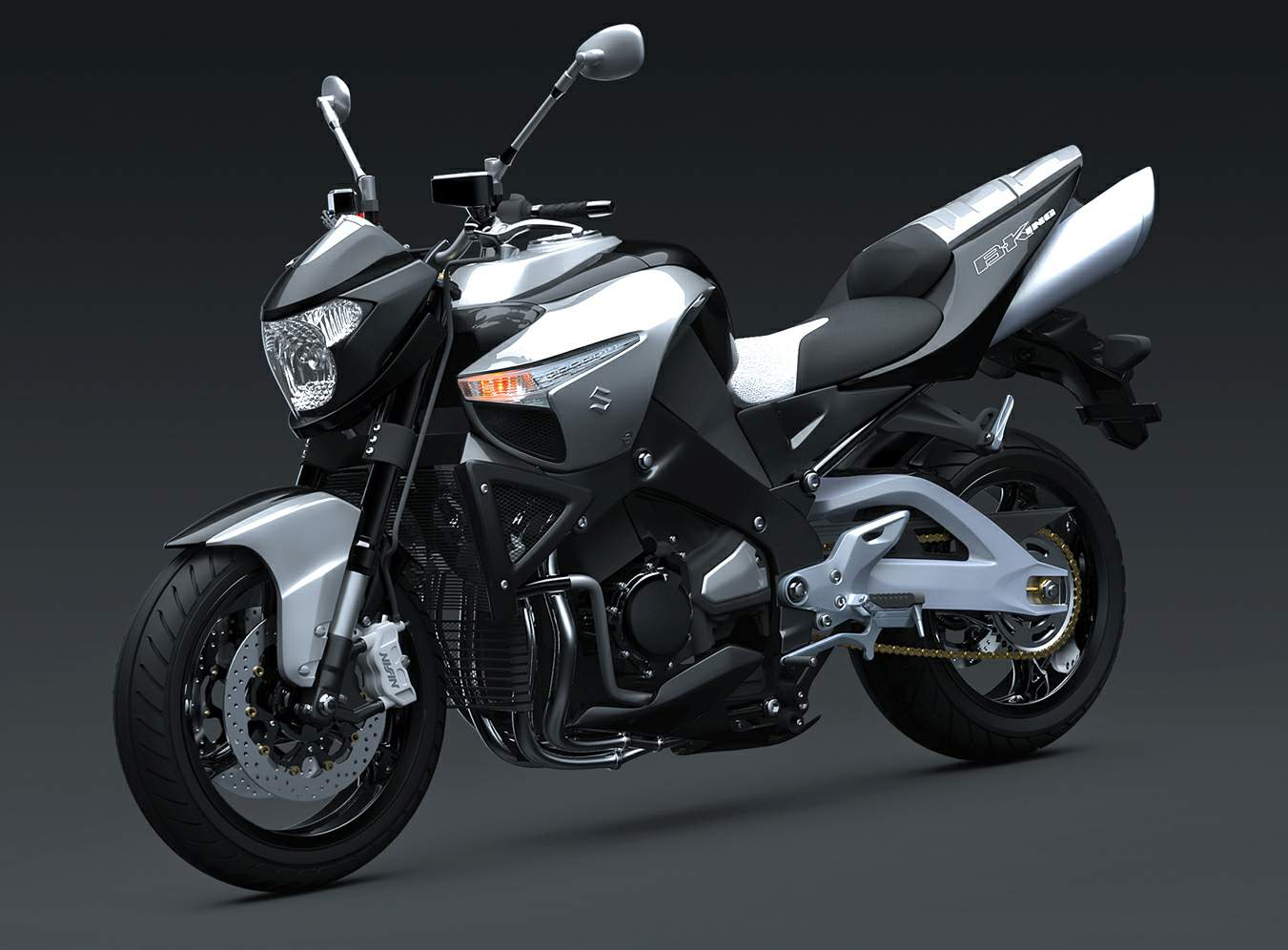
I can't help but feel just a little bit intimidated as I gaze at
its bulging body pieces and huge twin underseat exhaust
canisters protruding like trapezoidal double-barrel artillery
guns. Twin ram-air intakes large enough to inhale witless birds
sit underneath the fashionably integrated front turn signals.
Stylized pieces like the chrome bezel on the top of the fuel
tank, sculpted brake and clutch master cylinders and the
refined-looking instrument package give the Suzuki a high-end,
premium feel. Equally impressive is the high level of overall
fit and finish. Unsightly fasteners are kept to a minimum and
the body components fit together as if they were crafted out of
one complete piece.
Once in the saddle, there's no hiding its 578-lb mass (fully
fueled, ready to ride). Due to the substantial width of the gas
tank your legs are spread far apart, so riders with minimal
dexterity better bring their A-game when riding the
B-King. But things get better as soon as you reach out to
the widely-spaced tubular handlebars. The relaxed, upright
riding position and tallish bars make it a very comfortable
machine. However, the high mounted foot pegs force the rider's
legs into a more aggressive bend than seems necessary.
Thumb the starter and the gigantic 1340cc liquid-cooled
Inline-Four comes to life emitting a quiet, sewing machine-like
purr. 'Man, how much better would this thing sound with some
pipes' I think to myself. The engine is almost a complete carbon
copy of the one used in the new '08 Hayabusa, except for a
smaller airbox and a different 4-2-1-2 exhaust system that still
uses Suzuki's exhaust tuning valve (SET) inside. Pump the
hydraulic-actuated clutch a few times before you drop it into
gear and notice its light feel, followed by a progressive
engagement. Twist the throttle and it feels as you're piloting
an F-18 being flung off the end of an aircraft carrier.
Wide-open acceleration from a dead stop is that intense.
Yet the B-King is as obedient or as wild
as your right wrist commands. Feel like stunting in front of
your friends? Just hammer the throttle in the first two gears
and you'll look like your neighborhood's most-wanted villain.
Feel like keeping the peace? Keep the revs low and ride the
B-King's smooth wave of 70-plus lb-ft of twist from just 3000
rpm. Power delivery is flawless throughout the 11,000 rpm rev
range and is complemented by the precise throttle response
afforded by Suzuki's Dual Throttle Valve (SDTV) fuel-injection
system. The B-King is also outfitted with Suzuki's proprietary
drive mode selector (S-DMS) which allows the rider to modify
power output by choosing from one of two modes. By default the
bike is in full-power 'A' mode, but all it takes is a simple
push of a button mounted on top of the gas tank, (while the bike
is at a stand-still, in neutral) and the rider can select 'B'
mode which dramatically mellows its power delivery. The system
works well and can allow a rider of less experience to have a
more controllable ride. For those of us thrill junkies though,
'A' mode is all you'll ever use.
Power is transmitted to the gold-colored chain final drive via a
six-speed transmission that utilizes a back-torque limiting
clutch. Shifting action wasn't as smooth as other Suzuki's we've
tested recently, but nonetheless engagement was precise. We
never encountered any mis-shifts despite repeated full-throttle
acceleration antics. Gearing is versatile for the streets, with
a short first cog allowing for easy drag races, er, I mean
launches from a stoplight. Yet, thankfully, top gear is tall
enough for a low-rpm, buzz-free ride at freeway speeds.
But the lack of a front fairing or windscreen can impede
triple-digit fun as above 120-mph it feels like the wind is
trying to peel you off the bike. Suzuki realized that this might
be a hitch in the equation.
Instrumentation is easy to see at a glance and consists of a
swept analog tachometer flanked by a digital speedo, gear
position indicator, and a multitude of warning and indicator
lights. There's also a bar-style fuel gauge, coolant temperature
as well as odometer, dual trip meters and clock inside of the
tach. The B-King
also has a cool miles until maintenance required countdown
meter, so you'll always know when it's time for service.
With just shy of 160 horsepower at your disposal, you'd hope
that the engineers would have endowed the B-King with a chassis
stout enough to handle all that muscle. And we're pleased to
report that they have. A clean looking twin-spar cast aluminum
frame and matching three-piece cast aluminum swingarm is paired
to a fully adjustable (preload, compression, and rebound) KYB
43mm inverted fork and equally adjustable rear shock. Suzuki
claims that suspension damping characteristics are similar to
that of their GSX-R sportbike line and after repeated
"cloverleaf exploring" on the seemingly infinite freeway
interchanges Southern California has, we're believers.
While cornering, suspension feels both firm and responsive with
plenty of ground clearance, yet cruising down a pothole-laden
L.A. street reveals a far plusher ride than that of a GSX-R
sportbike. Despite the suspension's full range of adjustability,
we didn't feel the need to change the settings as the stock
setup is a good compromise between cruising the block and
spirited canyon blasts.
Contrary to what your eyeballs tell your brain, the B-King is
rather nimble in most situations. Sure it's not as flickable as
a 1000cc sportbike, but it still maintains a reasonable degree
of maneuverability considering its 5-foot wheelbase. It readily
changes direction with just a light tug of the wide bars and
once a turn has been initiated, subtle line changes can be made
without drama. Simply look where you want the bike to go and
it's there. Also impressive is its stability at any speed. No
matter how hard we tried we couldn't get the front end to wiggle
around or get out of shape. However, at slower speeds-especially
in parking lots, there's no masking the B-King's girth. That,
coupled with its non-adjustable steering damper, can make it
rather cumbersome when you're crawling around.
Stopping is achieved via a pair of radial-mount Nissin front
brake calipers that grab onto 310mm diameter rotors. A
radial-pump brake master cylinder pushes brake fluid through
rubber lines and there isn't a hint of fade, even during extra
aggressive, repeated use. Considering that the brakes are
stopping almost 600 lbs, there is a good amount of power and
plenty of feel at the end of the adjustable brake lever. Out
back a 260mm disc and single piston caliper helps keep control
while you're riding around on the fat back tire. ABS is also
available for $600 to help ensure stability during braking
regardless of road or weather conditions.
The B-King rolls on a set of 3.5 x 17 inch front and wide 6 x 17
inch rear three spoke aluminum wheels shod in Dunlop's Sportmax
Qualifier rubber (120/70R17 front, 200/50R17 rear). We've always
been a fan of the Qualifier's due to their mild steering
manners, quick warm-up times and gum-on-shoe levels of adhesion,
but the B-King's OE rear tire lacked the same amount of outright
grip that we've become accustomed to with the Qualifier. Maybe
it's the extra weight or the immense amount of power that the
200mm wide tire has to deal with, but it's possible to spin up
the rear tire on command during hard corner exit. Fortunately
the tire has great feel so when it does spin it doesn't catch
you off guard.
At the end of the day, the B-King really surprised us. It's a
big, burly streetfighter that for the right rider could be the
total package. It's got a fresh, futuristic look like nothing
else on the street backed up with a powerful yet refined
powerplant mated to a chassis that is both composed and agile.
And while it may not ever fit in with Grandma and her crew, the
B-King has us shouting BINGO!
Source Motorcycle USA

|
Any corrections or more information on these motorcycles will be kindly appreciated. |