|
|

|
|
|
|
Classic Bikes
Custom Bikes
Individual
Racing Bikes AJP
AJS
Aprilia
Ariel
Avinton / Wakan
Bajaj
Benelli
Beta
Bimota
BMW
Brough Superior
BRP Cam-Am
BSA
Buell / EBR
Bultaco
Cagiva
Campagna
CCM
CF Moto
Combat Motors
Derbi
Deus
Ducati
Excelsior
GASGAS
Ghezzi Brian
Gilera
GIMA
Harley Davidson
Hero
Highland
Honda
Horex
Husaberg
Husqvarna
Hyosung
Indian
Jawa
Kawasaki
KTM
KYMCO
Laverda
Lazareth
Magni
Maico
Mash
Matchless
Mondial
Moto Guzzi
Moto Morini
MV Agusta
MZ / MuZ
NCR
Norton
NSU
Paton
Peugeot
Piaggio
Revival Cycles
Roland Sands
Royal Enfield
Sachs
Sherco
Sunbeam
Suzuki
SWM
SYM
Triumph
TVS
Ural
Velocette
Vespa
Victory
Vincent
VOR
Voxan
Vyrus
Walt Siegl
Walz
Wrenchmonkees
Wunderlich
XTR / Radical
Yamaha
Zero
Video
Technical
Complete Manufacturer List
|
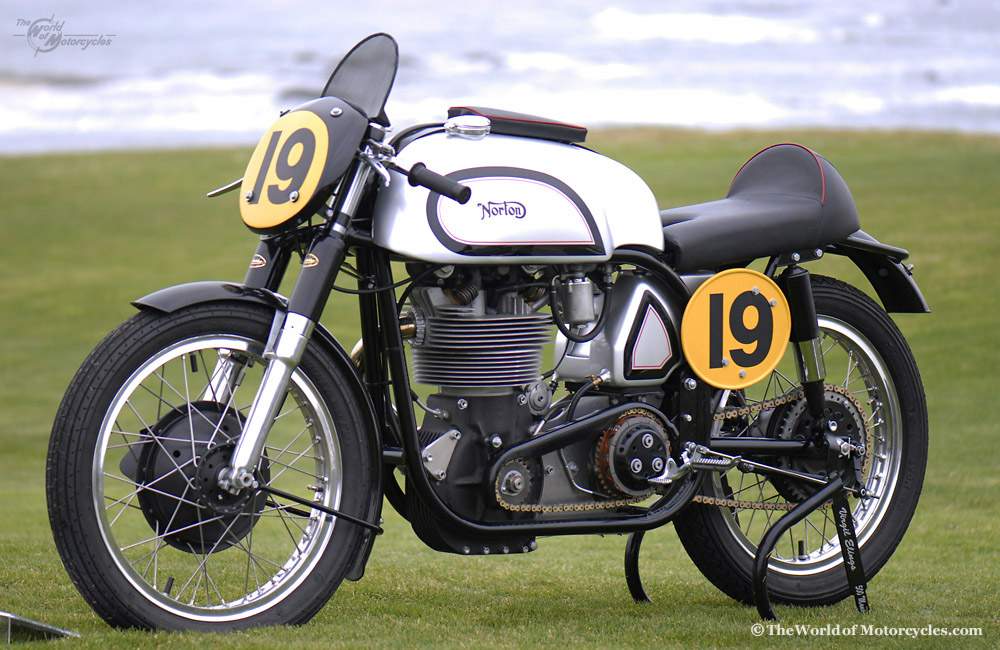
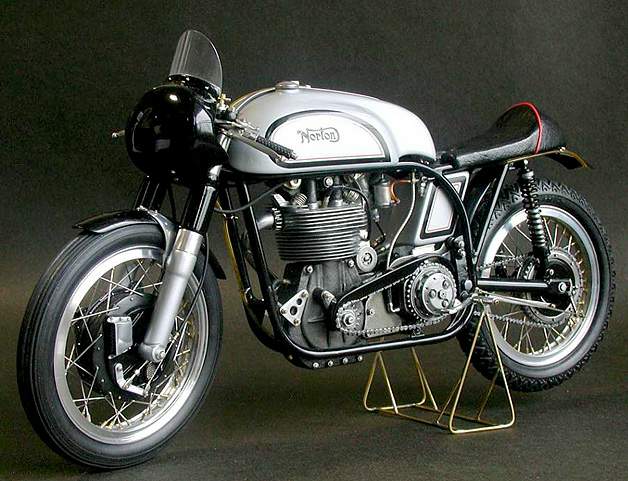
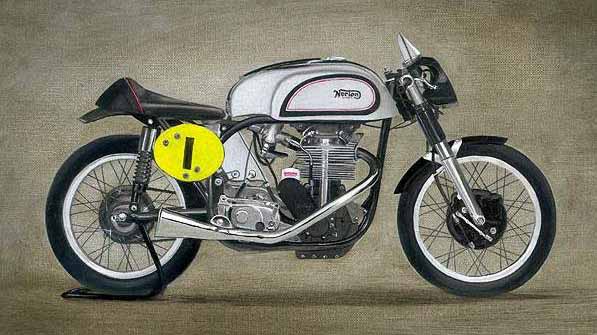
Manx Norton
Norton Manx Story The Norton company has always applied the term "Manx" to the racing motorcycles that it produces in limited quantity for the open market. The name refers to the Isle of Man, where the Tourist Trophy is run. This annual race attracts the finest British racers, who compete on racing motorcycles that have been derived from production models are are available on the open market. Norton built its first Manx (although it was called an International at the time) in 1932. Derived from the Grand Prix, the motorcycle was the work of Arthur Carrol and Joe Craig. The tuning and modification of the Internationals was left to the customers, who proved to be up to the job. Meanwhile the racing department of the company continued to modernize the official models, which were transformed rapidly in those years to meet the tough competition provided by the motorcycles and racers of Rudge, Velocette, and Sunbeam in Britain, and Bianchi, Guzzi, and Moto-sacoche on the Continent. Between 1936 and 1938 the bore and stroke of the Grand Prix 500 were changed twice and a double overhead camshaft distribution was installed for the first time. Before racing was halted by World War II, the official Norton 500 boasted a power of 50 h.p. No other single-cylinder engine of that class could generate more horsepower, but its power was not enough to discourage the Italian and German makers of multi-cylinder models. Norton managed to hold its own, especially on mixed circuits, where its weight-power ratio helped racers. The Norton company was fortunate to have such fine racers as Jimmy Guthrie and Harold Daniell, two of the greatest champions of the time, and new racers were continually appearing on the scene.
The first Norton motorcycles to reappear in racing in 1946 were old models that had been jealously guarded by their owners. Throughout Europe most of the racers who won improvised races had old SOHC Nortons, and the official Norton team reappeared with prewar DOHC motorcycles. Indeed, with the prohibition of superchargers it almost looked as if the single-cylinder might rule the roost, or at least have a temporary advantage over the four-cylinder Gilera, the two-cylinder BMW, and the two-stroke DKW. In reality, after losing the 1949 world championship to the two-cylinder AJS Porcupine in the 500 class and to the single-cylinder Velocette in the 350 class, Norton had to struggle in the following years to defend the slight margin that its racers had succeeded in winning for it. From 1951 on, the chief factor in Norton wins was its innovative Featherbed chassis, which was designed for Norton by the McCandless brothers. With this chassis Norton could outrace any motorcycle of equal power, especially on difficult tracks. The Norton Grand Prix won the world championship in 1950 (500 class), 1951 (350 and 500), and 1952 (350). These were not easy wins, and much credit was due to the fantastic skill of Geoffrey Duke, for whom the single-cylinder was perfectly suited.
In 1949 the Norton International had become the Manx. That was the year the old SOHC system was replaced by a DOHC one. In 1952 the Manx was given a squared-off engine. In 1954, after Italian multi-cylinder motorcycles had outraced the Norton (despite the valiant efforts of Ray Amm), the company decided that as of 1955 only Manx models would be entered in races. Beginning in 1955 private racers throughout the world also defended Norton's colors with honor. Tuned by specialists, the final version of the Norton Manx 500 was considerably more powerful than the Grand Prix model from which it had been derived. And for some time to come it was a real threat to the most advanced motorcycles that entered the Tourist Trophy.
|
|
|
Any corrections or more information on these motorcycles will be kindly appreciated. |