|
|

|
|
|
|
Classic Bikes
Custom Bikes
Individual
Racing Bikes AJP
AJS
Aprilia
Ariel
Avinton / Wakan
Bajaj
Benelli
Beta
Bimota
BMW
Brough Superior
BRP Cam-Am
BSA
Buell / EBR
Bultaco
Cagiva
Campagna
CCM
CF Moto
Combat Motors
Derbi
Deus
Ducati
Excelsior
GASGAS
Ghezzi Brian
Gilera
GIMA
Harley Davidson
Hero
Highland
Honda
Horex
Husaberg
Husqvarna
Hyosung
Indian
Jawa
Kawasaki
KTM
KYMCO
Laverda
Lazareth
Magni
Maico
Mash
Matchless
Mondial
Moto Guzzi
Moto Morini
MV Agusta
MZ / MuZ
NCR
Norton
NSU
Paton
Peugeot
Piaggio
Revival Cycles
Roland Sands
Royal Enfield
Sachs
Sherco
Sunbeam
Suzuki
SWM
SYM
Triumph
TVS
Ural
Velocette
Vespa
Victory
Vincent
VOR
Voxan
Vyrus
Walt Siegl
Walz
Wrenchmonkees
Wunderlich
XTR / Radical
Yamaha
Zero
Video
Technical
Complete Manufacturer List
|
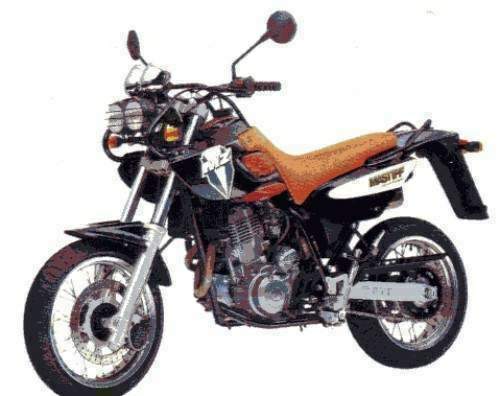
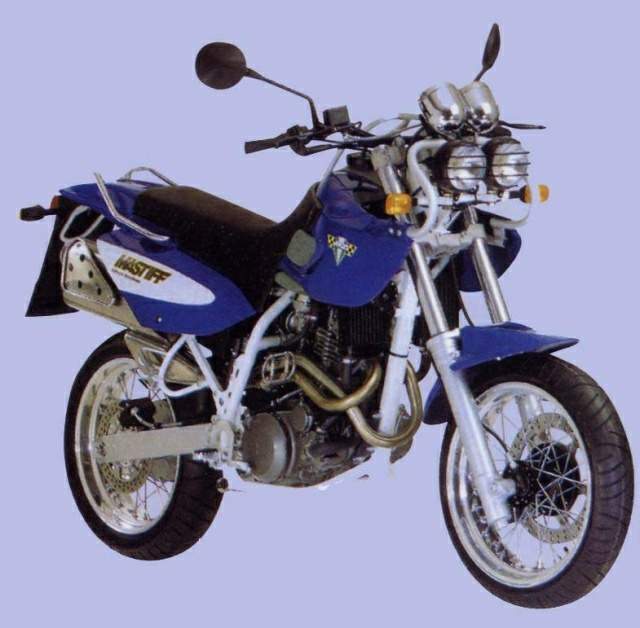
MuZ Mastiff 660
MZ first introduced this enduro-styled off-roader in 1997. The German firm's historical range of two-stroke engines were not suitable for a modern machine, so a Yamaha engine, the single-cylinder liquid-cooled motor from the XTZ660 Tenere, was used. The torquey, rugged design uses a five-valve cylinder head for efficient breathing and combustion, and the clever Yamaha Dual Intake System, which has one CV and one slide carb to give the best power delivery of both carb types. The Baghira chassis is basic, but effective. Long travel forks soak up off-road bumps, and a high-spec WP rear shock keeps the long box-section swingarm under control. Grimeca disc brakes are not particularly strong, but are designed for off-road use.
So, you've just viewed a "Crusty Demons of Dirt" stunt video and have an itch for a ride on the wild side. Problem is, pavement is your preferred riding surface, and while a traditional dual-purpose bike is enticing, you're looking for something with a bit more pizzazz. Perhaps what you need is a supermotard-style streetbike? Supermotard, for those unfamiliar with the term, is the French word for "Superbiker," an outgrowth of the made-for-TV events at Carlsbad Raceway that were a staple on ABC's "Wide World of Sports" through the 1980s. Designed to determine the best all-around motorcycle racer, "The Superbikers" pitted roadracers, dirt-trackers and motocrossers against one another on a course that was part asphalt, part dirt. Like all television shows, "The
Superbikers" eventually was canceled, but the French embraced the concept,
picking up the ball and running with it to the point that there are now a number
of supermotard racing series throughout Europe. A growing number of motorcycle manufacturers have taken notice of this market niche, with several street-legal production machines currently available in Europe and Japan. KTM was the first to import a supermotard-inspired bike into the U.S. when its 620 Duke arrived on the scene three years ago. And now, MZ is set to duke it out with KTM for a slice of American pie, stepping into the ring with its new Mastiff 660. If you've followed MZ's modernized model line over the past few years, you've undoubtedly noticed the German company's modular design approach. Most evident is MZ's wide use of the single-cylinder engine from Yamaha's XTZ660 dual-purpose bike. Along with the Mastiff and its dual-purpose counterpart, the Baghira, no fewer than three MZ Skorpion models share the liquid-cooled, sohc, five-valve mill. A free-breathing, boombox-looking muffler is credited with boosting the Mastiffs and Baghira's power output to match that of the twin-pipe Skorpion Replica, which itself offers a slight performance boost over the rest of the Skorpion family. On the CW dyno, the Mastiff produced 2 fewer peak horsepower than the Skorpion Replica we tested in April, 1996, but the Mastiff possesses a broader spread of torque that's most evident in the lower portion of the rev range. • Looking beyond the engine, MZ's latest duo has greatly expanded the company's parts inventory. But once again, commonality is a key element, because the Mastiff and Baghira share the same chassis. From the steering head back, these two look like twins separated at birth, making use of the same frame, swingarm, exhaust, seat, tank and tailsection. Outfitted in supermotard regalia,
the Mastiffs shorter rear shock and 46mm Paioli fork combine with wide, 3.5 x
17-inch front and 4.25 x 17-inch rear Akront wheels wearing low-profile Metzeler
MEZ1 radials. Parked alongside the Baghira, the Mastiff appears stout, squat and
pit-bullish in stature. Indeed, this bug-eyed bike is bad to the bone, with
sufficient bark to be deemed worthy of its guard dog-derived name. And while this may steer some
vertically challenged novices in another direction, that's a real shame, because
the Mastiffs nimble handling, linear power delivery and smooth gear changes all
make for near-effortless riding that would appeal to any cadet. Let's assume your good sense of
license preservation won't allow for shenanigans such as bunny-hopping curbs or
pulling stop-sign stoppies. Does the Mastiff still hold enough appeal? Why,
certainly! Whether it's the exhaust note of a big Single that's music to your
ears, or the wheel-standing, low-rpm torque, truth is, you don't need to be a
hooligan to be a Mastiff meister. But be forewarned: It will arouse a playful
attitude from even the most conservative rider. Letting the big dog eat in top gear
netted an even 100 mph on the CW radar gun. Although the Mastiff is no match for
the longer legs of the fully faired Skorpion Replica, it's still plenty fast for
a naked motorcycle that offers little in the Full instrumentation, wide handlebar
and extensive wraparound seat pales in comparison to the Mastiff's curious
tank-top "roll cage." The MZ is nothing if not different. supermotard
specialist? The Mastiff cooperates nicely, with enough engine braking to get the
rear stepped out with a downshift and some fancy clutch work. All this and more
simply underscore the Mastiffs primary mission: that of the quintessential
playbike. So, whether you are a beginner, an inner-city safarian, crusty canyon carver or future SuperTT star, the Mastiff has you covered. It's the sort of versatile motorcycle that encourages its rider to broaden his horizons and explore new ground. It's a bike you can grow with, but at $7195, it hardly comes at an entry-level price-particularly if you consider you're only getting one piston in the deal. But for Thumper fans the world over, the joy of feeling each and every power pulse as it's transmitted to the road is the only way to scratch an itch. □ Source Cycle World 1998
|
|
|
Any corrections or more information on these motorcycles will be kindly appreciated. |