Kawasaki’s original ZZR1100 certainly earned
itself a fierce reputation amongst bike enthusiasts when the model was
launched over 15 years ago. A wildly optimistic speedometer informing riders
that they were breaking the magic 300kph barrier was nothing more than
fantasy. However that never prevented the bike from reaching legend status
as for many years, optimistic speedo or not, the ZZR had the highest top
speed of any standard motorcycle. It was never a sportsbike by any stretch
of the imagination, a wet weight well in excess of 250kg saw to that but on
the street it offered all the cornering performance most riders
realistically needed while keeping them cosseted in relative comfort
compared to Kawasaki’s ZXR series of sportsbikes. The ZZR was a hugely
popular model and remains so today on the secondhand market and has proved
to be quite robust with many big ZZR11s still performing well with in excess
of 100,000km on their odometers.
In 2002 the ZZR1200 superseded the now aging ZZR1100 but failed to make an
impact in the market as buyers’ tastes had changed with more and more riders
choosing far lighter and more sporting machinery. The ZX-12R had been
released in 2000 and had taken over the mantle as Kawasaki’s flagship
hyperbike in the sports-tourer segment and the model has earned a loyal
following with its combination of reasonable handling along with an
incredible amount of top end power. By then the big ZZR name had lost some
of its gloss.
For 2006 Kawasaki are aiming to reinvent the ZZR legend with a bike born of
the marriage between the ZZR1200 and ZX-12R by producing a machine they
boldly claim to be ‘the most powerful streetbike in the world’. Few would
really doubt that claim as rarely have Kawasaki been headed in this
department. Suzuki have equaled them many times with various models and
Honda challenged for the top speed crown with the CBR1100XX Super Blackbird
but never quite got there. Suzuki are the only other manufacturer to have
produced a machine capable of really breaking the 300kph barrier with their
GSX1300R Hayabusa which goes head to head with the ZX-12R in the
marketplace. The market has been waiting a long time for a new Super
Blackbird and an updated Hayabusa but nothing appears to be too close on the
horizon to replace those models so it appears that this time around Kawasaki
is going to be unchallenged in the top speed war. For now…
Powering the new ZZR1400 is a 1352cc across the frame mounted in-line
four-cylinder powerplant. Rest assured that it will be super powerful and
while Kawasaki are not releasing any power figures as yet, I expect they are
about to become the first manufacturer to ever stake claim to the world’s
first production machine to break the 200hp barrier. Kawasaki have not gone
all out for top end as they have stated that the new machine offers more
than 10kg-m of torque at 2000rpm which means the six-speed gearbox should
rarely need to be stirred in order to make rapid forward progress.
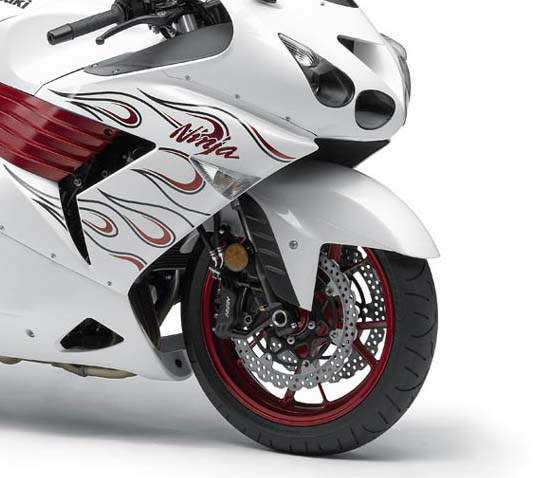
Nice touches like radial mount four-piston calipers clamping on generously
sized discs (optional ABS) combine with adjustable 43mm forks to suggest the
new ZZR could prove to be much more of a sporting weapon than before. Design
cues borrowed from the ZX-12R include a similar aluminium monocoque frame
where the upper spars double as the airbox. Also similar is the fact that
the engine is a stressed member and while the actual dimensions of the
machine have not been released Kawasaki have stated that the ZZR1400 will
roll on a wheelbase shorter than the ZZR1200 but slightly longer than the
ZX-12R. They also suggest the machine has a low seat height, only a short
reach to the bars and a comfortably narrow girth to help provide a sporty
feel.
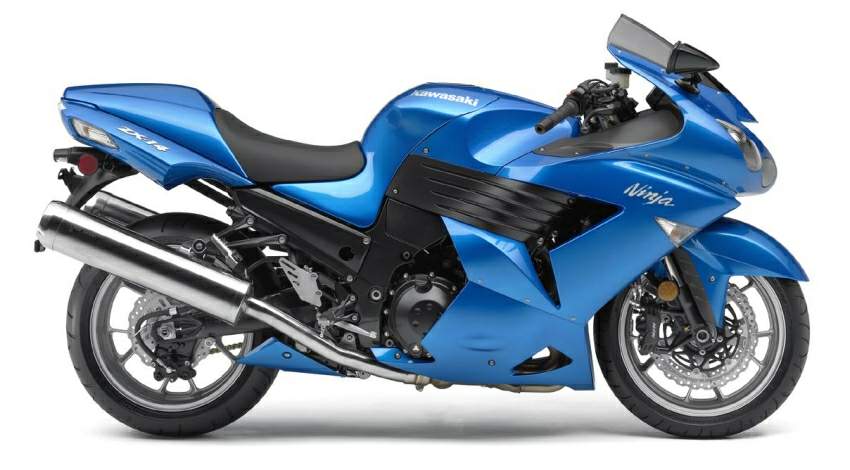
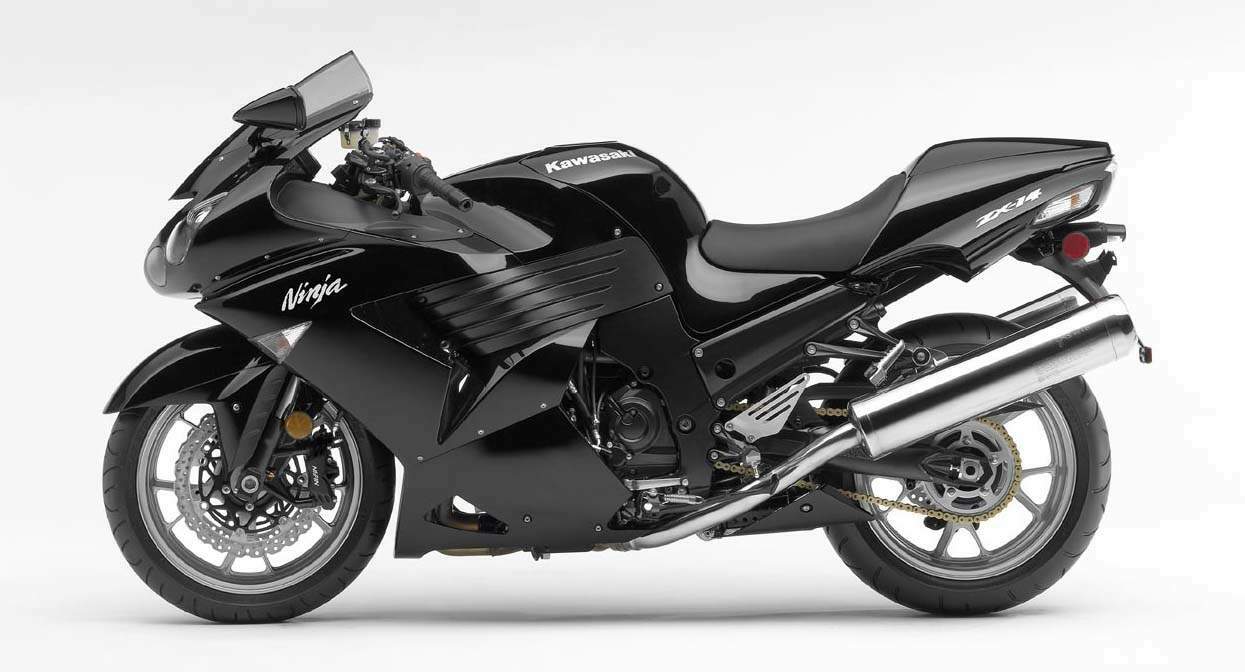
The indicators are integrated into the fairing at both ends of the machine
and long aluminium skinned mufflers positioned at each side of the machine
provide a visual link to the twin pipe layout of the original ZZR.
Conventional round faced analogue gauges are provided for the speedometer
and tachometer functions and a large LCD panel positioned above that
displays fuel level, gear indicator, tripmeters, odometer and clock. An
immobiliser function is provided while a pillion seat cowl and centre-stand
will be on the options list.
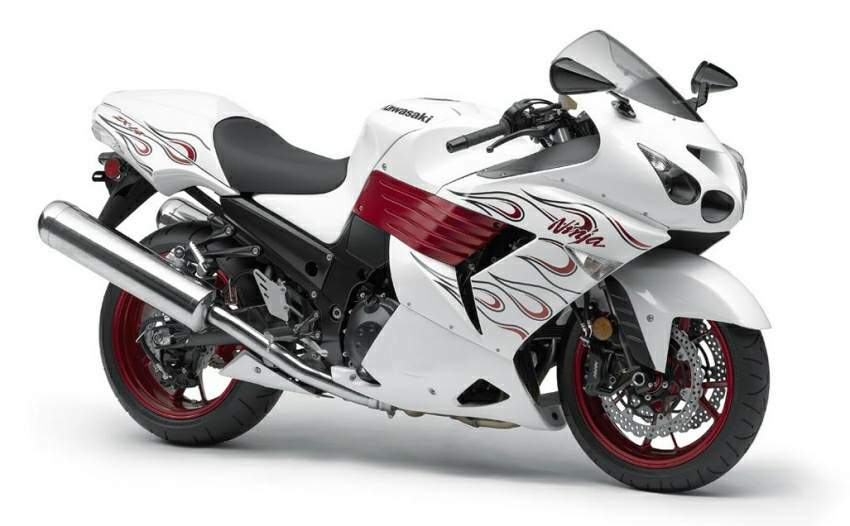
Styling wise the ZZR1400 looks to be a love or hate type of machine as the
long projected nose, distinctive quad headlamps and long fluted flanks are
certainly quite out there. There is no doubt that aerodynamic
efficiency has been a highly ranked design objective that will help to make
the ZZR1400 almost definitely the fastest motorcycle ever to enter
mainstream production.
FEATURES:
Key Features:
- Distinctive Ninja® styling
- Most powerful production Kawasaki motorcycle to date
- Next generation monocoque aluminum frame
- Comfortable riding position
1,352cc Four-Cylinder, DOHC Engine
- Tuned to provide smooth power across a very wide rev range while raising
Kawasaki’s legendary horsepower standards to a new level
- Carefully planned engine design keeps it compact and narrow
- Chrome composite plated aluminum cylinder bores are lightweight, durable,
and quickly carry heat away from the combustion chamber and piston for
supreme durability at high power outputs
Gear-Driven Dual Engine Balancers
- Already in perfect primary balance, dual secondary balancers virtually
eliminate unwanted vibrations for extremely smooth engine operation and
rider support
Ram Air Induction
- Central Ram Air duct produces a straighter path to the airbox for maximum
intake efficiency
- This system takes cooler, high-pressure air from in front of the fairing
and guides it through the air cleaner and into the engine for maximum power
output
Digital Fuel Injection
- 44mm Mikuni throttle bodies are fitted with sub-throttle valves that are
controlled by the ECU to provide precise response and make DFI® performance
smoother, with response similar to constant velocity carburetors
- 32-bit electronic control unit works with dual throttle valve system to
further enhance throttle response and control
- A digital computer feeds the engine exactly the amount of fuel it needs
for cleaner emissions and maximum fuel economy
Digital Ignition
- Digital Timing Advance enhances low-and mid-range power
- Four individual spark plug-mounted ignition coils fire each spark plug
independently to achieve the optimum timing for that cylinder at that
instant
- ECU includes an idle speed control system for easier starting and warm-up
Radial Pump Clutch Master Cylinder
- Hydraulic clutch features a radial-pump clutch master cylinder for smooth
and precise clutch engagement
Next-Generation Monocoque Aluminum Frame
- Evolved from the ZX-12R, the frame is a hollow aluminum box that arches
over the engine from the steering head to the swing arm pivot. It is narrow,
strong, rigid and very light
- Engine is rigidly mounted to increase the monocoque’s torsional rigidity.
Plus using the engine as a stressed frame member decreases the frame’s
weight by approximately four pounds
- Engine positioned forward in the frame, wheelbase and front/rear weight
balance were carefully designed to achieve high-speed stability and
responsive handling
- Massive head pipe casting contributes to frame rigidity
- The monocoque section houses the air box and air filter in a space-saving
design that actually simplifies air cleaner maintenance. Two screws hold a
plate on the left side of the frame that allows air cleaner access
- The battery is also housed within the frame and has simple access through
the back side of the frame
- The steering head and swing arm pivot areas are cast aluminum for superior
strength and rigidity
Inverted 43mm Cartridge Type Front Fork
- Damping rates offer stiff initial action to resist front-end dive when
braking
- Stepless damping adjustment improves suspension performance
Bottom-Link Uni-Trak® Rear Suspension
- Linkage rates provide linear suspension action
- The bottom-link design concentrates the weight lower in the chassis for a
lower center of gravity, which makes the motorcycle more nimble
Radial Mounted Petal Front Disc Brakes
- Radial mounted four-piston front brake calipers. Instead of mounting the
calipers with threaded tabs cast near the top of the caliper, the radial
design utilizes integrated mounting points at both the top and bottom of the
caliper, with the mounting bolts inserted through the rear of the caliper
instead of the side/front. This makes the caliper more rigid, which improves
brake feel over a wider range of operation
- A separate brake pad is used for each piston. One large pad can deform
with the heat generated by hard braking, resulting in a loss of brake feel
at the lever. Individual pads provide increased cooling efficiency and can
absorb more heat without deforming so they maintain consistent brake feel
stop after stop
- Petal design brake discs provide better cooling and warp resistance
- Radial-pump front brake master cylinder improves brake performance and
lever feel
- Wheel rims feature center ribs which are slightly offset so tire balance
weights can be located precisely along the wheel’s centerline.
Wind Tunnel-Designed Bodywork
- Since the monocoque frame goes over the engine the fairing is
uninterrupted by protruding frame spars, adding to the extremely long and
low styling. Both the front and rear turn signals are integrated into the
bodywork and have clear lenses to enhance the appearance
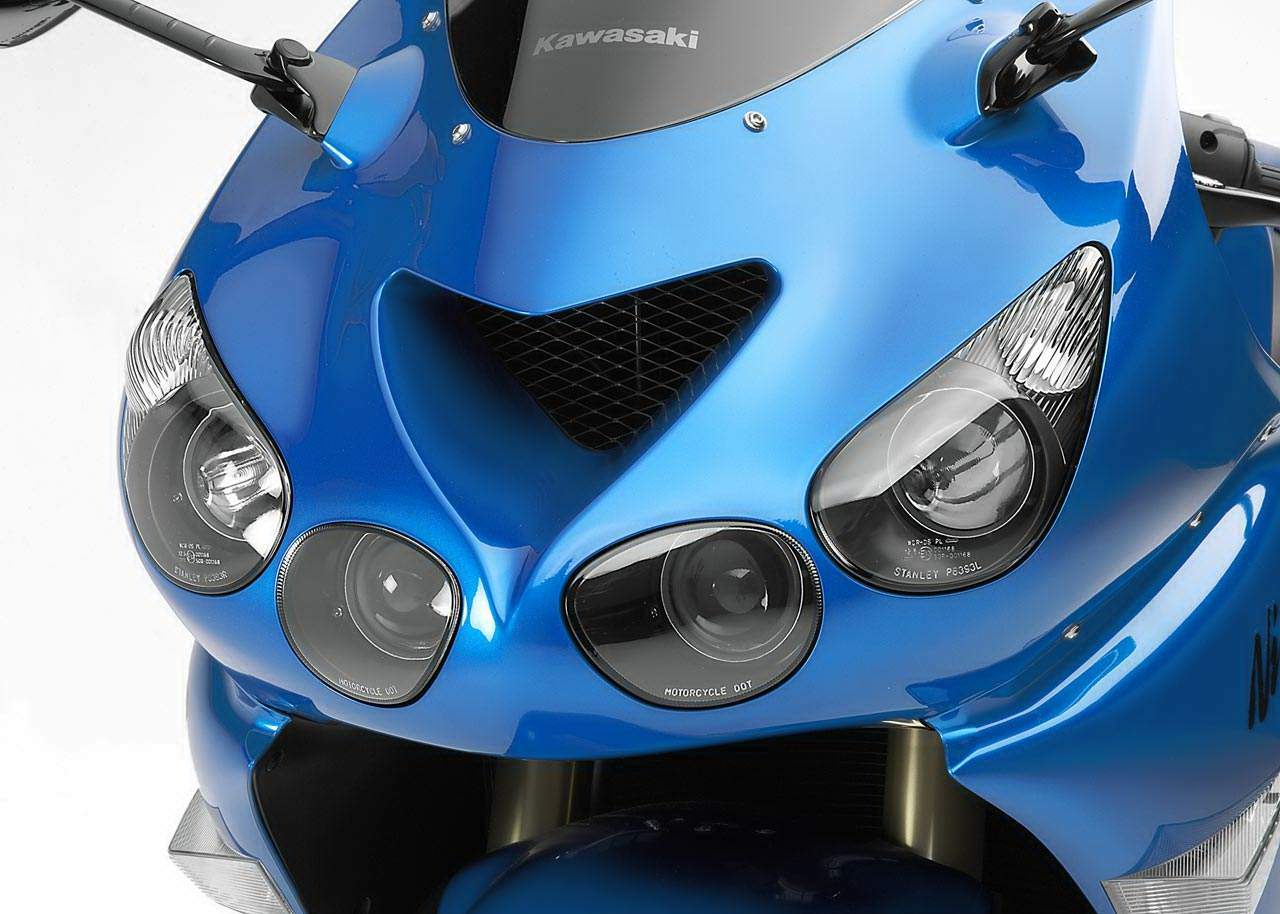
- Quadruple projector beam headlights give the ZX-14 a distinctive upper
fairing. The outer lights contain position lamps and the high beams, while
the low beams are in the center lamps
- Lightweight Denso radiator with high-density cores provides maximum
cooling efficiency
Full Instrumentation
- Dual analog speedometer and tachometer with white faces are easy to read
- Multi-function LCD digital display includes an odometer, two trip meters,
fuel gauge, gear position indicator and a clock
- Programmable shift indicator lamp illuminates at pre-set rpm to signal
rider upshift
- Programmable clutch engagement lamp illuminates at pre-set rpm to signal
the rider to engage the clutch
- CAN (Controller Area Network) interface between the meter uses fewer wires
while allowing a greater volume of information, such as estimated fuel
mileage, to be exchanged
NOTE: Some of the photos on
Motorcycle Specs are owned by somebody. If you see any of your
photos, you can let me know so that I can acknowledge it, or if
you object to it, I can remove it altogether. If any copyright
holder objects to their articles being placed on Motorcycle
Specs, it will be removed upon request. Any correction or more
info on these bikes will kindly beappreciated
Contact MePrivacy
Policy
Website Stats