|
|

|
|
|
|
Classic Bikes
Custom Bikes
Individual
Racing Bikes AJP
AJS
Aprilia
Ariel
Avinton / Wakan
Bajaj
Benelli
Beta
Bimota
BMW
Brough Superior
BRP Cam-Am
BSA
Buell / EBR
Bultaco
Cagiva
Campagna
CCM
CF Moto
Combat Motors
Derbi
Deus
Ducati
Excelsior
GASGAS
Ghezzi Brian
Gilera
GIMA
Harley Davidson
Hero
Highland
Honda
Horex
Husaberg
Husqvarna
Hyosung
Indian
Jawa
Kawasaki
KTM
KYMCO
Laverda
Lazareth
Magni
Maico
Mash
Matchless
Mondial
Moto Guzzi
Moto Morini
MV Agusta
MZ / MuZ
NCR
Norton
NSU
Paton
Peugeot
Piaggio
Revival Cycles
Roland Sands
Royal Enfield
Sachs
Sherco
Sunbeam
Suzuki
SWM
SYM
Triumph
TVS
Ural
Velocette
Vespa
Victory
Vincent
VOR
Voxan
Vyrus
Walt Siegl
Walz
Wrenchmonkees
Wunderlich
XTR / Radical
Yamaha
Zero
Video
Technical
Complete Manufacturer List
|
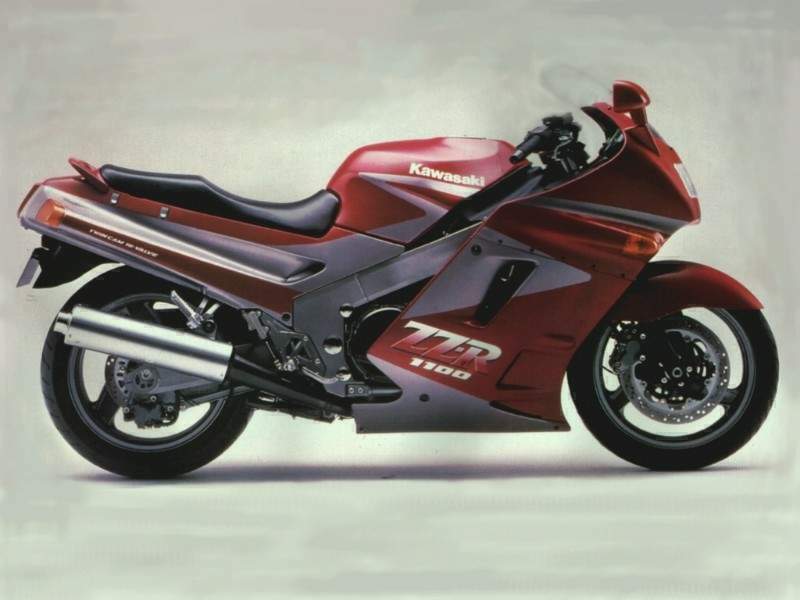
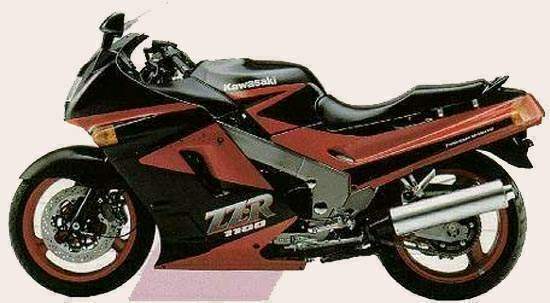
Kawasaki ZZ-R1100
Back in 1985 Kawasaki launched the GPZ1000R (also known as the 1000RX) and said they would never build a quicker bike. Making 125hp and a top speed of 162mph, Kawasaki claimed the 1000RX would 'outperform competing 1000cc-plus super-bikes for some years'. By 1988 Kawasaki had been forced to think again. The other Japanese manufacturers now had 160mph litre-plus bikes and Kawasaki Heavy Industries had to release a new machine to protect their traditional territory as the kings of top speed and fast engines. That bike was the ZX-10. It, too, ran 162mph but was lighter and generally sportier than the 1000RX it replaced. By 1990, the other manufacturers were still extracting more speed and refinement from their big bikes; Kawasaki obviously decided the ZX-10's impressive credentials were no longer quite good enough because they unveiled yet another world's fastest candidate -the 175mph ZZ-R1100. When Kawasaki's engineers set out to create the world's fastest bike in the late 1980s, they had the advantage of many years' experience in designing powerful four-cylinder engines - plus one very significant technical innovation. The result was a new superbike, the ZZ-R1100, whose liquid-cooled, four-cylinder engine, boosted by a novel 'ram-air' system, produced 145bhp and sent the bike hurtling to 175mph (282km/h).
That level of performance put the Kawasaki far ahead of all opposition when it was launched in 1990, and it remained the world's fastest bike for the next five years. There was much more to the ZZ-R (known as the ZX-11 in the States) than its engine, for it was a refined and efficient sports-tourer. But there was no escaping the fact that the Kawasaki's trump card was its phenomenal straight-line speed. Forced induction, to give the ram-air system its conventional name, was derived from Formula One racecar technology. It was a sealed system that ducted air from a slot in the fairing's nose, directly to the unusually large airbox. The faster the Kawasaki went, the more cool air was forced through its carburettors and into the engine. Intake system apart, the ZZ-R had much in common with the ZX-10, its predecessor as Kawasaki's flagship. Bulbous bodywork held faired-in indicators; the chassis was based on a rigid twin-spar aluminium frame. The new engine shared the ZX-10's liquid-cooled, 16-valve layout but had a 2mm larger bore, increasing capacity to 1052 cc / 64.1 cu-incc. Other changes included larger valves, new camshafts, lightened pistons, a new curved radiator and a more efficient twin-silencer exhaust system. When the throttle was wound open above 5000rpm, smooth power sent the bike rocketing forward. It kicked into hyperdrive at around 7000rpm and kept the rider's arms and reflexes stretched as it snarled to the 11,000rpm redline through the efficient six-speed gearbox. In contrast the response below 4000rpm was weak, though an improvement over that of the ZX-10. High speed composure and stability were remarkable. Even with the scenery and road flashing past at over 150mph (241km/h), the protection of its fairing and the quality of its chassis give the impression of travelling much less rapidly. American magazine Cycle managed a genuine 175mph (282km/h) from their full-power ZZ-R1100. Bikes in many European countries left the dealerships slightly slower due to politically enforced power limits. In most cases these were implemented by carburettor restrictors that were easy to remove. Although the ZZ-R's frame resembled that of the ZX-10 it was slightly thicker and stiffer, as well as 10mm (0.4in) shorter in the wheelbase. Steering geometry was steeper and the cycle parts were also new. Fork legs were enlarged to 43mm in diameter and, like the single rear shock, were adjustable for rebound damping as well as spring preload. Well-balanced feel The ZZ-R was a long, roomy bike that was far too heavy to be mistaken for a sports bike, but it handled well. Much of the mass seemed to drop away on the move, and the stiff chassis and firm suspension gave the Kawasaki a well-balanced feel. It was stable even at high speed, and its triple disc brake system was powerful. This was just as well, because if any bike needed good brakes it was the ZZ-R. The bike's comfort and practicality contributed to its reputation as a fine all-rounder. Numerous neat details included a comfortable seat, clear mirrors, bungee hooks and a much-needed grab-rail. But all those things were insignificant when compared with the ZZ-R 1100's greatest asset: the magnificent, ram-air assisted motor that generated its all-conquering speed.
|
|
|
Any corrections or more information on these motorcycles will be kindly appreciated. |