|
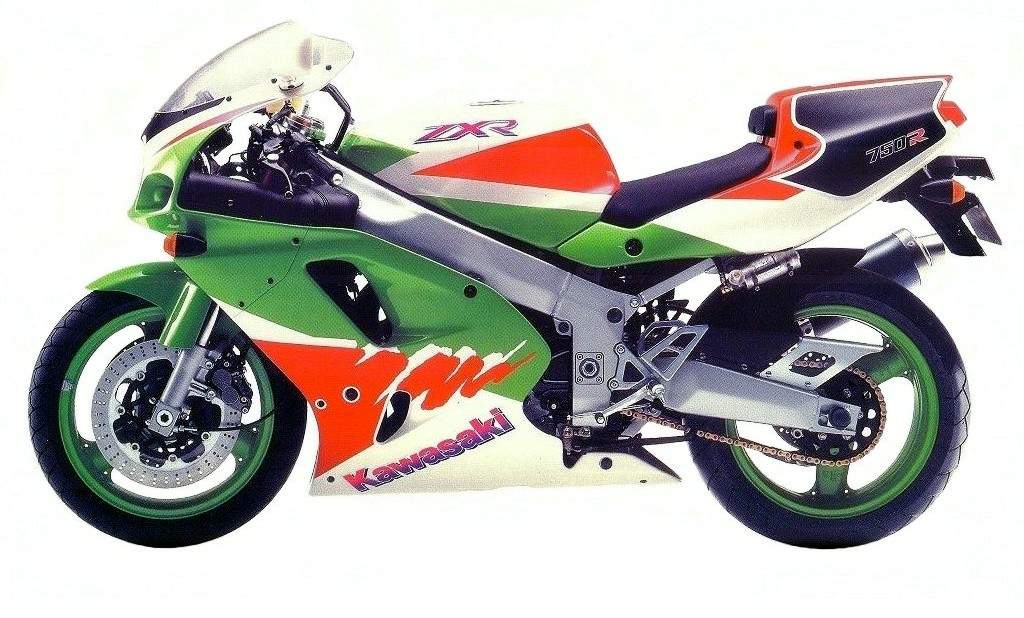
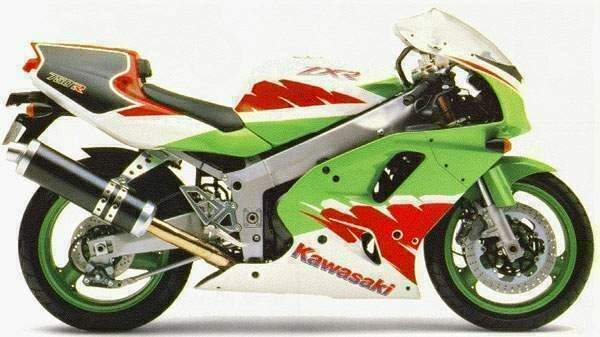
Kawasaki ZX-R 750R-M

|
Make Model |
Kawasaki ZX-R 750R-M |
|
Year |
1993-94 |
|
Engine |
Liquid cooled, four stroke, transverse four
cylinder, DOHC, 4 valves per cylinder. |
|
Capacity |
749 |
|
Bore x Stroke |
71 x 47.3 mm |
|
Compression Ratio |
11.5:1 |
|
Induction |
4x 38mm Keihin CVKD |
|
Ignition /
Starting |
Digital / electric |
|
Max Power |
121 hp 88.3 KW @ 10500 rpm (rear tyre 12.3 hp 4 @
11400 rpm |
|
Max Torque |
7.4 kg-m @ 9750 rpm |
|
Transmission /
Drive |
6 Speed / chain |
|
Front Suspension |
41mm Upside-down forks, adjustable ride height, 13-way rebound,
8-way compression. |
|
Rear Suspension |
Uni Track monoshock. adjustable ride height, preload,
4-way rebound. |
|
Front Brakes |
2x 320mm discs 4 piston calipers |
|
Rear Brakes |
Single 230mm disc 2 piston caliper |
|
Front Tyre |
120/70 ZR17 |
|
Rear Tyre |
180/55 ZR17 |
|
Dry-Weight / Wet-Weight |
205 kg / 221.6 kg |
|
Fuel Capacity |
18 Litres |
|
Consumption average |
14.8 km/lit |
|
Braking 60 - 0 / 100 - 0 |
12.8 m / 36.0 m |
|
Standing
¼ Mile |
10.7 sec / 207.1 km/h |
|
Top Speed |
258.9 km/h |

Flawed genius? That's a widely-held view of
the Kawasaki ZXR750. Who better then than ROB SMITH to give us all we need
to know to purchase the bike..?
If you'd regularly found yourself by the side of a twisty mountain road in
1989, chances are that at some stage you'd have been blown away by the sight
and sound of a howling lime green blur. Momentarily hovering low to the
ground, rasping and shrieking away into the distance leaving your senses
reeling with one question in your mind. "What the pharrrkwazat?
"Zat", was the Kawasaki ZXR750 H1.
Embodying outrageous ability with gorgeous styling, the ZXR is still a boss
motorcycle that, for its entire six year life in Australia, went as well as
it looked and provided Kawasaki race-rep fans with a class alternative to
the GSX-R or the pricey Honda RC30.
HISTORY
Back in 1988 the special K factory decided that the 16-valve, liquid-cooled,
in-line four residing in the dull, but far from pedestrian GPX750 would
realise far more of its potential slotted between a new twin-spar alloy
chassis with some trick suspenders, and a new sharper look. And so it was in
1989 the ZXR was born.
Having had a bit of judicious tuning, the 748cc ZXR, making about 95PS,
emerged blinking into the daylight wearing a bank of four 36mm Keihins fed
by a pair of trick looking inlets in the fairing.
Suspension was attended to by conventional forks adjustable for preload and
rebound at the front, and a Uni-Trak monoshock, adjustable for preload and
rebound damping at the rear. Wheelbase was a short 1410mm, with castor and
trail set at 24.5° and 100mm.
Clothed in green, white and blue or red and black it was a visual king hit.
1990 saw an H2 version with a swag of changes that included carb size
growing to 38mm. Wheelbase gained a significant 35mm, while inside the
engine there were longer conrods and shorter pistons to extract a bit more
power. The swingarm was changed and a new, more race style pipe added to the
looks.
Strangely, although the wheelbase was now longer, the swingarm struggled to
compress the rear suspension resulting in a rock hard ride.
1991 heralded the completely restyled J1 into the arena. Bore and stroke had
changed from the previous 68 x 51.5mm to 71 x 47.3mm to produce a capacity
of 749cc. USD forks were adjustable for rebound and ride height, the rear
shock remained uncompliant, and trail dimensions went down from 100mm to
95mm. Wheelbase shrank again to 1420mm.
Inside the engine, Kawasaki's engineers had hammered the overtime resulting
in a mass of changes that improved midrange, but perversely had cut actual
peak power. Did it matter? No not really, it was still a very fast machine.
1992 saw little actually change on the J2, other than an attempt at sorting
the utterly inappropriate rear shock with softer springing and damping.
1993 saw the much-improved L1 take up duties where the J2 left off. The big
news centred around the Ram -Air system, new pistons, cylinder head and cams
which boosted midrange and top-end power. Geometry changed yet again with
rake and trail now at 25° and 99mm, and the wheelbase measuring 1430mm. Rear
suspension, although marginally better, was still crap on anything that
didn't have the smoothness of a pool table.
1994 and '95 were years when the ZXR did very little other than change its
threads for variations in colours and graphics. Something big was obviously
coming from the factory, and 1996 saw the results of all the development
done over the ZXR's six years with the ZX-7R, an all new remake of a
fantastic bike that tends to get passed by in the search for the latest and
therefore greatest.
ON THE ROAD
Lets start with the H1. By today's standards the H1 is a bit of a porker
with a top heavy feel to it that makes you realise how far these sorts of
bike have come in the last 13 years.
Despite the suspension being hard and fairly unkind to the rider, the
chassis does it best to keep things stable right up to its top speed of
around 240km/h.
Steering is precise but requires more effort than you'd like to use at the
bars, around town this means stressed tendons and an almost psychopathic
desire to line up some country roads. Unfortunately just when the urban
sprawl ends and the ZXR should be in its element, the rear shock conspires
to upset things by refusing to compress enough to absorb anything bigger
than a an ant corpse. The result is that the ZXR leaps and hops around on
bumpy roads, intimidating rather than accommodating. Still, show the ZXR a
fast open sweeper with little for the suspension to do, and the rigid
chassis makes corner-carving an almost spiritual experience.
At last the opportunity to spank the motor hard reveals itself and
down-shifting for any corner just to hear the exhaust note at 10,000rpm
becomes the order of the day.
At a less frenetic pace and in newer company the early ZXR displays a
somewhat less than inspiring midrange. It's okay, but it never leaves you
thinking 'Heavens to Betsy, what's happened to my arms!'
Brakes are good, and offer reasonable power and feel, which is just as well
because the suspension certainly gives the tyre a good workout, especially
on the approach to downhill corners.
So why would you buy one? Well, aside from the fact that it's a great
looking motorcycle, you don't need to do a great deal to fix the
suspension's shortcomings. Once that's taken care of it's gorgeous, and
represents a well-finished and affordable alternative to mega-buck new stuff
and rewards an expert rider who's prepared to take the time to get to know
what it can do.
Jump forward a mere four years from that early bike to the ZXR750-L1 and it
has developed into a completely different machine; but strangely the same.
Along the way Robbie Phillis has finished third in WSB in 1991, and Scott
Russell has taken the ZXR to victory at Daytona in '92, and WSC in 1993.
It's an animal.
Just about everything has changed and the Ram-Air now lends the already
compelling induction noise a hollow resonance that starts with a low begging
moan, and ends with a climactic shriek that begs you to give it all you can
possibly can.
The engine still lacks the bottom-end and mid range of the competition, but
the shrieking rush to the top-end as the power crawls out of the dip at
7-8000rpm is the reason why you buy a ZXR. That and the wonderfully balanced
feel the bike has.
At a track day you'd shake your head in amazement that a bike that's almost
10 years old can be this composed. Steering is now corner stabbing sharp,
and turning while hanging late on the four-piston Tokico brakes is the ZXR's
stiletto up the sleeve. Just about every journo has written superlatives
about the ZXR'S front-end control, and they're right, it's good.
The gearbox is a pretty clunky device but dependable, perfectly in keeping
with the rough-neck engine's riot-inciting behaviour. Sadly though, the
suspension, while better, is still too damned hard for back road giggles
and, in conjunction with the stretched-out riding position, will have you
squeaking your order at the bar and nervously checking the contents of your
leathers.
Is it cheap on fuel? Chances are you won't care much, given the nature of
the bike, but like its predecessor it's okay. You can expect 200 kms to fill
up when you're right up it, and a bit more if you're not. Bottom line here
is that the ZXR is a brilliant bike to own and ride if you're a committed
sports bike rider who's prepared to sort the suspension, does a few track
days and rides well-surfaced roads. Oh yeah, and it looks the bollocks too.
IN THE WORKSHOP
The ZXR750 in all its guises is a tough bike that's quite well made and
mechanically resilient to the kind of abuse that it gets. (Anyone that says
they've never thrashed it should be eyed with a great deal of suspicion.)
Given that the engine is a tough unit with a good reputation, let's have
look at what you'll need to be aware of when buying one.
Because no-one buys a ZXR to just potter about, rev the bike at stationary
and look for smoke on the over-run, which'll be a sure sign that it's been
rung out from cold or with the front wheel higher than head height. Also the
gearbox - anyone can do a mono in first gear, but getting from there into
second and beyond can be a little more challenging. As a result second gear
can take a hammering, so be sure to load up at low revs and then rev it out
in second to make sure that it doesn't jump out of gear.
Check the steering head bearings for play from cack-handed mono landings,
and look for cracks in the fairing brackets from accident damage.
Make sure the rear shock hasn't been adjusted with tools other than with
proper C spanner and look for general signs of abuse and butchery all around
the bike. After that look at all the bits that touch down in a crash, as
these babies tend to get lobbed by those unable to control the wayward
behaviour of the rear shock on a bumpy road. As far as servicing goes there
are no nasty surprises.
MODIFICATIONS
Well it's got to be that shock hasn't it? The secret to eternal ZXR
happiness lies in that one change. See your local suspension expert for
advice. After that a pipe, jet kit and air filter will liberate a few
horses, but most importantly will sharpen throttle response. Personally I'd
leave the pipe unless I'd damaged the original and had to have an
aftermarket job, the standard noise is intoxicating and legal. You know it
makes sense!
WHICH ONE?
The early ones were classically lovely, but for me it's got to be an
L1-L2-L3 in Kawasaki green. Source Bikepoint |