|
|

|
|
|
|
Classic Bikes
Custom Bikes
Individual
Racing Bikes AJP
AJS
Aprilia
Ariel
Avinton / Wakan
Bajaj
Benelli
Beta
Bimota
BMW
Brough Superior
BRP Cam-Am
BSA
Buell / EBR
Bultaco
Cagiva
Campagna
CCM
CF Moto
Combat Motors
Derbi
Deus
Ducati
Excelsior
GASGAS
Ghezzi Brian
Gilera
GIMA
Harley Davidson
Hero
Highland
Honda
Horex
Husaberg
Husqvarna
Hyosung
Indian
Jawa
Kawasaki
KTM
KYMCO
Laverda
Lazareth
Magni
Maico
Mash
Matchless
Mondial
Moto Guzzi
Moto Morini
MV Agusta
MZ / MuZ
NCR
Norton
NSU
Paton
Peugeot
Piaggio
Revival Cycles
Roland Sands
Royal Enfield
Sachs
Sherco
Sunbeam
Suzuki
SWM
SYM
Triumph
TVS
Ural
Velocette
Vespa
Victory
Vincent
VOR
Voxan
Vyrus
Walt Siegl
Walz
Wrenchmonkees
Wunderlich
XTR / Radical
Yamaha
Zero
Video
Technical
Complete Manufacturer List
|
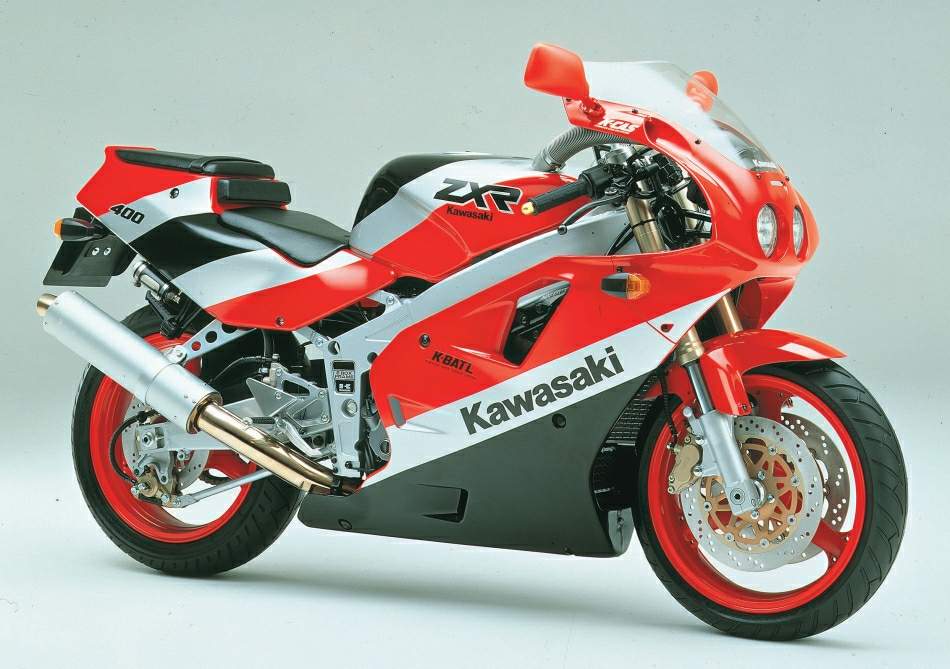
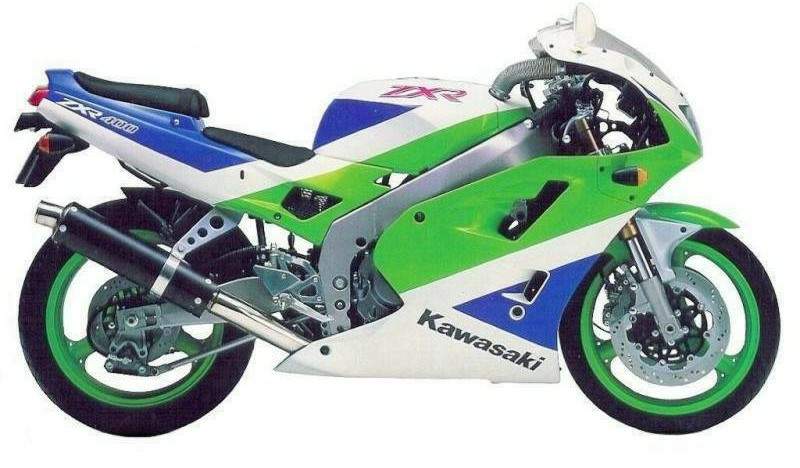
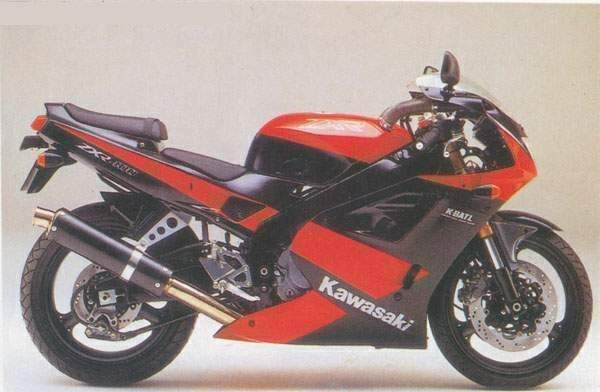
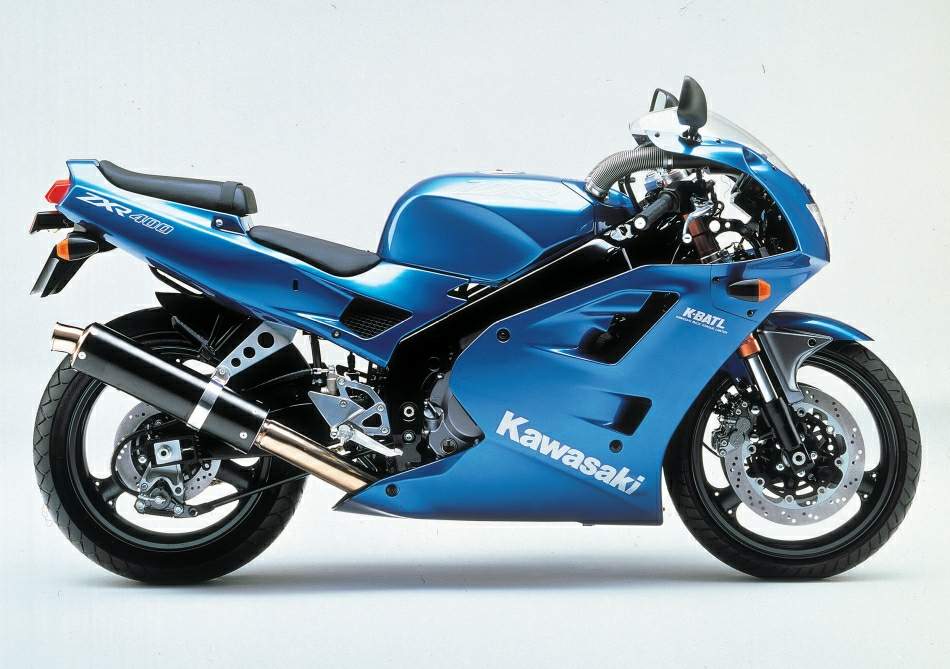
Kawasaki ZX-R 400
ZXR400 vs VFR400R3-M vs FZR400RR IT TIME. Time to thrash away the cobwebs; time to overtake squad cars and get drunk. Time to wake up and do it again. Oh, and I nearly forgot: time to scare myself silly. But I didn't this year, did I? I rode a ZXR400 and an FZR400RRSP, the spearhead of a new 400cc class whose nose is pressed unjustly hard against a wall of market prejudice. Do yourself a favour, sell-up, move out, do whatever it takes...but buy one. Here's why. Riding both, but preferably the Yam OWOM, re-defined my weedy TT-riding parameters. On paper or motorways their 60bhp are blown away by virtually everything modern and sporty. On asphalt they are the wildest one-finger vehicles since the 350LC. What's more, they're boring four-strokes. While many he-man bikes are blighted by throttles that stay resolutely off the stops and chassis needing above average skill when not, the little 400s get abused. They don't know the meaning of 'feathered throttle' and while you're busy abusing, you're also going in deeper, leaning further, whacking the throttle earlier. You are, just like old times, an equal partner in the bike-rider relationship. As priced, the ZXR is the bike to take on the world. Mitsui are importing just 100 FZRs which, at £6436, is probably a wise move. Pound for bhp, the Kawasaki, at £4799, may look expensive compared to its identikit big bro' but I can't see why it should be cheaper. It's easily as much bike. Especially if you believe that less is more. Although it looks like a 750J after a bizarre shrinking operation it feels like a 750J after a bizarre shrinking operation -but only superficially. The riding position is poised with nearer bars and more road-bike feel than the Yam. The seat has moderate padding; the mirrors are the widest and don't blur; the clutch is ragged and noisy. And that, bar one massive missive I'm saving up, is the end of the criticisms. Opening the throttle in the top three gears produces a bad-tempered growl akin to the 750, and little else. At 7000rpm it sounds interested but merely moves into a rough patch. lOOOrpm later it's clear and at your disposal. Compared to the FZR's amazing midrange it's as flat as a fart. Taken in isolation it's well-useable. Power only begins to climb seriously when the tacho is flying through the 11,500 take-off zone and heading rapidly for the 14,000 rev-limiter. The noise experience is total — pained but the best. Initially I changed up too early, I couldn't believe it could wail so without blowing up. Soon after I was addicted. This 400cc interpretation of ZXR performance is safe, fun, unintimidating and intense. All this excitement is managed by four critically-set Keihins and a gearbox that's notchy on the down-change but well-suited to the road. The more racy FZR has a very tall first gear followed by five very close ratios. The ZXR, much more a street bike, has a clutch-saving first gear, a wider gap to second and four more cogs marginally wider than either the Yam's or Honda's. This means shifts have to be timed exactly if you're hauling serious bottom. It's a decent compromise. As spaced the 'box renders town pootling far less messy than its 250 stroker competition, compensates just enough for the lack of midrange yet gives the 2500rpm power band its head. 400cc? Once attuned, it doesn't feel like it.
It also made the FZR's EXUP-boosted engine feel less special than last year. After the brash Kawasaki its equally oversquare thrash-unit came across as a hair-dryer. The Yam's tall first gear isn't really a problem. Carburation is so spot-on, the engine so torquey that the incongruously heavy clutch needs little slipping. The engine, though, you just wind up and you're used to it. From 30mph in sixth? No problem. If it has a rev-limiter I couldn't find it. The redline's at 14,000, peak power at 12,200 but it's still accelerating steadily at 15,500. There's no rush as per the ZXR due is part to marginally less power, but mainly to the Yamaha's better spread. The whirring EXUP makes gearchanges less critical — mostly you just hold the throttle open and steer around anything that gets in your way. Occasionally you have to brake. Geometry-wise, the FZR is the safe bet: wheelbase, rake and trail all fall between the Honda and Kawasaki. The immensely-stiff Deltabox frame and swing arm are slimmed OW01 tackle and a joy to behold as, come to that, is every weld and fastener. Build quality is unique on a bike this side of ,£8000 but oddly it's the road gear, rear light, sidestand and floppy rear winkers, that mar desirability. Although the seat is minimally padded, the Yam's compliant suspension makes it (wrists apart) more comfortable over long hauls and... faster. The ZXR, meanwhile, is depress-ingly like the 750 and threatens to turf you off the moment its Jagger Lips headlights lay beams on a bump. This is a shame. With the longest wheelbase, most outrageously steep headangle and 82 miniscule mm of trail the Kawasaki's handling is neutral at all speeds; it's immediate, easy and turns 250 quick. On smooth roads it has no vices and could run rings around Saturn; the brakes have staggering power, match the Yamaha's in the brick wall league and have better, less on-off feel for road riding. After a week, though, we noticed it was the only one without scraped pegs then thought for a second why: it was because the ZXR has virtually no suspension. The ZXR's shock and, to a lesser extent, forks have little movement. The (non-adjustable) rear compression damping allows for only mildly pitted surfaces and kicked it around on the TT course. It's bad at lOOmph, very bad at 70, and slowing the four-way rebound (set on quickest) made it worse. If the frame wasn't so flex-free and the forks so stiff slap-pers would follow. They don't and the excellent Bridgestone Cyroxes refused to give up grip or destroy the rider's confidence. Ultimately, though, I ended up cornering in fear of mid-turn bumps, fearing not gravel rash but the longterm prospects of my spine. The Yam is more a supreme handling sofa. At the TT it should have been swallowed by the enormity of the place yet seemed to just flatten bumps, steer itself, and rarely had to slow. It wears ace Michelin Hi-Sport radials and multi-adjustable suspension that works well on standard but also responds to tweaking. The forks' preload and compression needed bumping up to reduce dive on the one-finger brakes and settle the front into fast turns. So set, the FZR was the ideal IoM good-time motorcycle, but once home on twistier roads, where stability is less of a need, steering was quite slow and tucky on sub-30mph stuff and the Kawa remained the supreme, if more excitable, scratcher. Overall, the FZR handles like a bigger bike. It's neither as neutral nor easy as the other two and rewards precise riding. Once mastered, once you realise it isn't going to crash when you give the bars a seeing-to at lower speeds, it's the complete handler. A pukka racer. The bike I'd chose for my own flying (snigger) lap. But even so, even with that horrible shock, the ZXR shades it for everyday (fast) road use.. It's a bike you just get on and get bad with. Individually, the brakes, handling and riding position are all inferior in pure performance but collectively are more suited to the road rider's needs. Let's not forget either: a pillion perch of sorts, a possible 150 mile range and those crucially good mirrors. When the ZXR joins our long term test squadron a modded shock will follow — we confidently predict even greater things.
Tim Thompson ZXR400 v VFR400R3-M T T highlight No 1: Suzi Quattro, smelly Summerlands and Saturday night (alright). Post-adolescent fantasies on an ob-SCENE scale. Cannin' the Devilgate, canning wet T-shirts and all that. She's sweet, I'm sozzled and it's well-past my bedtime.TT highlight No 2: VFR400, Crosby, Monday night and a glance in the mirror: VFR750, grinning pink Arai, Hislop. Nah, can't be...cripes, it is — it's Steve Hislop! It was you know. And TT highlight No 3? Me (ZXR400, flat-out), Tim (VFR400, rung out) exiting The Bungalow. Thrash-happy ding-bats both. 14,000 cacophonic rpm on the ZXR's tacho, Goldman, for once agreed into fifth, stretching past the VFR, pushing the speedo needle past, gosh, 100 at least.Not mad, not terrifying, just right. Intense, heart-rippling joy on the right (re: safe) side of the crazies. If the ZXR is a concentrated ZXR750: focussed, proper and screaming with urgency, then the VFR is a junior RC30: tiny, plush, immensely sophisticated — but toy-like. A mini Rolls Royce for mini oil sheiks, a 400cc gag-bike. And it's an important distinction, The ZXR is tight, coiled and classic Kawasaki. The motor is harsh and peaky, the chassis harsh and butch, the look a bullseye. It epitomises the good things about itself- light and stunningly agile yet retaining the essential solidity that puts many off stinkWheel 250s.
Its excitement quotient IS, however, pure stroker. Below 8000rpm it bumbles, gathers speed measuredly, quietly, almost sleepily. Thanks to the well-spaced 'box it's useful and calming. Motorway cruising is no problem. Above 1 l,500rpm, however, and the ZXR comes alive (yeah — !) with an explosion of scrabbling, hungry, claws and teeth. Throttle against the stop, the hairs on the back of your neck stand to attention and your left boot, hopefully one step ahead of the rev-limiter, is doing double-time on the light, super-quick upshift. Again the ratios are ideal. Third and fourth are about 2000rpm apart, or from redline back to bottom edge of the powerband. Fourth to fifth closer still. Fifth to sixth so close they could have been joined at birth. It encourages precision. Miss a gear and it's like farting. Get it right, repeatedly, and it evokes a sense of immortality. The VFR is a totally different kettle of Bird's Eye. From 20 yards or earshot it's an RC30. That utterly distinctive, sublimely-finished look. That utterly distinctive dry, barking exhaust. But the Boss of 1987-1990 is now (with old fashioned twin beams, conventional forks and comparably small discs) starting to look its age. If the ZXR is purposefully compact, the VFR is downright titchy, a Dinky toy and an almost embarassing doddle to get yer knee down on. It's cramped but it's easy. The suspension is easy, the engine is easy: a soft, flexible, idiot-proof, elastic band. At the end of the day, against the others, you have to rev the nuts off it of course. The rest of the time you don't: progressive wind-it-on power from 7000rpm up with no glitches, no steps, no pressing need to overwork the immaeulate gearchange and no particular excitement. It's revvy, yes. But it doesn't seem so. It just seems as if the tacho numbers are artificially big. Peak power on the VFR is almost irrelevent-ly 'somewhere over five digits'. Peak power on the ZXR is etched onto my brain. The VFR's chassis and cycle parts are equally easy. The brakes are progressive but lack power compared to the equipment on the other two. The steering is the slowest, heaviest, easiest. The frame is immensely stiff. The multiadjustable suspension, as standard, the softest of the trio and contrasts massively with the ZXR's. It's easy on your bum. Easy over the TT's multitude of bumps. The easiest (re: slowest) to use to the full - a factor not helped by the Honda's Dunlop tyres, the worst of the group. After the ZXR the VFR is cuddly, sweet and slightly silly. A twinge of embarrassment follows it and overshadows how good it really is. After the VFR the ZXR - razor steering, brakes and tyres, razor power, razor presence, knackered knackers - is a proper, howling bastard motorcycle. Phil West CONCLUSION LOOK AT THE SPECS, they're so close it's ridiculous. It's also a crying shame we've been deprived of these sort of bikes for so long. You thrash 'em like you'd thrash a moped. But instead of carving up cyclists you find yourself carving up GSX-Rs. Their proportions are everything. Just the right weight. Just the right balance. Nothing intimidating. They're incapable of flying out of your hands in first gear; incapable of unbalancing you at the traffic lights; incapable of provoking anything but massive self-belief. Yet absolutely brilliant at riding around just about anything on any corner. But which is best? Difficult. The FZR is the ultimate racer on the road. The only, in our book, racer you, or almost anyone, can use to the FULL on the road. The ZXR's front end is almost as good, is the best (despite that rear shock) for the road, has the most exciting engine and is a crucial £1500 cheaper than the others. While the VFR is the best built, with the softest, most approachable characteristics, but is, ultimately, last year's toy. And the best of all? They're all just 400s. Chew on that. Bike 1991
|
|
|
Any corrections or more information on these motorcycles will be kindly appreciated. |