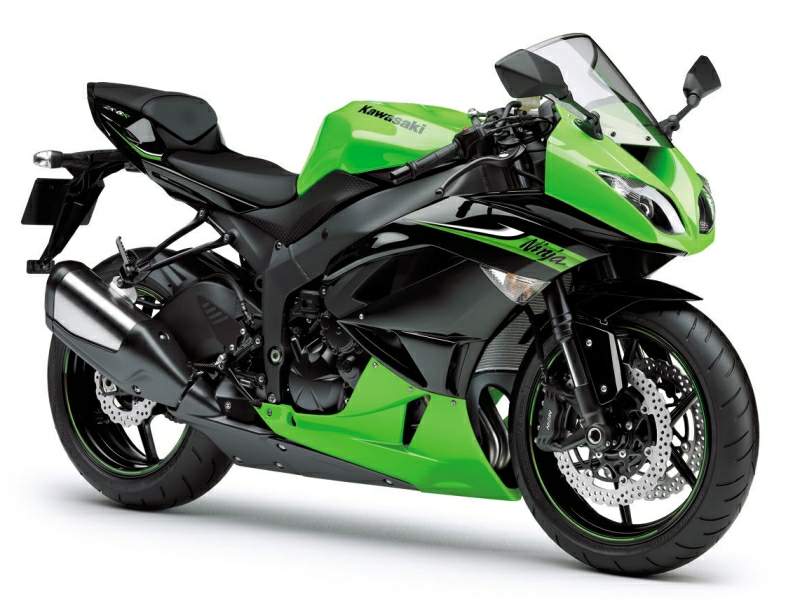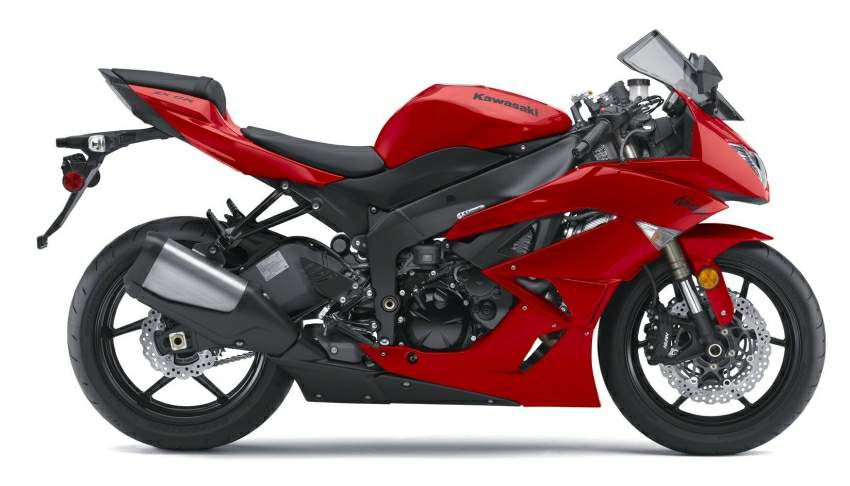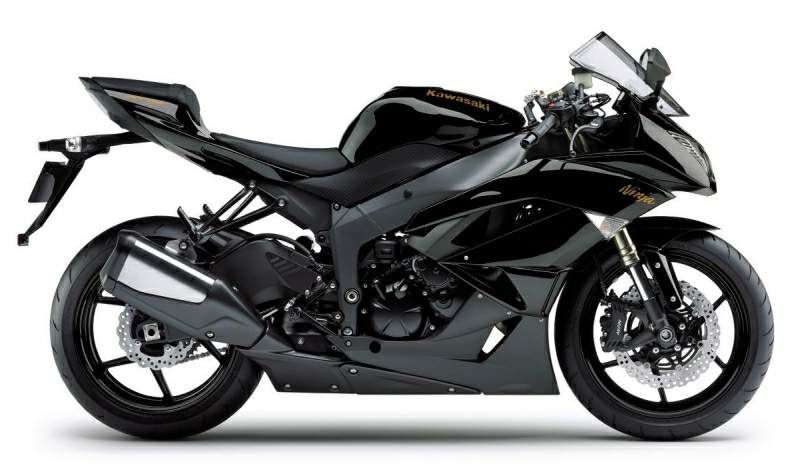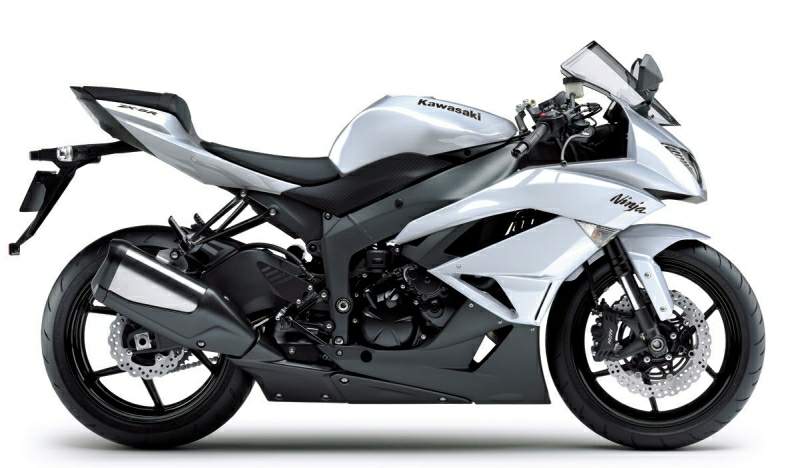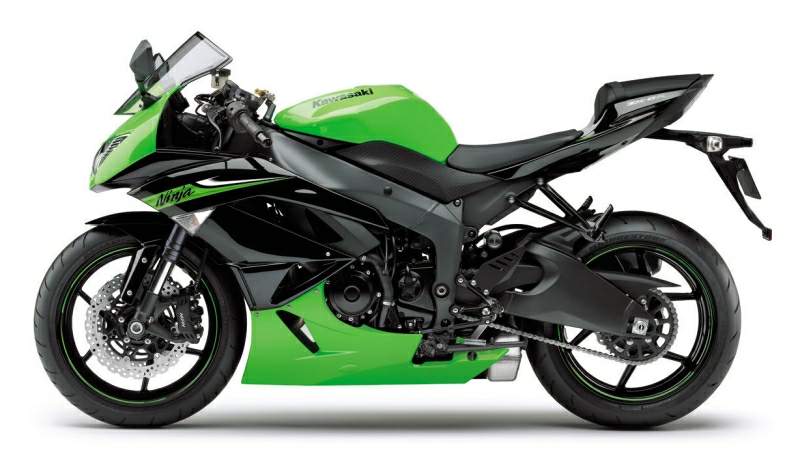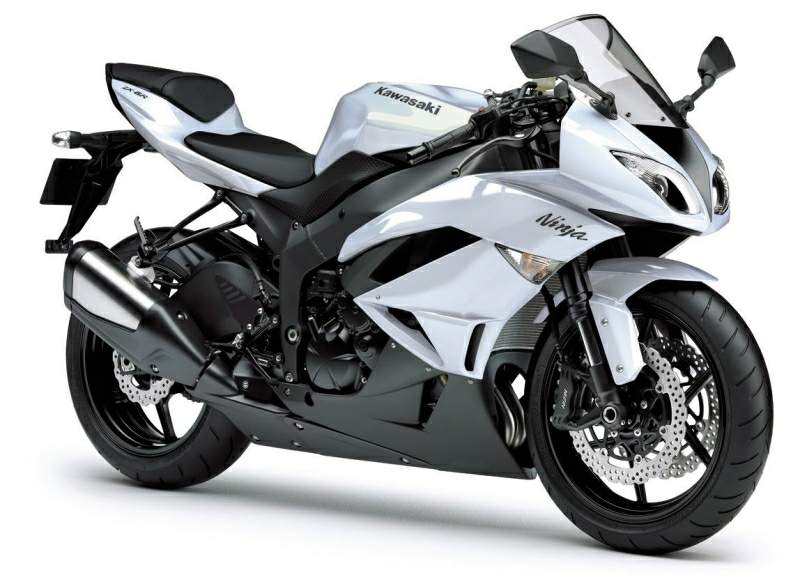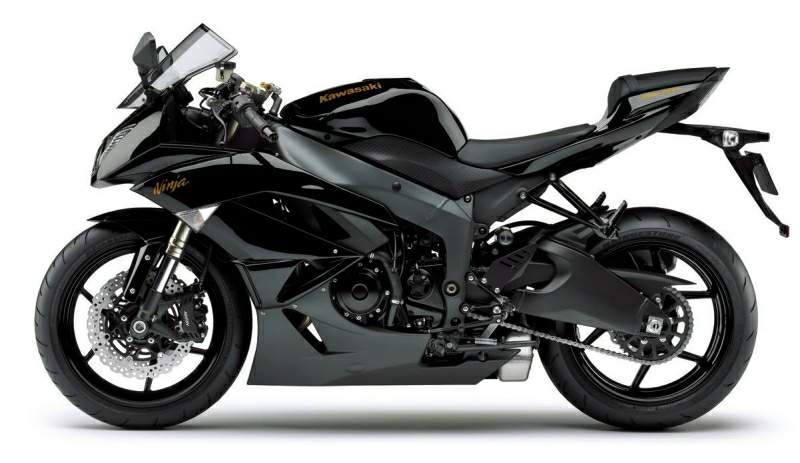
Aluminum perimeter, Rake / trail: 24 deg / 4.0
in.
Front Suspension
41 mm inverted Showa Big Piston Front fork with
top-out springs, stepless compression and rebound damping, fully-adjustable
spring preload,120mm 4.7 in.wheel travel
Rear Suspension
Bottom-Link Uni-Trak® with
gas-charged shock, top-out spring and pillow ball upper mount, dual-range
(high/low-speed) stepless compression damping, 25-way adjustable rebound
damping, fully-adjustable spring preload 134mm 5.2 in. wheel travel
The Middleweight Sportbike That Won Just About
Every Magazine Comparo! When it comes to performance, no class is more
competitive than middleweight sportbikes. To stand out in this crowd, a
motorcycle needs to do everything better than well — it needs to kick
serious tail in every department. Hats off to the Kawasaki Ninja® ZX™-6R
then, winner of 600cc comparison tests in just about every publication and
website of note on the planet. With an engine the critics agree feels
bigger than 599cc, and a chassis that out handles all others, the ZX-6R
returns as the bike to beat in 2010.
With a fine-tuned chassis including a class-exclusive Big Piston Fork and
fully adjustable shock out back, razor-sharp handling sets the ZX-6R
apart. To optimize front-rear rigidity balance, frame stiffness around the
swingarm pivot and the rear engine mounts is carefully tuned, with the
compact engine rotated forward around the output shaft for a steep
cylinder bank angle and optimal center of gravity. An exhaust layout with
a short side muffler keeps the weight low, and an exhaust pre-chamber
further contributes to the ZX-6R’s mass centralization.
The Ninja ZX-6R’s lean physique is fundamental to its light handling, with
every component on the bike carefully scrutinized for minimal weight. The
intake resonator box and supports for the instrument panel and mirrors are
unitized with the enlarged —to optimize intake volume — Ram Air duct,
contributing to weight savings and improving rigidity. Camshafts are made
of lightweight chrome-moly steel, and light, magnesium engine covers all
add up to big weight savings, along with transmission, oil pump and
starter gears carefully engineered for maximum strength and minimal
weight.
Along with its light weight and compact
design, the ZX-6R engine is packed with details to give it precise
throttle control and amazing performance, particularly in the mid-range.
Smooth power delivery is achieved through outstanding combustion
efficiency. Cylindrical guides in the top of the airbox guide the fuel
charge into the intake funnels to reduce buffeting and improve cylinder
filling, along with advanced cylinder porting techniques. High-current
secondaries in the ignition coils provide hot, consistent sparks at all
rpm.
In addition to its more than healthy bottom-end torque and smooth throttle
response, the engine’s mid-range performance benefits from a similar
number of refinements, including double-bore velocity stacks with inlets
at two different heights, special-profile pistons with low piston-ring
tension for reduced friction, and advanced cam chain guides for excellent
cam-chain stabilization.
That strong mid-range provides great drive out of corners and is
harmonized with the engine’s silky smooth high-rpm performance. This
linear throttle torque delivery results in unparalleled controllability
and offers the rider precise throttle control at all rpm. This
predictability pays dividends when making mid-corner power adjustments.
When combined with the reduced need to downshift provided by its healthy
mid-range performance, the predictable throttle response makes it easier
for riders to maintain their rhythm when stringing corners together.
In keeping with its racing heritage, the ZX-6R
employs a cassette-type transmission that simplifies gearing changes at
the track, reducing set-up time and allowing more time for riding. A
slipper clutch allows quick downshifts without upsetting the rest of the
chassis when reducing speed on corner entry.
Corner-entry controllability is yet another ZX-6R strong suit, thanks to
the use of Showa’s revolutionary BPF (Big Piston Front fork). The BPF
utilizes a large-diameter internal piston, which permits a reduction in
damping pressure, for smoother action and better front end feedback —
especially under braking and initial corner turn-in. Additionally, the BPF
eliminates many of the internal components used in a cartridge-type fork,
simplifying construction and resulting in a lighter overall fork weight.
Having already designed a lighter and more rigid swingarm for the Ninja
ZX-10R sportbike, the Kawasaki engineers utilized many of the same design
components for the ZX-6R’s swingarm. Shared swingarm parts include both
left and right inner plates, the left outer plate, rear stand bosses,
brake caliper stopper, chain guard and swingarm pivot shaft.
The response from Kawasaki’s acclaimed triple petal disc brake package
with radial calipers is as refined and powerful as ever. Radial-mounted
four-piston calipers and 300mm petal rotors up front provide awesome power
and excellent feel. The 220mm rear petal disc features a pedal coaxially
mounted with the footpeg for increased mid-stroke braking efficiency and
optimum feel. Its master cylinder reservoir mounts forward of the swingarm
— freeing up space around the footpeg, reducing parts and contributing to
weight savings. It all adds up to unflappable composure under braking, and
helps provide the precise control and feel that allows Supersport racers
to enter corners harder.
To better capitalize on this lighter machine
and its precise control response, the rider interface is appropriately
fine-tuned to enhance feedback from bike to rider and vice versa. The
relationship of the seat-to-pegs-to-bar “rider triangle” places the
handlebars close to the rider and angled for a highly intuitive riding
position. The fuel tank cover is flared just so around its top edge,
providing a large contact patch and contributing to excellent rider
feedback — similar to the ZX-10R. A narrow rear sub-frame and seat leading
edge provide a slim, highly flexible riding position for moving around the
bike, as well as a shorter reach to the pavement.
A highly refined fairing and one-piece front fender provide excellent
aerodynamics and airflow to the radiator, along with great wind protection
and minimal crosswind buffeting. An inner rear fender above the swingarm
also reduces turbulence and helps keep the tail clean. The ZX-6R’s
instrument panel provides information at-a-glance, and a race-quality
adjustable twin-tube Öhlins steering damper with relief valve completes
the track-ready package.
Highly confidence inspiring, the engine and chassis control precision
offered by the Ninja ZX-6R enables riders to push harder and maximize the
excitement that comes from actively controlling such a high-performance
track-focused machine.
Authentic Kawasaki Accessories are available through Kawasaki dealers.
Features and Benefits:
Key Feature
* Lean physique, low-mass, awesome power delivery and precise control
Lightweight Engine
* Camshafts are made of chrome-moly steel
* Lightweight magnesium engine covers are standard
* Lightweight top injector mounting plate
* Lightweight transmission gears and gear dogs
* Lightweight oil pump and starter gears
* Inlet pressure pulse monitor does away with cam angle sensor, further
contributing to lightness
* Cassette-type transmission makes it easy to quickly swap gear ratios,
reducing set-up time at the track
Massive Mid-Range Performance
* Double bore velocity stacks feature inlets at two different heights, for
increased performance in both the mid- and high-rpm ranges
* Cam and tappets nitriding enables high-load cam profiles, for maximum
performance
* Crown-finished pistons
* Molybdenum-coated piston skirts for reduced friction and engine break-in
* Low-tension piston rings reduce mechanical loss
* Advanced cam chain guides stabilize chain motion and further reduce
mechanical loss
* Exhaust collector layout contributes to superb low and mid-range
performance while maintaining high-rpm performance
More Precise Throttle Control
* Cylindrical guides in the top of the air cleaner box ensure accurately
sprayed fuel mist from the secondary injectors into the intake funnels,
improving combustion efficiency
* Long throttle bodies between oval sub-throttles and round main throttles
yield a smooth intake transition, for reduced inlet turbulence and
increased efficiency
* Advanced cylinder porting delivers excellent cylinder-filling and
scavenging
* High-current secondary coil circuitry for optimum combustion efficiency
Lightweight Chassis
* The sub-frame is a 2-piece aluminum die-casting consisting of a front
and rear section
* The lightweight sub-frame is very narrow, for a compact and slim rear
end
* Intake resonator box and supports for the instrument panel and mirrors
are unitized with the Ram Air duct, contributing to weight savings and
increased rigidity
Tuned Chassis Balance and Mass Centralization
* Frame stiffness around the swingarm pivot and the rear engine mounts
optimizes front-rear rigidity balance
* Engine is rotated forward around the output shaft for steeper intake
angle and excellent CG
* Exhaust layout with a short side muffler keeps the weight low
* Exhaust pre-chamber further contributes to mass centralization
Ergonomics and Chassis Feedback
* Seat-pegs-bar relationship places handlebars close to the rider and
turned in slightly for a highly intuitive riding position
* Fuel tank profile is flared around its top, similar to the ZX-10R,
providing a large contact patch for excellent rider feedback
* Slim-waisted fuel tank makes it easy for the rider to grip the tank with
his knees or to hang off in turns
* Sculpted seat allows the rider to shift his body far back on the rear
seat step, helping to reduce rider fatigue
* Steep rake angle for quick steering response and enhanced communication
from the front tire
* Rear brake master cylinder reservoir forward of the swingarm mount frees
up space around the footpeg, for simplicity and weight savings
Low Seat Height
* Narrow rear sub-frame makes it easy to reach the ground
* Front of seat is narrow and low, for a slim riding position and a short
reach to the pavement
Advanced Suspension
* ZX-6R features Showa's Big Piston Front fork (BPF) design, for fantastic
braking and initial corner turn-in
* The BPF eliminates many of the internal components used in a
cartridge-type fork, simplifying construction and resulting in lighter
overall fork weight
* The large-diameter of the BPF's internal piston allows a reduction in
damping pressure, for better feedback and smoother action
* The ZX-6R swingarm uses many of the same parts as the ZX-10R; both left
and right inner plates, the left outer plate, rear stand bosses, brake
caliper stopper, chain guard and swingarm pivot shaft
Brakes
* 220mm rear petal disc
* Rear brake lever is mounted coaxially with the footpeg for excellent
mid-stroke braking efficiency and optimum feel
Race-Quality Steering Damper
* A race-quality adjustable Öhlins steering damper with relief valve and
twin-tube design is fitted as standard equipment
Additional Features
* Highly evolved fairing for great wind protection, minimal cross-wind
effects
* Position lamps are integral with the projector beam headlights; the
Ninja ZX-6R features dual position lamps like the ZX-10R
* One-piece fender offers excellent aerodynamics
* Inner fender above the swingarm helps to reduce turbulence and keeps the
undertail clean
* Front brake hose routing with a three-way joint at the lower
triple-clamp facilitates bleeding air from the brake lines
* Similar in design to that of the ZX-10R, the instrument panel gives
at-a-glance information to the rider
2010 Kawasaki Ninja ZX-6R Technology
Engine
Precise Engine Control At All Rpm And Powerful Mid-Range Torque
One of the greatest sources of excitement when riding a supersport comes
from the reaction the rider gets when twisting the throttle. Engine
development focused on delivering precise throttle control and increasing
performance, particularly in the mid-range. Changes for improved
driveability yielded very linear throttle response that gives the rider
the feeling of being connected directly to the rear wheel. Stronger
mid-range torque means the rider can enjoy greater drive out of corners as
well as silky smooth high-rpm performance.
Precise throttle control
Cylindrical guides added to the top of the air cleaner box ensure more
accurately sprayed fuel mist from the secondary injectors. With fuel more
precisely directed into the intake funnels, combustion efficiency is
improved.
Longer throttle bodies increase the distance between main and
sub-throttles by 10 mm. The smoother transition between the oval
sub-throttles and round main throttles yields smoother airflow to the
engine, resulting in better driveability.
Revised cylinder porting delivers improved filling efficiency, for
improved performance across the rev range.
New ignition stick coils have 12% greater secondary coil current. The
improved combustion efficiency results in improved performance and
driveability.
Slipper clutch
Adjustable back-torque limiting clutch helps reduce rear-wheel hop that
may occur when downshifting at high rpm.
Increased mid-range performance
New double bore intake funnels (“velocity stacks”) feature inlets at two
different heights, allowing performance increases in both the mid- and
high-rpm ranges.
Optimised cam nitriding (NV) and tappets with increased durability enabled
the use of high-load cam profiles which improve overall performance.
Pistons with new profiles and improved crown finishing contribute to the
gain in performance.
Molybdenum coating on piston skirts reduces friction and facilitates
engine break-in.
Piston rings with less tension reduce mechanical loss.
Revised cam chain guides stabilise chain motion, further contributing to
reduced mechanical loss.
Revised exhaust collector layout contributes to improved low and mid-range
performance while maintaining high-rpm performance.
Additional Features
Exhaust pre-chamber under the engine makes efficient use of space,
reducing exhaust noise and helping to minimise silencer volume.
Chassis
One of the goals for the 2009 Ninja ZX-6R was to give the new bike lighter
handling. The superb combination of mid-corner stability and ability to
change lines on command was maintained from the ZX600P, but frame rigidity
was revised and mass further centralised to make the new Ninja ZX-6R even
easier to tip into corners. Further, the naturally aggressive ergonomics
package was fine-tuned to offer riders an even better “fit” and to enhance
the high level feedback that communicates to the rider what the bike is
doing.
Revised chassis balance and mass centralisation
While structure of the main frame is basically the same as that of the
ZX600P, revised rigidity around the swingarm pivot and the rear engine
mounts optimises front-rear rigidity balance.
The engine is mounted with a steeper cylinder bank angle. Rotated around
the output shaft, the engine’s C of G is 16 mm higher and the head pipe is
situated 10 mm higher. The result is improved turning performance and
easier turn-in.
New exhaust layout with a short side muffler lowers weight previously
located under the seat, contributing to a much lighter feel when turning.
Use of an exhaust pre-chamber further contributes to mass centralisation.
Ergonomics and chassis feedback
Kawasaki’s Ninja supersport seat-pegs-bar relationship was adjusted
slightly, with the handlebars moved closer to the rider and turned in
slightly. The new position contributes to the bike’s naturally intuitive
riding position.
Fuel tank cover from the ZX1000E is more flared around its top, making it
easier for the rider to rest the inside of his arm on the tank when
leaning into a turn. The larger contact patch contributes to the increased
feedback to the rider.
Slim, waisted fuel tank makes it easy for the rider to grip the tank with
his knees or to hang off in turns.
Front to back, the new seat is shorter, allowing the rider to rest his
tailbone on the rear seat step. This improved “fit” also contributes to
the excellent feedback the rider gets from the chassis.
Steeper caster angle (25o >> 24o) enhances communication from the front
tire.
Changes to the frame, while not easily visible, also contribute to
enhanced feedback. Revisions to the front engine mounts and head pipe
offer a more direct feel from the front. Adjustments to the rigidity of
the swingarm and around the swingarm pivot give a clear feeling of rear
wheel traction.
Relocating the rear brake master cylinder reservoir tank forward of the
swingarm mount frees up space around the footpeg. The change also enables
a reduction of parts and the shorter hose contributes to weight savings.
Lower seat height
The narrow width of the new rear sub-frame helps make it easier to reach
the ground.
The front of seat is narrower, contributing to the narrow riding position
and offering a shorter reach to the pavement.
Seat height is approximately 5 mm lower than that of the ZX600P.
Race-quality steering damper
An adjustable Öhlins steering damper with relief valve and twin-tube
design is fitted as standard equipment. The second tube, which acts like a
reservoir tank, and the damper internals, ensure stable damping
performance even under racing conditions. (Even if the damping fluid in
the cylinder gets hot it will not froth.) The damper unit has an integral
clamp so that piston motion is not hindered.
Lighter Weight
In addition to the more flickable handling, our engineers wanted to make
the new bike as light as possible. All engine and chassis parts were
re-evaluated to reduce weight. The new Ninja ZX-6R has a curb mass
approximately 10 kg lighter than its predecessor.
Additional Features
New cowling offers the rider better wind protection and was designed to
better withstand side winds.
Position lamps are now integral with the projector beam headlamps. Like
the ZX1000E, the new Ninja ZX-6R features dual position lamps.
New one-piece front fender (previously a three-piece construction) offers
improved aerodynamics and contributes to parts reduction.
An inner fender added above the swingarm helps keep the undertail clean.
Intake ducts at the front of the lower fairings direct cool air into the
engine compartment, contributing to more effective heat dissipation from
the engine and radiator.
A cover integral with the exhaust pre-chamber gives it the appearance of
being unitised with the lower fairing.
Left side of the swingarm now features a design like that of the ZX1000E.
In addition to the left inner and outer plates, other parts common with
the ZX1000E include the right inner plate, rear stand bosses, brake
caliper stopper and chain guard and pivot shaft.
Revised front brake hose routing with a three-way joint at the lower
triple-clamp facilitates bleeding air from the brake lines.
Similar in design to that of the ZX1000E, the new instrument panel gives
at-a-glance information to the rider.
Suspension
The new BPF is one of the great contributing factors to the new Ninja
ZX-6R’s great composure under braking. Compared to a cartridge-type fork
of the same size, the BPF features a main piston almost twice the size
(f37 mm vs f20 mm on ZX600P); oil inside the BPF acts on a surface area
almost four times the size. The larger surface area allows the damping
pressure to be reduced while ensuring the damping force remains the same.
Reducing the damping pressure allows the slide pipe to move more smoothly,
which is especially noticeable at the initial part of the stroke. The
result is greater control as the fork begins to compress and very calm
attitude change as vehicle weight shifts forward when reducing speed, and
thus greater chassis stability on corner entry.
Because the BPF eliminates many of the internal components used in a
cartridge-type fork, construction is simplified resulting in lighter
overall fork weight.
Compression and rebound damping adjustment are located at the top of each
fork tube. Preload adjustment is at the bottom.
Brakes
Large-diameter semi-floating 300 mm stainless-steel front petal discs
deliver formidable stopping power. 6 mm thick, the discs are able to
withstand the rigors of circuit riding.
Powerful radial-mount calipers give a very direct feel at the lever.
Radial-pump master cylinder ensures excellent touch and offers superb
control.
A 220 mm petal disc slows the rear.
Revised rear brake pedal is now mounted coaxially with the footpeg for
increased braking efficiency mid-stroke and a greater brake pedal stroke
feeling.
Corner-Entry Controllability
The new Ninja ZX-6R takes corner entry performance to the next level.
Featuring the first production-use of Showa’s BPF (Big Piston Front fork),
Kawasaki’s acclaimed triple petal disc brake package with radial calipers
and radial-pump master cylinder, and a highly effective slipper clutch,
the Ninja ZX-6R offers supersport riders the calm composure and precise
control and feel to enter corners harder.
Weight Savings
Camshafts are now made of SCM for a weight savings of approximately 400 g.
Lightweight magnesium engine covers are fit standard so that riders
looking to maximise circuit performance do not need to change them. The
magnesium covers save approximately 610 g.
For racing applications, noise-reducing pads inside the engine covers can
be removed for an additional reduction of approximately 340 g (for a total
savings of 950 g compared to the aluminum covers).
Revised top injector mounting plate saves approximately 80 g.
While maintaining rigidity, narrower transmission gears and revised gear
dog shape contribute a 170 g weight savings.
Oil pump and starter gears have less meat, contributing a weight reduction
of approximately 70 g.
Monitoring inlet pressure pulses enables the cam angle sensor to be
eliminated, further contributing to engine weight reduction.
Coolant reservoir relocated and redesigned. The new shape and shorter tube
save approximately 150 g.
Revised and relocated heat pads contribute approximately 170 g to weight
savings.
Lightweight chassis
The 2-piece sub-frame is an aluminum die-casting consisting of a front and
rear section. This layout enables a very precise and very lightweight
construction. The new sub-frame is also very narrow, allowing the rear of
the bike to be very compact and slim.
Resonator box and stays for the instrument panel and mirrors are unitised
with the Ram Air duct, contributing to weight savings and increased
rigidity.
Frame brackets revised to reduce overall number of parts, which also
contributes weight savings.
New throttle case material contribute a weight savings of approximately 30
g.
While the rear flap stay has the same shape as the ZX-10R, using a new
resin material saves approximately 150 g.