|
|

|
|
|
|
Classic Bikes
Custom Bikes
Individual
Racing Bikes AJP
AJS
Aprilia
Ariel
Avinton / Wakan
Bajaj
Benelli
Beta
Bimota
BMW
Brough Superior
BRP Cam-Am
BSA
Buell / EBR
Bultaco
Cagiva
Campagna
CCM
CF Moto
Combat Motors
Derbi
Deus
Ducati
Excelsior
GASGAS
Ghezzi Brian
Gilera
GIMA
Harley Davidson
Hero
Highland
Honda
Horex
Husaberg
Husqvarna
Hyosung
Indian
Jawa
Kawasaki
KTM
KYMCO
Laverda
Lazareth
Magni
Maico
Mash
Matchless
Mondial
Moto Guzzi
Moto Morini
MV Agusta
MZ / MuZ
NCR
Norton
NSU
Paton
Peugeot
Piaggio
Revival Cycles
Roland Sands
Royal Enfield
Sachs
Sherco
Sunbeam
Suzuki
SWM
SYM
Triumph
TVS
Ural
Velocette
Vespa
Victory
Vincent
VOR
Voxan
Vyrus
Walt Siegl
Walz
Wrenchmonkees
Wunderlich
XTR / Radical
Yamaha
Zero
Video
Technical
Complete Manufacturer List
|
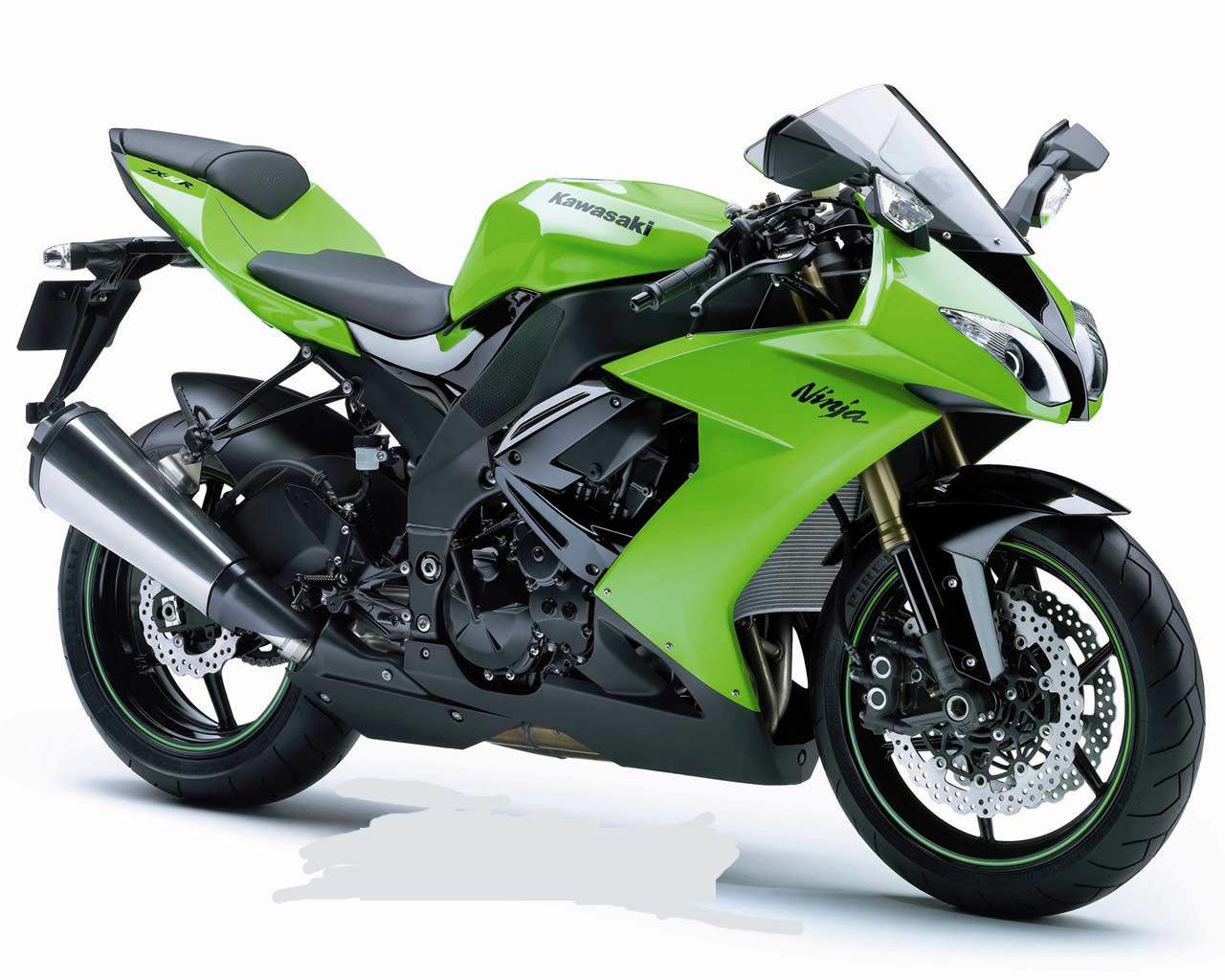
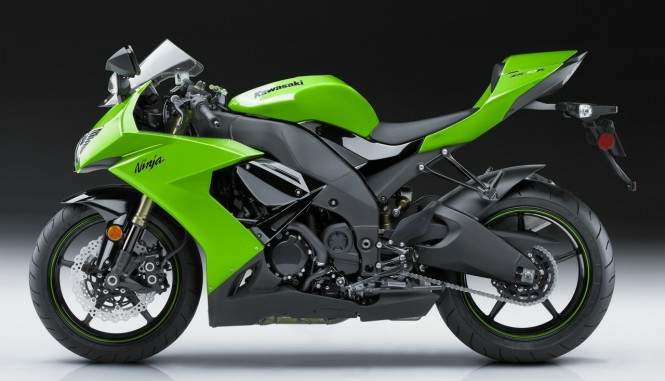
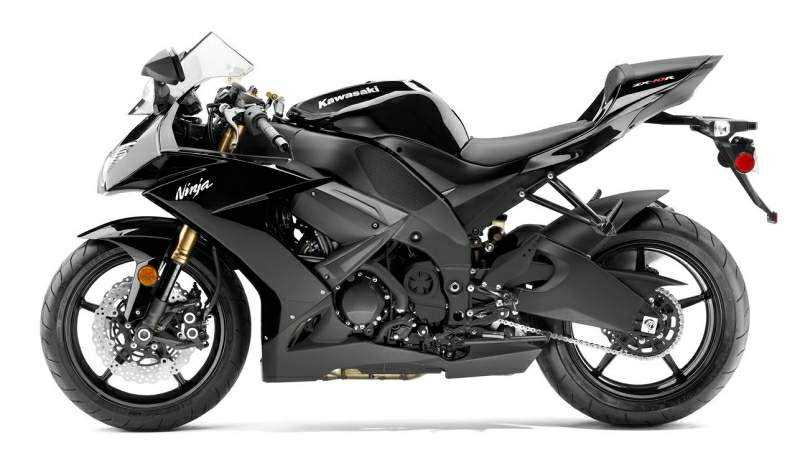
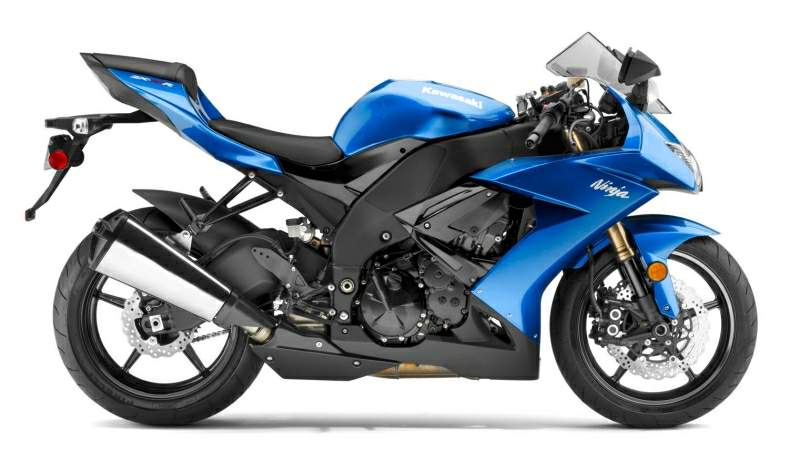
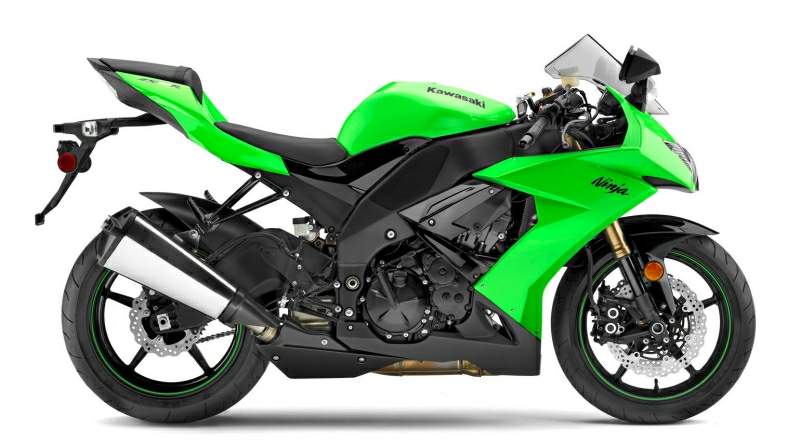
Kawasaki ZX-10R
KAWASAKI’S 2008 NINJA® ZX™-10R SUPERBIKE IS POISED FOR COMPETITION - Factory superbike talent in a street savvy performer
For the 2008 NINJA® ZX™-10R, Kawasaki engineers aimed for an ideal superbike with engine and chassis performance capable of satisfying professional racers, combined with top-notch streetbike qualities for mainstream riders. It’s a delicate balance, but these aren’t your average engineers. They’ve been directly involved in the development of every 600 and 1000cc supersport machine since the 2003 Ninja ZX-6R, plus Kawasaki’s factory Superbike racing efforts, so they have the know-how to deliver the goods. The result is an exceptionally communicative machine that provides the clean two-way rider/machine dialog demanded by professional racers. Placing the ZX-10R in the racing crucible and applying lessons from that unforgiving environment resulted in an ideal balance to satisfy the most demanding of riders. Japanese Superbike racer Akira Yanagawa was the man pushing the engine and frame components to the limits of their performance in actual competition. Parts that met with Yanagawa’s approval were then tried on the production test bike, tweaked, retested on the racer and adjusted again. This process was repeated throughout the development cycle for the all-new 2008 Ninja ZX-10R.
The 2008 Ninja ZX-10R features a new Kawasaki Ignition Management System that assists with torque management by monitoring throttle opening, gear position and rate of RPM change, then retarding ignition timing to reduce torque when sudden unwanted RPM spikes are detected. This system doesn’t interfere with normal operation and still allows the engine to rev freely under typical riding conditions. A superb engine deserves a superb chassis, and this is where the new ZX-10R really shines. To achieve the best-possible handling, Kawasaki used the lessons learned at the track to build a list of refinements including: changing the length of the steering tube and moving it 10mm forward, alleviating stress concentrations through subtle changes to the frame stampings (switching concave parts to convex pieces), increasing the wall thickness around the relocated swingarm pivot, adding ribbing on the interior of the pivot plate, and mounting a narrower, two-piece sub-frame to the main frame’s upper cross member.
With a fully-adjustable 43mm inverted fork and a new swingarm that uses pressed instead of cast beams, the ZX-10R’s track orientated suspension endows the chassis with better feedback. Refinements include adding a Diamond Like Carbon (DLC) coating to the fork tubes for less stiction and enhanced feedback, relocating the springs to the bottom of the fork for reduced oil frothing, and new settings that are better-suited for racetrack use. Rear suspension changes include dual (low and high-speed) compression damping on the fully-adjustable rear shock for better fine-tuning, a new mounting spot for the Uni-Trak® linkage and a re-shaped swingarm with a top-mounted brace.
No part was left untouched on the ZX-10R, even the wheels are new. Produced using a squeeze-casting process instead of the earlier gravity casting method, the new wheels are lighter, stiffer and more precise, to perfectly match the new chassis. The lower unsprung weight of the wheels helps improve suspension action and their reduced rotational inertia provides quicker steering and acceleration. Braking duties are handled by radial mounted Tokico brake calipers squeezing new 310mm petal discs which are 10mm larger for 2008, and feature reduced thickness from 6 to 5.5mm for better heat dispersion. The rear is a 220mm petal disc squeezed by a single-piston caliper. Unsprung weight was reduced by switching the disc housings and brake calipers to aluminum. The new housings also aid heat removal and now feature 10 pins for a more rigid outer disc support.
The designers didn’t rest when it came to styling either. Given great freedom with the 2008 ZX-10R, their efforts are illustrated in the clean design with superb fit and finish. While shaping the rear frame, tank and seat to offer improved ergonomics and increase the rider’s contact with the bike, they also refined its aerodynamics from a new front cowling to the sharp, minimalist tail cowl. The result of these efforts is a slim and compact package with the presence befitting its Ninja name.
Source Kawasaki.com
Roland Brown goes to Qatar to ride Kawasaki's new ZX10RBloody hell, this thing's fast! Powering onto the Losail circuit's start-finish straight in second gear, I'm pulling my weight as much as possible over the front wheel of the ZX-10R - yet still this fearsome lime-green missile snaps its front wheel off the ground as I glance down to see the digital speedo flashing up through 130mph. What seems like a few moments later, I'm at the other end of the kilometre-long straight, trying to keep my head still against the wind tumbling over the low screen, changing into top gear with the bike still accelerating - and glancing down to see 180mph on the clock before I sit up and squeeze the powerful front brake into action. No doubt about it, the overriding impression after two days at Losail aboard the latest ZX-10R is of its pure, unabashed, mesmerising speed. But there's a lot more to this third-generation 10R, which has been comprehensively overhauled yet again with the aim of making it even quicker, more track focused and more exciting to ride. Straight-line speed was not the main goal, as Kawasaki's development team were aware that the secret to going fast around a racetrack on a bike this powerful was providing not just even more horsepower but also the ability to use it. "The objective was to offer more power and control - to give the rider what is needed to push to the limit on a track," says Project Leader Yasuhisa Okabe. Extra horsepower was very definitely part of the brief, however. A new induction system combined with conventional tuning mods including hotter cams and titanium valves to generate an extra 13bhp at the top-end, lifting max output to 185bhp (188PS) at 12,500rpm, or a phenomenal claimed 197bhp (200PS) with ram-air effect included. But equally important was the introduction of KIMS or Kawasaki Ignition Management System, which monitors a long list of functions to fine-tune throttle response. Part of its function is to retard the ignition if revs rise too quickly - effectively a form of traction control. But rather curiously Okabe insists that this is not a performance aid, and is there simply to prevent power spikes from damaging the exhaust's catalytic converter. There are plenty of chassis changes, too, including a stiffer frame, revised steering geometry, new suspension and rear linkage, and a slightly longer and stiffer swing-arm. The strikingly shaped titanium silencer plays its part, helping lower the centre of gravity compared to the old bike with its high-level pipe. The new exhaust is part of a restyle that includes sharp-edged bodywork that gives a distinctly more aggressive look.
From the rider's seat the most obvious changes are the lower, narrower screen, and the back of the indicators, which are mounted on the quickly detachable mirror stalks. The big round central tacho with its inset digital speedo is retained, now incorporating UV-blocking glass to make it easier to read. The tank top is slightly wider, the seat front narrower and the seat back further forward, all in an attempt to improve feedback. Handlebar, seat and footrest positions are unchanged and gave the green bike a familiar feel as I headed out onto the Losail track. The first few gentle, tyre-warming, circuit-reacquainting laps are often the best chance to evaluate a bike's low-rev performance on a track launch, and the ZX-10R did its best to help. The tuning mods have robbed a few horsepower at low and medium revs, but final gearing is lowered by a tooth to compensate, and the first, fourth and fifth internal ratios have been shortened. There's probably a fraction less grunt - compared to last year's bike, and to the opposition too. But the Kawasaki pulled very smoothly from below 5000rpm, suggesting that it will still have plenty of punch for top-gear overtaking on the road. And boy, did it shift when I remembered where the track went and started opening the throttle in anger. The top-end stomp was truly immense, sending the ZX-10R cannonballing out of the turns as the tacho bar jabbed towards the 13,500rpm redline through the gears. The way the front wheel went light exiting several second-gear turns made me glad of the adjustable Öhlins steering damper, which kept the bar-flapping exciting rather than scary. Exiting the first-gear left-hander, I had to keep well forward on the bike to prevent a bigger wheelie that required backing off the gas. But along with this violence the 10R was impressively controllable, suggesting that Kawasaki's main aim has been achieved. Throttle response from the KIMS system was very smooth, and the blend of big-bore torque and high rev limit meant that for many bends I had a choice of two gears, both of which resulted in ferocious acceleration.
As for the much-anticipated traction control; well, that was perhaps the only slight engine-related disappointment apart from the muted intake howl. I arrived in Qatar slightly anxious about the prospect of trying to light up the back tyre of a near-200bhp bike to see if the KIMS saved me from being spat into orbit; but it seems that's not what it's for. Even Spanish race ace Pere Riba said that he wasn't aware of traction control when putting in a hot lap. To its credit, the ZX-10R did allow fast laps in relative safety in more traditional fashion: with supremely responsive handling and abundant tyre grip. It took some tweaking to get there, mind you, because on my first session the 10R required too much steering input and ran wide into bends, perhaps reflecting its less racy steering geometry compared to the previous model, and suggesting it was sitting too low at the rear under my 85kg weight. Suspension at both ends is multi-adjustable and the new shock can be tweaked for both high- and low-speed compression damping. I ended up reducing preload and compression damping, and increasing shock preload and low-speed compression. By my sixth session the Kawasaki was steering effortlessly, felt poised in mid-bend and stayed stable when hard on the gas on the way out. At 179kg dry this bike is 4kg heavier than the old model (mainly due to the new exhaust), but once set-up it felt brilliantly light, agile and responsive. The massive grip of Pirelli's rubber, in combination with the ultra-abrasive track surface, was another reason why nobody had crashed after four days. On the first day we used soft-compound Dragon Supercorsa SC2s that were excellent, outgripped only by the outrageous hoops we used on the second day: a front specially developed for Losail, plus a near-slick like rear as used in Superstock racing. Fortunately there's plenty of ground clearance.
The ZX-10R wasn't short of stopping power, either, which was just as well given the speed it was reaching by the end of that long main straight. The front brake is revised with thinner, larger diameter (310mm from 300mm) petal discs, and radial four-pot calipers with two instead of four pads. Kawasaki say they give equal power with more feel; they certainly stopped the 10R mighty hard, though without the one-finger ferocity of Brembo's top Monoblocs. That's perhaps the only respect in which this latest ZX-10R is anything other than supremely ferocious, though. This latest in the line manages to combine the visual appeal and aggression of the original model with the control and refinement of last year's version - and then some. Kawasaki set out to make the ZX-10R quicker, more track focused and more exciting to ride. On the basis of these fast and furious days in Qatar, it earns a tick in all three boxes. ZX-10R Tech The KIMS (Kawasaki Ignition Management System) monitors a long list of functions 200 times each second, crucially including the rate at which revs are increasing. When the system detects a sudden rev jump , the other factors - including vehicle speed, gear and throttle position - are taken into account, and if necessary the ignition timing is retarded to cut power. Although this is how some traction control systems work (though not more sophisticated MotoGP style ones that also monitor front and rear wheel speed), Kawasaki says KIMS is not a performance boost, but is intended merely to prevent power spikes from causing long-term damage to the exhaust catalyser. The new exhaust system has a low-level titanium silencer and a pre-chamber below the engine. It's heavier than the previous under-seat system but helps centre the bike's mass and lower its centre of gravity.
The chassis is also reworked, starting with the frame, which is strengthened to give increased torsional rigidity, and whose main spars are shaped to allow the rider's leg to fit better in bends. The steering head is 10mm further forward, the swing-arm pivot area is stiffer and the rear subframe is a narrower, two-piece aluminium die casting. A new swing-arm made from pressed instead of cast aluminium (for better feedback) pivots 2mm lower and is 2mm longer. Steering geometry is slightly less steep (rake and trail are 25.5 degrees and 110mm, from 24.5/102mm). The 43mm front forks have springs at the bottom rather than the top, so they are immersed in oil, reducing frothing for improved performance. The shock linkage is more progressive, and the new shock unit is adjustable for both low- and high-speed compression damping. Yasuhisa Okabe, ZX-10R Project Leader When we want to add power it's not just at full throttle - power delivery is very important. That's why we put in some system control, KIMS. It doesn't control only the ignition, it has many different fuel and ignition maps and functions for more easy control. KIMS is not intended to help the rider go faster, it's more to increase endurance of the catalyser. Power spikes cause chemical damage to the catalyser, and for latest regulations we need longer durability of emissions control. In future we will see traction control on this bike, but maybe in a different way. For the race kit KIMS we don't have a catalyser and we can use the same logic but change the function and values. Then it can make a good rider faster. But it's not to use in every corner, it's more for if they have a problem with sliding in one corner, or when the rear tyre is worn, they can fix the problem. Roland Brown
|
|
|
Any corrections or more information on these motorcycles will be kindly appreciated. |