|
|

|
|
|
|
Classic Bikes
Custom Bikes
Individual
Racing Bikes AJP
AJS
Aprilia
Ariel
Avinton / Wakan
Bajaj
Benelli
Beta
Bimota
BMW
Brough Superior
BRP Cam-Am
BSA
Buell / EBR
Bultaco
Cagiva
Campagna
CCM
CF Moto
Combat Motors
Derbi
Deus
Ducati
Excelsior
GASGAS
Ghezzi Brian
Gilera
GIMA
Harley Davidson
Hero
Highland
Honda
Horex
Husaberg
Husqvarna
Hyosung
Indian
Jawa
Kawasaki
KTM
KYMCO
Laverda
Lazareth
Magni
Maico
Mash
Matchless
Mondial
Moto Guzzi
Moto Morini
MV Agusta
MZ / MuZ
NCR
Norton
NSU
Paton
Peugeot
Piaggio
Revival Cycles
Roland Sands
Royal Enfield
Sachs
Sherco
Sunbeam
Suzuki
SWM
SYM
Triumph
TVS
Ural
Velocette
Vespa
Victory
Vincent
VOR
Voxan
Vyrus
Walt Siegl
Walz
Wrenchmonkees
Wunderlich
XTR / Radical
Yamaha
Zero
Video
Technical
Complete Manufacturer List
|
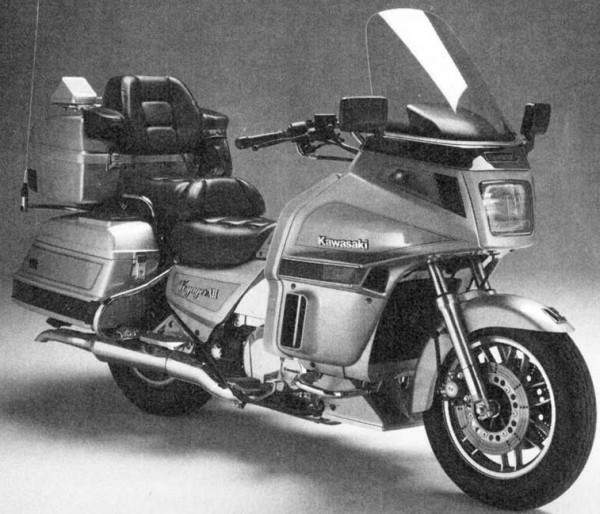
Kawasaki ZG 1200 Voyager XII
Touring riders are supposed to be rich as Midas, with saddlebags full of money they're practically panting to spend. Maybe so, but for those of us with buying power a few clicks down, Kawasaki offers its Voyager. If you want proof by the numbers, try these figures on for size: At $8700, the Voyager is $1100 less expensive than the next priciest tourer, Yamaha's Venture; $2800 less than Honda's GL1500; and a whopping $4300 less than Harley-Davidson's FLHTC Ultra Classic. Kawasaki's Voyager is also the quickest in its class. The liquid-cooled, 16-valve, five-speed inline-four provides acceleration both from 0 to 60 mph and through the quarter-mile that whips every other big-rig tourer. It complements that impressive speed with an almost ethereal smoothness (courtesy of twin gear-driven counterbalancers), a broad powerband, tack-sharp carburetion and instantaneous throttle response. The Voyager's the class lightweight, too—at least of the big Japanese tourers. Only Harley's FLTC and FLHTC and BMW's K100LT scale under the Kawasaki's 803-pound wet weight. But then, the Voyager entered the high-stakes touring game in 1986 with those attributes, as the quickest, least expensive and one of the lightest. Not much has changed since then. In 1987 the Voyager gained a cruise control, rear speakers for the AM/FM cassette deck, winglets on the fairing's trailing edges and different paint. Otherwise, the firm's flagship tourer remains the same, with steel-tube frame, triple-disc brakes, manually adjustable suspension, 16-inch front and 15-inch rear wheels, hydraulically adjusted valves and a multitude of adjustments for rider and passenger accommodations. Out on the superslab, in the land of chicken fried steaks and bottomless cups of coffee, a rider rarely feels he's had to give up much of consequence in trade for the Voyager's bargain-basement price. The fairing offers good wind protection for average-height riders, the riding position is roomy and relaxed and, set in the lower range of its adjustment, the suspension lets the bike fairly float over a wide variety of road surfaces. There's abundant small-item storage, the stereo offers decent sound quality plus a host of adjustments to amuse the rider, and the cruise control works competently, exhibiting only a slight jerkiness in maintaining speed on downhills. Still, there are shortcomings, and first among them is the saddle. The soft, thin padding practically guarantees you'll be ready to take a break well before the bike runs through its 6.1-gallon fuel supply. The Voyager lacks a particularly refined sense of straightline stability, too. The Dunlop Gold Seal F21 front tire follows rain grooves and pavement ruts, and even on a smooth surface the bike wanders slightly. And a passenger will complain about both a shortage of weather protection and a surfeit of wind noise. Once a rider reaches the bright lights of the big city, he'll be thankful he's not paying for some things most other tourers have aplenty; namely, weight and clumsy low-speed handling. The low mass, 16-inch front wheel and tillerlike handlebars help yield remarkably light, quick steering, making the Voyager one of the most agile touring bikes at slow speeds. That same steering quickness, though, exacts a penalty. It's tough to maintain a precise course at slightly more than a walking pace, especially if the bike's burdened with a full load and passenger. Many of those traits characterize the Voyager's twisty road behavior as well. The bike feels nimble, with slot-car steering response that gets it in and out of corners quickly. Such assets help rank Kawasaki's Voyager—again—near the top among touring bikes for back road handling. Still, a rider needs to exercise a gentle hand at the helm. Flicking the bike into turns makes the front end feel rubbery, and discourages further exploration of the rather limited cornering clearance; the footpegs touch down first and at a lesser lean angle than almost any other modern motorcycle. For a solo rider, setting the suspension to eight psi in the front, 25 psi in the rear (5.7 to 8.5 psi and 21 to 36 psi are the suggested ranges, front and rear) and clicking the shocks' rebound damping to the fourth of their four adjustments gives the best compromise for ride and handling. Unfortunately, the Voyager's lengthy roster of bests and mosts is accompanied by a similarly long list of annoyances. Of all the available adjustments to the handlebars, trunk, passenger saddle and windscreen height, only the bars offer any useful range. Anything but the farthest rearward position for the trunk and saddle cramps riders and passengers of average size, and the same riders end up looking through the top edge of the screen at its lowest position. Moreover, the narrow saddlebag openings force you to jam the bag liners in as if you were stuffing a turkey, and the stereo's main controls are too small for use with heavy gloves. Balancing that list are the easy-to-use two-stage mainstand, and the quick-detach saddlebags. What's important to remember is that many of the Voyager's faults are largely inconveniences, and not due to the bike's fundamental approach to touring—one of low-buck; not low-ball. This motorcycle takes the basic touring-bike formula and folds in a generous mixture of speed, light weight and agility. For the rider who wants a full measure of amenities for the long haul, but who has to hold onto a dollar until that eagle grins, Kawasaki's Voyager still represents a sound investment. Source Cycle Magazine of 1986
|
|
|
Any corrections or more information on these motorcycles will be kindly appreciated. |