Air cooled, four stroke, transverse four
cylinder, DOHC, 2 valve per cylinder.
Capacity
903
Bore x Stroke
66 x 66 mm
Compression Ratio
8.5:1
Induction
4x 26mm Mikuni VM26SS
Ignition /
Starting
Mechanical breaker dual lead coil /
electric
Max Power
82 hp 59.8 kW @ 8500 rpm
Max Torque
73.5 Nm @ 7000 rpm
Transmission /
Drive
5 Speed / chain
Frame
Double tubular steel cradle
Front Suspension
36mm Telescopic forks
Rear Suspension
Dual shock, 5-way preload adjustment
Front Brakes
Single 296mm disc 2 piston caliper
Rear Brakes
200mm drum
Front Tyre
3.25H-19
Rear Tyre
4.00S-18
Dry-Weight
230 kg
Fuel Capacity
18 Litres
Consumption average
33 mp/g
Standing
¼ Mile
12.3 sec / 112 mp/h
Top Speed
135 mp/h
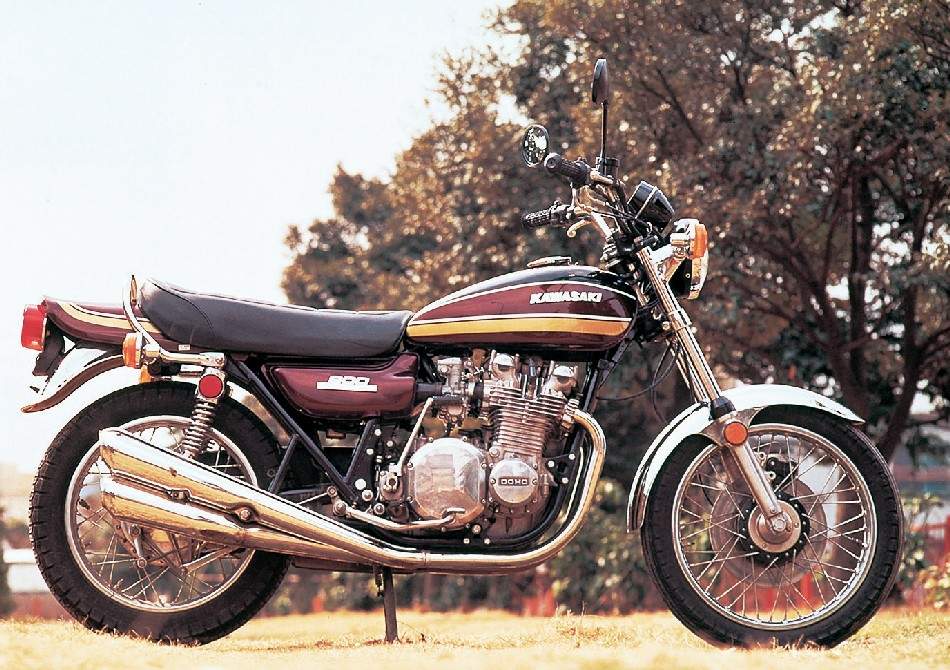
1974 Z1-A
FRAME NUMBER: Z1F-020001 >
ENGINE NUMBER: Z1E-020001 >
COLOUR: CANDYTONE BROWN/ORANGE OR CANDYTONE GREEN/YELLOW
Major changes for this model were the silver engine finish, redesigned tank
and tailpiece markings and a stop lamp failure light in the tachometer. The
idiot light cover was also changed, the warning lights were now placed in a
different order. The best gets better.
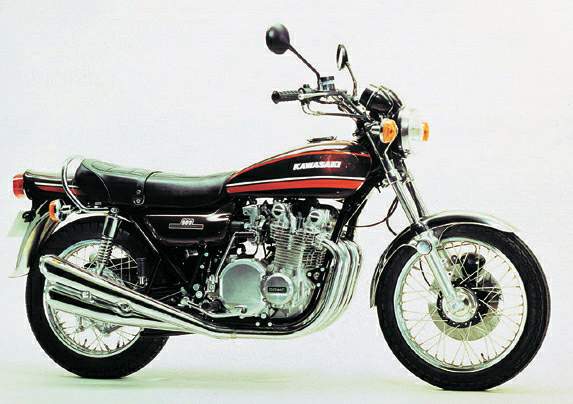
1975 Z1-B
FRAME NUMBER: Z1F-047500 >
ENGINE NUMBER: Z1E- 047500 >
COLOUR: CANDY SUPER BLUE OR CANDY SUPER RED
Major changes for this model were paintwork and markings, larger side panel
badges and the adoption of an 'O' ring chain instead of the previous built
in chain oiler. The switchgear was slightly cosmetically changed and the
Speedo was now in 10-mph increments. The fuel tap was changed from black to
silver and the carbs were modified to improve performance.
After the revolution Honda CB 750, it was in 1972
that Kawasaki lays first brick of the race for power with its Z900. It is
immediately a success that the machine confirms its reliability, both in
everyday life than on circuits.
Compared to the Honda CB 750, it provides a larger engine thus more power (82
hp instead of 67), and more torque and argument, dual overhead camshafts.
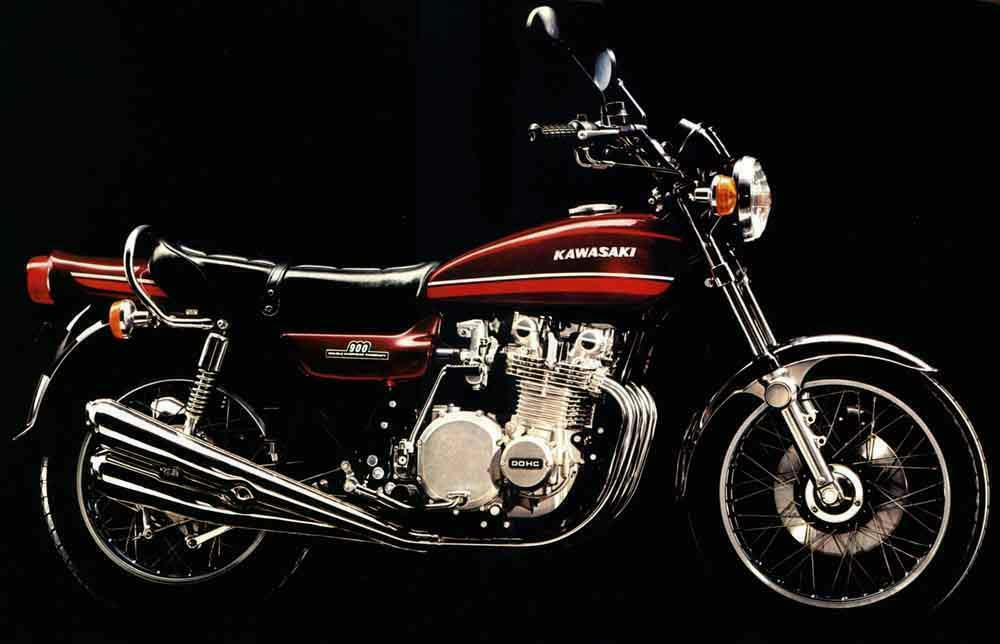
While keeping the 4 exhaust pipes traditional at the time (the devil pounds),
it has a look of hell, especially in color Tobacco with its orange flames and
black engine mat. The cooling fins of the breech but keep a sharp color
aluminum. This dress will be taken over by the 750 Zéphir at its latest
development. For practicality, the chain is lubricated from an oil tank
located under the seat in the left side of the frame.
The machine will be distributed from 1972 to 1976 and each year suffer a
slight change. In 1974, 900 Z1A is distributed with a new decoration (less
beautiful than the original) and the engine loses its matte black paint. In
1975, technology evolves, the machine (Z1B) comes with a chain to O-rings,
where abandoned oil pump. In 1976, the machine (A4 series) is now shipped
standard with dual front disc.
In 1977, the machine disappears from the catalog of the manufacturer, victim
of the war to the power it has triggered. It is replaced by the Z1000.
NOTE:
Some of the photos on Motorcycle Specs are owned by somebody. If you see any of
your photos, you can let me know so that I can acknowledge it, or if you
object to it, I can remove it altogether. If any copyright holder objects
to their articles being placed on Motorcycle Specs, it will be removed upon
request. Any correction or more info on these bikes will kindly be
appreciated.
Contact MePrivacy
Policy Website
Stats